
How Does CNC Machining Nylon Differ From Other Plastics?
Choosing the right plastic for CNC machining can be tricky. If you pick one that's difficult to machine or unsuitable for your needs, you waste time and materials. Let's look specifically at Nylon.
CNC machining Nylon requires careful management of its tendency to absorb moisture, its flexibility which can cause deflection or burrs, and its relatively low melting point which demands sharp tools, appropriate speeds/feeds, and often coolant to prevent melting or gumming, unlike more rigid or stable plastics.
Understanding how a material behaves under the cutting tool is crucial for getting good results, especially when aiming for tight tolerances like the +/- 0.005" we typically hold at Worthy Hardware, or even tighter +/- 0.001" precision when needed. Nylon presents unique challenges and considerations compared to materials like Acetal (Delrin), Polycarbonate, or PEEK. Knowing these differences helps us plan the machining process effectively and deliver high-quality custom parts to clients like Mark Chen in Canada, who value both quality and efficiency. Let's explore these differences further.
What is the best plastic for CNC machining?
Overwhelmed by the vast number of plastics available? Picking one that machines poorly leads to slow production, bad surface finish, and higher costs. You need a material that cuts cleanly and predictably.
There's no single "best" plastic, as it depends heavily on the application's requirements (strength, temperature, chemicals). However, plastics like Acetal (Delrin), PEEK, ABS, and Polycarbonate are generally considered highly machinable, offering good dimensional stability and chip formation.
When we talk about "best" for machining, several factors come into play:
-
Machinability: How easily does the material cut? Does it produce clean chips or does it gum up the tool? Does it require special tooling?
-
Dimensional Stability: Does the material hold its shape well during and after machining? Is it prone to warping or absorbing moisture (like Nylon)?
-
Thermal Stability: Does the heat generated during cutting cause melting or deformation? Materials with higher melting points are generally easier in this regard.
-
Chip Control: Can chips be easily cleared from the cutting zone? Poor chip control can lead to tool breakage or a bad surface finish.
-
Cost: Material cost is always a factor.
Here's a quick comparison of some common CNC-machined plastics:
| Plastic | Machinability | Dimensional Stability | Thermal Stability | Chip Control | Relative Cost | Notes |
|---|---|---|---|---|---|---|
| Acetal (Delrin) | Excellent | Excellent | Good | Excellent | Moderate | Great all-around choice, low moisture absorption |
| PEEK | Good | Excellent | Excellent | Good | Very High | High temp, chemical resistant, needs experience |
| ABS | Good | Good | Fair | Good | Low | Easy to machine, often used for prototypes |
| Polycarbonate | Good | Good | Good | Fair-Good | Moderate | Tough, transparent, requires sharp tools |
| Nylon (PA 6/6) | Fair-Good | Fair (absorbs moisture) | Fair | Fair-Good | Moderate | Strong, wear-resistant, needs moisture management |
| UHMW PE | Fair | Fair | Poor | Fair | Low-Moderate | Slippery, wear-resistant, can be 'gummy' |
At Worthy Hardware, we machine all these materials and many more (over 100 types, including metals and composites). We understand the nuances of each.
For example, while Acetal is often praised for its ease of machining, PEEK requires specific sharp tooling and careful feed/speed control due to its toughness and cost.
Nylon, as we'll discuss more, needs attention paid to its flexibility and moisture content. The "best" choice truly comes down to matching the material properties to the part's function and balancing that with machinability and budget.
Can nylon be CNC machined?
Are you unsure if Nylon is suitable for your precision CNC parts? You might worry about it melting, bending, or not holding tight tolerances, causing project delays or part failures.
Yes, Nylon can absolutely be CNC machined. It's a common material for CNC turning and milling. However, success requires specific techniques to manage its properties, such as using sharp tools, appropriate speeds and feeds, coolant, and accounting for its flexibility and moisture absorption.
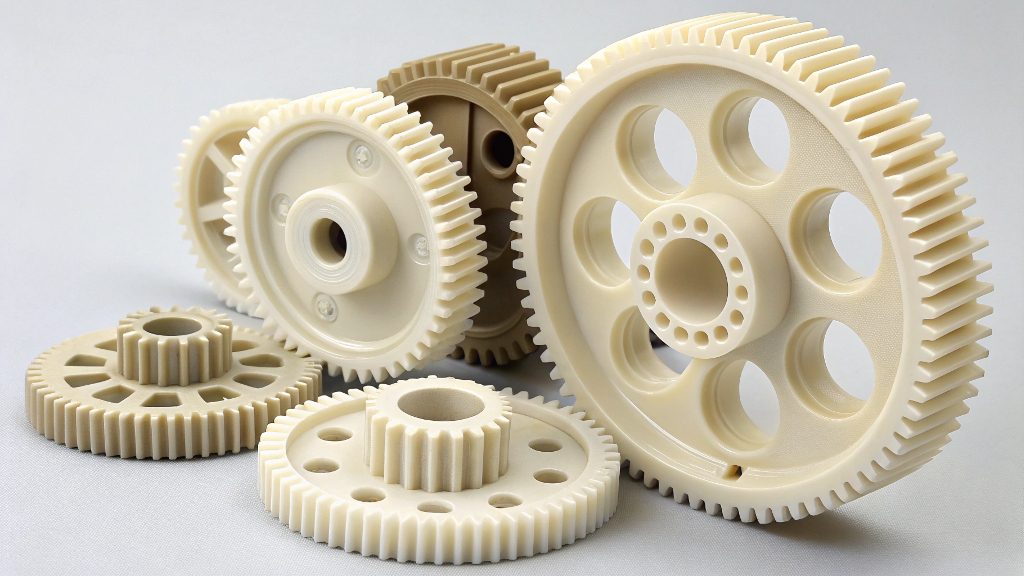
Nylon is a versatile and widely used engineering thermoplastic known for its toughness, wear resistance, and decent strength-to-weight ratio. We frequently machine various grades of Nylon (like Nylon 6, Nylon 6/6) at Worthy Hardware for applications ranging from gears and bearings to structural components and prototypes. While it's machinable, it does present challenges compared to more rigid plastics like Acetal or metals:
-
Melting/Gumming: Nylon has a relatively low melting point compared to metals or high-performance plastics like PEEK. The heat generated during cutting can cause it to soften, melt, or gum up the cutting tool if speeds and feeds are too high or if the tooling isn't sharp enough. Using sharp, often specialized plastic-cutting tools (like those with high positive rake angles and relief angles) is crucial. Proper coolant application (like compressed air or flood coolant) helps dissipate heat effectively.
-
Flexibility/Burrs: Nylon is more flexible than many other engineering materials. This means thin sections can deflect under cutting pressure, leading to dimensional inaccuracies. Proper workholding is essential. Its toughness can also lead to burr formation, especially during drilling or milling exit points. Deburring might be a necessary secondary operation, though sharp tools and optimized cutting paths can minimize this. We always ensure sharp edges are broken and deburred by default unless specified otherwise.
-
Moisture Absorption: This is a key characteristic of Nylon. It absorbs moisture from the air, which causes it to swell slightly and can change its mechanical properties (making it slightly less strong but tougher). This needs consideration during design and machining, especially for parts requiring tight tolerances (+/- 0.005" or less). Sometimes, parts are machined slightly undersize, anticipating swelling, or the material is conditioned before final machining.
Despite these points, with the right experience, tooling, and process control—all of which we have at Worthy Hardware—Nylon can be reliably machined into complex shapes with good surface finishes and adherence to specifications, serving applications across industries from automotive to consumer products.
How is nylon different from plastic?
Confused by the terms "Nylon" and "plastic"? Using them interchangeably can lead to misunderstandings about material properties and selecting the wrong material for your project. Let's clarify the difference.
Nylon is a specific type of plastic. "Plastic" is the broad, general term for a wide range of synthetic or semi-synthetic polymers. Nylon belongs to a specific family within plastics called polyamides (PA).
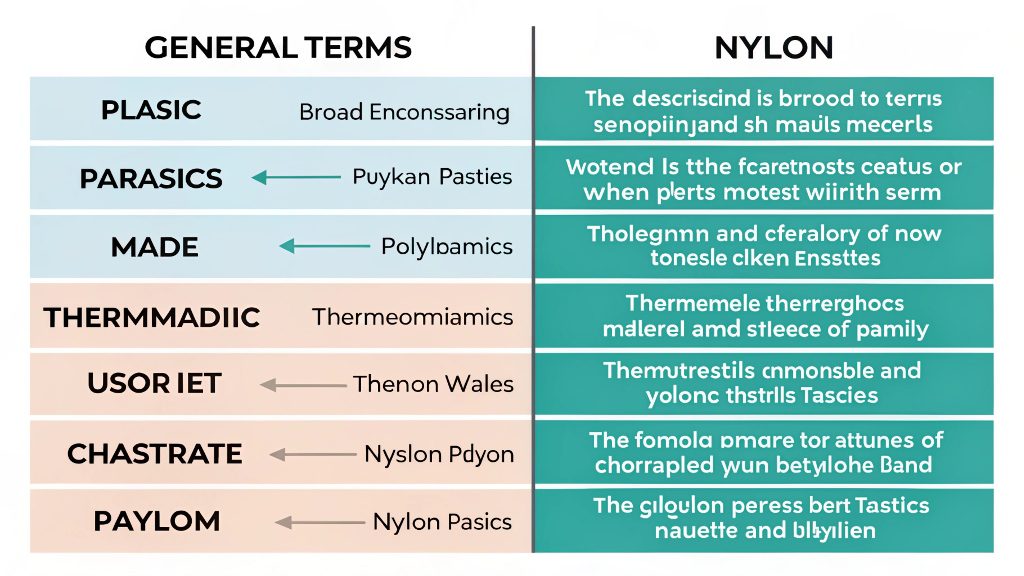
Think of it like this: "Vehicle" is a general term. A "car" is a specific type of vehicle. Similarly, "plastic" is the general category, and "Nylon" is a specific type of plastic.
Here's a simple breakdown:
-
Plastic: A very large group of materials made from polymers (long chains of molecules). They can be classified in many ways, such as thermoplastics (soften when heated, like Nylon, ABS, PVC, Polycarbonate, PEEK) and thermosets (permanently harden when cured, like epoxy or Bakelite).
-
Polyamide (PA): A specific family within the thermoplastics group, characterized by amide linkages in their molecular backbone.
-
Nylon: The common trade name for certain types of polyamides, most famously developed by DuPont. There are different types of Nylon, identified by numbers related to their molecular structure (e.g., Nylon 6, Nylon 6/6, Nylon 11, Nylon 12).
As I often explain to clients, Nylon and other common plastics have distinct properties:
-
Nylon (e.g., Nylon 6/6): Known for toughness, good wear resistance, good chemical resistance (especially to oils and fuels), relatively high strength for a standard plastic, but significant moisture absorption which affects dimensions and properties.
-
ABS: Lower strength and temperature resistance than Nylon, but good impact resistance, easy to process and machine, often used for housings and prototypes.
-
Polycarbonate (PC): High impact strength, good temperature resistance, transparent, but less wear-resistant than Nylon.
-
Acetal (POM/Delrin): Rigid, excellent dimensional stability (low moisture absorption), good machinability, naturally lubricious, but lower impact strength than PC.
-
PEEK: High-performance, excellent heat and chemical resistance, very strong and stiff, stable, but much more expensive.
So, while Nylon is a plastic, it has a unique set of properties that differentiate it from other plastics like ABS, PVC, Acetal, or PEEK. Choosing Nylon means specifically selecting for its characteristics, such as toughness and wear resistance, while being mindful of its limitations, particularly moisture absorption. At Worthy Hardware, we machine all these diverse plastics, helping customers select the precise material needed for their application.
What is the best nylon for machining?
You know Nylon can be machined, but there are different types. Which specific Nylon grade cuts the cleanest and holds dimensions best, avoiding extra trouble and cost during manufacturing?
Cast Nylon (typically Nylon 6) is often considered superior for machining compared to extruded Nylon (like Nylon 6/6). Cast Nylon generally has lower internal stresses, higher molecular weight, and slightly better dimensional stability, leading to cleaner cuts and less risk of warping.
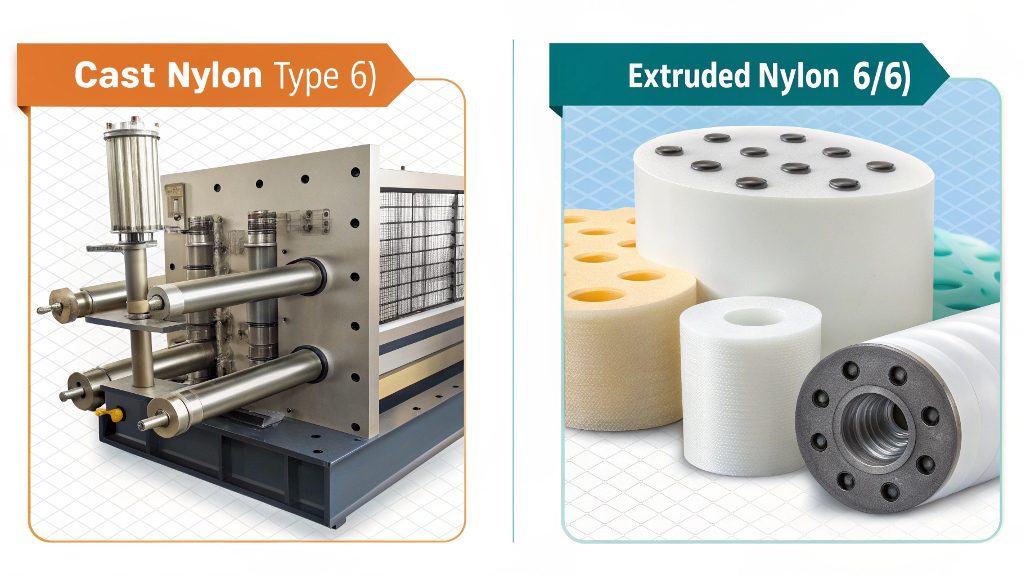
While both cast and extruded Nylon are machinable, there are subtle but important differences affecting the process:
-
Cast Nylon (Type 6): Made by pouring liquid monomer directly into a mold where it polymerizes. This process results in a material with very low internal stress, higher crystallinity, and higher molecular weight compared to extruded Nylon.
- Advantages for Machining: Less likely to warp or bind during machining due to lower stress. Often machines more cleanly with less "gumming." Can be produced in larger stock shapes (rods, plates) which is beneficial for bigger parts. Generally exhibits slightly better wear resistance and lower moisture absorption than Nylon 6/6.
-
Extruded Nylon (Commonly Nylon 6/6 or Nylon 6): Made by melting polymer pellets and forcing them through a die into a shape (rod, tube, plate). This process can induce internal stresses within the material.
- Considerations for Machining: Can be more prone to warping, especially if significant material is removed unevenly. May require stress-relieving (annealing) before tight-tolerance machining. Nylon 6/6 generally has slightly higher tensile strength and a higher melting point than Nylon 6, but also absorbs moisture more readily.
Other Factors:
-
Filled Grades: Nylon can be filled with additives like glass fibers (GF) or Molybdenum Disulfide (MDS).
-
Glass-Filled (Nylon GF): Much stiffer and stronger, more dimensionally stable, but highly abrasive on cutting tools. Requires harder tooling (like carbide) and adjusted speeds/feeds.
-
MDS-Filled (Nylon MDS): Often grey or black, contains molybdenum disulfide for enhanced lubricity and wear resistance. Generally machines similarly to unfilled Nylon but offers better bearing properties.
-
-
Moisture Condition: As mentioned before, moisture affects Nylon's dimensions and machinability. A drier Nylon will machine more crisply but might be more brittle. Conditioned (moisture-stabilized) Nylon is tougher but slightly softer and larger dimensionally.
For general-purpose machining where tight tolerances and stability are key, Cast Nylon 6 is often the preferred choice among Nylons. However, extruded Nylon 6/6 is also very common and perfectly machinable with the right techniques.
When a customer like Mark Chen sends us a drawing for a Nylon part, we consider the grade specified, the tolerances required (+/- 0.005" or tighter), and the part geometry to determine the best machining strategy, potentially recommending Cast Nylon if stability is paramount and the grade isn't fixed.
Conclusion
Machining Nylon requires specific know-how due to its moisture absorption, flexibility, and heat sensitivity, distinguishing it from other plastics. Choosing the right Nylon type and using appropriate techniques ensures successful, high-quality parts. Worthy Hardware has the expertise.