
Which Is More Cost-Effective: Machined ABS Or Injection Molded ABS?
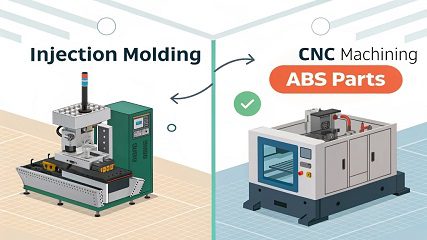
Choosing the right manufacturing process for your ABS parts is confusing. You need to balance cost, quantity, and quality, but making the wrong choice can be expensive and cause delays.
For large production runs, injection molded ABS is more cost-effective per part, despite the high initial tooling cost. For small quantities and prototypes, CNC machined ABS is cheaper because it does not require a mold. The best choice depends entirely on your project's volume.
The choice between machining and molding is a critical one that impacts your budget and timeline. It's not just about the final quantity; it's about understanding the fundamental costs and benefits of the material itself. To make the right decision for your business, we need to look closer at the factors that drive these costs. Let’s dive into the details to see which method truly gives you the best value.
Is ABS cost effective?
You need a strong, reliable plastic for your project but must keep a close eye on the budget. Material selection can make or break your profitability, creating a lot of pressure.
Yes, ABS is very cost-effective. It delivers strong mechanical properties, good impact resistance, and excellent toughness at a much lower price than many other engineering plastics like Polycarbonate or Nylon. This balance makes it a popular choice for a wide range of applications.

ABS (Acrylonitrile Butadiene Styrene) is what I call a workhorse material. We use it all the time here at Worthy Hardware for clients who need durable parts without the high cost of premium plastics. Its value comes from its unique blend of three different monomers, which gives it a fantastic combination of properties.
Why ABS Provides Great Value
The real strength of ABS is its balance. The acrylonitrile provides chemical resistance and heat stability. The butadiene delivers toughness and impact strength, which is why it's used in things like LEGO bricks and car bumpers. The styrene gives the material a nice, glossy finish and makes it easy to process. This combination means you get a part that is strong, looks good, and can be produced easily, all of which helps keep manufacturing costs down.
Comparing ABS to Other Plastics
When we look at the cost-to-performance ratio, ABS really shines. It's a significant step up in performance from general-purpose plastics like polypropylene (PP) but remains much more affordable than high-performance materials like PEEK or ULTEM.
| Feature | ABS (Acrylonitrile Butadiene Styrene) | PC (Polycarbonate) | PEEK (Polyether Ether Ketone) |
|---|---|---|---|
| Relative Cost | Low | Medium | Very High |
| Impact Strength | High | Very High | High |
| Heat Resistance | Medium | High | Very High |
| Machinability | Excellent | Good | Good |
For many of my customers, like those in consumer electronics and automotive parts, ABS is the perfect solution. It meets their technical requirements without inflating their budget, allowing them to remain competitive.
Which is cheaper, ABS or PLA?
You're working on a prototype or early-stage product and need the most affordable material possible. Every dollar counts, and you cannot afford to overspend on material that might change later.
Generally, PLA (Polylactic Acid) is cheaper than ABS. PLA is one of the most affordable 3D printing filaments available and is easier to print with. However, for applications requiring higher strength and temperature resistance, the slightly higher cost of ABS often provides better value.

Comparing ABS and PLA is a common conversation I have with clients, especially those in the early stages of product development. While both are popular thermoplastics, they are designed for very different purposes, and their costs reflect that. PLA is fantastic for simple prototypes, visual models, and applications where strength isn't the primary concern. Its low melting point makes it easy to work with in 3D printers, which contributes to its low price.
When to Choose ABS Over PLA
Although PLA is cheaper per kilogram, it's not always the right choice. ABS offers superior mechanical properties that justify its slightly higher price.
- Durability and Strength: ABS is much tougher and more durable than PLA. It can withstand impacts and stress that would cause PLA to crack or break. This makes it suitable for functional parts and end-use products.
- Temperature Resistance: ABS has a higher glass transition temperature (around 105°C) than PLA (around 60°C). This means an ABS part can be used in warmer environments, like inside a car on a hot day, where a PLA part would deform.
- Post-Processing: ABS can be easily sanded, painted, and finished with techniques like vapor smoothing to create a very smooth, professional-looking surface. PLA is more difficult to post-process.
When a client from the hardware startup industry comes to us, they often start with PLA for initial form-and-fit tests. But as soon as they need to test the part's function or durability, we almost always switch to CNC machined ABS. The small extra cost for the material is a worthwhile investment to get a prototype that behaves like a final production part.
What is the cost of ABS material?
You need to create a budget for your project and need a clear number for your material costs. Vague price ranges aren't helpful when you need to plan your expenses accurately.
The raw material cost for ABS pellets or filament is relatively low, typically ranging from $2 to $4 USD per kilogram. However, the final cost of an ABS part depends heavily on the manufacturing process, part complexity, and order quantity, not just the raw material price.

A common mistake I see is focusing solely on the raw material price. A client might see that ABS costs $2 per kilogram and assume their parts will be extremely cheap. But the raw material is just one small piece of the puzzle. The manufacturing process is where most of the cost comes from. A complex part that requires many hours of CNC machining will be much more expensive than a simple part, even if they use the same amount of ABS.
Factors Influencing the Final Part Cost
To give my customers an accurate quote, I have to look at several factors beyond just the weight of the part.
- Manufacturing Process: As we've discussed, CNC machining has high labor and machine time costs, while injection molding has a high initial mold cost. The process you choose is the biggest cost driver.
- Part Complexity: A part with complex curves, undercuts, and tight tolerances requires more sophisticated programming and machine time for CNC machining. For injection molding, it requires a more complex and expensive mold. Simple, blocky parts are always cheaper to produce.
- Order Volume: The quantity you order has a massive impact. With CNC machining, the price per part doesn't decrease significantly with volume. With injection molding, the cost per part drops dramatically as you produce more, because you are spreading the high mold cost over thousands of units.
- Finishing Requirements: If your ABS part needs painting, plating, or polishing, these extra steps will add to the final cost.
A simple cost breakdown might look like this for a small part:
| Cost Component | CNC Machining (100 units) | Injection Molding (10,000 units) |
|---|---|---|
| Material Cost | Low | Low |
| Setup/Tooling Cost | Low | Very High |
| Labor/Machine Time | High | Very Low |
| Cost Per Part | Medium | Very Low |
Understanding these factors is key to managing your budget effectively.
What is the difference between machining and injection molding?
You have a final design but don't know the best way to make it. Understanding the core differences between manufacturing methods is essential to making an informed, cost-effective choice.
CNC machining is a subtractive process that carves parts from a solid block of material. Injection molding is an additive process that injects molten material into a custom-made mold. Machining is best for low volumes and high complexity, while molding is for high-volume production.

At my company, Worthy, we specialize in CNC machining, so I know its strengths very well. But I always advise my customers on the best process for their specific needs, even if it's not machining. The goal is to build long-term relationships, and that means giving honest advice. Let's break down how these two powerful processes work and where each one excels.
The CNC Machining Process
CNC machining starts with a digital 3D model (a CAD file) and a solid block of ABS plastic. I program our CNC machine with instructions based on the model. The machine then uses spinning cutting tools, like drills and mills, to remove material from the block step-by-step until only the final part remains.
- Best for: Prototypes, low-volume production (1 to 1000 parts), parts with very tight tolerances, and complex geometries that are difficult to mold.
- Advantages: No expensive tooling, fast turnaround for small quantities, easy to make design changes.
- Disadvantages: Higher cost per part, slower for mass production, creates material waste.
The Injection Molding Process
Injection molding is a completely different approach. First, we must create a precision metal mold (or tool), which is the negative of the final part. This is a highly skilled and expensive process. Once the mold is ready, we heat ABS pellets until they become liquid and inject this molten plastic into the mold under high pressure. The plastic cools, solidifies, and the mold opens to eject the finished part.
- Best for: High-volume production (10,000+ parts), simple to moderately complex parts.
- Advantages: Extremely low cost per part at high volumes, very fast cycle times, highly repeatable.
- Disadvantages: Extremely high upfront cost for the mold, design changes are very expensive, not feasible for low quantities.
My insight for my customers is always based on their production volume. If they need 50 prototypes for testing, CNC machining is the only logical answer. If they are ready to launch their product and need 50,000 units, we start the conversation about investing in an injection mold.
Conclusion
For large quantities, injection molding is the cheaper choice for ABS parts. For prototypes and small runs, CNC machining is much more cost-effective. Your production volume is the most important factor.