
When should I choose laser cutting over CNC machining for sheet metal projects?
Choosing the wrong process for your sheet metal part wastes time and money. Delays and budget overruns can hurt your business. Let me help you understand the key differences.
Choose laser cutting for quickly cutting complex 2D shapes from sheet metal. It's fast and cost-effective for outlines and patterns. Select CNC machining when you need 3D features like pockets, threaded holes, or beveled edges, especially on thicker plates where high precision is critical.
The decision seems simple on the surface, but the details are important. Your material, design complexity, required tolerances, and budget all play a big role. Making the right call from the start saves you from costly mistakes and production delays later. Let's break down the specifics so you can choose with confidence for your next project.
Is laser cutting better than CNC machining?
You want the best method for your part, but hearing that one process is "better" is confusing. You need to know which one is better for your specific needs.
Neither is better; they are suited for different jobs. Laser cutting excels at speed and complex 2D cuts on thin to medium sheets. CNC machining is superior for creating 3D features, achieving very tight tolerances, and working with thick materials. The best choice depends on your design.
The real question isn't which is better, but which tool is right for the job. You wouldn't use a screwdriver to hammer a nail. I often talk to clients, like Mark from Canada, who need help deciding. He once sent a design for a flat panel with many holes and slots. His previous supplier used CNC machining for everything, which was slow and expensive. We suggested a hybrid approach. We used our laser cutter to quickly cut the main profile and all the through-holes. Then, we used a CNC machine just to add the few threaded holes he needed. This saved him nearly 40% on cost and cut the lead time in half. It’s about using each process for what it does best.
Here’s a simple breakdown to help you decide:
| Feature | Laser Cutting | CNC Machining |
|---|---|---|
| Best For | Complex 2D profiles, intricate patterns, lettering | 3D shapes, pockets, threaded holes, part features |
| Speed | Very fast for cutting through sheets | Slower, as it removes material layer by layer |
| Material Use | Efficient with minimal waste | Creates more waste (chips) |
| Setup Time | Very short, just load the digital file | Longer, requires tool setup and part clamping |
| Cost | Lower for 2D profiles and prototypes | More cost-effective for complex 3D parts or thick stock |
Why is laser cutting preferred in certain manufacturing processes?
Your project has a tight deadline, and you need parts fast without sacrificing quality. Traditional methods might be too slow or expensive, especially for complex designs. You need a fast, flexible solution.
Laser cutting is preferred for its incredible speed, precision, and versatility on sheet metal. It can cut intricate patterns that are difficult for other methods. With no physical tooling required, setup is almost instant, making it perfect for both prototypes and large production runs.
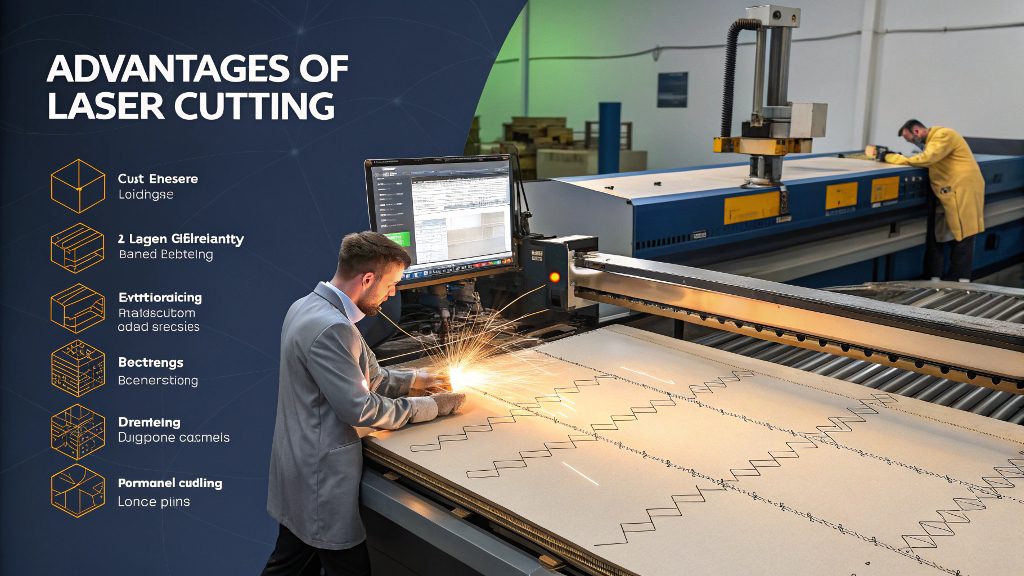
Laser cutting's advantages make it a go-to choice for many applications. Let's explore why it stands out.
Speed and Efficiency
A laser cutter doesn't need to change tools. It moves a focused beam of light to cut the material. This makes it incredibly fast, especially on large sheets with many parts. At my company, Worthy, we can take a customer's CAD file and start cutting within minutes. This rapid turnaround is crucial for clients in industries like electronics or consumer products who need to get to market quickly.
Design Flexibility
The laser beam is tiny, which allows it to cut very sharp corners and extremely detailed patterns. This gives engineers and designers huge freedom. If you can draw it, a laser can likely cut it. We've helped hardware startups create unique enclosures and designers produce custom lighting fixtures that would be impossible or too expensive to make with other methods.
Cost-Effectiveness
Because there is no custom tooling to create, the setup cost is very low. This makes laser cutting ideal for small batches and prototypes. You can order one part or one thousand. Also, the laser's precision allows for tight nesting of parts on a sheet, which means less wasted material. This material saving translates directly into lower costs for my customers.
What is the main disadvantage of laser cutting?
Laser cutting seems like the perfect solution for everything, but you worry there's a catch. You need to know the limitations before committing to a process that might not work for very thick or specific types of materials.
The main disadvantage of laser cutting is its limitation with material thickness. As the sheet gets thicker, the laser struggles to cut cleanly and efficiently. This can result in a tapered edge, a rougher finish, and the potential for heat distortion in the surrounding material.
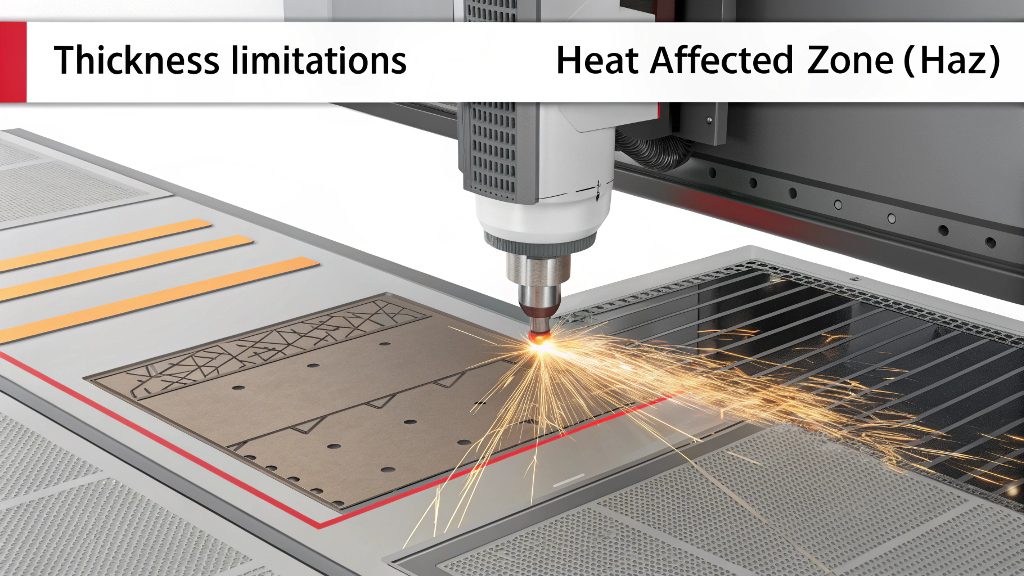
While laser cutting is a fantastic tool, it's important to understand its limits. The primary issues are related to material thickness and the heat it generates.
Thickness Limitations
Most laser cutters work best on sheet metal up to about 0.250 inches (around 6mm). At our facility, we can handle thicker gauges, but it's not always the best choice. For a project with 0.5-inch thick steel plates, for example, waterjet cutting or CNC machining would provide a cleaner, more vertical edge. The laser can leave a slight angle on the cut edge of thick material, which may not be acceptable if the parts need to fit together perfectly.
Heat Affected Zone (HAZ)
The laser cuts by melting the material, which creates a small area along the cut edge known as the Heat Affected Zone (HAZ). In this zone, the material's properties can change slightly. For most applications, this is not an issue. However, for certain high-stress parts or specific alloys used in aerospace, the HAZ might be a concern. It can make the edge slightly harder and more brittle. We always discuss this with our customers to ensure the process fits their application. For most projects, the HAZ is minimal and has no negative effect.
How accurate is laser cutting sheet metal?
Your parts need to fit together perfectly. You're worried that a fast cutting process like laser cutting might not deliver the tight tolerances your design requires for assembly.
Modern laser cutting is extremely accurate. At Worthy, we can consistently hold tolerances as tight as +/- 0.005 inches (0.127mm). For most sheet metal applications, this level of precision is more than enough to ensure perfect fit and function for even complex assemblies.
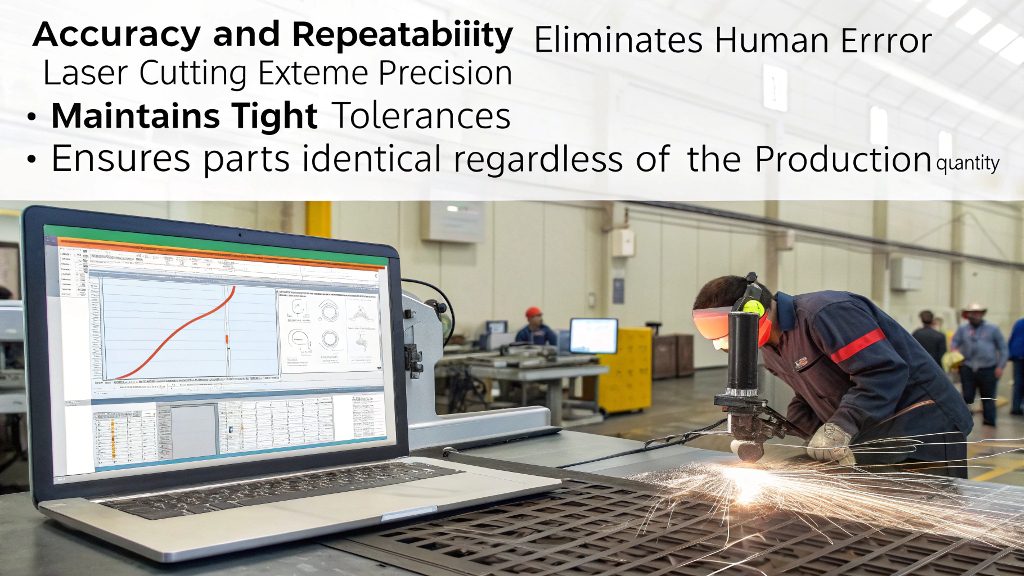
Accuracy is one of the biggest strengths of laser cutting. The process is controlled by a computer that follows the digital design file exactly. This removes the potential for human error found in manual processes.
Understanding Tolerances
The precision comes from several factors. The laser beam itself is very fine, allowing for precise cuts. The computer numerical control (CNC) system that guides the laser head is also highly accurate. Because there's no physical contact or cutting force, the material doesn't bend or warp during the process. This means the final part matches the digital model very closely. We offer auto-quoting for standard tolerances, but our engineers can manually review projects that need even tighter controls, sometimes reaching below 0.005".
Repeatability
Just as important as accuracy is repeatability. This means that the first part and the thousandth part will be virtually identical. This is critical for customers in the automotive or robotics industries who rely on interchangeable parts. I have a client in Japan who orders thousands of small brackets every month. They need every single one to be the same. Laser cutting is the only process that can deliver that level of consistency at a competitive price and speed. This reliability is why so many of our long-term partners trust us with their production runs.
Conclusion
Choose laser cutting for fast, complex 2D sheet metal profiles. For 3D features and thick plates, choose CNC machining. Understanding this difference will save you time and money.