
What Secondary Services are Essential for Complete Large Part CNC Machining?
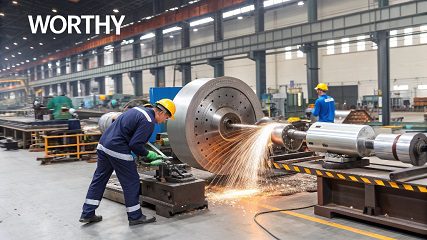
Your large CNC part is machined, but it's not finished. Without the right secondary services, your project can stall, leaving you with an incomplete component and potential delays.
Essential secondary services for large part CNC machining include surface finishing like anodizing or powder coating, heat treatment for strength, and thorough quality inspection. These processes ensure the part is not just shaped correctly but is also durable, protected, and ready for its final application.
The journey of a large CNC machined part doesn't end when the cutting tool stops. The primary machining process creates the shape, but that's often just the first step. To transform that precisely shaped metal or plastic block into a fully functional, reliable component, it needs to go through several additional stages. These "secondary" steps are just as critical as the initial machining, especially for large, high-value parts where failure is not an option. Let's look at what these key services are and why they are so important for getting the job done right.
What is secondary machining?
You hear the term "secondary machining" or "secondary operations," but it’s not always clear what it means. This confusion makes it difficult to plan and budget for your project accurately.
Secondary machining refers to any process performed on a part after the primary CNC machining is complete. This includes surface treatments, heat treatments, deburring, quality inspections, and final assembly. These steps finish the part to its final specifications, making it ready for use.
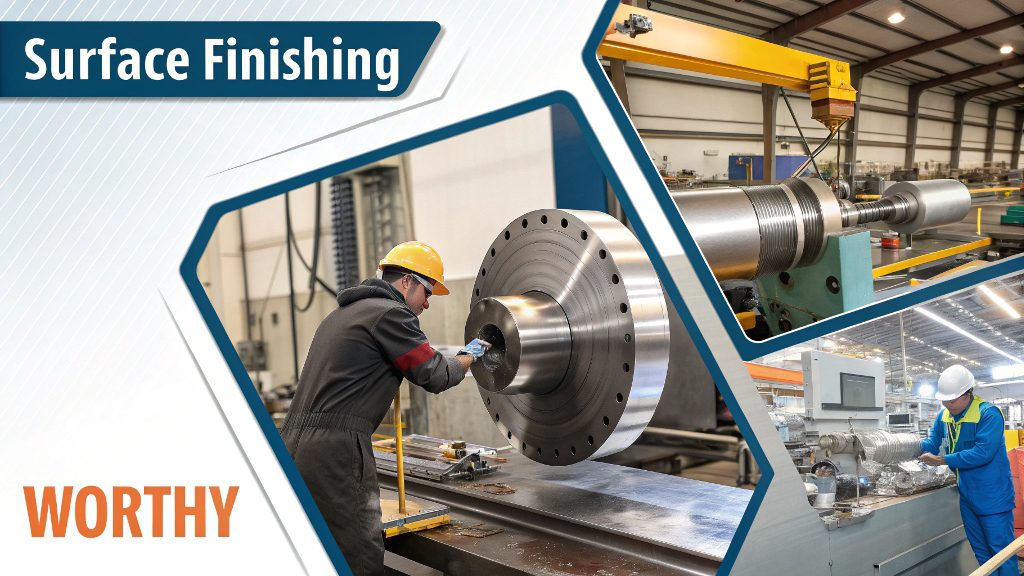
When we talk about secondary machining, we are talking about everything that happens after the main shape has been cut. Think of it as preparing the part for the real world. At my company, Worthy, we see this as an essential part of our service, not an optional extra. The primary machining gives the part its size and form, but secondary operations give it its final properties and finish. For large parts, these steps are even more critical because the initial investment is so high. I've found that customers get the best results when they view their project holistically, including these crucial finishing touches from the start.
We can break these services down into a few main groups:
1. Surface Finishing
This is all about how the part looks and how it resists its environment.
| Finishing Service | Purpose |
|---|---|
| Polishing | Creates a smooth, reflective surface. |
| Anodizing | Adds a hard, corrosion-resistant layer. |
| Powder Coating | Applies a durable, decorative paint-like finish. |
| Plating | Coats the part with another metal (e.g., zinc, chrome). |
| Sandblasting | Creates a uniform matte texture. |
2. Material Property Enhancement
Sometimes, the material itself needs to be tougher or stronger.
- Heat Treatment: This process involves heating and cooling the metal under controlled conditions. It can make a part harder, tougher, or relieve internal stresses created during machining. This is a must-have for large structural components that will be under a lot of strain.
3. Final Preparation and Assembly
These are the last steps before the part is shipped.
- Welding: If your final product is made of multiple machined pieces, they often need to be welded together.
- Deburring: Sharp edges left over from machining are removed to ensure safety and proper fit.
- Inspection: We use precise tools to measure and verify every dimension against your design. For large parts, this is a non-negotiable step to guarantee quality.
What are CNC machining services?
You need a part made, but the term "CNC machining services" feels very broad. You might wonder if you are getting milling, turning, or something else, making it hard to choose the right supplier.
CNC machining services use computer-controlled machines to cut material from a workpiece and create a custom part. The main services are CNC milling for complex shapes, CNC turning for cylindrical parts, and multi-axis machining for very intricate designs. A complete service includes these and secondary operations.
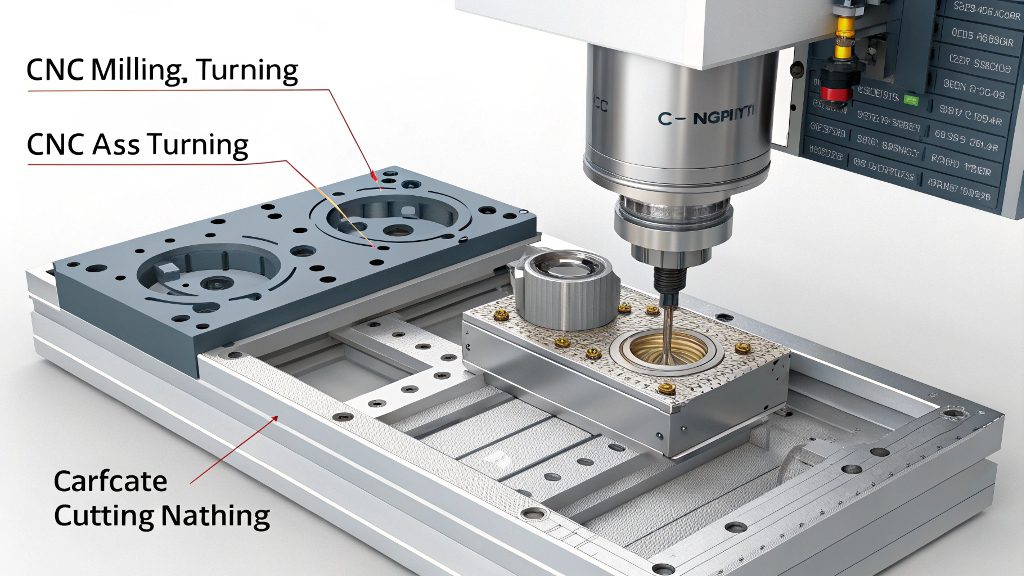
When a customer comes to us, they are looking for a complete solution. A "CNC machining service" isn't just about one machine; it's about a whole process. At Worthy, our services start with one of the core machining types. The choice depends entirely on the part's design.
-
CNC Milling: This is the service we use for parts that are squarish, rectangular, or have complex flat surfaces and pockets. A cutting tool moves along multiple axes to cut away material. We can handle very large parts with our milling machines, up to 2,032 x 1,219 x 610 mm (80” x 48” x 24”).
-
CNC Turning (Lathes): If the part is cylindrical, like a shaft or a pin, we use a CNC lathe. The part spins while a stationary cutting tool removes material. Our lathes can handle large diameters up to 813 mm (32”) and lengths up to 1,575 mm (62”).
-
5-Axis CNC Machining: This is for the most complex parts. The machine can move the part and the tool on five different axes at the same time. This means we can create very intricate shapes in a single setup, which improves accuracy and efficiency.
But a true service provider doesn't stop there. Our CNC machining service is a package. It includes the primary cutting and all the necessary secondary services discussed earlier. This is what customers like Mark Chen need—a one-stop shop that takes a design and delivers a finished, inspected, and ready-to-use component.
Which advantage makes CNC machines suitable for complex part manufacturing?
You have a complex part design and wonder if CNC machining is the right choice. Other methods exist, so what makes CNC stand out for difficult or intricate geometries?
The key advantage of CNC machining for complex parts is its incredible precision and repeatability. Guided by a computer program, the machine can execute intricate cuts and create complex geometries with tolerances as tight as +/- 0.001", something impossible to achieve consistently by hand.
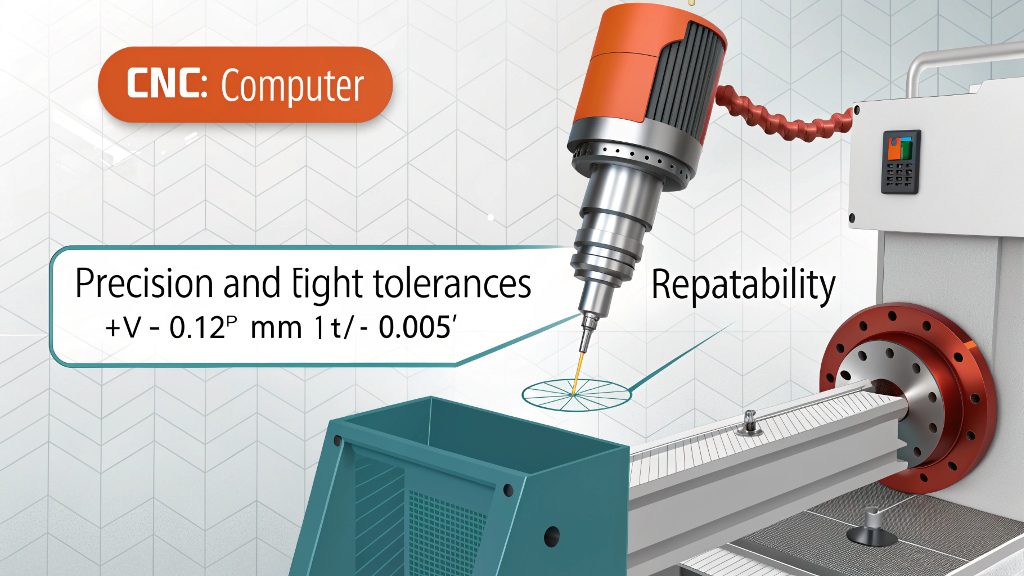
The secret is in the "C" of CNC: Computer. Before we cut any metal, your 3D design file is translated into a set of instructions for the machine. This code tells the machine exactly where to move, how fast to go, and how deep to cut. There is no guesswork. This digital control is what provides the two main benefits for complex parts:
-
Precision and Tight Tolerances: A human operator, no matter how skilled, cannot match the precision of a computer-controlled machine. We can consistently hold tolerances of +/- 0.127 mm (+/- 0.005"), and for projects that require it, we can achieve precision tolerances below +/- 0.001". For complex parts where different features must align perfectly, this level of precision is essential. I've worked on aerospace and medical parts where this accuracy was the most important factor.
-
Repeatability: Once the program is perfected, a CNC machine can produce one, ten, or ten thousand identical parts. For complex components, this ensures that every single part in a production run will be exactly the same as the first one. This is critical for customers who need interchangeable parts or who are scaling up from a prototype to high-volume production. This consistency is something that manual methods just cannot guarantee.
Because of this, CNC machining is the best method for creating complex parts from a solid block of material, especially for large components where the cost of a mistake is very high.
What factors should be considered when selecting a program for a CNC machine?
You have a final part design, but how does it become reality? The step between the design and the machine is the program, and getting it right is critical for success.
Key factors for selecting or creating a CNC program include the part's geometry, the material being used, the required tolerances and surface finish, and the specific tools available. The goal is to create the most efficient and accurate toolpath to produce the part.
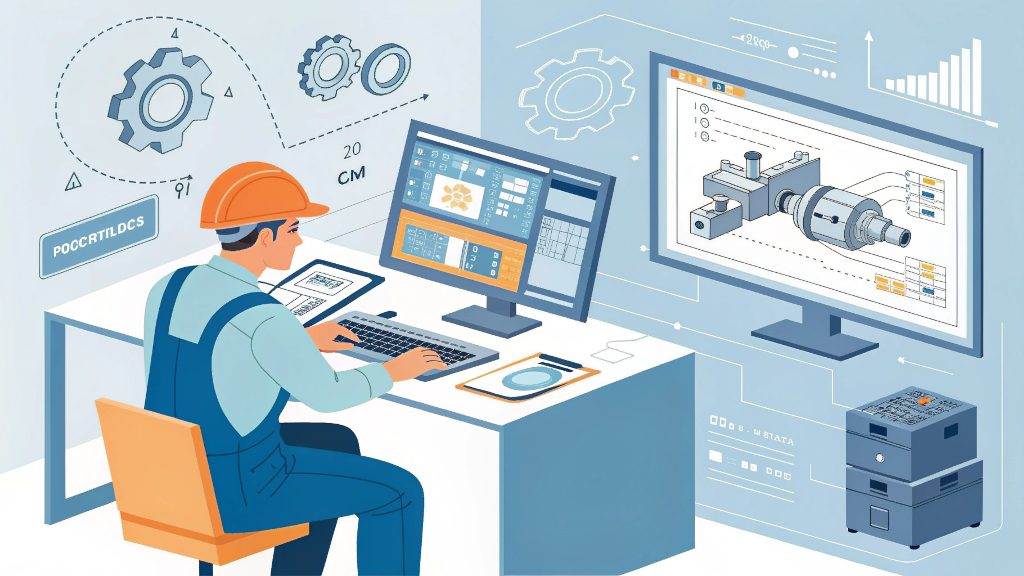
Creating the CNC program, which is often done using CAM (Computer-Aided Manufacturing) software, is a job for an experienced engineer. It’s not just about tracing the lines of the design. My engineers and I have to think about several factors to create a program that is both effective and efficient. When we program a job, we carefully consider each of these points.
Key Programming Considerations
-
Part Geometry: The complexity of the part is the first thing we look at. Does it have deep pockets, thin walls, or curved surfaces? This determines the type of toolpaths we need to use. For a simple part, a basic 2D path might work. For a complex one, we will need a sophisticated 3-axis or 5-axis toolpath.
-
Material Type: Machining aluminum is very different from machining stainless steel or titanium. We have to adjust cutting speeds, feed rates, and even the type of coolant used based on the material's properties. The wrong settings can lead to broken tools, a poor surface finish, or a ruined part.
-
Tools and Machining Strategy: We select the right cutting tools for the job. We must decide what size and type of tool to use for roughing (removing a lot of material quickly) and for finishing (creating the final smooth surface). The program must also include tool changes and define the optimal path for each tool to take to avoid collisions and maximize efficiency.
-
Tolerances and Surface Finish: If you need very tight tolerances or a super-smooth surface finish (like 125 Ra or better), the program must be designed for it. This usually means adding extra finishing passes with a specific tool at a slower speed.
Getting the program right from the start saves time and money, and it's the only way to ensure the final part perfectly matches the customer's design.
Conclusion
In short, a great CNC machining service combines primary cutting with essential secondary operations like finishing and inspection to deliver a complete, high-quality, and functional large part.
Are you looking for a reliable partner to handle your large part CNC machining from start to finish? At Worthy, we offer a complete one-stop solution. I'm Sandra Gao, and my team of experienced engineers is here to help you optimize your design and deliver high-quality, fully finished parts. We manage everything from the initial cut to surface finishing and 100% inspection.
Contact us today at [email protected] or visit our website at www.worthyhardware.com to get a quote for your next project.