
What Is the Difference Between Blanking and Punching in Stamping
By Sandra Gao | Founder & Engineering Lead, Worthy Hardware | Updated: 2025
If you're sourcing stamped metal parts from China, mixing up blanking and punching can cost you more than you think — wrong specs mean rework, delayed shipments, and money lost before a single part ships.
I'm going to fix that right now.
My name is Sandra Gao. I'm the founder of Worthy Hardware, a precision metal stamping factory in China certified to ISO 9001:2015. We've been supplying stamped parts to customers in North America, Europe, Japan, Singapore, Australia, New Zealand, and the Middle East for over 15 years. Every week, I review drawings from procurement managers and company owners who use "blanking" and "punching" interchangeably — and sometimes that mix-up turns a simple order into a complicated conversation.
The short answer: both blanking and punching use a punch and die to cut sheet metal. In blanking, the cut-out piece is your product. In punching, the cut-out piece is scrap — the remaining sheet with the hole is your product.
Let me explain both in detail so you never have to second-guess yourself when reviewing a drawing or discussing specs with a supplier.
1. What Is Punching in Metal Stamping?
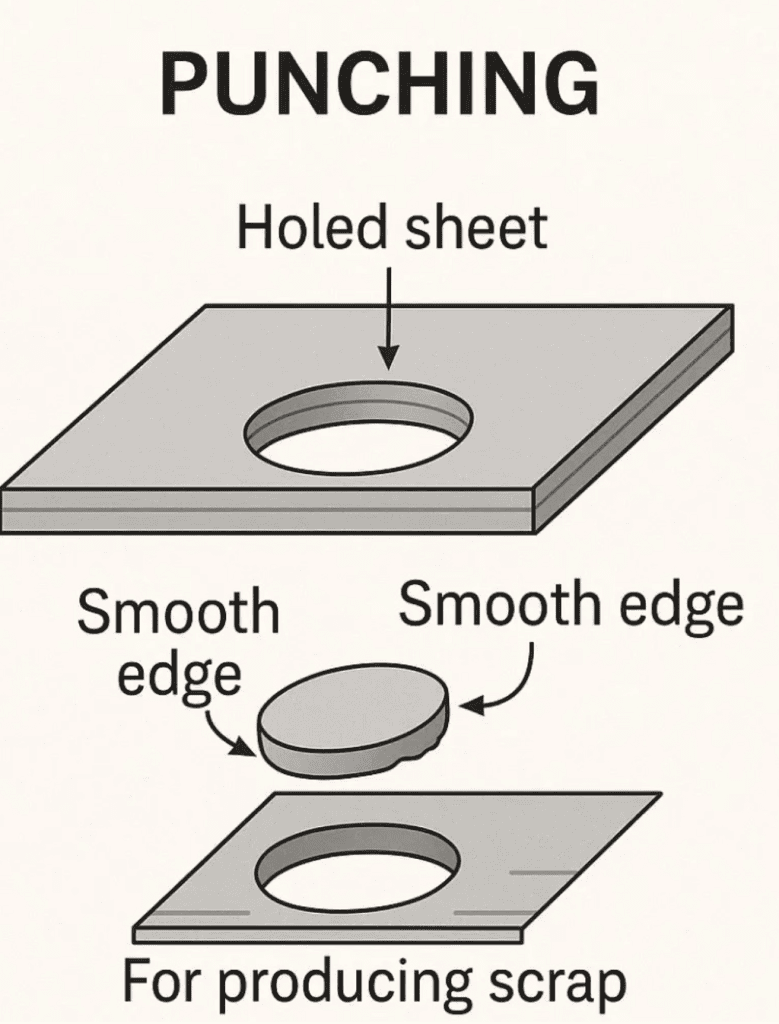
Punching is a stamping process where a punch presses through sheet metal to create a hole. The small piece that falls out — called a slug — is waste. The sheet with the hole is the part you want.
Think of it like a paper hole punch. You don't care about the little circle that drops into the bin. You care about the clean hole left behind.
Worthy Hardware's punching capabilities:
We run punching operations on presses from 5 to 500 tons. We punch holes in brackets, terminals, mounting plates, connectors, and shields every day. Our tolerances reach 0.001" (0.025mm) — which matters critically when holes must align precisely with screws, pins, or mating components.
Punching is one of the most common operations in metal stamping. Nearly every stamped part has at least one punched hole. We frequently combine punching with other operations inside a progressive die, so the strip moves through the die and gets punched, bent, and formed in a single continuous pass. This reduces handling, improves consistency, and keeps your per-piece cost down.
We also use electronic press and tool monitoring on our production lines. This means we detect tool wear or abnormal press forces in real time — before a bad part is ever made. For customers like you, this directly addresses one of the most common complaints we hear: "We found quality problems after waiting weeks for delivery." Our monitoring system helps us catch problems at the source, not at your dock.
2. What Are the Main Methods of Punching?
Different punching methods suit different part designs, production volumes, and budgets. Here are the most common methods we use at our factory:
Conventional Punching
A single punch creates a single hole in one stroke. The most basic method. We use it for simple round or shaped holes in standard bracket and terminal designs.
Nibbling
The punch makes a series of small overlapping cuts to create a larger or irregular shape. This works well for prototypes or low-volume runs where investing in a full custom die isn't justified. A good option when you need to validate a design before committing to tooling.
Perforating
Multiple holes are punched simultaneously or in a repeating pattern across the sheet. You see this in ventilation panels, speaker grilles, filter screens, and heat sinks.
Notching
The punch removes material from the edge of the sheet rather than the interior. We use notching to create tabs, to prep blanks for bending, or to define part boundaries in a progressive strip.
Lancing
The punch cuts and bends in one stroke without fully removing material. The result is a tab or louver that remains attached to the sheet — commonly used in heat management components and cable management parts.
Piercing
In strict engineering language, piercing typically refers to non-round or irregular hole shapes. In practice, many engineers use "punching" and "piercing" interchangeably. When there is any ambiguity, our engineers will confirm intent directly from the drawing rather than assume.
How to choose the right punching method:
The key factors that influence the choice include hole size and shape, material type and thickness, and your production volume. Not sure which method is right for your part? Send your drawing to [email protected]. We'll give you a specific recommendation within 24 hours.
3. What Is Blanking in Sheet Metal?
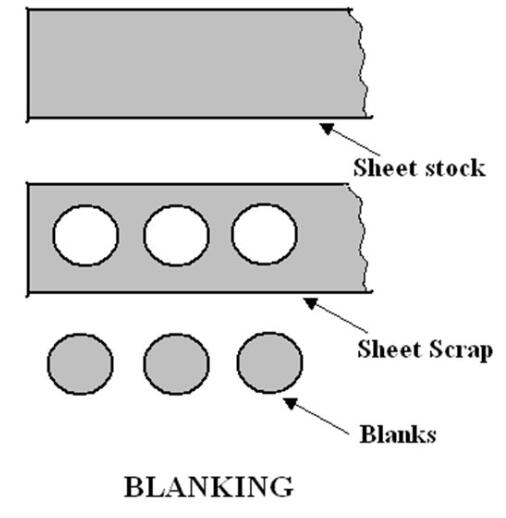
Blanking is the reverse of punching. The punch cuts through the sheet metal, and the piece that falls out is your finished part — called a blank. The remaining sheet with the hole is scrap, sometimes called the skeleton.
A useful analogy: blanking is like cutting cookies from dough. The cookie is what you keep. The surrounding dough is waste.
Typical blanking applications at Worthy Hardware:
We use blanking to produce flat parts such as washers, mounting brackets, contact terminals, flat springs, and retaining plates. The blank may be a finished part on its own, or it can be the starting point for downstream operations like bending, forming, drawing, or assembly.
Why blanking accuracy matters:
Blanking accuracy sets the quality ceiling for everything that follows. If the blank edge is rough, out of tolerance, or has excessive burr, every subsequent operation compounds that error. This is why we invest in sharp, well-maintained tooling and conduct regular die inspections. We keep spare inserts on hand to minimize downtime, which means your delivery schedule stays intact.
Technical note on edge quality:
During the blanking process, sheet metal goes through four stages: rollover, burnish zone, fracture zone, and burr. An ideal blanked cross-section should have a burnish zone of approximately 30–40% of material thickness, with burr height controlled to within 5% of material thickness. Die clearance is the core variable controlling this ratio — typically set at 5–10% of material thickness per side, depending on material type and desired edge quality. Too little clearance causes fracturing and excessive burr. Too much clearance creates a rounded, rollover edge. Our engineers set and verify clearance for every new die and document it in our tooling records.
For applications requiring extremely tight flatness and edge quality on flat parts, we also offer Fine Blanking: using a triple-action press structure (blank holder, punch, and ejector acting simultaneously), we can achieve a near-vertical, full-burnish cross-section with tolerances down to ±0.01mm. This is suited for automotive gear components, medical device parts, and other high-precision applications.
For high-volume orders, we design progressive dies that integrate blanking with punching, bending, and forming in a single strip. The blank separates from the strip at the final die station. This approach delivers high throughput, tight dimensional consistency, and low per-piece cost — which is exactly what customers sourcing OEM parts for resale need to protect their margins.
4. What Are the Differences Between Punching and Blanking?
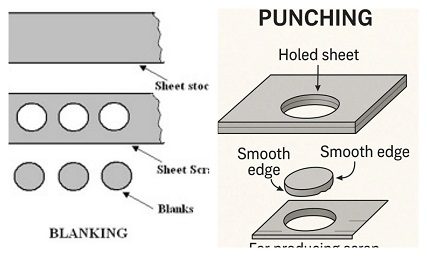
Here is a clear comparison for quick reference when reviewing drawings or discussing specs with your supplier:
| Dimension | Punching | Blanking |
| What is the product | The sheet with the hole is your part | The cut-out piece is your part |
| What is the scrap | The small cut-out piece (slug) is scrap | The remaining skeleton sheet is scrap |
| Edge quality focus | Hole edge quality — must accept fasteners, contacts, or mating features | Cut-piece edge quality — appears directly on your finished part |
| Die clearance setup | Clearance is set on the punch to control hole size | Clearance is set on the die opening to control blank dimensions |
| What it defines | Holes, slots, notches — detail features within a part | The overall outline of the component |
| Sequence in progressive die | Typically performed in earlier die stations | Typically the final separation station |
How they work together:
In practice, most stamped parts require both blanking and punching. A mounting bracket might be blanked from a steel coil to establish its outer shape, then punched to add mounting holes and slots. In a progressive die, both operations occur automatically as the strip advances through successive stations. The result is a finished part that exits the press ready for inspection and packaging.
A real-world example from our factory:
A customer in Canada once sent us a drawing labeled "punch out part profile from 1.5mm stainless steel." What he actually needed was blanking — he wanted the cut-out piece as his part, not the sheet with the hole. Because our engineers review every drawing carefully, we identified the intent immediately and confirmed before cutting any tooling. That single communication check saved him from a costly die revision and a three-week delay.
If you're ever unsure how to describe your operation, just send the drawing — we'll name it correctly for you.
5. What Materials Are Best for Blanking and Punching?
Almost any sheet metal can be blanked and punched. But material choice affects tooling life, edge quality, dimensional accuracy, and total part cost.
Low-Carbon Steel (Mild Steel)
The most common material for blanking and punching. Soft, clean-cutting, affordable, and widely available in standard thicknesses. We use it daily for brackets, clips, retainers, and structural components. Recommended clearance: 6–8% per side.
Stainless Steel (301, 304, 316)
Harder than mild steel. Requires higher press force and causes faster tooling wear — which we account for in our tooling maintenance schedule and per-piece pricing. Popular for parts requiring corrosion resistance in medical, food, and outdoor applications. Recommended clearance: 5–7% per side.
Aluminum
Lightweight, easy to punch, and excellent for electronics enclosures, lighting components, and consumer product housings. Aluminum can gum up tooling without proper lubrication management. We use application-specific lubricants and cleaning cycles to keep tool life consistent. Recommended clearance: 6–8% per side.
Brass and Copper
Ideal for electrical terminals, contacts, and connectors due to high conductivity and good formability. Both materials punch cleanly with well-maintained tooling. A significant portion of our production serves electronics customers who rely on brass and copper components. Recommended clearance: 6–8% per side.
Phosphor Bronze and Beryllium Copper
Used for precision spring contacts, connector pins, and high-cycle terminals. Excellent spring properties and electrical conductivity. More expensive than standard brass, but essential for applications requiring both mechanical and electrical performance.
Titanium
We can blank and punch titanium for aerospace and medical applications. It is demanding on tooling and requires slower press speeds and specialized die coatings. The result is a very strong, lightweight part with excellent corrosion resistance. Not common, but we have the capability and experience to deliver it.
Key factors to consider when selecting material:
- Thickness: Thinner materials punch with less force and produce cleaner edges. As thickness increases, press tonnage requirements and burr management become more critical
- Hardness: Harder materials accelerate tool wear, increasing maintenance frequency and affecting per-piece cost at high volumes
- Ductility: If your part needs bending or forming after blanking, choose a material ductile enough to handle the strain without cracking. Work-hardening materials such as certain stainless steel grades require tighter bend radius controls
- Surface and finish requirements: Aluminum anodizes well. Stainless may need passivation. Copper and brass often go through electroplating for conductivity or corrosion protection
At Worthy Hardware, we work with 100+ materials across ferrous and non-ferrous categories and support 50+ surface finishes including plating, anodizing, powder coating, and polishing. We have helped customers make material switches that reduced part cost by 15–30% without any loss of function.
Send your drawing and requirements to [email protected]. You'll receive an honest, engineering-based recommendation — not a sales pitch.
6. Why Work With Worthy Hardware for Blanking and Punching?
We are a B2B precision metal stamping manufacturer based in China, certified to ISO 9001:2015, supplying customers in North America, Europe, Japan, Singapore, Australia, New Zealand, and the Middle East.
Here is what makes us different from the average stamping supplier:
✅ No MOQ
We handle everything from single prototypes to full mass production runs. You can validate your design before committing to volume.
✅ 100% Inspection With Documentation
Every part is inspected before it ships. We provide a full inspection report with every shipment — dimensional report, material report, and surface finish report. We don't sample-check and hope for the best.
✅ Tight Tolerances
We hold tolerances down to 0.01mm consistently across production runs.
✅ Electronic Real-Time Monitoring
Our presses and tooling are monitored electronically in real time to catch deviations before they become defective parts.
✅ Engineering Support
Four experienced engineers are available to review your drawings, suggest design improvements, and help you reduce cost without compromising quality.
✅ Delivery Time Reference
Prototypes and samples: typically 7–15 business days. Standard production orders: typically 20–35 business days. We align with your timeline and communicate proactively if anything changes.
✅ Payment Methods
We accept T/T (wire transfer), L/C (letter of credit), and other standard B2B payment methods.
✅ Quality Issue Resolution Guarantee
If any part fails to meet the agreed specifications, our standard process is to provide a full non-conformance analysis report (8D or 5-Why format) — followed by replacement, rework, or refund. Every commitment we make is confirmed in writing before production begins.
We understand that procurement managers and company owners sourcing parts from overseas need a supplier who communicates clearly, delivers on time, and ships exactly what was agreed. That is the standard we hold ourselves to on every order.
7. Frequently Asked Questions
Q: Can blanking and punching be completed in the same die?
A: Yes. In a progressive die, punching is typically completed in earlier die stations, and blanking serves as the final separation operation. This is the most common and efficient combination in metal stamping production.
Q: What is the minimum hole size you can punch?
A: As a general rule, hole diameter should not be smaller than material thickness. For thin materials such as 0.3mm stainless steel, minimum hole diameter can reach 0.4mm. We recommend evaluating this on a case-by-case basis based on your specific material and part requirements.
Q: How do I know whether my part requires blanking or punching?
A: The core question is: do you want the piece that is cut out, or the sheet with the hole remaining? If your part is a standalone shape — such as a washer or bracket outline — that is blanking. If your part is a sheet or larger structure that needs holes added, that is punching. Not sure? Send us the drawing and we'll identify it for you.
Q: Do you offer prototypes?
A: Yes. We accept single-piece prototype orders with no minimum order quantity. The prototype stage is the best opportunity to validate your design and process parameters before committing to production tooling.
Q: How is pricing calculated?
A: Stamped part pricing consists of material cost, tooling cost (one-time), and per-piece processing cost. The higher the volume, the lower the per-piece cost. Send us your drawing, material spec, tolerance requirements, and target quantity — we'll provide a detailed, itemized quote.
Ready to Get a Quote or Discuss Your Drawing?
📧 Email: [email protected]
🌐 Website: www.worthyhardware.com
Send us your drawing, your material, your tolerance requirements, and your target quantity. We will respond with a clear, detailed quote and any engineering feedback that could improve your part or reduce your cost.
About the Author
Sandra Gao is the founder of Worthy Hardware, a precision metal stamping manufacturer in China certified to ISO 9001:2015, with over 15 years of experience supplying OEM stamped components to customers across North America, Europe, Asia-Pacific, and the Middle East. Worthy Hardware specializes in progressive stamping, fourslide stamping, tool and die, and metal assembly for industries including aerospace, automotive, electronics, medical, and industrial manufacturing. For engineering inquiries related to precision stamping, Sandra can be reached directly at [email protected].
The technical content in this article has been reviewed by the Worthy Hardware engineering team and reflects over 15 years of hands-on production experience and verified process parameters. If you have technical questions, we welcome direct inquiries.