
What Is The Difference Between Black Anodizing And Black Oxide?
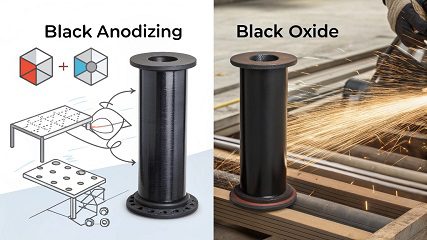
Choosing between two black finishes can be confusing. Making the wrong choice can affect your part’s durability and cost. I will explain the key differences to help you choose correctly.
Black anodizing is an electrochemical process for non-ferrous metals like aluminum, creating a thick, durable oxide layer that is then dyed black. Black oxide is a chemical conversion coating for ferrous metals like steel, forming a very thin layer of black iron oxide (magnetite).
Now that you understand the basic difference, you might be curious about the details. What are the processes behind these finishes? And how do you know which one is truly right for your specific material and application? Getting this right is critical for the success of your project. Let's dive deeper into each process so you can make an informed decision for your custom machined parts.
What is the difference between oxide and anodize?
The terms 'oxide' and 'anodize' sound similar and can be confusing. This confusion might lead to specifying the wrong finish for your parts, impacting both performance and your budget.
Anodizing is an electrolytic process that intentionally grows a thick, controlled oxide layer on a metal's surface, typically aluminum. A black oxide finish, however, is a chemical process that converts the surface of ferrous metals into a much thinner layer of iron oxide.
The best way to understand the difference is to look at the process itself. Anodizing is an electrochemical process. We submerge a part, like an aluminum component, into an acid bath and pass an electrical current through it. The part acts as the anode, and this process forces a thick, highly structured oxide layer to grow on the surface. This layer is integral to the part. In contrast, black oxide is a chemical conversion. We dip a ferrous part, like steel, into a hot bath of alkaline salts. This causes a chemical reaction that converts the surface iron into magnetite. It doesn't build up a layer; it changes the existing surface.
Here is a simple table to break it down:
| Feature | Anodizing | Black Oxide |
|---|---|---|
| Process | Electrochemical | Chemical Conversion |
| Base Materials | Non-ferrous (Aluminum, Titanium) | Ferrous (Steel, Stainless Steel, Copper) |
| Layer | Grows a thick, integrated oxide layer | Converts surface to a thin magnetite layer |
| Dimensional Change | Adds a small amount to the surface | Negligible to none |
| Primary Purpose | Durability, wear & corrosion resistance | Mild corrosion resistance, aesthetics |
What is the difference between blackening and black oxide?
You might hear "blackening" and "black oxide" used for finishing steel parts. Are they different? Using the terms incorrectly could cause confusion with your supplier, which might lead to delays.
The good news is, there is no real difference. "Blackening" is just a common, informal term for the black oxide coating process. Both terms refer to the same chemical conversion that forms a black, corrosion-resistant finish on ferrous metals like steel.
I remember a client, a procurement officer like Mark Chen from Canada, who was very specific in his request for "blackening" on a batch of low-carbon steel parts. When our quote came back specifying "black oxide," he called me, worried that we had misunderstood his requirement. I had to reassure him that in the manufacturing industry, these two terms mean the exact same thing. Other names for it include "gun bluing," especially when used on firearms. The process involves immersing the steel parts into a hot bath of chemicals, which converts the surface into magnetite (Fe3O4). A key point often missed is that this finish offers only very mild corrosion protection on its own. It's the post-treatment oil or wax dip that really provides the corrosion resistance by sealing the porous surface.
What is black anodising?
You need a durable, attractive black finish for your aluminum parts. Is black anodizing the answer? Not fully understanding the process could mean you don't get the durability you actually need.
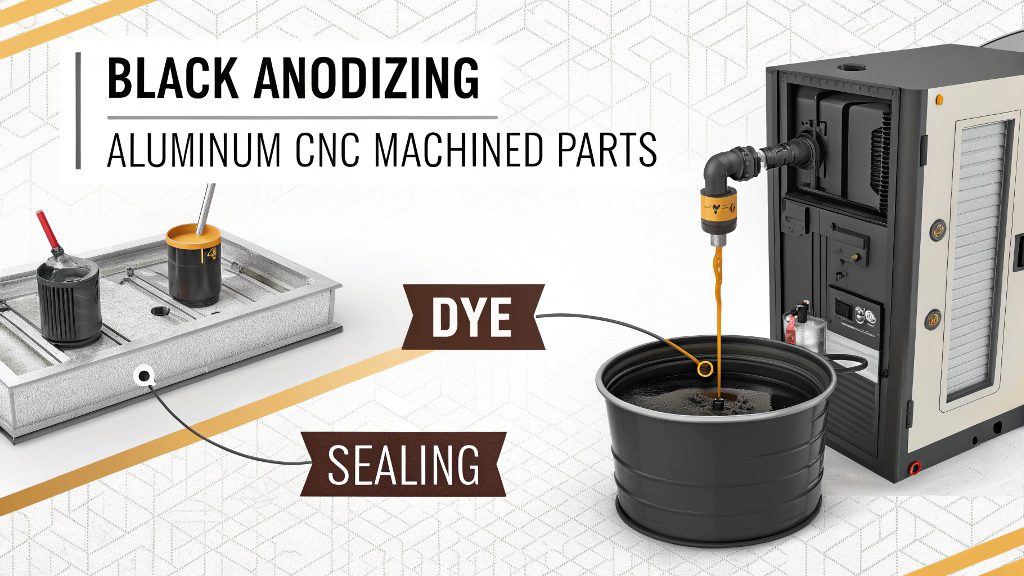
Black anodizing is a multi-step process. First, an electrochemical process creates a hard, porous aluminum oxide layer. Second, the part is submerged in a black dye bath, which fills the pores. Finally, the part is sealed to lock in the color and maximize corrosion resistance.
Black anodizing is one of the most popular finishes we provide for aluminum CNC machined parts, and for good reason. It’s not just a surface coating like paint; it’s an integral part of the metal. The process has three main steps. First is the anodizing itself, where we build that hard, porous aluminum oxide layer. The thickness of this layer can be controlled. A standard Type II anodize is great for aesthetics and corrosion resistance. A Type III, or hardcoat, creates a much thicker, harder layer for high-wear applications. The second step is dyeing. The porous nature of the new layer is perfect for absorbing dye. We dip the part in a tank of black dye, which sinks deep into the surface. The final, critical step is sealing. This closes up the pores, trapping the dye permanently inside and providing a barrier against moisture.
Is anodizing the same as oxidizing?
Anodizing creates an oxide layer, so is it just a fancy word for oxidizing, like rusting? Thinking this way is a common mistake that overlooks the control and durability that anodizing provides.
No, they are not the same. Oxidation is often a natural, uncontrolled process, like steel rusting, which is destructive. Anodizing is an engineered electrochemical process that creates a highly controlled, uniform, and protective oxide layer that actually improves the metal's properties.
Think about the rust you see on an old car. That is natural oxidation. It’s random, it flakes off, and it continuously eats away at the base metal until there’s nothing left. It weakens the part. Anodizing is the complete opposite; it's what I call "oxidation on purpose." We use a controlled environment—an electric current and an acid bath—to force the creation of an oxide layer. For aluminum, this aluminum oxide layer is incredibly hard, second only to diamond. It's perfectly uniform and fully integrated with the aluminum underneath, so it can't flake or peel off like paint. So, while both processes involve creating an oxide, one is a destructive disease, and the other is a custom-fit suit of armor. We use chemistry to build a superior surface, not to let it decay.
Conclusion
Black anodizing is an electrochemical process for aluminum that creates a durable, dyed layer. Black oxide is a chemical conversion for steel, offering a thin, black finish with minimal dimensional change.