
What Is The Difference Between Acetal And PEEK In CNC Machining?

Choosing the right plastic for CNC machining can feel like a gamble. Pick the wrong one, and you risk part failure and wasted budget. You need clarity to choose correctly.
The main difference between Acetal and PEEK is performance versus cost. PEEK offers superior strength and resistance to heat and chemicals, making it ideal for extreme environments. Acetal is a cost-effective, easy-to-machine plastic perfect for general-purpose mechanical parts under normal conditions.
Understanding these two plastics is crucial for any project's success. Both are excellent materials, but they are designed for very different jobs. One is a high-performance specialist, and the other is a versatile workhorse. Knowing when to use each one will save you time, money, and a lot of headaches. Let's dive deeper to help you make the best choice for your specific needs.
What is the difference between acetal and PEEK?
You see Acetal and PEEK on material lists, but how do you decide? Guessing can mean your parts fail from heat or wear out too fast. Let's break them down.
The biggest differences are in thermal performance, chemical resistance, and price. PEEK is a high-performance thermoplastic for extreme jobs, while Acetal (often called Delrin) is a go-to engineering plastic for a huge range of standard applications. They are not interchangeable.
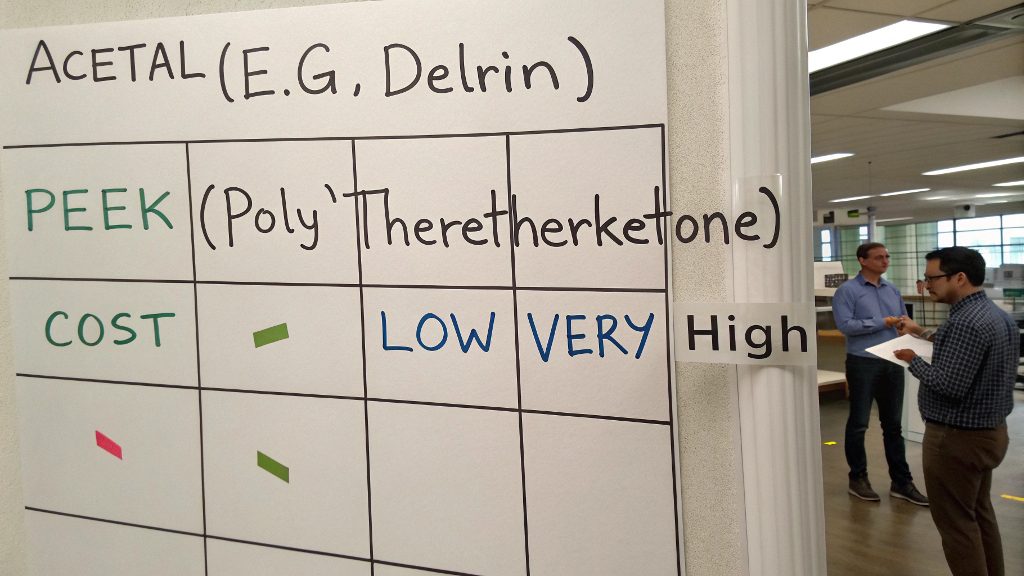
To really see the difference, it helps to compare them side-by-side. I often explain this to customers like Mark from Canada, who needs to balance performance with cost. He needs to know exactly what he's paying for. PEEK is much more expensive, but for some applications, nothing else will do. Acetal provides fantastic value for less demanding roles. One interesting point many people miss is hardness; on paper, Acetal is slightly harder than PEEK. However, PEEK is much tougher and has far better wear resistance, especially when things get hot. We use a simple table to make the choice clear for our clients.
| Feature | Acetal (e.g., Delrin) | PEEK (Polyetheretherketone) |
|---|---|---|
| Cost | Low | Very High |
| Max Service Temp | ~85°C (185°F) | ~250°C (482°F) |
| Wear Resistance | Good | Excellent |
| Chemical Resistance | Good (but weak against strong acids/bases) | Excellent (resists a very broad range of chemicals) |
| Machinability | Excellent, produces great finish | Good, but more challenging due to heat sensitivity |
| Primary Use | Gears, bushings, fixtures, general mechanical parts | Aerospace, medical implants, high-temp industrial parts |
Is PEEK better than Delrin for machining?
You hear PEEK is a "super-plastic." Does this make it better than Delrin? Assuming it's better for everything can lead you to over-spec and over-spend on your project.
No, PEEK is not always better than Delrin (a brand of Acetal). PEEK is better only when you need its specific properties, like high-temperature performance. For general mechanical parts, Delrin is often the superior choice because it's cheaper, easier to machine, and dimensionally stable.

The "better" material is the one that meets your project's requirements without overkill. At my company, Worthy, we guide customers on this all the time. For example, a customer needed parts for a medical device that required repeated steam sterilization. Delrin would warp and fail under that heat, so PEEK was the only option. The high cost was justified because the application demanded it.
On the other hand, we produce thousands of parts from Delrin for consumer electronics and industrial machines. These parts, like gears and rollers, need to be strong, have low friction, and hold their shape. They will never be exposed to 200°C temperatures. In these cases, using PEEK would be like buying a race car just to drive to the grocery store. It's an unnecessary expense. For most everyday engineering challenges, Delrin provides excellent performance at a fraction of the cost.
What is PEEK machining?
You need to machine PEEK but heard it can be tricky. How do you get it right? Machining it wrong can cause cracks and ruin expensive material, which is a painful mistake.
PEEK machining is the CNC process of cutting parts from PEEK plastic stock. It requires sharp carbide tools, careful heat management, and specific speeds and feeds to prevent stress and melting. We often anneal the material before and after machining for the best results.
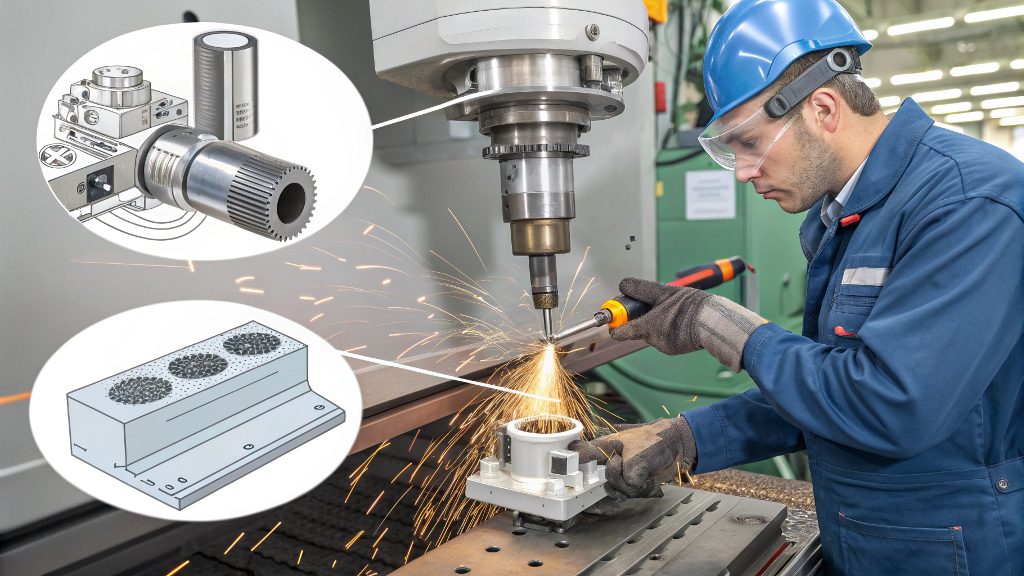
Machining PEEK is different from machining Acetal or aluminum. PEEK is a poor thermal conductor, meaning heat builds up at the cutting edge instead of distributing through the part. This is the main challenge. If you let it get too hot, you can induce stress in the material, which can cause cracking or warping later.
At our facility, we follow strict protocols. First, we use very sharp carbide tools. A dull tool will rub instead of cut, generating way too much heat. Second, we adjust our cutting parameters. We use lower spindle speeds but higher feed rates. This creates a thicker chip that pulls heat away from the workpiece. Finally, for parts with very tight tolerances, annealing is a critical step. We heat the raw PEEK material in an oven and cool it slowly to relieve any internal stress. We often repeat this process after rough machining to ensure the final part is perfectly stable.
What is the disadvantage of acetal?
Acetal seems like a great, cheap material. Are there any hidden downsides? Not knowing a material's weakness can lead to unexpected part failure, which can be a disaster for your product.
Yes, Acetal has limits. Its main disadvantages are low heat resistance (it deforms above 85°C), poor resistance to strong acids, and the fact that it is very difficult to bond with adhesives. It can also degrade with prolonged UV exposure.
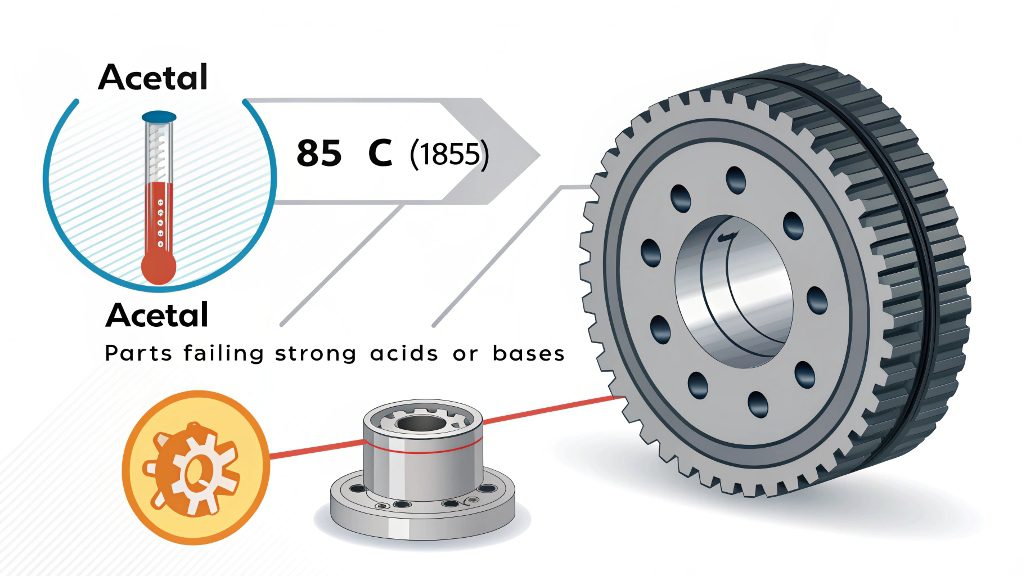
Every material has trade-offs, and Acetal is no exception. Its biggest weakness is temperature. I’ve seen cases where a customer used an Acetal part too close to a motor, and it softened and failed. If your part will operate anywhere near 85°C (185°F), you need to choose a different material.
Another key disadvantage is its chemical resistance. While it handles solvents well, it doesn't stand up to strong acids or bases. If the part needs to be cleaned with harsh chemicals, Acetal might not survive. Its slick, low-friction surface is a great feature for mechanical parts, but it also means that most glues and adhesives won't stick to it. We always tell our customers to design for mechanical fastening, like using screws, instead of trying to glue Acetal parts together. Understanding these limitations is the key to using this fantastic material correctly and avoiding future problems.
Conclusion
In short, choose PEEK for extreme heat and chemical jobs where cost is secondary. Choose Acetal for a reliable, low-cost, and easy-to-machine workhorse for general mechanical applications.