
What is quenching in metal processing and how does it affect CNC machined parts?

Are your metal parts failing or wearing out too fast? This can lead to costly replacements and hurt your reputation. Quenching makes your CNC machined parts significantly harder and more durable.
The simplest answer is that quenching is a heat treatment process. We heat a metal part to a certain temperature, hold it there for a while, and then cool it down very quickly. This process is done to increase the metal's hardness and wear resistance.
This quick overview gives you the basic idea, but the details are what really matter for getting high-quality parts. Understanding how quenching works helps you specify the right requirements for your project. Let's dive deeper to see how this process impacts your components and why it is a critical step in manufacturing.
What is metal quenching?
Confused by technical terms? The word 'quenching' might sound complicated. Let's break it down into simple, easy-to-understand steps so you know exactly what is happening to your parts.
Metal quenching is a controlled three-step process: heating, soaking, and rapid cooling. The metal is heated, held at temperature to ensure it's heated all the way through, and then cooled quickly in a liquid or air to lock in a harder internal structure.
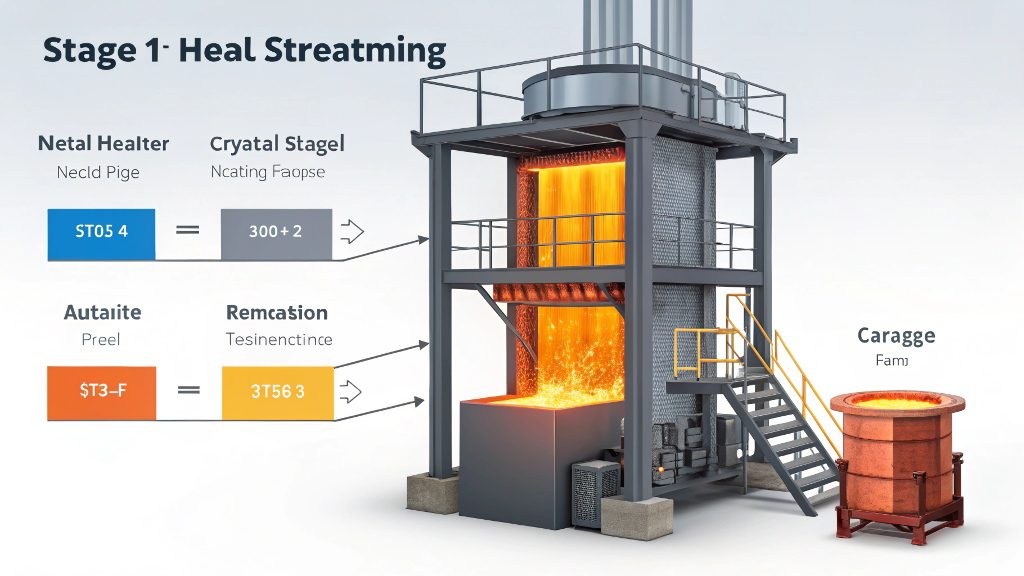
Stage 1: Heating (Austenitizing)
First, we heat the metal part in a furnace to a specific, very high temperature. This temperature is usually above 723°C (1333°F) for steel. At this point, the internal crystal structure of the metal changes into a state called austenite, which is able to absorb more carbon.
Stage 2: Soaking
Once the part reaches the target temperature, we don't cool it immediately. We hold it at that temperature for a set period. We call this "soaking." This step is very important because it allows the heat to spread evenly throughout the entire part. For thick or complex parts, soaking ensures the inside reaches the same temperature as the surface.
Stage 3: Cooling (Quenching)
This is the main event. We take the hot part out of the furnace and cool it down very quickly. We do this by plunging it into a quenching medium[^1]. The type of medium we use depends on the metal and the desired outcome. The goal of this rapid cooling is to "trap" the hard crystal structure before it can change back into a softer form.
| Quenching Medium | Cooling Speed | Common Use Cases |
|---|---|---|
| Water | Very Fast | Carbon steels, where maximum hardness is needed |
| Oil | Fast | Alloy steels, to reduce risk of cracking |
| Air | Slow | Tool steels, sensitive materials |
| Brine (Saltwater) | Very Fast | Simple carbon steels, faster than water |
What effect does quenching have on metals?
Are you worried about your parts performing under pressure? A soft metal can bend or wear out, causing big problems. Quenching completely changes a metal's properties to handle tough jobs.
Quenching primarily increases a metal's hardness and tensile strength, making it much stronger. It also greatly improves wear resistance. However, this process can make the metal more brittle, so a second treatment called tempering is often required to add toughness.
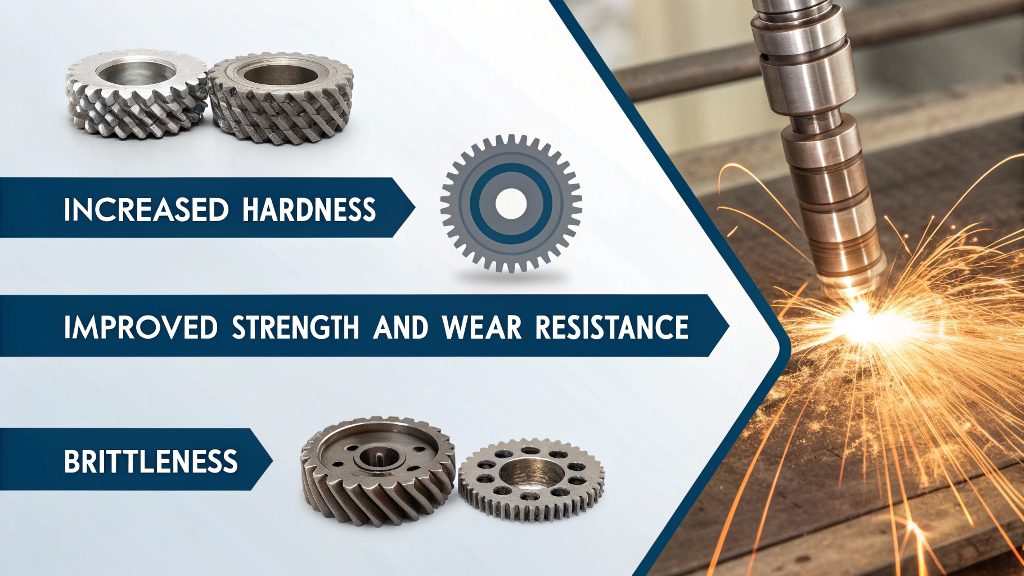
The main reason we quench parts is to change their mechanical properties for the better. When I talk with clients, I explain that it’s a trade-off. We gain some properties but might lose others. Here’s a breakdown of the key effects.
Increased Hardness
This is the most well-known benefit. Hardness is the metal's ability to resist being scratched, dented, or worn down. After quenching, a metal like medium-carbon steel can become several times harder than it was before. This is essential for parts like gears, shafts, and cutting tools that face constant friction.
Improved Strength and Wear Resistance
With increased hardness comes increased tensile strength. This means the part can handle more force and tension before it bends or breaks. This also directly leads to better wear resistance. A quenched part will last much longer in applications where it rubs against other surfaces.
The Downside: Brittleness
There is a trade-off. While quenching makes a part very hard, it also makes it more brittle, like glass. A brittle part can shatter or crack if it receives a sharp impact. This is a big risk in many applications. To solve this, we almost always perform another heat treatment called tempering right after quenching. Tempering reduces some of the hardness and brittleness, resulting in a part that is both hard and tough.
What is quenching in the manufacturing process?
When should you heat treat your part? This is a key decision that affects cost, time, and quality. Getting the order wrong can ruin a perfectly good part or blow your budget.
In manufacturing, quenching is a heat treatment step that can happen either before or after CNC machining. The choice depends on the final precision needed. We either machine the soft metal first and then quench it, or quench first and then machine the hardened metal.
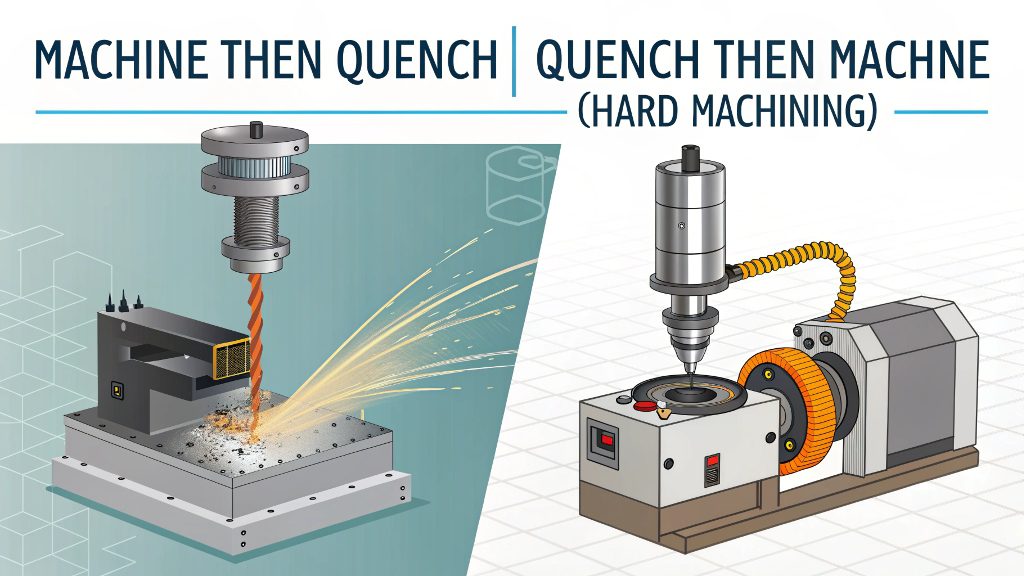
As a manufacturer, I have to plan the production sequence carefully. Placing quenching at the right step is critical for success. We work with our customers to decide the best path for their specific parts. There are two main approaches.
Approach 1: Machine, then Quench
This is the most common and cost-effective method. We take the raw metal stock, which is relatively soft, and perform all the CNC milling or turning operations. Machining soft metal is faster, easier on our tools, and uses less energy. After the part is fully shaped, we then send it for quenching and tempering to achieve the desired hardness.
- Pros: Cheaper and faster machining.
- Cons: The heating and cooling of quenching can cause the part to slightly warp or change dimensions. This can be a problem if you have very tight tolerances of +/- 0.001" or less.
Approach 2: Quench, then Machine (Hard Machining)
For applications that require extreme precision, like in aerospace or medical devices, we reverse the process. We first quench the raw metal block to make it hard, and then we perform the CNC machining. This is called "hard machining." Because the part is already in its final hardened state, there is no risk of distortion from heat treatment after machining.
- Pros: Achieves very high precision and excellent surface finish.
- Cons: Hard machining is much slower, requires special, more expensive cutting tools (like CBN or ceramic), and puts more stress on our machines. This makes the process more expensive.
We always discuss these options with you to find the right balance between cost and the tolerances your design requires.
What is quenching in simple words?
Tired of complex engineering terms? Sometimes you just need a simple, direct explanation. Let's forget the technical jargon and describe quenching in a way that makes perfect sense.
In simple words, quenching is like flash-freezing for hot metal. This rapid cooling traps the metal in a super-strong state. Think of it as permanently locking in strength, making the part much tougher and more durable for its job.
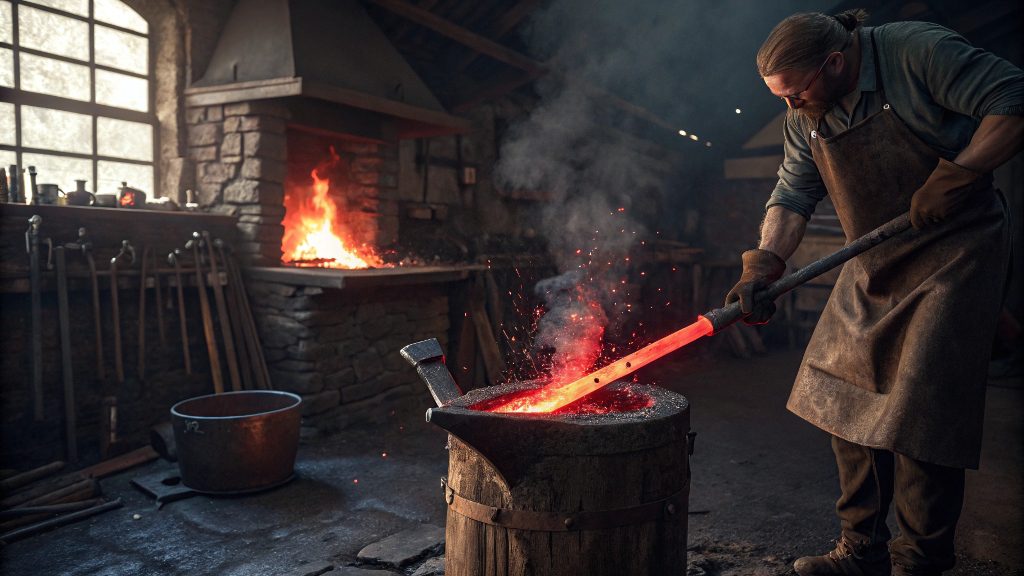
Imagine a blacksmith forging a sword. You’ve probably seen it in movies. The smith heats the blade until it glows bright red, then plunges it into a bucket of water. Steam erupts, and the metal sizzles. That dramatic moment is quenching.
What is happening inside the metal? When you heat steel, its internal structure becomes loose and rearranged. If you let it cool slowly, the structure arranges itself back into a soft, relaxed state. But if you cool it very quickly—by plunging it in water or oil—the structure doesn't have time to relax. It gets frozen in a tense, tightly packed, and very strong formation.
Think of it like making candy. If you boil sugar and water and let it cool slowly, you get large, soft sugar crystals. But if you pour the hot syrup onto a cold marble slab, it cools instantly into a hard, glassy sheet of candy. Quenching does something similar for metal. It creates a fine-grained, hard internal structure instead of a coarse, soft one.
So, when we talk about quenching your CNC parts at Worthy, we are taking a precisely machined component and giving it that final "super strength" treatment. This ensures the part won't wear down, bend, or fail, giving you a reliable product that lasts.
Conclusion
In short, quenching is a vital heat treatment that makes metal parts harder and more wear-resistant. This ensures your components perform reliably and have a long service life.