
What is 5-axis milling and when should you use it?
Struggling with complex part designs? Are setup times getting longer and more expensive? There is a better way to machine intricate geometries in a single setup.
5-axis milling is an advanced CNC machining process that moves a cutting tool across five different axes at the same time. You should use it for parts with complex shapes, like those in aerospace or medical devices, to improve accuracy, get a better surface finish, and reduce setups.
This technology might sound complicated, but it is a game-changer for many projects. I have seen it solve manufacturing problems that seemed impossible with traditional methods. It opens up new design possibilities and can actually save you money in the long run.
Let's break down what it is really used for and how it can help your business.
What is 5 axis machining used for?
Are your parts too complex for standard machines? Do you waste time with multiple setups and manual repositioning? 5-axis machining solves these exact problems for many industries.
5-axis machining is used for creating parts with complex, curved surfaces. It is essential in industries like aerospace for turbine blades, medical for orthopedic implants, and automotive for engine components. It handles jobs that are too difficult for 3-axis machines.
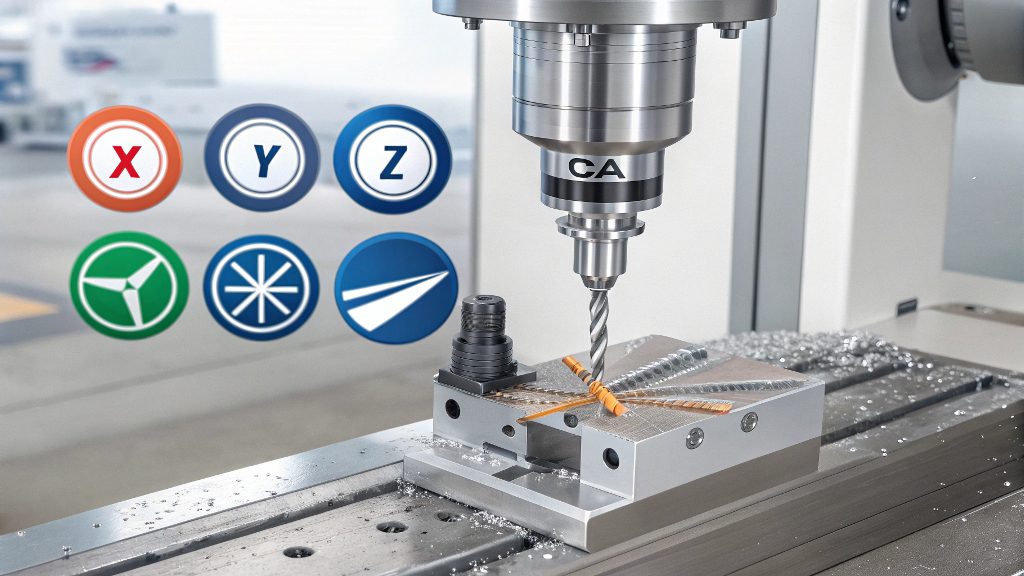
The five axes we typically talk about are the three linear axes X, Y, and Z, plus two rotational axes, usually A and C. This allows the cutting tool to approach the workpiece from any direction. Because of this, we can machine very complex shapes in a single setup, which is a huge advantage. At my company, Worthy, we often use it for customers in demanding fields.
Key Applications
- Aerospace: This is the classic example. We make parts like turbine blades, impellers, and other structural components. These parts have complex curves and surfaces. With 5-axis machining, we can create these smooth, aerodynamic shapes with high precision.
- Medical: The medical industry needs custom implants and surgical tools. These often match a patient's unique anatomy. 5-axis machining is perfect for creating these organic shapes in materials like titanium.
- Automotive: High-performance engine blocks, pistons, and cylinder heads have intricate ports and contours. 5-axis machines can carve these out efficiently, improving engine performance.
By using shorter, more rigid cutting tools that can be angled, we also get a better surface finish and reduce tool vibration. This increases both quality and tool life.
What are the disadvantages of 5 axis machining?
Is the high cost of 5-axis machining making you hesitate? Are you worried about the complexity of programming and operating the machines? These are valid concerns for many businesses.
The main disadvantages are the high initial investment for the machine and the complex programming required. It also demands highly skilled operators, and maintenance costs can be higher. This is why it is not always the best choice for simple parts.
While 5-axis technology is powerful, it is not always the right tool for every job. It is important to understand the trade-offs before you decide. From my experience, the biggest hurdles for our customers are cost and complexity. The machines themselves are a significant investment, much more than a standard 3-axis mill. This cost has to be justified by the complexity of the parts you need or the efficiency gains you will achieve.
Key Drawbacks to Consider
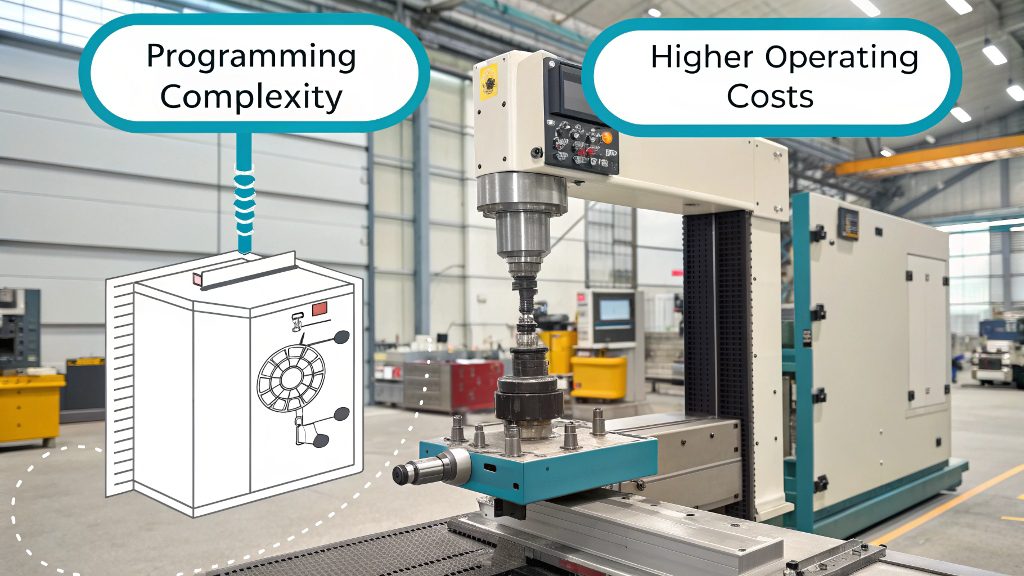
- Programming Complexity: Creating the toolpaths for a 5-axis machine is much more complicated. It requires specialized CAM software and an experienced programmer to avoid tool collisions and ensure the part is machined correctly. This programming time adds to the upfront cost of a project.
- Higher Operating Costs: You need a highly skilled machinist to set up and run a 5-axis machine. Finding and retaining this talent can be a challenge. Maintenance is also more complex due to the extra moving parts in the rotary tables and tilting head.
- Not Ideal for Simple Parts: If you have a simple part with only a few flat faces, using a 5-axis machine is overkill. It would be much faster and cheaper to produce it on a 3-axis machine. The extra setup and programming time would not be worth it.
What is the difference between 3 and 5 axis milling?
Confused about which CNC process is right for your part? Do 3-axis and 5-axis machines seem similar but you're unsure of the real difference? Understanding the basics is key.
A 3-axis machine moves the tool along the X, Y, and Z axes. The workpiece stays fixed. A 5-axis machine adds two rotational axes, allowing both the tool and workpiece to move, which is ideal for complex shapes.
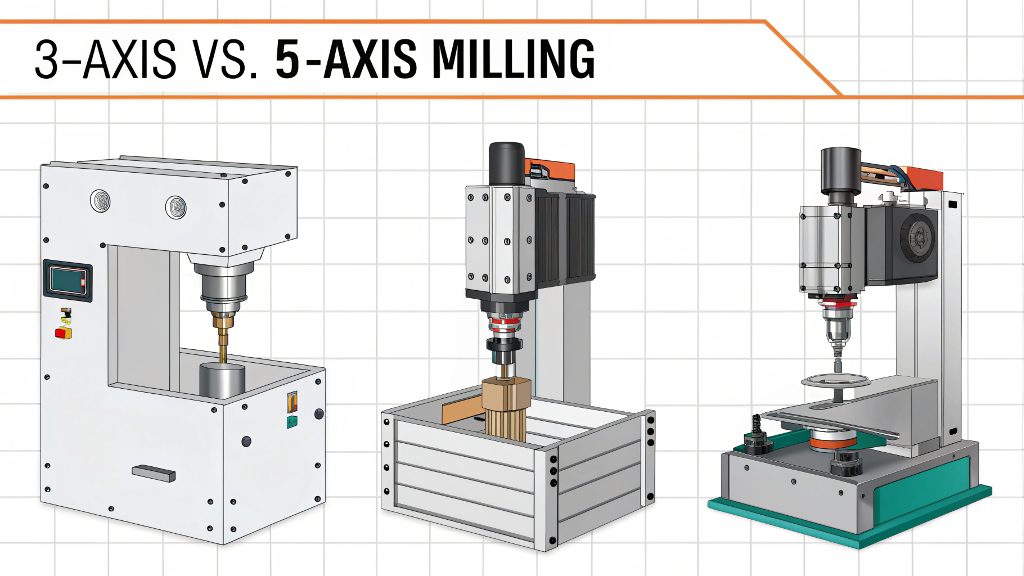
The primary difference comes down to movement and capability. Imagine you are carving a block of wood. With a 3-axis machine, your chisel can only move up-and-down, left-and-right, and forward-and-backward. To carve the sides or bottom, you have to physically stop, unclamp the block, turn it, and clamp it again. Each time you do this, there is a small risk of error. A 5-axis machine is like being able to tilt and rotate the block of wood without ever unclamping it, allowing your chisel to reach almost any surface in one continuous motion.
3-Axis vs. 5-Axis Milling
| Feature | 3-Axis Milling | 5-Axis Milling |
|---|---|---|
| Movement | X, Y, and Z linear axes | X, Y, Z linear axes + A and C rotational axes |
| Workpiece | Remains stationary during cutting | Can be rotated and tilted |
| Complexity | Best for simple parts, 2.5D shapes, shallow cavities | Ideal for complex 3D shapes, deep cavities, undercuts |
| Setups | Often requires multiple setups | Can machine five sides in a single setup |
| Cost | Lower machine and programming cost | Higher machine and programming cost |
This ability to work on five sides of a part in one setup is called "single-setup machining" or "done-in-one." This is the main reason 5-axis milling saves so much time and increases accuracy for complex parts. It eliminates the need for multiple machines and fixtures, reducing the chance of human error during re-positioning.
What is the difference between 5 axis and 6 axis milling machine?
Have you heard of 6-axis machines and wondered how they could be more advanced than 5-axis? Does an extra axis always mean better performance? The distinction is important.
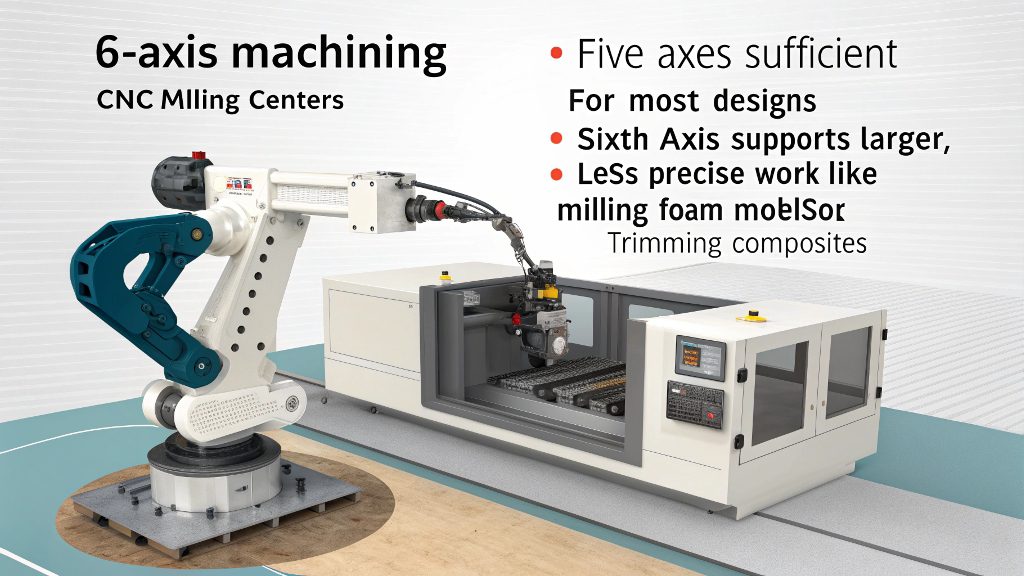
A standard 5-axis machine has three linear and two rotational axes. A 6-axis machine adds a sixth axis, often for auxiliary operations like feeding material or for specialized robotic arm movements, not just part cutting.
![]()![]()![]()![]()
This is where things can get a little confusing. In the world of CNC milling centers, a true "6-axis" machine forsubtracting material is very rare. Usually, when people talk about 6-axis machining[^1], they are referring to a CNC machine integrated with a robotic arm or another system that provides the sixth axis of movement. The sixth axis is not typically another rotational axis for the cutting head. Instead, it serves a different function to support the overall manufacturing process.
Understanding the 6th Axis
For most part designs, five axes are more than enough to reach any surface. So what does a sixth axis do?
- Robotic Machining: Many 6-axis systems are actually robotic arms with a spindle attached. They offer incredible flexibility but often lack the rigidity and precision of a traditional 5-axis CNC machine center. They are used for larger, less precise work like milling foam models or trimming composites.
- Hybrid Machines: Some machines combine milling with another technology, like additive manufacturing (3D printing). The sixth axis might control the material deposition head.
- Automation: In high-volume production, the sixth axis could be part of a system that loads raw material or unloads finished parts, essentially blending machining with automation.
So, while a 6-axis robot has more freedom of movement, it is not necessarily a better "milling machine" than a 5-axis one. For creating high-precision metal and plastic parts, a 5-axis CNC center remains the industry standard for complex geometries.
Conclusion
In summary, 5-axis milling is a powerful tool for complex parts. It improves accuracy and efficiency. Understanding its uses and limits helps you choose the right process for your project.