
What Industries Rely on Metal Stamping Parts
Written by: Sandra Gao | Sales Manager, Worthy Hardware Last updated: 2025 Company info: Founded in 1998 | 2,000 sqm facility | 80 employees | ISO9001 Certified Website: www.worthyhardware.com | Email: [email protected]andra Gao, Founder of Worthy Hardware
Why I Wrote This Article
Over the years at Worthy, I've talked with procurement managers from dozens of countries and industries almost every single day — some are owners of established trading companies, like our long-time customers in Canada who've been sourcing from us for years. Others are engineers at hardware startups just getting off the ground. Regardless of who they are, the question I hear most often is the same: "Is my product actually a good fit for metal stamping?"
Worthy was founded in 1998, which means we've spent 27 years in precision metal stamping. Our facility covers 2,000 square meters, and among our 80 employees, a good number are technicians and engineers who've grown with the company over the long term. We're ISO9001 certified, which underpins the quality systems we use to serve customers globally.
This article isn't marketing copy. It's a working summary put together by our engineering team and customer-facing staff, based on real projects across 8+ major industries over the years. Where possible, we can provide anonymized inspection reports or process records to back up the data referenced here.
If you're trying to figure out whether metal stamping is right for your industry, I hope this saves you some guesswork.
What Industries Actually Use Metal Stamping?
Short answer: if your product includes metal components and you need precision, consistency, and cost control at scale, metal stamping is almost always part of the answer.
Right now, Worthy serves customers across automotive, aerospace & defense, electronics & semiconductors, medical & dental, robotics & industrial automation, energy, lighting, consumer products, and hardware startups — spanning 12+ sub-sectors, with customers across North America, Europe, Japan, Singapore, Australia, New Zealand, and the Middle East.
Over nearly three decades, we've completed thousands of projects. Every industry has taught us something different — automotive taught us what "zero-defect delivery" really means, aerospace taught us that every single part needs to be traceable, and hardware startups taught us that a good supplier should function as a design partner, not just a job shop.
Below, I'll walk through the real requirements of each industry and how Worthy specifically addresses them.
Automotive Industry
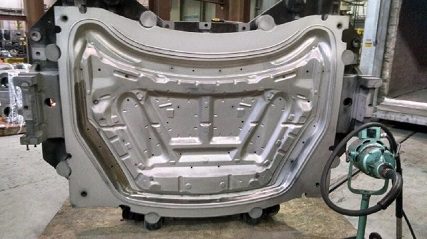
Automotive is the single largest consumer of stamped metal parts globally. A typical vehicle contains 400-600 stamped components — structural brackets, mounting plates, terminal connectors, heat shields, spring clips, sensor housings, and more. This industry demands:
- High volume: Annual production from 100K to millions of units
- Tight tolerances: Critical dimensions typically require ±0.05mm to ±0.1mm
- Process stability: Every part must match the last — Cpk on critical dimensions needs to hit 1.33 or higher
- PPAP documentation: New parts require a complete Production Part Approval Process package
- Zero tolerance for delivery slips: A stopped automotive line costs money by the hour
How Worthy Serves Automotive Customers:
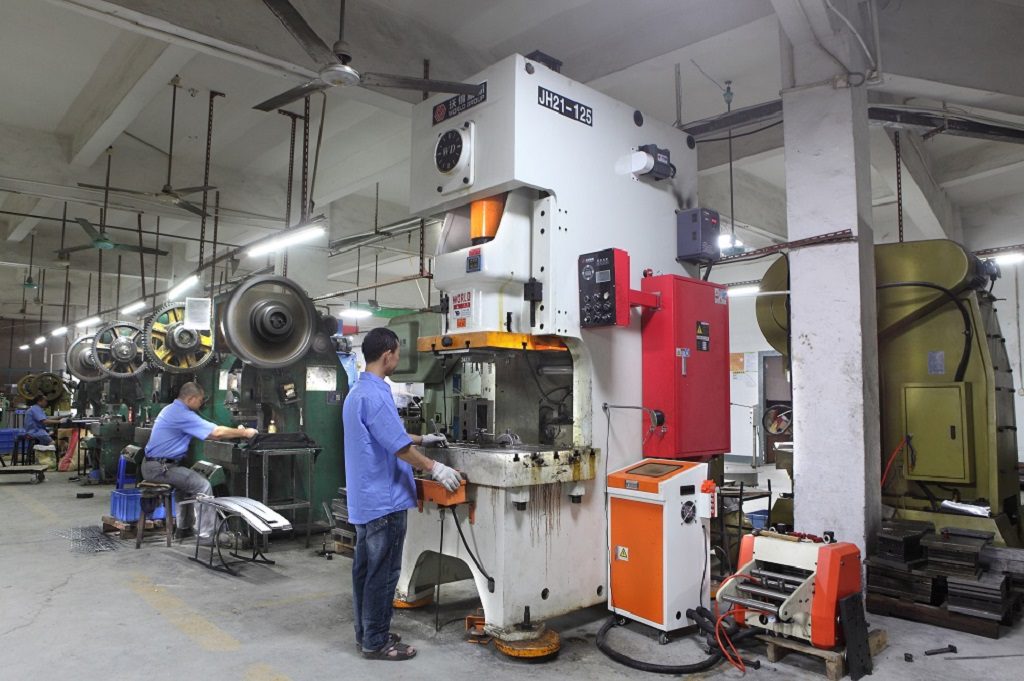
We produce progressive die stamped brackets, terminals, and mounting components for customers with annual volumes ranging from 10K to over 2 million pieces. Our electronic press monitoring systems flag pressure anomalies in real time — catching defects before they happen, not after. Every automotive project comes with a complete PPAP package: dimensional reports, material certifications, capability studies, and control plans.
Real Case Study: A North American Tier 2 automotive supplier needed a steel mounting bracket (SPCC material, 2.0mm thick, 6 holes, 3 bends) at 150K units/month. We built a 14-station progressive die with in-die sensor monitoring. Since first-article PPAP approval, this program has run for over 2 years with zero quality incidents and a 99.4% on-time delivery rate.
(Anonymized PPAP documentation available upon request for this project.)
Common Materials: Carbon steel (SPCC, SPHC, S45C), stainless steel (SUS304), aluminum (A5052, A6061)
Aerospace & Defense
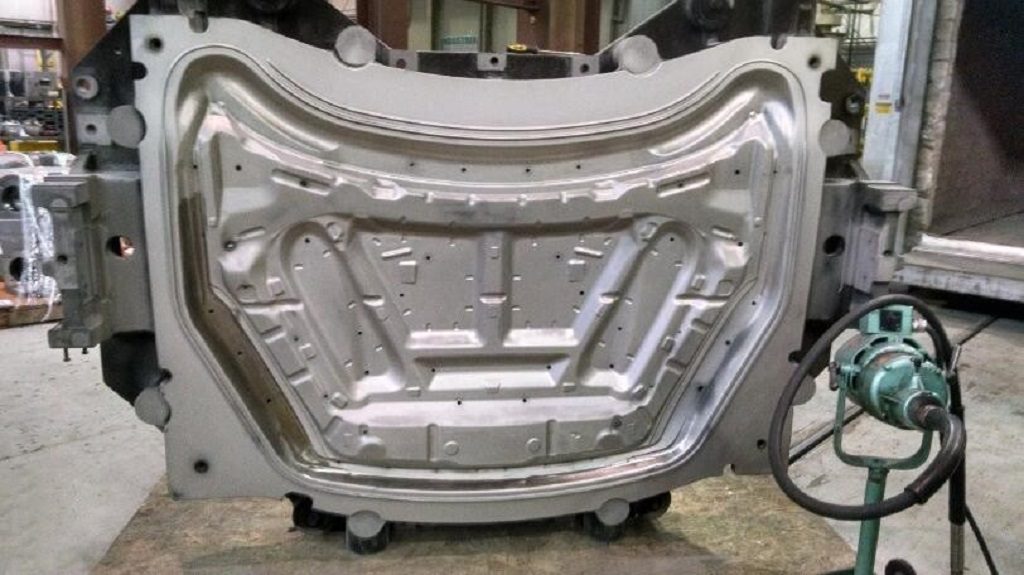
This is the most demanding industry we serve. Parts must perform reliably in extreme conditions — temperature cycles from -55°C to +200°C, constant vibration, high structural loads — where failure simply isn't an option. This industry requires:
- Extreme tolerances: Critical features often need ±0.025mm or tighter
- High-strength materials: Titanium alloys, alloy steel (4130, 4140), precipitation-hardened stainless (17-4PH)
- Full material traceability: Every part traceable back to the original material heat/lot number
- 100% inspection on critical dimensions (not sampling — every single part, checked)
- Complete documentation: Inspection reports, material certifications, process records, all included
How Worthy Serves Aerospace & Defense Customers:
Our standard practice is 100% inspection, which aligns naturally with aerospace requirements. We provide full lot traceability and material certifications for every coil, dimensional inspection reports for every batch, and First Article Inspection Reports (FAIR) in AS9102 format. Our engineers have deep hands-on experience with titanium and high-strength alloys, including managing common issues like galling and springback with these materials.
Real Case Study: A U.S. defense contractor needed Grade 2 titanium structural clips (0.8mm thick, 12 precision holes, 2 bends, angular tolerance ±0.025mm) at 8,000 units/year. We used carbide inserts at all cutting stations to withstand titanium's high abrasiveness, and performed 100% CMM inspection on all hole positions. Cpk on critical dimensions reached 1.67.
A Note on Certification, Honestly: We do not currently hold AS9100 certification, but we are ISO9001 certified, and our quality management system and inspection processes are designed to meet AS9100-level rigor. If your project requires a formally AS9100-certified supplier, we're happy to discuss your specific requirements directly — in many cases, our process controls and documentation systems meet the actual technical requirements even without the formal certificate.
Common Materials: Titanium (Grade 2, Grade 5), alloy steel (4130, 4140), stainless steel (17-4PH, SUS304, SUS316), Inconel
Electronics & Semiconductors
The electronics industry consumes a staggering volume of small precision stamped parts. Every phone, laptop, server, and networking device contains dozens of stamped components: EMI shields, RF shield covers, connector contacts, terminal pins, heat sinks, ground clips. This industry demands:
- Miniaturization: Parts as small as 2mm x 3mm, with features measured in tenths of a millimeter
- Massive volumes: Annual production from 500K to over 50 million units is standard
- Excellent conductivity: Copper, brass, phosphor bronze for electrical performance
- Consistent plating: Gold, tin, nickel, or silver plating for reliable contact surfaces
- Ultra-high-speed production: Progressive die presses running 400-800 strokes per minute
How Worthy Serves Electronics Customers:
This is one of our strongest areas. We use pure copper (C1100), brass (C2600, C2680), and phosphor bronze (C5191) on progressive die and fourslide presses to produce connectors, terminals, contact springs, EMI shields, and ground clips at high speed. We consistently hold ±0.025mm tolerances on micro features, and our in-die tapping capability makes us particularly well-suited for connector and terminal applications.
Real Case Study: A Singapore-based semiconductor equipment manufacturer needed phosphor bronze contact springs at 2.4 million units/year. Each spring required 6 bends across 3 planes, with a contact force spec of 0.45N ± 0.05N. We produced these on fourslide equipment — multi-directional forming was essential to shape all bend planes in a single operation. Contact force was verified via 100% automated end-of-line testing.
Common Materials: Pure copper (C1100, C1020), brass (C2600, C2680), phosphor bronze (C5191, C5210), beryllium copper (C1720)
Medical & Dental
Medical devices require biocompatible materials, production under controlled conditions, and full traceability. Regulatory requirements (FDA, CE marking) cascade down to component suppliers — meaning we're held to a higher bar for process control and documentation than most other industries. This industry requires:
- Biocompatible materials: Stainless steel (SUS316, SUS304), titanium (Grade 2, Grade 5)
- Extremely tight tolerances: Implant-related parts often need ±0.025mm
- Surface quality: No burrs, no scratches, no contamination
- Full traceability: Lot-level tracking from raw material to finished part
- Validated processes: Once a process is validated, it cannot be changed without formal change control
How Worthy Serves Medical Customers:
We stamp surgical instrument components, implant fixation devices, equipment housings, and internal mechanism parts using SUS316 and titanium. Every medical project has a dedicated inspection protocol, and we maintain batch segregation and traceability throughout production. Every shipment comes with a Certificate of Compliance (CoC), Material Test Report (MTR), and full dimensional inspection report.
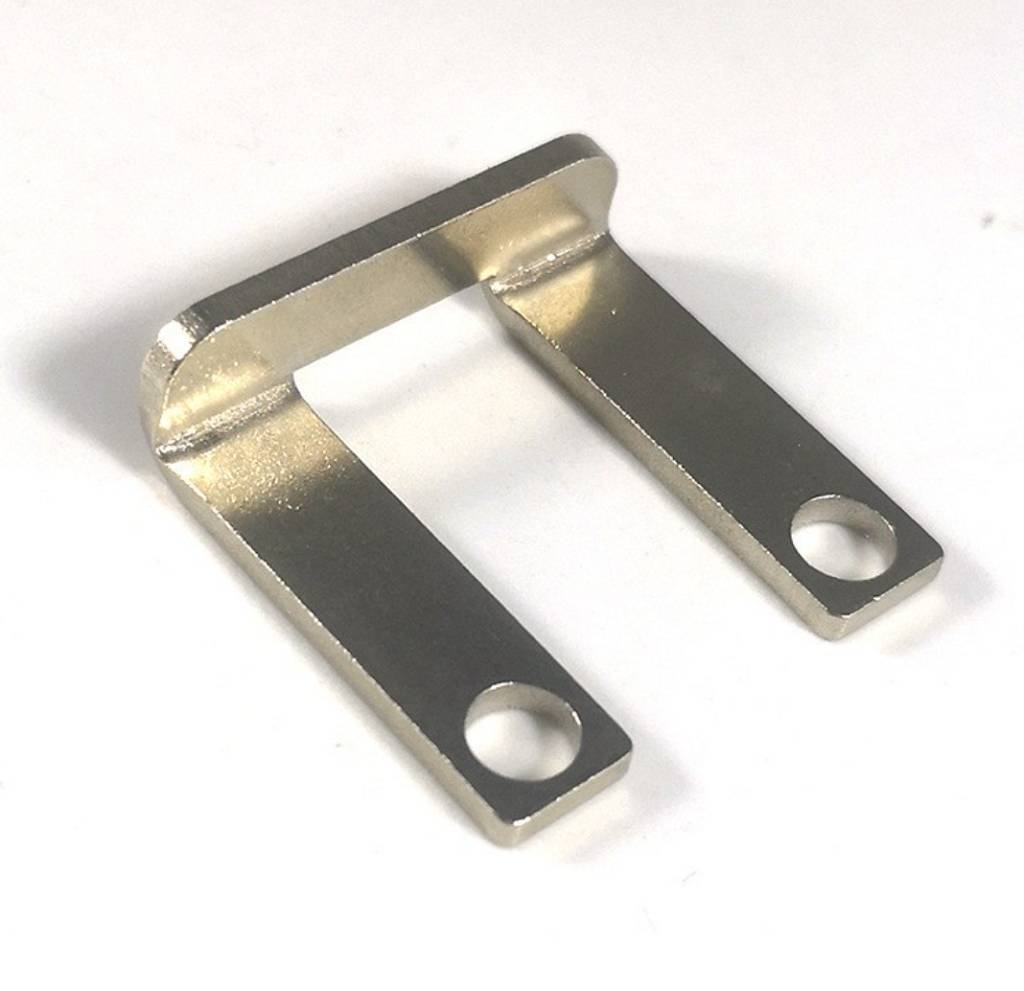
Real Case Study: A European medical device company needed stainless steel (SUS316L) bone plate fixation clips — 0.6mm thick, 4 precision holes, position tolerance ±0.02mm, deburred to below 0.05mm. Annual demand: 25,000 units. We designed a progressive die with fine-blanking stations for clean, burr-free hole edges, followed by tumble deburring and 100% visual inspection under 10x magnification.
Common Materials: Stainless steel (SUS316, SUS316L, SUS304), titanium (Grade 2, Grade 5)
Robotics & Industrial Automation
Robotics systems and industrial automation equipment use hundreds of custom stamped parts for structural frames, actuator brackets, sensor mounts, motor housings, cable management clips, and gear assemblies. These parts typically face:
- Dynamic loads: Repeated mechanical stress and vibration over millions of cycles
- Custom geometries: Every robotics design is unique — parts are almost always custom
- Moderate volumes: Typically 1,000 to 50,000 units/year (much lower than electronics)
- Rapid iteration: Robotics companies frequently update designs as performance improves
How Worthy Serves Robotics Customers:
Our combination of sample stamping (for design validation) and production stamping (for scaling) fits naturally into the robotics development cycle. Customers typically start with small sample batches (50-200 units) to validate fit and function, then move to production tooling once the design is finalized. Our engineers' DFM (Design for Manufacturability) feedback often reduces manufacturing complexity while improving part performance.
Real Case Study: A Japanese robotics company needed an aluminum motor housing — for a collaborative robotic arm joint, requiring lightweight construction while maintaining structural rigidity, tolerance ±0.05mm, annual demand 6,000 units. The initial design revealed a problem at the sample stage: a mounting boss was prone to stress concentration during stamping, risking fatigue cracks under long-term vibration. Our engineers proposed a fillet radius modification that resolved the risk without affecting the assembly function.
Once the design was finalized, we built the production die and have since delivered 12,000 units per quarter with zero design changes required since.
Common Materials: Carbon steel (SPCC), stainless steel (SUS304), aluminum (A5052)
Energy Industry
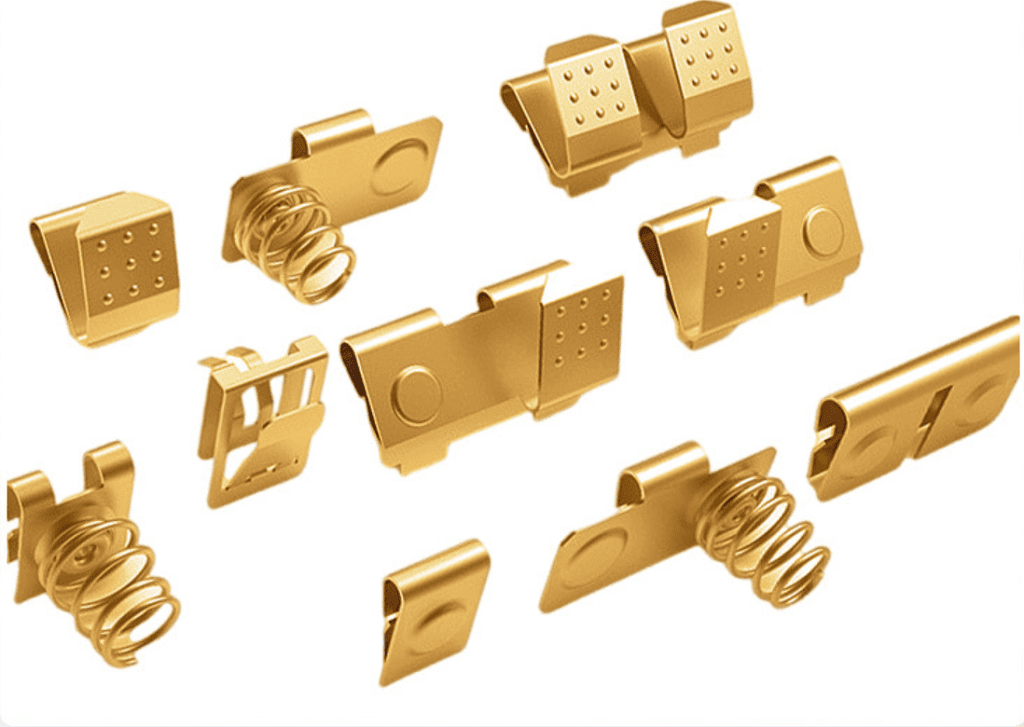
The energy sector — including solar, wind, battery, and power distribution — uses stamped parts to produce busbars, connectors, mounting hardware, junction box components, and battery cell contacts. This is a fast-growing sector with requirements including:
- High-conductivity materials: Copper busbars for power distribution
- Weather resistance: Parts need to perform outdoors for 20+ years
- Scalability: Volumes are ramping up quickly as renewable energy adoption grows
How Worthy Serves Energy Customers:
We stamp copper busbars, aluminum mounting brackets, and stainless steel fasteners for solar inverters, battery management systems, and power distribution equipment. We're capable of processing copper up to 3.0mm thick, and we offer tin or silver plating on contact surfaces — making us well-suited for high-current applications.
Common Materials: Copper (C1100), aluminum (A5052, A6061), stainless steel (SUS304)
Hardware Startups
This is one of our fastest-growing customer segments — and one we take particularly seriously. Hardware startups face a unique challenge: they need production-grade parts to validate their designs, but don't yet have the volume (or budget) to justify traditional production tooling investment. They need:
- No minimum order quantity: Sometimes just 50 or 100 units
- Fast turnaround: Product development cycles are measured in weeks, not months
- Design support: Most startup founders are strong on product vision but don't always have deep manufacturing expertise
- A scalable path — a supplier who can grow with them from prototype, to 10K units, to a million units
How Worthy Serves Hardware Startups:
This is where our business model really shows its value. We offer:
- No-MOQ sample stamping — orders start as low as 50 units for design validation
- Free DFM feedback — our 4 engineers (each with 10+ years of stamping experience) review your design before you commit to tooling, flagging manufacturability, cost, and quality issues upfront
- Bridge tooling — lower-cost soft tooling for initial runs of 1,000-5,000 units, transitioning to hardened production tooling once volume increases
- Seamless scale-up — the same supplier from sample to mass production, with no re-qualification and no learning curve with a new vendor
Real Case Study: A Canadian consumer electronics startup designed a novel cable management clip. They came to us with a 3D model, needing 100 samples for beta user testing. Our engineers reviewed the design and identified two features that would be difficult to produce consistently via stamping, proposing minor adjustments that preserved function while improving manufacturability. We delivered 100 sample clips within 2 weeks. Following positive beta feedback, they placed an order for 5,000 units (bridge tooling), then 50,000 units (production tooling). Total time from first inquiry to mass production: 4 months.
Common Materials: Varies by application — startups we work with have used everything from carbon steel to titanium.
Industries We Serve: Full Overview
| Industry | Common Stamped Parts | Key Requirements | Typical Volume | Primary Materials |
| Automotive | Brackets, terminals, clips, connectors, heat shields | High volume, PPAP, Cpk≥1.33, fast delivery | 100K–2M+/year | Carbon steel, stainless steel, aluminum |
| Aerospace & Defense | Structural clips, shields, brackets | ±0.025mm tolerance, full traceability, 100% inspection | 1K–50K/year | Titanium, alloy steel, 17-4PH |
| Electronics | Connectors, EMI shields, contacts, pins, terminals | Miniaturization, massive volume, high conductivity | 500K–50M+/year | Copper, brass, phosphor bronze |
| Medical & Dental | Surgical components, implants, housings | Biocompatibility, ±0.02mm tolerance, full documentation | 5K–100K/year | SUS316, titanium |
| Robotics & Industrial Automation | Motor housings, sensor mounts, actuator brackets | Custom geometry, vibration resistance, rapid iteration | 1K–50K/year | SUS304, SPCC, aluminum |
| Energy | Busbars, connectors, mounting hardware | High conductivity, weather resistance, scalability | 10K–500K/year | Copper, aluminum, stainless steel |
| Hardware Startups | Sample parts, first production batches | No MOQ, fast delivery, design support, scalability | 50–50K (growing) | All materials |
Don't See Your Industry Here?
Even if your specific application isn't detailed above, metal stamping is very likely still a fit for your needs. We've also completed projects for customers in:
- Lighting — reflectors, heat sinks, mounting brackets
- Consumer Products — appliance components, furniture hardware, decorative fittings
- Education — lab equipment components, research prototypes
- Supply Chain & Purchasing — we support procurement teams sourcing stamped components for multi-vendor assembly projects
The common thread across all these industries: if you need a custom metal part made precisely, consistently, and cost-effectively — whether the quantity is 50 pieces or 5 million — metal stamping is very likely the right process, and Worthy has the capability to deliver it.
What Our Customers Say
"We've worked with Worthy on automotive bracket programs for over two years now. What's stood out most is that their engineers proactively flag potential quality risks before they become problems, rather than reacting after the fact. That kind of communication has saved us from a couple of potential line stoppages." — Procurement Manager, North American Automotive Parts Trading Company
"As a small hardware startup, we worried our order volume was too small for anyone to take us seriously. But Worthy's engineers spent real time helping us improve our design, and sample turnaround was fast. From 100 sample units to 50,000 in production, we never had to switch contacts — that consistency mattered a lot to us." — Founder, Canadian Consumer Electronics Startup
(All testimonials shared with customer permission and anonymized to protect business confidentiality. More detailed project communication records available upon request for verification.)
How We Address Common Procurement Pain Points
Talking with procurement managers over the years, we've noticed the biggest worry usually isn't "can this be made" — it's these specific concerns:
Inefficient communication: Many suppliers' sales reps have limited technical knowledge and need to relay questions back and forth to engineering before responding. Our approach is to have engineers directly involved in customer communication, so technical questions get answered on the spot — no waiting for information to filter through layers.
Delayed shipments missing peak sales seasons: We use electronic press monitoring and progress tracking so customers can check real production status at any time, instead of discovering a delay right before the deadline.
Finding out about quality issues after a long wait: We stick to 100% inspection rather than sampling, so problems get caught before shipment — not after the customer receives a batch with defects.
If any of these pain points sound familiar, we're glad to talk through your specific project directly and address your concerns head-on.
Get in Touch
Don't see your exact application listed here? Send us your requirements at [email protected] and our team will evaluate feasibility and respond within 24 hours.
You can also visit www.worthyhardware.com directly to learn more about our facility capabilities, certifications, and past project case studies.
About the Author: Sandra Gao is the Sales Manager at Worthy Hardware, where she coordinates technical communication and order execution between the engineering team and overseas customers. She has extensive cross-industry experience supporting hundreds of clients across North America, Europe, Japan, and Southeast Asia in precision metal stamping projects.