
What Factors Should I Consider When Choosing Between Progressive Die and Transfer Die Stamping?
Choosing the wrong stamping process can skyrocket costs and delay your project. You need to pick the right method from the start. I'll show you how to choose wisely.
Consider your production volume, part complexity, and budget. Progressive die stamping is best for high-volume, complex parts where its speed justifies the high initial tool cost. Transfer die stamping offers more flexibility and lower tool costs, making it ideal for lower volumes or larger parts.
Making the right choice between these two powerful manufacturing methods is critical for your project's success. As someone who has managed thousands of stamping projects, I've seen how this decision impacts everything from the per-part price to the delivery schedule. It's not just about which process is "better," but which is better for your specific needs. Let's dive into the details so you can feel confident in your decision and communicate your requirements clearly to your supplier.
What is the difference between progressive dies and transfer dies?
Are you confused by stamping terminology? This confusion can lead to ordering the wrong service. Let's clarify the key difference between these two important die types to ensure you get what you need.
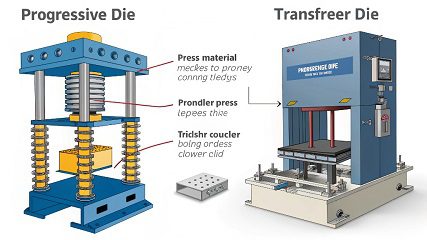
A progressive die performs multiple operations at different stations on a part that stays attached to a metal strip. In contrast, a transfer die cuts the part from the strip first, then uses mechanical "fingers" to move the individual part between stations for further operations.
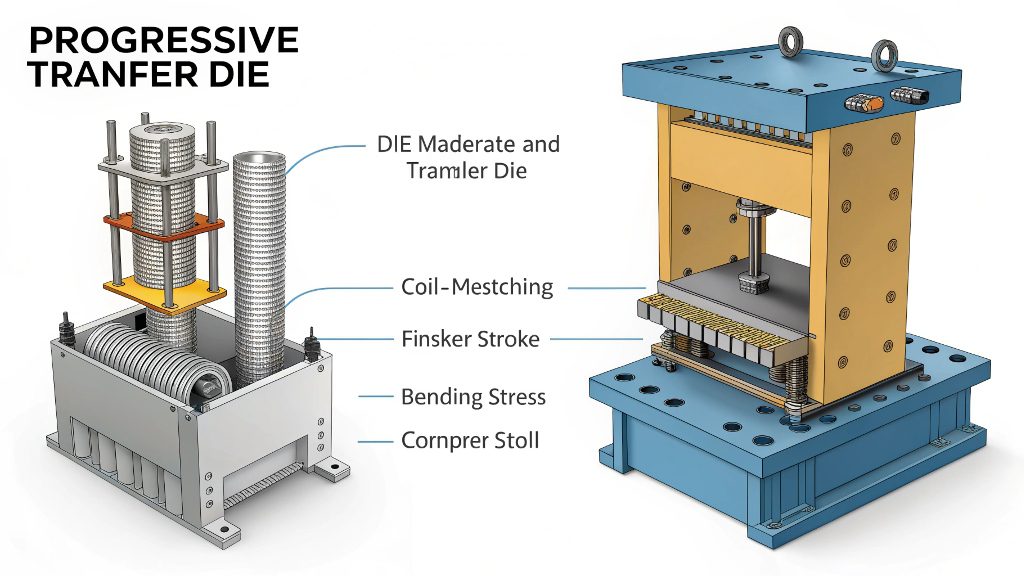
Let's break this down further. Think of a progressive die as an assembly line within a single tool. A coil of raw material is fed into one end of the press. With each stroke of the press, the metal strip "progresses" or moves a set distance to the next station. At each station, a specific action happens—punching, coining, bending—until a finished part emerges at the end, still attached to the carrier strip. It’s an incredibly fast and contained process.
A transfer die works differently. It often starts with a blank that is already cut out, or the first station cuts it. Then, instead of being carried by the material strip, the part is physically picked up and moved to the next operation by a transfer mechanism. This process is slower but allows for more complex operations, like deep drawing or forming features on all sides of the part, which would be impossible if it were still attached to a strip.
What are the disadvantages of progressive die stamping?
Thinking progressive die stamping is always the best choice? The high upfront cost can be a huge shock. Let's look at the downsides so you can avoid making a costly mistake.
The main disadvantages are the very high initial tooling costs and the potential for significant material waste. The complex tool is expensive to build, and design changes after production begins are difficult and costly.
The biggest hurdle for my clients is always the tooling cost. A progressive die is a marvel of engineering, but it is not cheap. It combines many different operations into one die set, which requires incredible precision and a lot of development time. For a customer like Mark in Canada, who is very cost-sensitive, this initial investment of tens of thousands of dollars only makes sense if he plans to produce hundreds of thousands or even millions of parts. For smaller runs, the cost is simply too high.
Another key factor is material waste. The part is carried through the die on a metal strip, and this carrier strip becomes scrap, often called a "skeleton." Depending on the part's shape, this can lead to a lot of wasted material, which adds to the overall cost. Finally, these tools are not flexible. Once the die is built, making even a small design change can be very expensive and time-consuming, sometimes requiring a completely new tool. This lack of flexibility is a major drawback if your product design is not yet finalized.
What are the advantages of progressive stamping?
Do you need millions of identical parts quickly and affordably? Manual processes are too slow and inconsistent. Progressive die stamping offers incredible speed and consistency, making mass production very efficient.
Its main advantages are high-speed production, excellent part-to-part repeatability, and a very low per-part cost at high volumes. Once running, the process needs minimal labor, which guarantees consistency and rapid output.
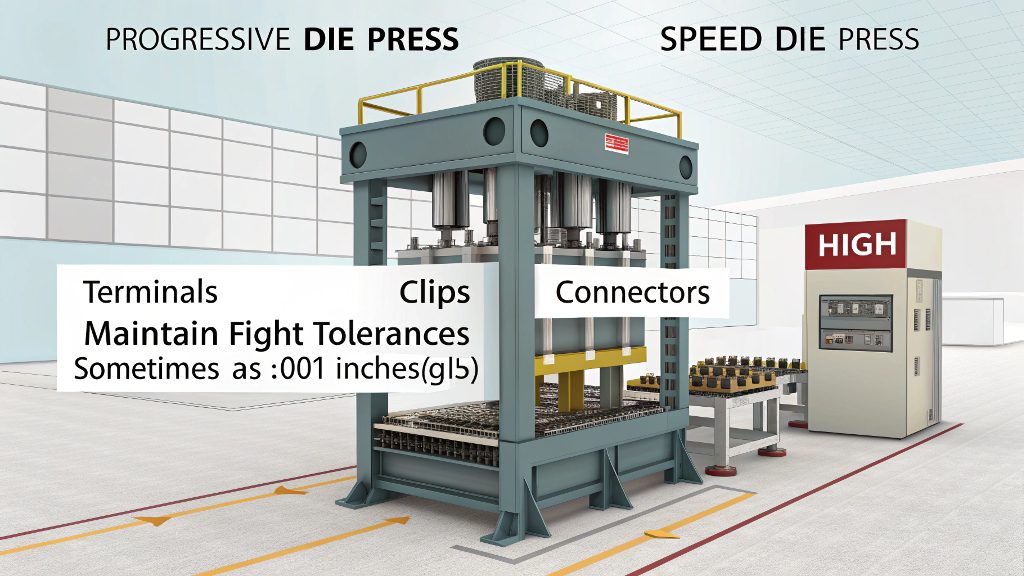
The primary advantage is speed. A progressive die press can run at hundreds of strokes per minute, producing finished parts with every single stroke. This is how we can manufacture millions of parts like terminals, clips, and connectors so quickly. For my customers in the automotive or electronics industries, this high-speed output is essential to keep their assembly lines moving.
This speed also leads to incredible consistency. Because the part is held securely in the material strip and every operation is fixed within the die, the variation from one part to the next is almost zero. We can hold extremely tight tolerances, sometimes as fine as .001" (.025mm). This repeatability is crucial for high-tech applications where every part must fit and function perfectly. When you have a massive order, this process ensures every single piece is a perfect copy of the last, and the low labor involvement keeps the per-part price down, which is a huge benefit for high-volume purchasing.
What is the difference between a progressive die, a compound die, and a combination die?
The world of die stamping has many confusing terms. Misunderstanding them can lead to production issues and quoting errors. Let's clear up the confusion between these three common die types.
A progressive die performs sequential operations along a moving strip. A compound die performs multiple cutting operations in a single press stroke. A combination die performs both cutting and non-cutting (forming) operations in one stroke.
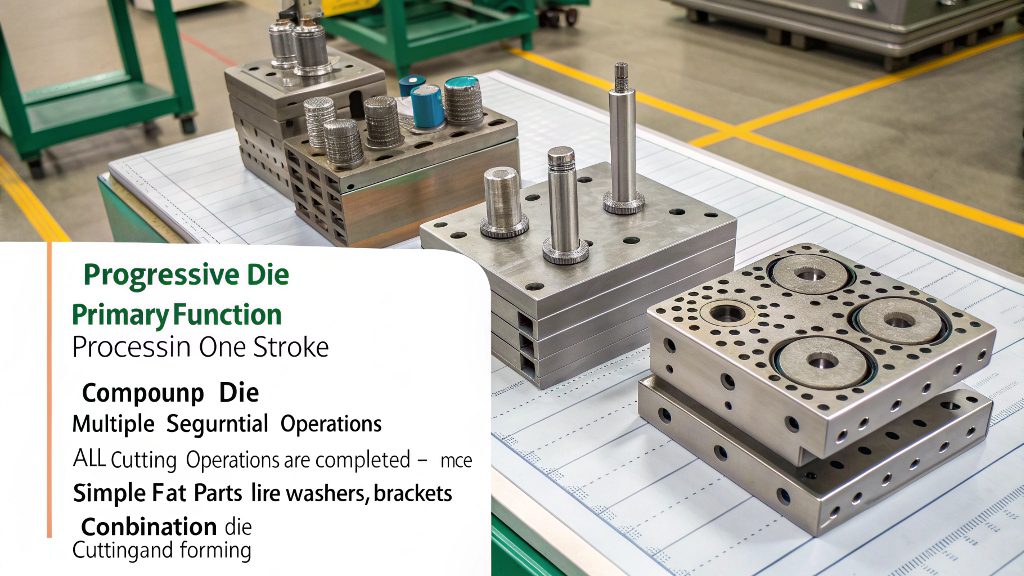
I often have to explain these differences to help customers choose the right tool for their part. Let's use a simple comparison to make it clear.
| Die Type | Primary Function | Process in One Stroke | Best For |
|---|---|---|---|
| Progressive Die | Multiple sequential operations | A single operation at one station (but many stations operate at once) | Complex parts in high volumes (e.g., connectors, brackets) |
| Compound Die | Multiple cuts on a single plane | All cutting operations are completed at once | Simple, flat parts like washers, where flatness is critical |
| Combination Die | Cutting and Forming | Performs both cutting (e.g., blanking) and forming (e.g., bending) | Simple parts that need one cut and one forming step |
A progressive die is like a factory assembly line. The part moves from station to station to get built. A compound die is for simple, flat parts where all the hole punching and outer-profile cutting needs to happen at the exact same moment to ensure perfect alignment and flatness. A combination die is a step up, doing a cut and a form in one hit—for example, blanking out a circle and then pressing it into a cup shape, all in one press stroke.
Conclusion
In short, choose progressive dies for high-volume, complex parts. For lower volumes, larger parts, or deep draws, a transfer die is often the more cost-effective and flexible manufacturing solution.