
What Are The Common Problems In Thread Manufacturing And How To Solve Them?

Struggling with bad threads in your machined parts? These frustrating errors can stop your assembly line. I'll show you how to identify and solve these common manufacturing issues.
Common problems include incorrect sizing, damaged threads, insufficient depth, and poor cleanliness. Solving them involves precise tool selection, correct machine parameters, rigorous inspection with gauges, and thorough cleaning processes. This ensures reliable and functional threads for every part.
Getting threads right is a core part of precision machining. For my clients like Mark from Canada, a perfect thread means a smooth assembly process and a reliable final product. But small mistakes can happen, leading to big problems. It's crucial to understand why these issues occur and how a good supplier like us at Worthy Hardware prevents them. Let's start from the beginning and look at how threads are actually made.
What is the manufacturing process of thread?
Confused about how threads are actually made? The process seems complex and full of jargon. Let me simplify the key steps in thread manufacturing for you.
Thread manufacturing involves either forming or cutting. Forming displaces material to create the thread shape, which is strong. Cutting removes material using taps or dies. Both methods require drilling a pilot hole first, followed by the threading operation and then a quality check.

The journey of creating a perfect thread is a precise, multi-step process. It's not just about drilling a hole and forcing a screw in. At Worthy, we follow a strict procedure. First, we analyze your design to understand the material and thread specification (e.g., M6x1.0). This determines the tools and machine settings we need. The next step is drilling a pilot hole. The diameter of this hole is absolutely critical. If it’s too small, the tapping tool can break; if it’s too large, the threads won’t be deep enough and will be weak. Then comes the actual threading, which we do by cutting or forming.
Thread Cutting vs. Thread Forming
These are the two main ways to create threads.
| Feature | Thread Cutting | Thread Forming |
|---|---|---|
| Process | Removes material with a sharp tool (tap) | Displaces and molds material (form tap) |
| Strength | Standard strength | Stronger due to work-hardening |
| Chips | Produces chips that must be cleared | Chipless, making it cleaner |
| Best For | Most materials, including hard or brittle ones | Ductile materials like aluminum, soft steels |
After threading, we perform a thorough cleaning and a 100% inspection to guarantee quality.
What is most commonly used to produce internal threads?
Need to create threads inside a hole? Wondering what the industry standard tool is? I'll explain the most common and reliable method for making internal threads.
Tapping is the most common method for producing internal threads. A tool called a "tap" is used to cut or form the threads inside a pre-drilled hole. This can be done by hand for simple jobs or on a CNC machine for high precision and volume production.

The main tool for creating internal threads is called a tap. Think of it as a very hard screw with cutting edges. While you can tap a hole by hand, it’s a slow process that requires a lot of skill to keep the tap perfectly straight. For all our B2B customers who need precision and consistency, we rely on CNC tapping.
Hand Tapping vs. CNC Tapping
Using a CNC machine gives us complete control. The machine rotates and advances the tap at a perfectly synchronized rate. This precision is impossible to achieve by hand. It guarantees that every thread on every part is identical, straight, and meets the exact drawing specifications. This is especially important for our high-volume CNC machining services, where consistency is key.
Types of Taps
We don't just use one type of tap. The right choice depends on the material and the hole type.
- Spiral Point Taps: These are workhorses for "through-holes" (holes that go all the way through the part). They push the metal chips forward and out of the way.
- Spiral Flute Taps: These are essential for "blind holes" (holes that don't go all the way through). The spiral shape acts like a drill bit, pulling chips up and out of the hole. Using the wrong tap in a blind hole can trap chips, breaking the tool and ruining the part.
How to ensure a good quality thread is cut?
Worried about receiving parts with faulty threads? Poor quality can cause major assembly issues. I’ll share my key strategies for ensuring every single thread is perfect.
To ensure good quality, you must control the entire process. This means using the correct pilot drill size, selecting the right type of tap for the material, using proper cutting speeds and lubrication, and performing rigorous inspections with go/no-go gauges after threading.

Over the years, I've seen all the common thread problems. This experience has helped us at Worthy Hardware build a system to prevent them. It’s about paying attention to the details at every step. My customers can't afford delays because of a bad thread, so we make sure it never happens. We address each potential issue with a specific solution. For instance, a shallow or flat thread is often due to a worn-out tool, so we have strict tool life management. A rusty thread is unacceptable, so we apply appropriate protective oils after cleaning, especially for materials like steel. Here is how we solve the most common problems I see in the industry:
| Common Problem | My Solution at Worthy Hardware |
|---|---|
| Stripped/Damaged Threads | We use sharp, high-quality taps and ensure the CNC machine's feed rate matches the thread pitch perfectly. This prevents tearing. |
| *Hole Too Small | The pilot hole is critical. We use precision drills and follow strict charts to ensure the hole size is perfect before tapping. |
| Hole Too Large | This happens from an oversized pilot hole. Our strict process controls and pre-tap verification prevent this error from ever occurring. |
| Insufficient Depth | We program our CNC machines to the exact depth on your drawing. We then physically measure it to confirm it's correct. |
| Slanted Threads | Our CNC machines ensure perfect 90-degree alignment between the tool and the part, guaranteeing a straight thread every time. |
| Dirty Threads | After machining, every threaded hole is cleaned with compressed air and inspected to be free of chips and fluids. This is standard. |
| No Chamfer | A chamfer (a small bevel) helps guide the screw. We add a chamfer to every thread opening by default to ensure easy assembly. |
What equipment and tools are required for accurately inspecting and verifying the correct manufacturing of thread sizes?
How can you be sure a thread is made correctly? Visual checks aren't enough for precision parts. I'll show you the essential tools we use for accurate thread inspection.
The most critical tools are thread plug gauges, specifically "Go" and "No-Go" gauges. The "Go" gauge must screw in completely, and the "No-Go" gauge must not. For external threads, thread ring gauges are used. Calipers and depth micrometers also verify hole and thread depth.
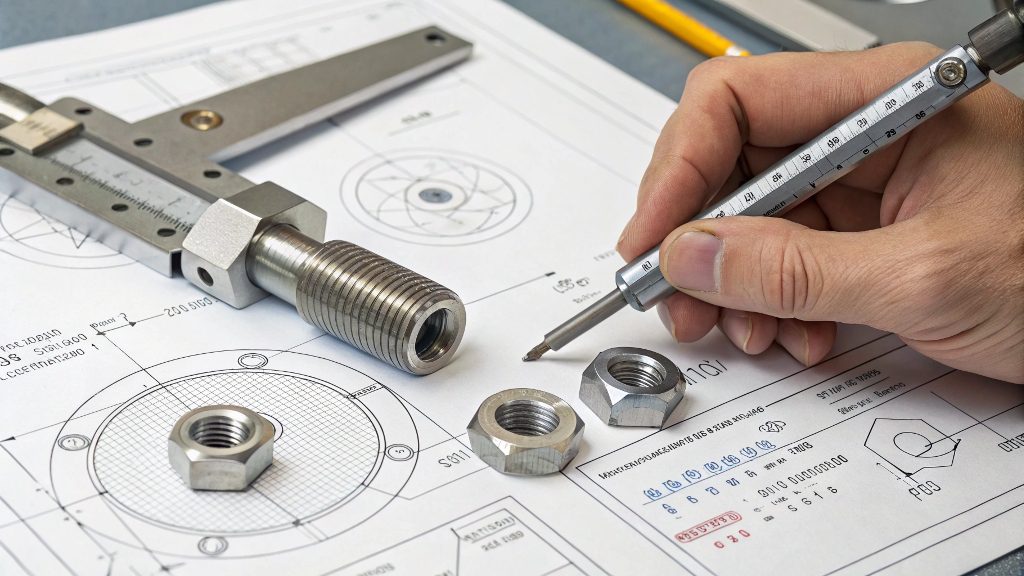
Inspection is the final and most important guarantee of quality. At Worthy Hardware, every part undergoes a 100% inspection, and that includes every single thread. We don't just assume it's right because the machine made it; we verify it with precise tools.
The Essential Go/No-Go Gauges
This is our primary inspection method. For every thread size we machine, we have a dedicated, certified plug gauge. It has two sides:
- Go Gauge: This side has a longer thread. It must screw smoothly into the hole for the entire length of the thread. This confirms the minimum pitch diameter is correct and the thread is not undersized or obstructed.
- No-Go Gauge: This side has only a few short threads. It should not screw in more than one or two turns. This confirms the thread is not oversized. If the No-Go gauge goes all the way in, the part is rejected immediately. There are no exceptions.
Measuring Depth and Diameter
Our inspection process starts even before tapping. We use digital calipers to verify the pilot hole diameter is within tolerance. After tapping, we use the depth rod on a caliper or a specialized depth micrometer to measure the usable thread depth, ensuring it meets the specification on your engineering drawing.
Conclusion
Perfect threads require correct processes and strict inspection. Understanding common problems and using the right tools ensures every part fits and functions exactly as designed, every single time.