
What Are The Best 3D Printing Materials For Functional Prototypes In Manufacturing?

Struggling to pick a 3D printing material for prototypes that actually work? Choosing poorly leads to weak parts and wasted money. Let's look at the top materials for functional testing.
For functional prototypes, Nylon (PA) is often best due to its strength, durability, and flexibility. Other strong choices include ABS for toughness and PETG for ease of printing and chemical resistance. PLA is great for visual models.
Choosing the right material is just the start. You need to understand why certain materials work best for specific needs. Let's break down the common questions engineers and designers, maybe like my client Mark Chen in Canada, ask about functional prototyping materials. We'll explore the details together.
What is the best material for functional parts 3D print?
Need 3D printed parts that can handle real stress, not just sit on a shelf? Weak materials mean failed tests and frustration. Let's pinpoint the best options for functional performance.
Nylon (Polyamide) is frequently the top choice for functional 3D printed parts. Its excellent mechanical strength, wear resistance, and flexibility make it ideal for gears, living hinges, and snap-fit components requiring durability under stress.
Nylon really shines when your prototype needs to do more than just represent the final shape. It needs to perform a task, withstand forces, or connect with other parts reliably.
Why Nylon Stands Out
Nylon's unique combination of properties makes it so useful. It's strong, meaning it can take a load without breaking easily. It's also somewhat flexible, so it can bend slightly under stress and return to its shape, which is great for things like snap-fit enclosures or clips.
Its excellent wear resistance means parts like gears or sliding components last longer, even in prototype testing. Many Nylon variants also resist chemicals and heat well, adding to their versatility. In my work helping clients prepare for CNC machining, I often see Nylon prototypes used for rigorous testing before committing to metal parts.
Comparing Nylon to Other Functional Materials
While Nylon is great, it's not the only option. How does it stack up?
| Feature | Nylon (PA) | ABS | PETG |
|---|---|---|---|
| Strength | Very Good | Good | Good |
| Flexibility | Good | Moderate | Moderate |
| Durability | Excellent | Good | Good |
| Temp Resistance | Good to Excellent | Moderate | Moderate |
| Ease of Printing | Moderate | Moderate | Easy |
| Wear Resistance | Excellent | Fair | Fair |
ABS is tough and impact-resistant but can be brittle compared to Nylon's fatigue resistance. PETG is easier to print and has good chemical resistance, but typically isn't as strong or wear-resistant as Nylon.
Considerations for Using Nylon
Nylon isn't perfect. Its main drawback is that it absorbs moisture from the air (hygroscopic). This can change its properties and make it harder to print consistently. You need to store it properly (dry box) and sometimes dry it before printing.
It also requires higher printing temperatures than PLA or PETG and can warp, often needing a heated bed and an enclosed printer for best results. Despite these challenges, for truly functional, durable prototypes, Nylon is often worth the extra effort.
What materials are used in 3D printing prototypes?
Feeling lost in the sea of 3D printing material options for prototypes? Choosing without guidance means wasted effort on unsuitable models. Let's review the most frequently used prototyping materials.
A wide range is used for 3D printing prototypes. Common choices include PLA for quick visual models, ABS for toughness, PETG for balance, Nylon for function, TPU for flexibility, and various resins (SLA/DLP) for high detail.
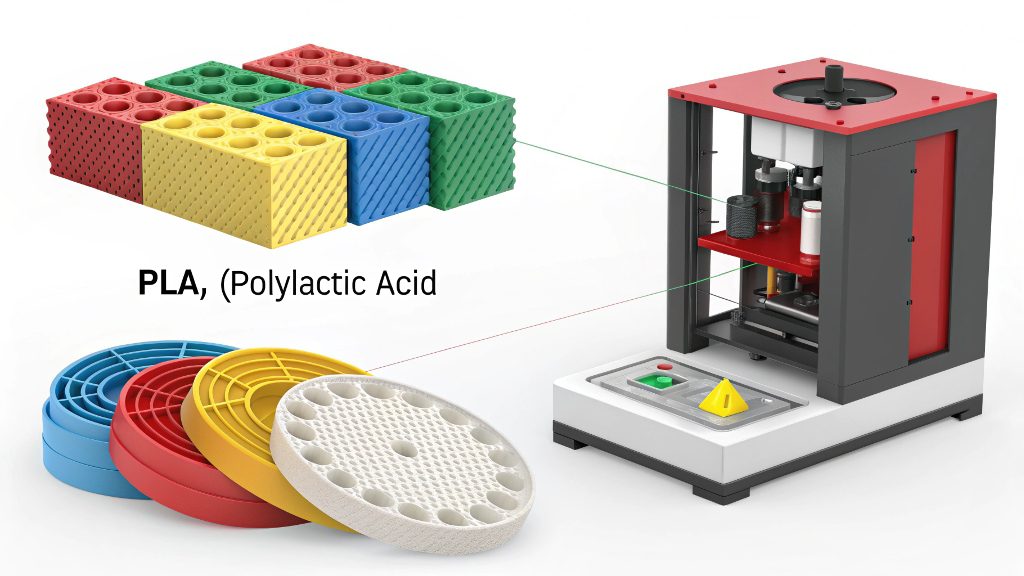
The specific material choice depends heavily on what the prototype is for. Is it just to see the shape? Does it need to test a mechanism? Or check a precise fit? Different materials suit different stages and goals.
Common Thermoplastics for Prototyping (FDM/FFF)
These are the filaments used in the most common type of desktop 3D printers.
-
PLA (Polylactic Acid): This is often the starting point. It's easy to print, relatively cheap, comes in many colors, and produces good visual detail. It's great for quickly checking the form and size of a design. However, it's brittle and softens at low temperatures, making it unsuitable for most functional tests.
-
ABS (Acrylonitrile Butadiene Styrene): LEGO bricks are made from ABS, which tells you about its toughness and impact resistance. It handles higher temperatures than PLA. It's a good choice for early functional prototypes that need to withstand some handling or basic mechanical stress. The downside is that it's harder to print (needs a heated bed, often an enclosure to prevent warping) and emits fumes.
-
PETG (Polyethylene Terephthalate Glycol): This material strikes a nice balance. It's almost as easy to print as PLA but significantly stronger, more durable, and more heat/chemical resistant. Some grades are even food-safe. It's a versatile choice for both visual models and many functional prototypes where Nylon might be overkill.
-
Nylon (Polyamide): As we discussed, this is the go-to for demanding functional prototypes needing strength, flexibility, and durability.
-
TPU (Thermoplastic Polyurethane): This is a flexible, rubber-like material. If you need to prototype gaskets, seals, flexible joints, or vibration dampeners, TPU is the filament to use. It can be tricky to print, requiring slower speeds.
Photopolymer Resins (SLA/DLP/LCD)
These liquid materials are used in printers that cure the resin with light.
-
Standard Resins: Produce very high-detail parts with smooth surfaces. Excellent for visual prototypes where aesthetics and fine features matter most, like display models or checking intricate designs. Often brittle.
-
Tough/Durable Resins: Formulated to mimic the mechanical properties of plastics like ABS or PEEK. Better for functional prototypes needing impact resistance or higher strength than standard resins, especially for fit testing.
-
Flexible/Elastic Resins: Similar to TPU, these create rubbery parts for prototyping seals, gaskets, or soft-touch elements.
Choosing Based on Prototype Goal
Understanding the purpose of your prototype is key.
| Material Category | Best For Prototype Type | Notes |
|---|---|---|
| PLA | Visual, Concept Models, Quick Form Check | Easy, cheap, fast, but low strength/temp res. |
| PETG | Form/Fit Testing, Some Functional (Moderate Load) | Good balance of ease and properties. |
| ABS | Functional (Impact Resistance), Temp Resistance | Tougher, but harder to print than PETG/PLA. |
| Nylon | Functional (High Stress, Wear Resistance) | Strongest common filament, needs care printing. |
| TPU / Flex Resin | Flexible Parts, Gaskets, Grips | Simulates rubber. |
| Standard Resin | High-Detail Visual, Smooth Surface, Fit Check | Best aesthetics, often brittle. |
| Tough Resin | Functional (Fit, Impact), Mimic Production Mats | Stronger resin option. |
We often see clients start with PLA or PETG for initial checks, then move to Nylon or Tough Resins for functional tests before finalizing designs for CNC machining with us at Worthy Hardware.
What is the best 3D filament for prototyping?
Focusing on filament printing (FDM) for your prototypes? Using the wrong type can be costly or simply overkill for the job. Let's find the most practical filament for prototyping needs.
PLA is often considered the best overall filament for early-stage prototyping due to its ease of use, low cost, and speed. For prototypes needing better strength or heat resistance, PETG offers a great balance without ABS's printing difficulty.
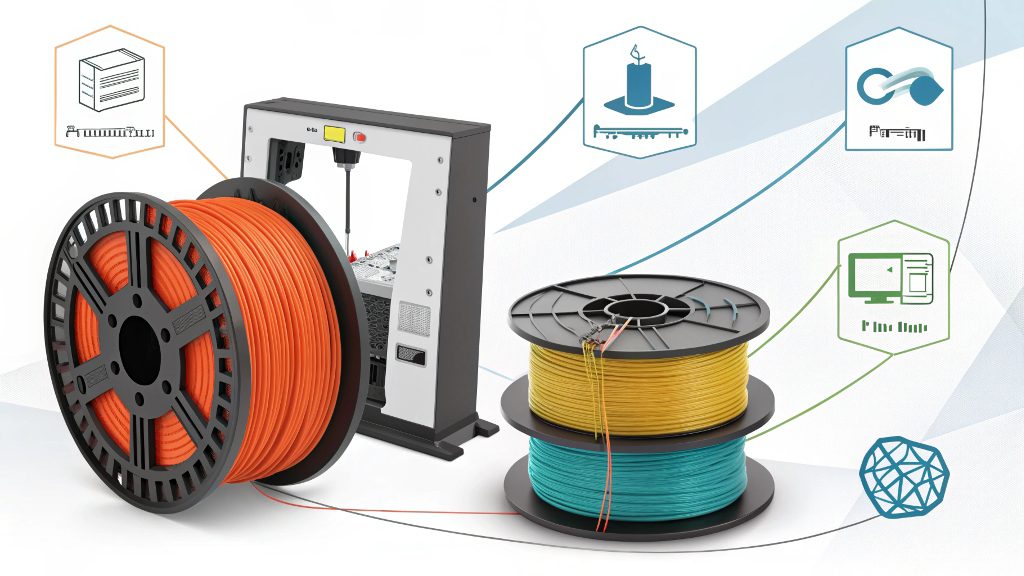
When we talk about filament, we're usually dealing with FDM (Fused Deposition Modeling) printers, the most common type found in workshops and design labs. Choosing the best filament depends entirely on what stage of prototyping you are in and what you need the prototype to do.
PLA: The Go-To for Early Stages
I almost always recommend starting with PLA if you're just getting into 3D printing for prototypes.
-
Pros: It's incredibly easy to print successfully on almost any FDM printer, often without a heated bed. It prints relatively quickly, is one of the cheapest filaments available, and comes in a huge variety of colors. It produces parts with good detail and surface finish (for FDM). It's perfect for quickly getting a physical model in your hands to check size, shape, and basic assembly (form/fit).
-
Cons: Its main weaknesses are mechanical. It's brittle, meaning it snaps rather than bends under stress. It also has a low glass transition temperature (around 60°C), so it will soften and deform in warm environments (like inside a car on a sunny day) or under any significant load. It's not suitable for parts that need to bear weight, resist impacts, or handle heat.
PETG: The Balanced All-Rounder
If PLA isn't strong enough, but you want to avoid the challenges of ABS, PETG is often the next step.
-
Pros: It's significantly stronger and more durable than PLA, with better heat resistance and good chemical resistance. It's less brittle, offering some impact resistance. It doesn't warp as badly as ABS, making it easier to print, though it usually requires a heated bed. It adheres well between layers, creating strong parts.
-
Cons: It can sometimes be 'stringy' during printing, leaving fine threads of plastic that need cleanup. It typically requires higher printing temperatures than PLA. It absorbs moisture more readily than PLA (though less than Nylon), so storage matters.
ABS: When Toughness Matters More
Before PETG became popular, ABS was the standard choice for stronger FDM prints.
-
Pros: It's known for its toughness, impact resistance, and higher temperature resistance compared to PLA/PETG. It can also be chemically smoothed using acetone vapor for a glossy finish, which can be useful for certain prototypes.
-
Cons: It's notoriously difficult to print. It requires a heated bed (often 100°C or higher) and usually an enclosed print chamber to maintain a warm ambient temperature and prevent warping and layer splitting. It also releases noticeable fumes during printing, requiring good ventilation.
Nylon: For Demanding Functional Prototypes (Filament Form)
When functional performance is paramount, Nylon filament is a top contender.
-
Pros: Excellent strength, flexibility, durability, and wear resistance, making it suitable for gears, living hinges, and parts under constant stress.
-
Cons: Very hygroscopic (must be kept dry), requires high extrusion temperatures (often 250°C+), needs a heated bed, and usually benefits from an enclosure. Can be one of the more challenging filaments to print successfully.
Decision Factors for Filament Choice
| Filament | Primary Prototyping Use | Ease of Printing | Relative Cost | Key Benefit |
|---|---|---|---|---|
| PLA | Visual, Form/Fit (Early) | Very Easy | Low | Speed, Ease, Cost |
| PETG | Form/Fit (Later), Functional (Moderate Load) | Easy | Low-Medium | Balanced Properties, Ease |
| ABS | Functional (Impact/Temp), Fit | Moderate | Low-Medium | Toughness, Temp Resistance |
| Nylon | Functional (High Stress, Wear) | Difficult | Medium-High | Strength, Durability |
For most initial prototyping cycles, PLA and PETG cover a lot of ground efficiently. You only need to move to ABS or Nylon when specific functional requirements demand their properties.
What is the best 3D printer for prototyping?
Thinking about buying a 3D printer just for prototyping work? Choosing the wrong machine wastes money and might not produce useful parts. Let's explore the best printer types for prototyping.
The "best" 3D printer for prototyping depends on your needs. FDM printers offer the best value and material variety for early/functional prototypes. SLA printers excel at high-detail, smooth-surface prototypes for fit and finish checks. Choose based on budget, required detail, and materials.
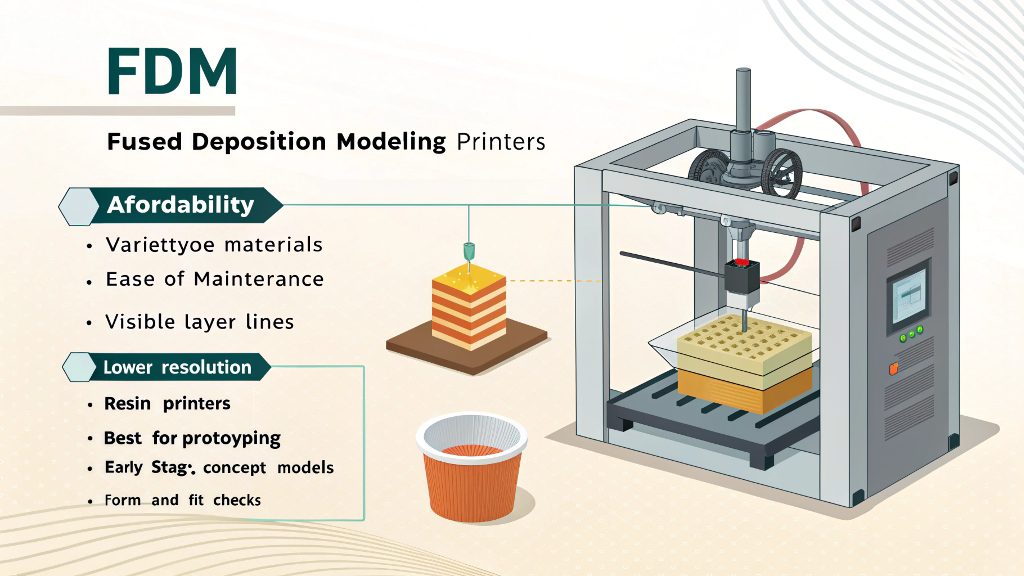
There isn't one single "best" printer; the ideal choice depends heavily on factors like your budget, the level of detail you need, the types of materials you want to use, and the primary purpose of your prototypes. Let's look at the main technologies.
FDM (Fused Deposition Modeling) Printers
These are the most common and generally most affordable type of 3D printer. They work by melting plastic filament and extruding it layer by layer.
-
How it works: Think of a computer-controlled hot glue gun building an object from the bottom up.
-
Pros: Wide range of affordable machines available. Huge variety of filament materials (PLA, PETG, ABS, Nylon, TPU, composites). Can produce relatively large parts cost-effectively. Generally faster for draft-quality prints. Easier maintenance typically.
-
Cons: Visible layer lines affect surface finish. Lower resolution and dimensional accuracy compared to resin printers. Can require tinkering and calibration for best results, especially with challenging materials like ABS or Nylon.
-
Best for Prototyping: Excellent for early-stage concept models, form and fit checks, and many types of functional prototypes where surface perfection isn't the top priority. The material versatility is a major advantage for testing different properties. Many of my clients, like Mark, use FDM for their initial in-house checks.
SLA (Stereolithography) / DLP / LCD Printers
These printers use light (lasers, projectors, or LCD screens) to cure liquid photopolymer resin layer by layer.
-
How it works: A build platform lowers into a vat of resin, and light selectively hardens the resin in the shape of each layer.
-
Pros: Produce parts with exceptional detail, smooth surfaces, and high accuracy. Ideal for complex geometries and intricate features.
-
Cons: Printers and resins are generally more expensive than FDM counterparts. Build volumes are often smaller. Requires post-processing steps: washing parts in solvent (like isopropyl alcohol) to remove uncured resin, and then curing them under UV light to achieve final hardness. Resins can be messy and require careful handling and disposal. Material choice is more limited than FDM, though growing (standard, tough, flexible, castable types).
-
Best for Prototyping: Superb for high-fidelity visual models, checking precise fits and clearances, creating master patterns for casting, and prototypes where surface finish is critical.
SLS (Selective Laser Sintering) Printers
These are high-end industrial machines that use a laser to fuse powdered material (most commonly Nylon) together layer by layer.
-
How it works: A laser selectively melts particles in a bed of powder; the unfused powder supports the part during printing.
-
Pros: Creates strong, durable functional parts, often with properties close to injection-molded parts (especially with Nylon). No need for support structures, allowing complex internal geometries.
-
Cons: Extremely expensive machines and materials. Requires significant space, infrastructure, and safety precautions for powder handling. Post-processing involves cleaning off excess powder. Not typically an in-house solution for smaller companies or design teams.
-
Best for Prototyping: High-performance functional prototypes, especially those needing the strength and durability of Nylon. Also used for short-run manufacturing. Most companies access SLS technology through service bureaus rather than buying a machine.
Key Factors When Choosing
Consider:
-
Budget: FDM is the most accessible, SLA/DLP is mid-range, SLS is high-end.
-
Detail/Accuracy: SLA/DLP offers the highest resolution and smoothest finish.
-
Materials: FDM has the widest range of common thermoplastics. SLA offers specialized resins. SLS excels with Nylon powder.
-
Purpose: Visual models? FDM or SLA. Functional tests? FDM (PLA/PETG/ABS/Nylon) or SLS (Nylon) or Tough SLA Resins.
-
Ease of Use: FDM can require tuning. SLA involves messy post-processing.
For many prototyping needs, a good quality FDM printer offers the best versatility and value to start. If high detail is paramount, an SLA printer is the better choice.
Conclusion
Choosing the right 3D printing material and printer depends on your prototype's goal. Nylon excels for function, while PLA and PETG offer great value for general prototyping needs.