
What Are the Shear Stress Differences Between Common Metals in Manufacturing?

Choosing the wrong metal can lead to part failure under load. This costs time and money. Understanding shear stress helps you select the right material for durable, reliable parts.
Shear stress varies greatly between metals. Generally, steels have much higher shear strength than aluminum. For many metals, like steel and aluminum, the shear strength is roughly half to two-thirds of their tensile yield strength.
Selecting the right material is critical for any manufacturing project, especially when dealing with forces that can cause parts to fail. Shear stress is one such force, and it behaves differently depending on the metal used. Knowing these differences is key to designing components that last. Let's explore this topic further to help you make informed decisions for your CNC machined parts.
What metal has the highest shear strength?
Need ultimate strength for your parts? Choosing a metal with low shear resistance risks immediate failure under load. Learn which metals offer top performance for demanding applications.
Generally, alloy steels and titanium alloys have the highest shear strengths among common engineering metals. Their resistance significantly surpasses that of aluminum alloys or basic carbon steels, making them ideal for high-stress uses.
When we talk about high shear strength, several materials come to mind, especially in the context of parts we machine here at Worthy Hardware.
Understanding High Shear Strength Materials
-
Alloy Steels: These are iron-based metals mixed with other elements like chromium, nickel, molybdenum, or vanadium. These additions significantly increase hardness and strength, including shear strength. Heat treatment processes, like quenching and tempering, can further enhance these properties dramatically. Think about high-strength bolts or gears – they often rely on alloy steels.
-
Titanium Alloys: Titanium is known for its excellent strength-to-weight ratio. While not always as strong as the absolute strongest steels, its alloys (like Ti-6Al-4V) offer impressive shear strength combined with lower density and excellent corrosion resistance. This makes them perfect for aerospace components or high-performance automotive parts where weight saving is crucial.
-
Stainless Steels: Certain types, particularly precipitation-hardening grades (like 17-4 PH), can achieve very high shear strength after heat treatment, while also providing corrosion resistance.
-
Other Metals: While less common for general machining due to cost or difficulty, materials like tungsten or certain superalloys (e.g., Inconel) possess extremely high shear strength, often used in very specialized, high-temperature applications.
Here's a simplified comparison of typical ultimate shear strength ranges (values can vary greatly based on specific alloy and treatment):
| Material Group | Typical Ultimate Shear Strength (MPa) | Notes |
|---|---|---|
| Aluminum Alloys | 100 - 300 | Lightweight, good corrosion resist. |
| Carbon Steels (Low) | 250 - 400 | Common, economical |
| Alloy Steels | 500 - 1000+ | High strength, requires heat treat |
| Stainless Steels | 400 - 900+ | Corrosion resistant, some are strong |
| Titanium Alloys | 550 - 800+ | High strength-to-weight ratio |
Choosing the "highest" depends on the specific requirements of your application, including other factors like cost, weight, corrosion resistance, and manufacturability. We can help guide you based on your design needs.
What are the different types of stress in metallurgy?
Confused by engineering terms like tensile, compressive, or shear? Misunderstanding these basic stress types can lead to fundamental design flaws and part failures. Let's clarify these forces.
Metallurgy mainly considers five stress types: tensile (pulling apart), compressive (squeezing together), shear (sliding past), torsional (twisting), and bending (a mix of tension and compression). Each impacts material choice and design.
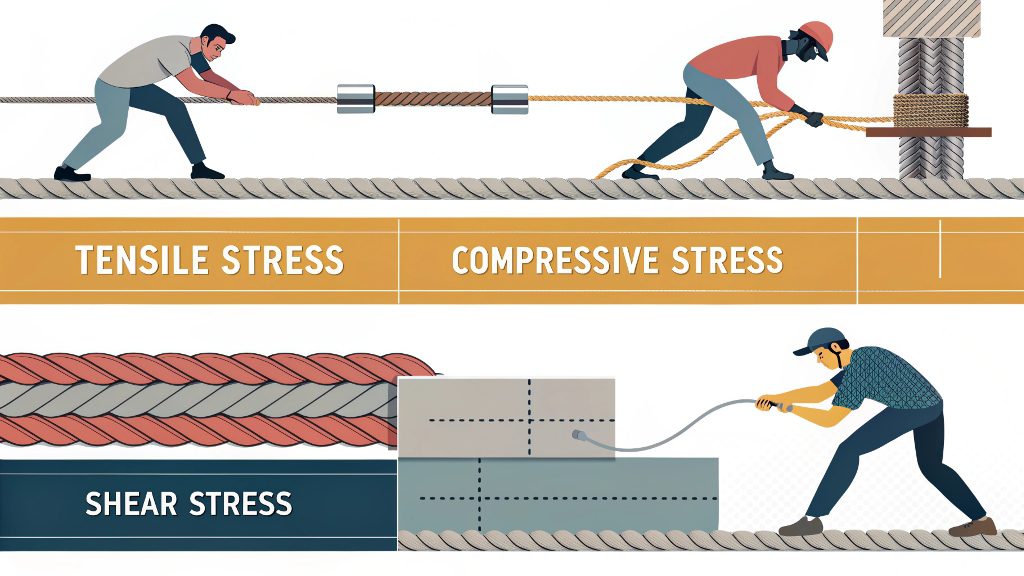
Understanding the different ways a material can be stressed is fundamental in designing reliable parts. When you send us a drawing for CNC machining, the geometry and intended use of the part imply it will experience one or more of these stresses. Let's break them down:
Basic Stress Types Explained
-
Tensile Stress: This happens when forces pull a material apart, trying to stretch it. Think of a rope in a tug-of-war. Materials need good tensile strength to resist breaking under tension.
-
Compressive Stress: This is the opposite of tensile stress. Forces push or squeeze the material together, trying to shorten it. Imagine the legs of a heavy table experiencing compression. Materials need compressive strength to avoid buckling or crushing.
-
Shear Stress: This occurs when forces act parallel to a surface, trying to make layers of the material slide past each other. Cutting with scissors is a shear action. Bolts holding plates together experience shear stress. Materials need adequate shear strength to resist this sliding failure.
-
Torsional Stress: This is a twisting force applied to an object, like twisting a screwdriver. It's actually a type of shear stress, but specifically relates to rotation. Shafts transmitting power experience torsional stress.
-
Bending Stress: This is a more complex stress state that combines both tensile and compressive stress within the material. When a beam bends, the top surface might be in compression, while the bottom surface is in tension.
Here’s a quick summary:
| Stress Type | Force Direction | Simple Example |
|---|---|---|
| Tensile | Pulling Apart | Rope being pulled |
| Compressive | Pushing Together | Table leg under load |
| Shear | Sliding Parallel | Scissor cutting paper |
| Torsional | Twisting | Screwdriver turning |
| Bending | Combination (Pull/Push) | Shelf holding books |
Recognizing which stresses your part will face is the first step in choosing the right material and ensuring the design is robust. We machine parts from over 100 materials, each performing differently under these various stresses.
What is shear stress in metal?
Parts failing unexpectedly along a surface? Shear stress might be the hidden culprit you overlooked in your design. Understand this critical sliding force to prevent shearing failures.
Shear stress in metal is an internal resisting force caused by external forces acting parallel to a material's cross-section. It tries to make adjacent internal planes of the metal slide past one another, like cutting paper.
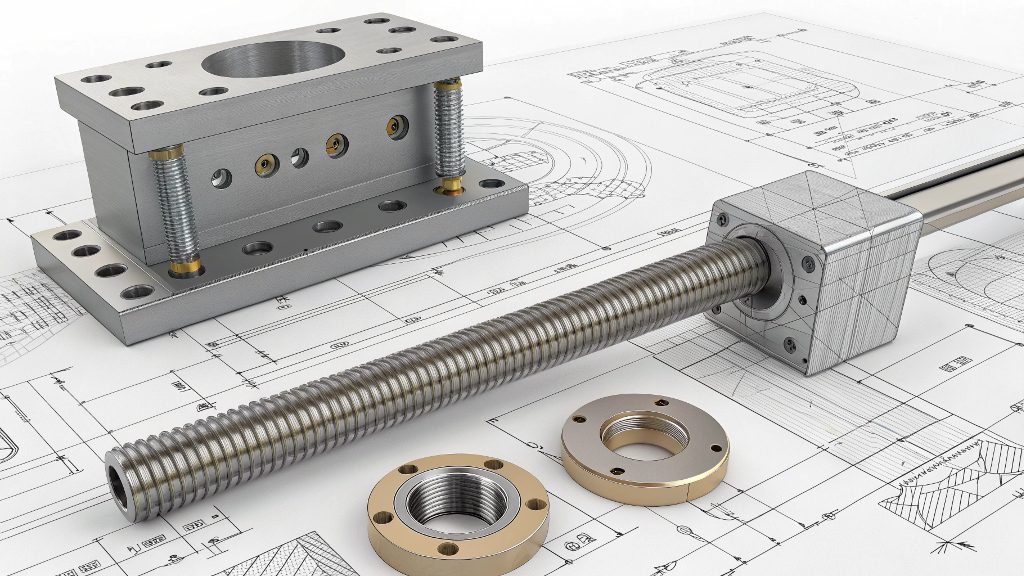
Let's dive deeper into what shear stress really means for a metal part. Imagine you have a thick metal plate, and you're trying to punch a hole through it. The force exerted by the punch acts downwards, parallel to the surface area that is being cut out around the edge of the hole. This force creates shear stress within the metal along that cylindrical surface.
Key Aspects of Shear Stress
-
Force Direction: The defining feature is that the applied force is parallel to the surface resisting the force. This contrasts with tensile or compressive stress, where the force is perpendicular to the surface.
-
Mechanism: It causes or tries to cause one layer or plane of the material to slide relative to the adjacent plane. Think of a deck of cards – pushing the top card sideways while holding the bottom card still creates shear between the cards. In a solid metal, the atomic bonds resist this sliding motion up to a point.
-
Calculation: In its simplest form (average shear stress), it's calculated as the shear force (V or F) divided by the area (A) over which it acts: τ = V / A. The units are typically Pascals (Pa) or pounds per square inch (psi).
-
Where it Occurs: Shear stress is critical in many applications we encounter:
-
Fasteners: Bolts, rivets, and pins holding components together are often primarily loaded in shear.
-
Cutting/Machining: Processes like milling, turning, drilling (and punching) inherently involve high shear stresses to remove material.
-
Structural Beams: Shear stresses exist alongside bending stresses in beams under load.
-
Shafts in Torsion: Twisting a shaft induces shear stress throughout its cross-section.
-
Understanding a material's shear strength (the maximum shear stress it can withstand before failing) is crucial for designing parts that won't yield or fracture under these conditions. This is a key property we consider when advising customers like you on material selection.
What is the difference between average shear stress and maximum shear stress?
Are your stress calculations leading to unexpected failures? Simply using average stress can be misleading and risky, especially in critical parts. Learn why distinguishing average from maximum shear stress is vital.
Average shear stress (τ_avg = V/A) assumes stress is evenly distributed over an area. Maximum shear stress (τ_max) recognizes that stress peaks at certain points within the cross-section, which is often the critical value for design.

While the basic formula τ = V/A gives us the average shear stress across a section, this is often a simplification. In reality, the stress isn't perfectly uniform. Understanding where the stress concentrates, the maximum shear stress, is often much more important for predicting failure, especially in ductile materials or under fatigue loading.
Why the Distinction Matters
-
Non-Uniform Distribution: In many common shapes, the shear stress distribution is not flat. For example:
-
Rectangular Beam: Shear stress is zero at the top and bottom surfaces and maximum at the neutral axis (the center). The maximum is typically 1.5 times the average (τ_max = 1.5 * τ_avg).
-
Circular Shaft (Solid): In torsion, shear stress is zero at the center and maximum at the outer surface. In transverse shear (like a beam), it's maximum at the center, often around 4/3 times the average (τ_max ≈ 1.33 * τ_avg).
-
-
Failure Prediction: Materials usually fail where the stress is highest. Designing based only on average shear stress might lead you to believe a part is safe when, in fact, the maximum shear stress at a specific point exceeds the material's shear strength.
-
Stress Concentrations: Sharp corners, holes, or notches in a part can cause localized areas of much higher stress (both shear and tensile/compressive). These stress concentration factors must be considered in detailed design, as they significantly increase the local maximum stress.
-
Analysis Tools: For complex geometries, like many of the custom CNC parts we produce, calculating the exact maximum shear stress analytically can be difficult. This is where tools like Finite Element Analysis (FEA) become invaluable. FEA software simulates the stress distribution throughout the part, clearly showing the location and magnitude of maximum stresses.
So, while average shear stress provides a quick estimate, knowing that maximum shear stress is often higher (sometimes significantly) and occurs at specific locations is crucial for robust engineering design. We always consider material properties and potential stress concentrations when manufacturing parts to ensure they meet your performance requirements.
Conclusion
Understanding shear stress differences in metals is vital for choosing materials and designing durable parts. From high-strength steels to lightweight aluminum, each behaves differently under shear forces.
About Us:
I'm Sandra Gao from Worthy Hardware, a CNC machining service provider based in China. We specialize in custom CNC milling and turning parts from metals like aluminum, steel, stainless steel, titanium, and plastics. We offer tight tolerances (down to +/- 0.001"), various surface finishes, and support everything from prototypes to high-volume production with 100% inspection. Our engineers help optimize designs for cost and manufacturability. Contact us at [email protected] or visit www.worthyhardware.com for your B2B machining needs.