
Progressive vs. Transfer Stamping: Which is Best for Your Metal Parts?
Confused about stamping methods for your parts? Picking the wrong one leads to higher costs and project delays. Let's clarify which process is right for your needs.
Choose progressive stamping for high-volume, high-precision small parts, as it's faster and more automated. Use transfer stamping[^1] for larger, more complex parts or lower production runs, as it offers greater flexibility in design and tooling. The best choice depends on your part's complexity and quantity.
You now have a basic idea of which method might suit you. But the real savings and quality improvements come from understanding the details. I often speak with clients like Mark from Canada, who need to balance quality and cost. He knows that the right process choice is critical. Let's break down each method further so you can make an informed decision for your next project.
What are the advantages of progressive die stamping?
Looking for high-speed, consistent production for your parts? Slow manual processes can hurt your deadlines and profits. Progressive die stamping is the key to fast, repeatable, automated manufacturing.
The main advantages are speed, lower labor costs, and high repeatability. Since the metal strip moves automatically through multiple stations in one die, it’s ideal for producing large quantities of small, intricate parts quickly and with very consistent quality, significantly reducing the cost per piece.
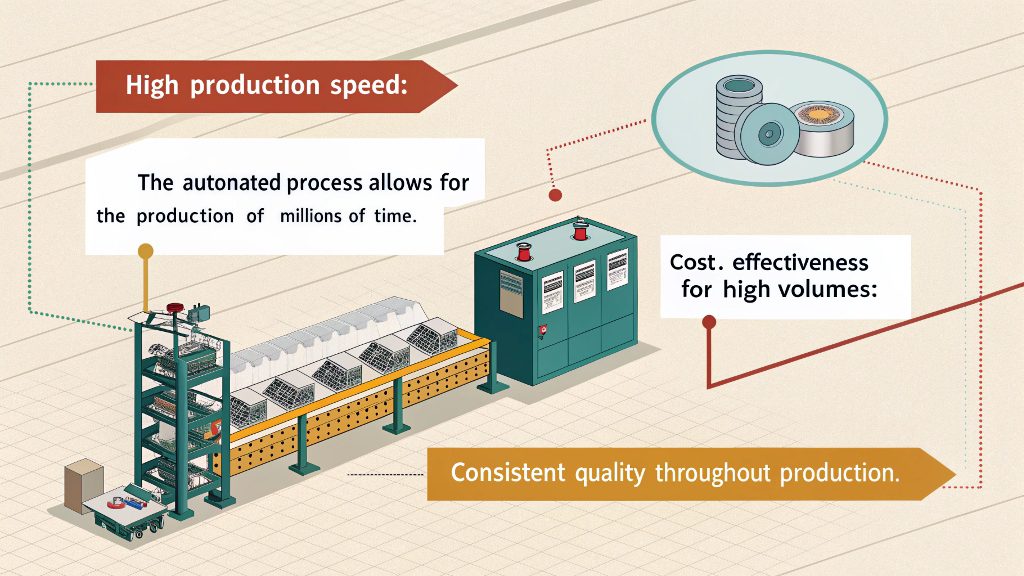
When we talk about advantages, it's all about efficiency at scale. I remember working on a project for a client in the electronics industry. They needed millions of small terminals. This is where progressive stamping shines.
High Production Speed
The press runs continuously. The metal coil feeds in one end, and finished parts come out the other. This automated process is incredibly fast, allowing us to produce thousands, or even millions, of parts in a short amount of time. For large orders, nothing beats this speed.
Cost-Effectiveness for High Volumes
Because the process is so automated, labor costs are very low once the machine is set up. The initial tool is expensive, but when you divide that cost over a million parts, the cost per part becomes very low. This is why it’s the go-to method for our customers with ongoing, high-volume needs.
Consistent Quality
The part stays connected to the metal strip as it moves through the die. This ensures precise alignment at every station. The result is extremely high repeatability and tight tolerances, often down to .001" (.025mm). Every part is virtually identical to the last.
What is the difference between a transfer press and a progressive press?
Do you have a larger part that needs stamping? A progressive press might not be the right fit for it. Using the wrong press causes production problems and wastes material.
A progressive press uses a single die set with multiple stations, and the part remains attached to a carrier strip as it moves. A transfer press uses multiple individual dies, and a mechanical system picks up and moves the separated part from one die station to the next.
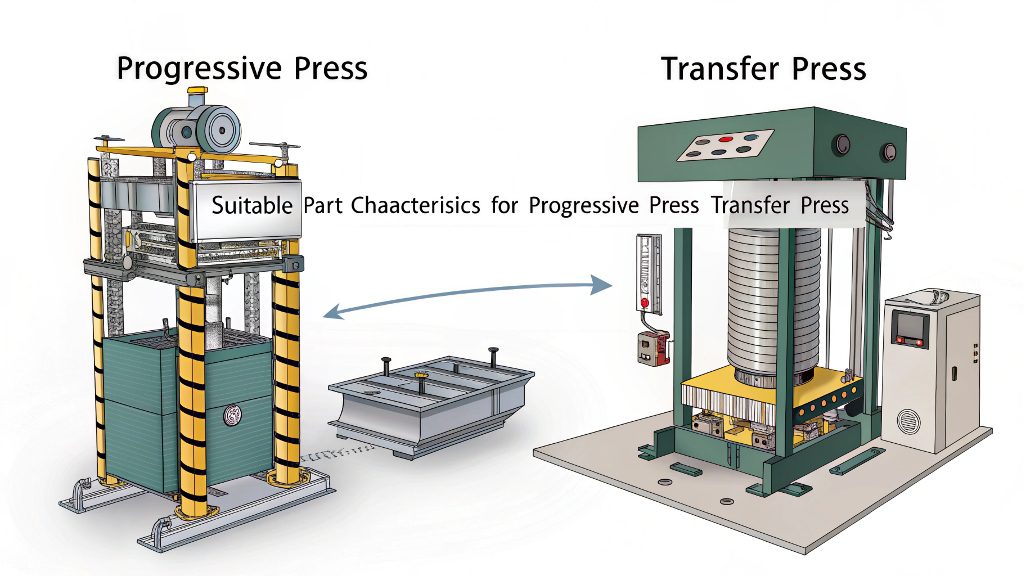
The core difference comes down to how the part moves from one operation to the next. This simple difference has big implications for your project. Let's compare them directly.
How the Part is Handled
In a progressive press, a coil of metal is fed through. The part is formed, bent, and punched but stays attached to the main metal strip, called a carrier. This strip is what "progresses" the part through the tool. In a transfer press, the part is cut from the strip first. Then, a mechanical "transfer" system, like robotic arms, physically picks up the individual part and moves it to the next station.
Suitable Part Characteristics
Because the part is freed early on, transfer presses are excellent for larger or more awkwardly shaped parts. Think of automotive brackets or deep-drawn cups. Progressive presses are better suited for smaller components like connectors, terminals, and clips, where the carrier strip provides stability.
This table breaks it down:
| Feature | Progressive Press | Transfer Press |
|---|---|---|
| Part Handling | Attached to carrier strip | Individual, moved by mechanics |
| Best For | Small, intricate parts | Large, bulky, deep-drawn parts |
| Material Usage | Carrier strip creates scrap | More efficient, less scrap |
| Tooling | Single complex die set | Multiple separate dies |
What are the disadvantages of progressive die stamping?
Is progressive stamping always the best choice? High initial costs and material waste can make it the wrong decision. You need to know the drawbacks before committing to this method.
The primary disadvantages are the very high initial tooling cost and the amount of scrap material produced. The complex die is expensive to design and build, making it unsuitable for low-volume runs. The carrier strip required to move the part is ultimately scrap, increasing material waste.
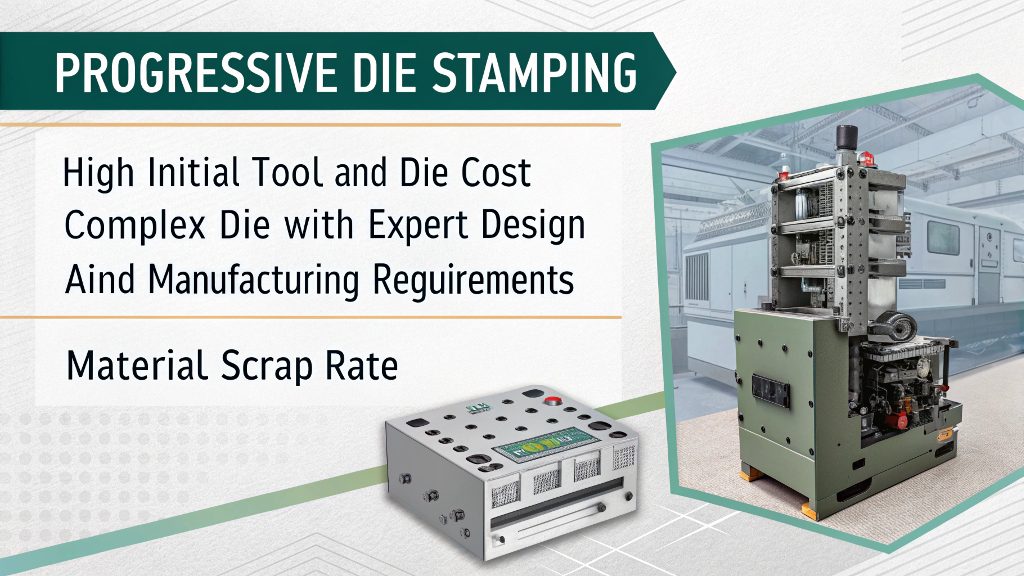
While progressive die stamping is a powerful process, it's not a universal solution. I always discuss these potential downsides with my clients to ensure it aligns with their budget and production goals. We must be honest about where this method falls short.
High Initial Tool & Die Cost
Building a progressive die is a significant investment. These tools are complex, requiring expert design and precise manufacturing. You are essentially building a mini-automated factory inside one die. For a client in North America who only needed 5,000 prototypes of a mounting plate, the tooling cost would have made the price per part far too high. For such small quantities, the upfront cost is often the biggest barrier.
Material Scrap Rate
The carrier strip that holds the part as it moves through the die is necessary for the process. However, once the finished part is cut off at the last station, this entire carrier strip becomes scrap metal. For parts that are small compared to the strip width, this can lead to significant material waste. We always work to optimize the layout to minimize this, but it’s an inherent part of the process. This waste adds to the overall cost of each part.
What is the difference between compound progressive and transfer die?
Need to choose a die for your project? The details matter. Confusing compound, progressive, and transfer dies can lead to picking a process that isn't optimized for your part's design.
A progressive die performs different operations at sequential stations. A transfer die also uses sequential stations, but for separated parts. A compound die performs multiple cuts or punches, like inner and outer diameters, in a single press stroke at one station, often for flat parts like washers.
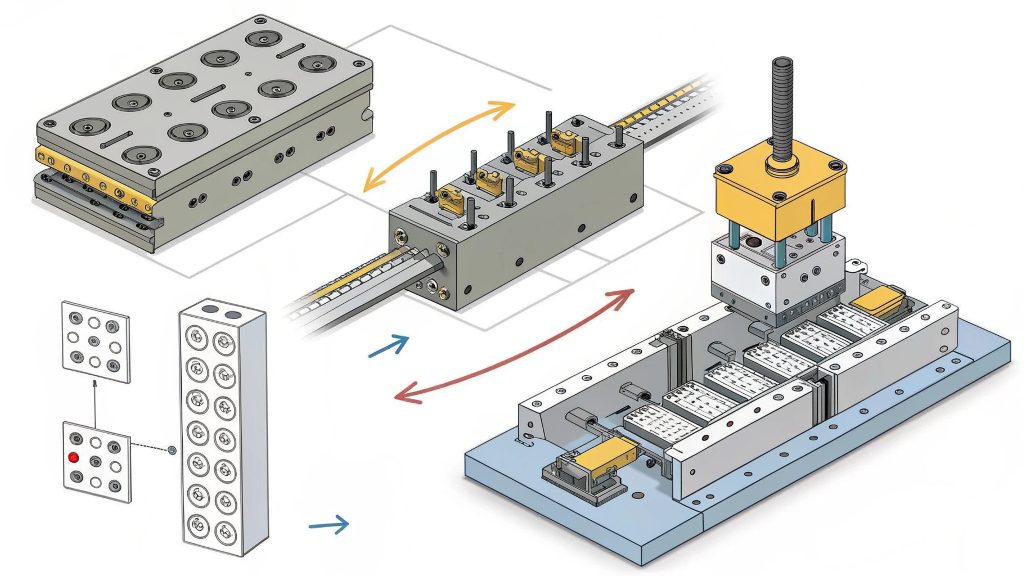
We've covered progressive and transfer dies, but "compound die" is another term you might hear. It's important to understand this third option as it serves a very specific purpose. Each die type is a specialized tool for a particular job.
Focus on Operations
- Progressive Die:
This is about sequence. Think of it as an assembly line within one tool. Station 1 punches a hole, Station 2 makes a bend, Station 3 forms a feature, and so on. It’s ideal for creating complex, three-dimensional parts from a metal strip. We use this for clips and terminals. - Transfer Die:
This is also about sequence, but for loose parts. It's like a progressive die but without the carrier strip. This freedom allows for more drastic forming operations, like deep drawing, or even flipping the part over between stations, which is impossible in a progressive die. - Compound Die:
This is about simultaneity. It performs multiple cutting operations in one hit at a single station. The classic example is making a washer. A compound die will punch the center hole and cut the outer diameter at the exact same time. This results in excellent flatness and concentricity but is generally limited to simpler, 2D parts. It's less common but very effective for specific applications.
Conclusion
Progressive stamping is best for high-volume, precision parts. Transfer stamping offers flexibility for larger parts or lower volumes. Choosing correctly optimizes both cost and quality for your project.