
How Do Nylon Materials Compare To Acetal (Delrin) For Precision Machined Components?

Choosing the right plastic is tough. Wrong material means failed parts. We can help you pick between Nylon and Delrin for your machined components.
Acetal (Delrin) generally offers better dimensional stability, lower moisture absorption, and superior machinability than nylon. Nylon, however, often has better wear resistance, impact strength, and chemical resistance to certain substances.
Picking the right material for your precision machined components is very important. Many of my customers ask about nylon and acetal, often sold under the brand name Delrin. Both are popular engineering plastics. But they have key differences that can really affect how your part performs. Understanding these differences is the first step to a successful project. Let's look deeper into how these two materials stack up against each other.
How does acetal compare to nylon in machining applications?
Parts failing due to wrong plastic choice? This causes delays and costs. Understanding Acetal vs. Nylon properties helps you choose wisely for reliable components.
Acetal (Delrin) is generally harder and more rigid, leading to better machinability with cleaner cuts and easier chip removal. Nylon is softer, tougher, and can be more challenging to machine to tight tolerances.
When we talk about Acetal (like Delrin) and Nylon for machined parts, several key differences come up. I often discuss these with clients like Mark Chen, who needs reliable parts for his business in Canada.
One of the first things my production supervisor mentions is machinability. He says, "Delrin is harder. When machining, compared to nylon, which is softer, it's easier to clear the chips away. So, Delrin is generally easier to machine." This means we can often achieve tighter tolerances and better surface finishes on Delrin parts more consistently.
Nylon, on the other hand, tends to absorb more moisture. This can be a big deal. When nylon absorbs moisture, it can swell and change its dimensions. This also affects its strength and stiffness. Acetal absorbs very little moisture, so it's much more dimensionally stable, which is critical for precision parts.
Here’s a quick comparison:
| Property | Acetal (Delrin) | Nylon (General Purpose) |
|---|---|---|
| Machinability | Excellent, good chip formation | Fair to good, can be gummy |
| Moisture Absorption | Low (around 0.2%) | High (can be up to 2.5% or more) |
| Dimensional Stability | Excellent | Fair (affected by moisture) |
| Hardness | Higher | Lower |
| Wear Resistance | Good | Excellent (especially specific grades) |
| Impact Strength | Good | Excellent |
| Coefficient of Friction | Low | Low |
So, if your part needs to hold tight dimensions in different humidity levels, or if ease of machining is a top priority to keep costs down for high volume CNC machining services, Acetal is often the better choice. But if you need high impact strength or specific wear characteristics, Nylon might be the way to go. We always look at the specific application before recommending a material.
Is Acetron GP somehow better than Delrin for my parts?
Confused by plastic brand names? Acetron GP and Delrin sound similar. Choosing the wrong one can impact your part's performance and lifespan.
Acetron GP (an acetal copolymer) offers better chemical resistance and less centerline porosity than Delrin (an acetal homopolymer). Delrin typically has slightly higher mechanical strength and hardness. "Better" depends on your specific needs.
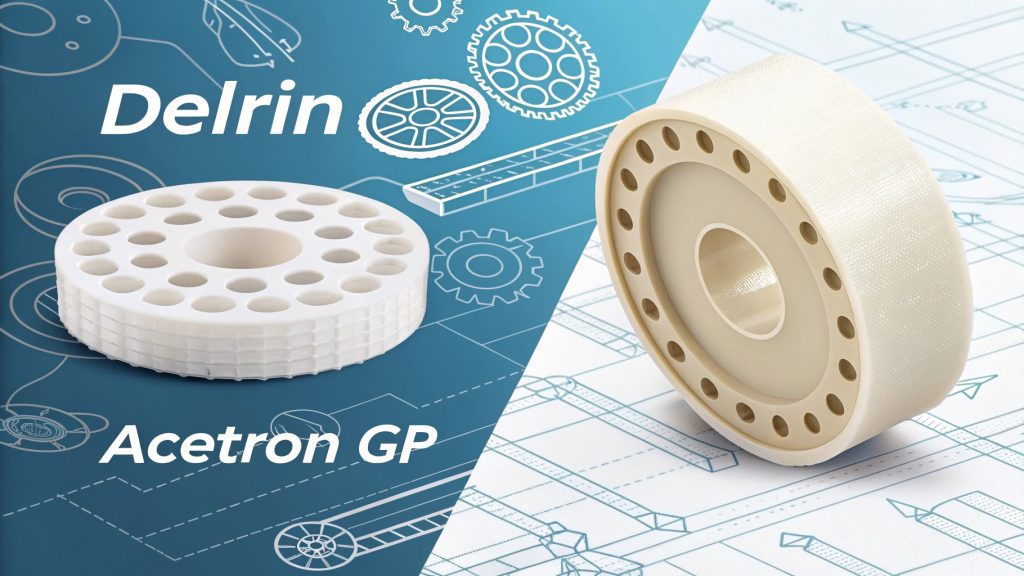
This is a common question I get, especially from engineers who are deep into material specifications. Both Acetron GP and Delrin are types of acetal. The main difference is that Delrin is typically an acetal homopolymer (POM-H), while Acetron GP is an acetal copolymer (POM-C). This might sound very technical, but it leads to some practical differences.
My experience shows that Delrin (homopolymer) tends to have slightly higher mechanical properties. This means it can be a bit stronger, stiffer, and harder. It also often has better wear resistance. So, for applications needing maximum strength or wear life, Delrin might seem like the obvious choice. I remember a project for an automotive client where a small gear needed the best possible wear resistance, and Delrin 150 was perfect.
However, Acetron GP (copolymer) has its own advantages. One big one is its improved chemical resistance, especially against hot water and strong alkaline solutions. If your part will be exposed to these kinds of environments, Acetron GP is usually the safer bet. Another advantage is that copolymers like Acetron GP tend to have less centerline porosity. Centerline porosity is a condition where tiny voids can form in the center of thicker stock shapes of homopolymer acetal. For larger parts or those where internal integrity is absolutely critical, Acetron GP can be more reliable. Copolymers are also sometimes considered slightly easier to machine because they can be more forgiving.
So, when deciding if Acetron GP is "better" than Delrin, it’s not a simple yes or no.
-
Choose Delrin (POM-H) for: slightly higher strength, stiffness, hardness, and wear resistance.
-
Choose Acetron GP (POM-C) for: better chemical resistance (especially hot water/alkalis), less centerline porosity in thick sections, and sometimes better dimensional stability over a wider temperature range.
We, at Worthy Hardware, can machine both, and we help customers choose based on their specific application, just like we do for custom CNC parts.
What plastic is actually stronger than nylon for demanding applications?
Nylon isn't strong enough for your part? This can lead to failures. You need a tougher plastic that can handle demanding loads and stresses.
Many plastics are stronger than nylon, especially in tensile strength. PEEK, Ultem (PEI), Torlon (PAI), and carbon fiber reinforced polymers (CFRPs) offer significantly higher strength and stiffness for more demanding applications.
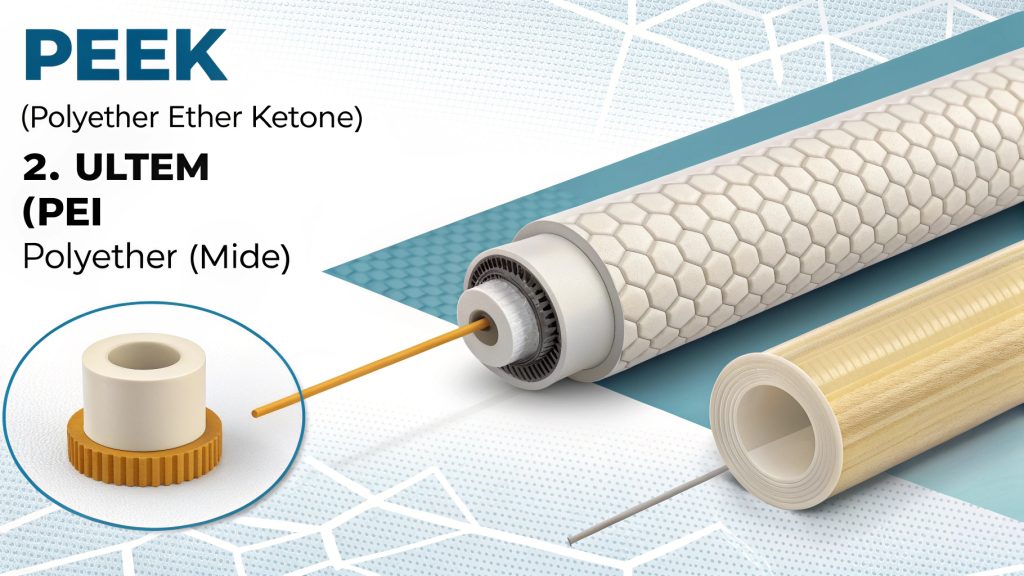
Nylon is a great all-around engineering plastic, known for its toughness and wear resistance. But sometimes, you just need more strength. "Stronger" can mean different things – higher tensile strength, better impact resistance, or more stiffness. When customers come to us needing something significantly stronger than standard nylon, we have several options we discuss.
For really demanding applications, especially where high temperatures are also a factor, PEEK (Polyether Ether Ketone) is a top choice. PEEK has excellent mechanical strength, stiffness, and can operate at very high temperatures. It also has great chemical resistance. We've machined PEEK for aerospace and medical components where performance is absolutely critical. It's more expensive, but its properties often justify the cost.
Another option is Ultem (PEI - Polyetherimide). Ultem also offers high strength, good temperature resistance, and is more dimensionally stable than nylon. It's often used in electrical connectors and medical devices.
If you need extreme strength and performance at very high temperatures, Torlon (PAI - Polyamide-imide) is a possibility. It's one of the highest-performing thermoplastics available. However, it's also challenging to machine and quite costly.
We shouldn't forget about reinforced plastics. For example, glass-filled nylon is significantly stronger and stiffer than unfilled nylon. And if you need the ultimate in strength-to-weight ratio, carbon fiber reinforced polymers (CFRPs) are in a class of their own, though these are composites and processed differently than typical thermoplastics.
Even Acetal (Delrin) can be stronger than some nylons in terms of tensile yield strength and stiffness, especially if the nylon has absorbed moisture. I once had a customer in the electronics sector who switched from nylon to Delrin for a housing because the nylon parts were warping slightly over time due to humidity changes, affecting the fit. The Delrin parts, being more stable, solved the problem.
So, yes, there are many plastics stronger than nylon. The best choice depends on the specific type of strength you need, the operating environment, and your budget.
What material could be considered equivalent to Delrin for my project?
Looking for Delrin alternatives? Supply issues or cost concerns can arise. You need a material with similar properties to keep your project on track.
Other acetal copolymers like Tecaform, Celcon, or Hostaform are very similar to Delrin (especially Delrin's copolymer grades). For specific properties like low friction, UHMWPE or PTFE might be considered, though mechanical properties differ.

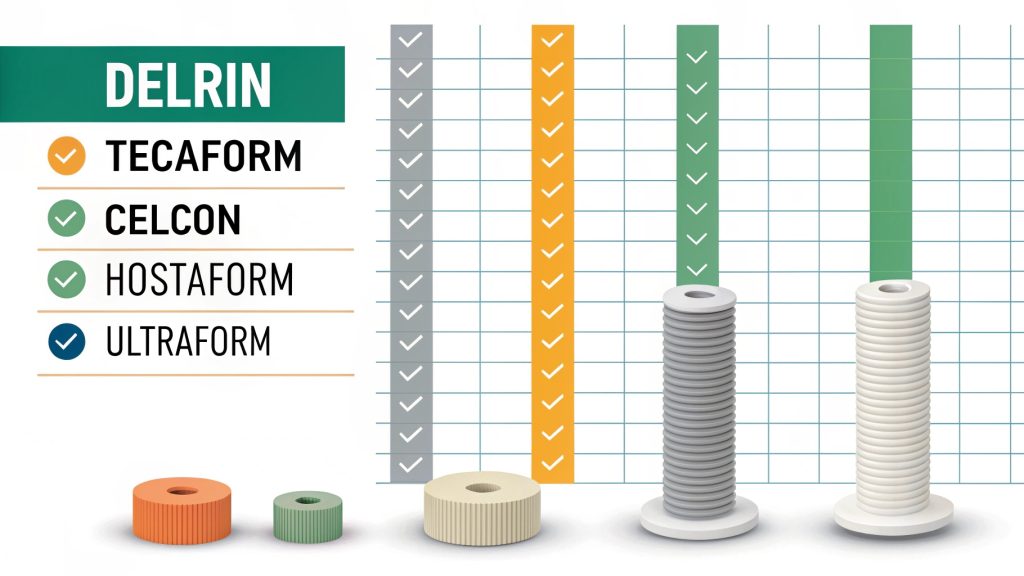
When customers ask for a material "equivalent" to Delrin, I first try to understand which properties of Delrin are most important for their application. Delrin is a brand name for acetal, and there are other brands and types of acetal that are very similar.
If you're using Delrin (which is often an acetal homopolymer, POM-H), direct equivalents would be other POM-H grades. However, more commonly, people are looking for general acetal properties. In that case, acetal copolymers (POM-C) are excellent alternatives and sometimes even preferred. Brand names for acetal copolymers include:
- Tecaform®
- Celcon®
- Hostaform®
- Ultraform®
These materials offer very similar characteristics to Delrin, such as good machinability, low friction, good stiffness, and excellent dimensional stability due to low moisture absorption. As I mentioned earlier, copolymers can even offer advantages like better chemical resistance to hot water and less centerline porosity. We often use these various acetal grades interchangeably based on availability and minor performance nuances, after discussing with the client. For instance, a client needing custom CNC parts for a food processing application found that a specific grade of POM-C offered better resistance to cleaning chemicals they used, making it a better "equivalent" for them than a standard POM-H.
If the key property of Delrin you need is low friction and wear resistance, but other mechanical properties are less critical, you might also consider:
-
UHMWPE (Ultra-High Molecular Weight Polyethylene): Excellent wear resistance and low friction, but lower strength and stiffness than Delrin.
-
PTFE (Teflon™): Extremely low friction and excellent chemical resistance, but much softer and weaker than Delrin.
If it's good general mechanical properties and machinability you're after, and moisture isn't a huge concern for a specific application, some grades of Nylon (especially cast nylon or moisture-conditioned nylon) might be considered, though they won't be as dimensionally stable as Delrin.
Polypropylene (PP) is cheaper and machines well but is not as strong or stiff.
Ultimately, finding an "equivalent" means matching the critical performance requirements of your part. At Worthy Hardware, we can source and machine a wide range of these materials, and we're always happy to discuss the best fit for your precision machining needs.
Conclusion
Choosing between Nylon and Acetal (Delrin) depends on your part's specific needs like stability, strength, or machinability. We can help you select the best material.