
How Does Material Choice Affect CNC Machining Precision and Surface Finish?

Your parts aren't meeting the required specs. This leads to project delays and wasted money. The problem often starts and ends with your material choice, which dictates machining success.
The material you choose is critical for CNC machining. Harder materials can achieve finer finishes but require specific tools and slower speeds. Softer materials machine faster but can deform under pressure, which impacts both the final precision and surface quality. Your material directly sets the strategy for a successful part.
Choosing the right material is just the beginning of the story. Many factors come into play when you aim for that perfect part. The technology itself, the specific material properties, and other key factors all work together to achieve the results you need. Let's look deeper at how these elements connect to create a high-quality finished product. It's a process I've guided hundreds of clients through, and understanding these details can save you from costly mistakes down the line.
How does CNC technology improve precision?
Manual machining often leads to inconsistent parts and human error. This inconsistency can ruin an entire production run, costing you valuable time and resources. CNC technology removes the guesswork.
CNC technology improves precision by using computer-controlled movements based on a digital design. This process eliminates human error and allows for incredibly tight tolerances. Because it is automated and repeatable, it consistently produces identical parts, ensuring quality from the first piece to the last.
CNC stands for Computer Numerical Control. In simple terms, a computer program tells the machine exactly where and how to cut. This program, often called G-code, directs every movement, spin, and tool change with incredible accuracy. This automation is the key to precision. Unlike a human operator, the machine does not get tired or make small mistakes. It performs the exact same path every single time. This is what we call repeatability.
I remember a client, let's call him David, who came to us with parts made manually. His rejection rate was high because of small inconsistencies. Once we moved his project to our 5-axis CNC machines, his part rejection rate dropped to nearly zero. He could trust that the 1st part and the 1,000th part would be functionally identical. This level of precision is not just about quality; it's about reliability for your business. Our machines can hold tolerances as tight as +/- 0.001", which is often impossible to achieve consistently by hand.
What material is used in precision machining?
You need parts with very tight tolerances. But using the wrong material can make achieving that precision nearly impossible, no matter how good the machine is. The right material is a stable foundation.
Common materials for precision machining include stable metals like aluminum (6061, 7075), stainless steel (303, 304), and titanium. For plastics, high-performance options like PEEK and Delrin (Acetal) are excellent. These materials hold their shape well during machining and can achieve a superior surface finish.
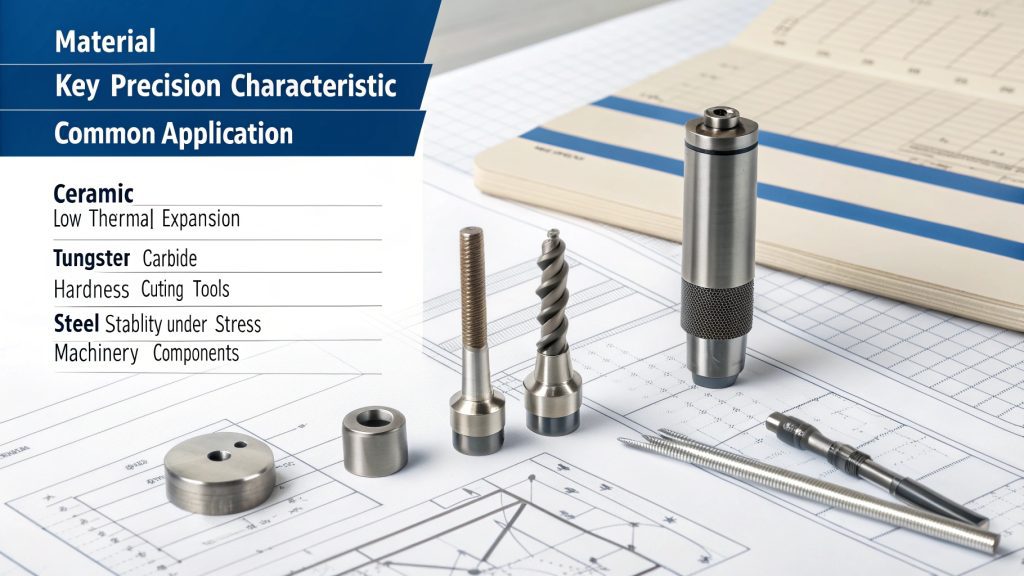
The best materials for precision work share a key feature: stability. This means they do not change shape easily due to heat or stress from the cutting tool. For example, some materials expand significantly when they get hot during machining. This can ruin the final dimensions. That's why materials with low thermal expansion are often preferred for high-tolerance jobs.
Hardness also plays a big role.
A harder material can often be cut to a crisper, more defined edge, which is essential for creating fine details. Softer materials might "smear" or create burrs instead of a clean cut. I’ve created a simple table below to show some popular choices and why they work well for precision applications. This is a conversation I have with my clients every day to make sure their design is matched with a material that can actually deliver the needed results.
| Material | Key Precision Characteristic | Common Application |
|---|---|---|
| Aluminum 6061 | Excellent machinability, good strength-to-weight. | Prototypes, electronic housings. |
| Stainless Steel 304 | High corrosion resistance, holds detail well. | Medical devices, food-grade equipment. |
| Titanium | Incredible strength, low thermal expansion. | Aerospace components, high-performance parts. |
| PEEK | High-temperature resistance, chemical stability. | Semiconductor parts, medical implants. |
What factors should be taken into consideration when selecting stock for CNC machining?
Choosing a material seems simple, but there's more to it than just picking from a list. The wrong choice can lead to high costs, difficult machining, and parts that fail. A few key factors will guide you.
When selecting material, consider the part's final application (strength, weight, corrosion needs), your project budget, and the material's machinability. You must also think about the required surface finish and the specific tolerances your part needs to function correctly.
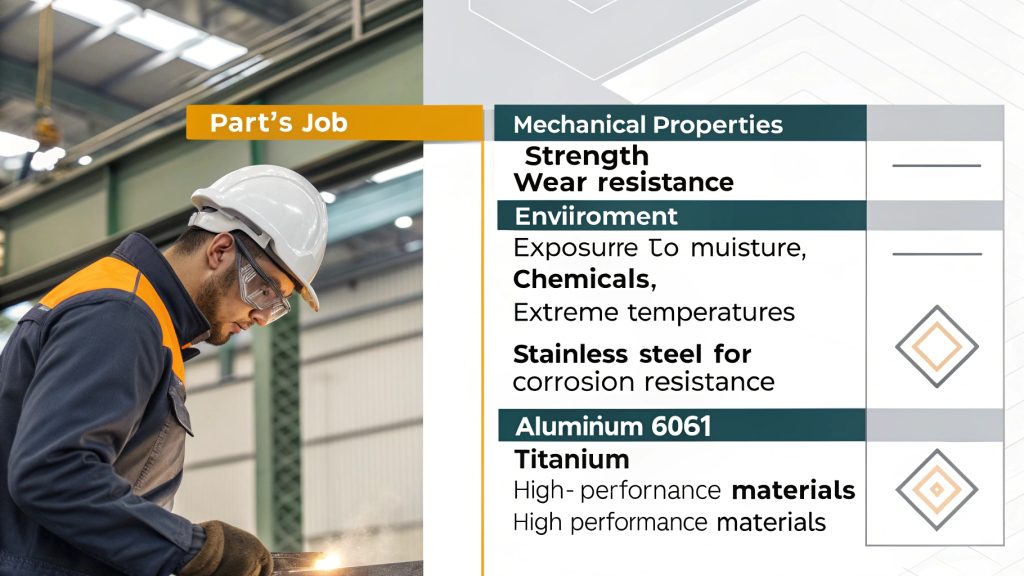
Let's break these factors down. First is the part's job. What does it need to do? This relates to its mechanical properties. Does it need to be very strong? Does it need to resist wear? A part for an airplane will need different properties than a case for a consumer electronic device.
Second, consider the environment. Will the part be exposed to moisture, chemicals, or extreme temperatures? This will immediately point you toward materials like stainless steel for corrosion resistance or a high-performance plastic like ULTEM for heat resistance.
Third is cost. This is a major factor for all my clients, like Mark in Canada. High-performance materials like titanium are excellent, but they are also expensive. I often advise clients to start with a more affordable material like Aluminum 6061 for initial prototypes. We can test the design and function first. Then, if needed, we can move to a more specialized material for the final production run. This simple step can save a lot of money.
Finally, you have to consider machinability, which we will discuss next.
What characteristics of materials affect their machinability in a machine shop?
Some materials seem to fight the cutting tool every step of the way. This can cause tool wear, slow down production, and result in a poor surface finish. Understanding a material's core characteristics is key.
Key characteristics are hardness, ductility, and thermal conductivity. Hard materials require slower speeds and stronger tools. Ductile materials can produce long, stringy chips that are hard to manage. Materials with poor thermal conductivity can cause heat buildup, damaging both the part and the tool.
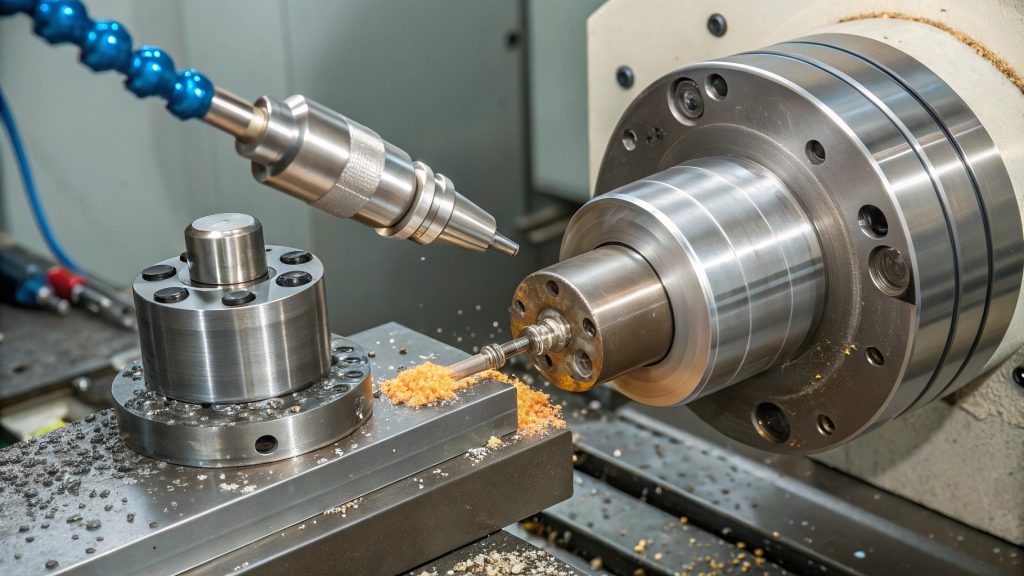
These properties directly affect the final precision and surface finish. Let's look at them one by one.
Hardness: A very hard material, like tool steel, resists the cutting tool. To machine it well, we must use very strong tools, slower spindle speeds, and lower feed rates. This takes more time but allows us to achieve very high precision and a smooth finish.
Ductility and Elasticity: This is about how a material behaves under pressure. Some materials, like soft copper or certain plastics, are very ductile. Instead of a chip breaking off cleanly, they can produce long, stringy chips that wrap around the tool. Some materials are also elastic and "spring back" after the tool passes. This can make holding tight tolerances very difficult, as the final dimension might not match what was cut. We have to adjust tool geometry and cutting strategy to prevent this.
Thermal Conductivity: Cutting generates a lot of heat. Materials like aluminum are great because they dissipate this heat quickly. But materials like titanium or stainless steel trap heat at the cutting point. This heat can wear out the tool very fast and cause the part to expand, affecting precision. We manage this with special coolant and by carefully controlling the cutting parameters.
Conclusion
Choosing the right material is a critical first step. It directly impacts your part's precision, finish, cost, and performance. Partner with an expert at Worthy Hardware to get it right.