
What Are the Most Malleable Metals for Custom CNC Parts Manufacturing?

Choosing the right metal for CNC can be tough, especially when you need good formability. Pick the wrong one, and you face machining issues. Let's explore the most malleable metals.
The most malleable metals include gold, silver, and platinum. For custom CNC parts manufacturing, aluminum and copper are excellent choices due to their high malleability, good machinability, and cost-effectiveness, allowing for complex shapes.
So, you know aluminum and copper are great malleable options. But what if you need more specific information for your project? Let's dig a bit deeper into what makes a metal suitable for CNC machining and explore other common questions. This will help you make the best choice for your parts, ensuring your components meet your exact needs.
What is the best steel for CNC machining?
Steel offers strength, but which type is easiest to machine? Choosing a tough steel can mean slow work, worn tools, and higher costs. Let's find out which steels are best.
For CNC machining, low-carbon steels like 1018 and free-machining steels such as 12L14 are often best. They offer good machinability, produce manageable chips, and are relatively economical, making them great for many custom parts.
When we talk about the "best" steel for CNC, we are usually looking for a balance. We want good machinability, reasonable cost, and the right properties for the final part. I've found that several types of steel stand out in my experience at Worthy.
First, there are low-carbon steels. Think of grades like 1018 or A36. These steels are quite soft and ductile. This softness makes them easier to cut. Our cutting tools tend to last longer with these materials. They are also generally less expensive than other steel types. The main trade-off is that they are not as strong as other steels.
Next, we have free-machining steels. Grades like 12L14 or 1215 are good examples. These steels have small amounts of elements like sulfur or lead added. These additions make a big difference in how they machine. The chips break off easily, which is very helpful for our automated CNC processes. These steels also tend to give a better surface finish. We use these a lot for high-volume parts where speed and finish are very important.
Then, there are alloy steels. If your part needs more strength or toughness, you might look at something like 4140 steel. It is harder to machine compared to low-carbon or free-machining steels. But, it offers much better mechanical properties, especially after heat treatment. We adjust our CNC machine speeds and feeds carefully when working with these stronger steels.
Here's a simple table to compare:
| Steel Type | Machinability | Strength | Cost | Common Use Cases |
|---|---|---|---|---|
| Low-Carbon (1018) | Good | Low | Low | General purpose parts, brackets, fixtures |
| Free-Machining (12L14) | Excellent | Moderate | Moderate | High-volume turned parts, shafts, fittings |
| Alloy Steel (4140) | Fair | High | Higher | Gears, high-stress components, tooling |
Choosing the right steel really depends on what your part needs to do. For general CNC work where super high strength is not the main concern, I often suggest starting with a low-carbon or free-machining steel. It makes the manufacturing process smoother and often more cost-effective.
What is the flexible material for CNC?
You need parts that can be easily shaped or formed during machining. Stiff, brittle materials can crack or severely limit your design complexity. Let's identify materials that offer good flexibility.
In CNC, "flexible" often means easy to shape, pointing to malleable metals. Aluminum and copper are top choices for their excellent formability and machinability, allowing for intricate designs and smooth contours easily.
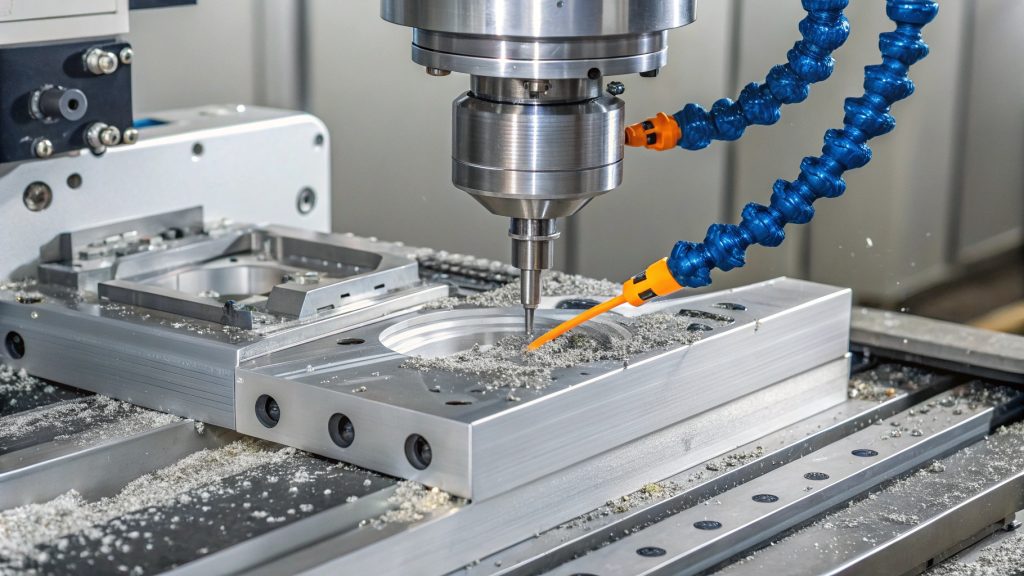 "Flexible Material for CNC Machining")
When customers ask me for a "flexible" material for CNC, I usually try to understand what they mean. Sometimes they mean a material that is literally flexible after it's machined, like a spring. More often, especially for custom CNC parts, they mean a material that is flexible during the machining process. This means it is easy to cut, bend, and shape into complex forms. This idea of flexibility is very closely related to a metal's malleability and ductility.
Aluminum is a real star when it comes to this kind of flexibility. Alloys like 6061 are incredibly popular for good reason. It is lightweight. It is strong enough for many different applications. And it machines beautifully – like a dream, really. Its malleability means we at Worthy can create complex geometries, thin walls, and smooth curves without putting too much stress on the material or our cutting tools. I remember one project for a client where we had to make these very intricate electronic enclosures with lots of curves and small features. Aluminum was the perfect choice; it allowed us to get all the bends and details just right.
Copper is another fantastic option if you need flexibility in shaping. It is even more malleable than aluminum. This is why copper is often used for things like electrical contacts that need to be formed precisely, or for detailed decorative pieces. Its high thermal and electrical conductivity are also big advantages for certain applications. Brass, which is an alloy of copper and zinc, also machines very well and offers good malleability. We often use brass for manufacturing fittings, valves, and musical instrument parts. These materials – aluminum, copper, and brass – don't "fight back" much when being cut. This means we can achieve faster cycle times and better surface finishes for your parts.
What is the best material for CNC?
So many material options for CNC, it can feel overwhelming! Picking the wrong one means wasted money, valuable time, and ultimately, subpar parts. Let's uncover what makes a material "best".
The "best" CNC material truly depends on your project's specific needs like strength, cost, and function. However, aluminum (especially 6061) is a widely favored all-rounder due to its excellent machinability, good strength-to-weight ratio, and affordability.
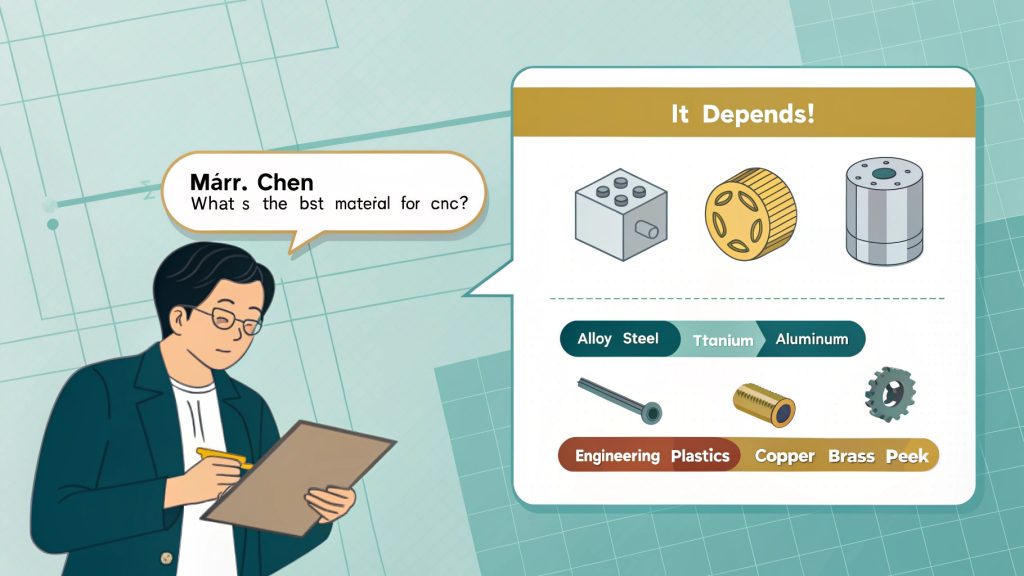
I get asked "What's the best material for CNC?" all the time by people like Mark Chen, who are looking for quality and value. My honest answer is always: it depends! There is no single "best" material that fits every single situation perfectly. The ideal material for your CNC part hinges on several important factors. These factors are specific to your part and how it will be used.
First, what does the part actually do? What is its function? If the part needs to be very strong and withstand high forces, you might look at alloy steels or even titanium. If it needs to be lightweight, perhaps for an aerospace or portable application, then aluminum or certain engineering plastics are great choices. For parts that need to conduct electricity or heat well, copper or brass are top contenders.
Second, what is your budget? This is always a practical consideration. Exotic materials like titanium or high-performance plastics like PEEK can be quite expensive. On the other hand, aluminum and some common steels are much more cost-effective. We always try to find that sweet spot for our customers – the material that gives the necessary performance without breaking the bank.
Third, how complex is the design of your part? Highly malleable and machinable materials like aluminum or brass are generally easier to machine into intricate shapes with fine details. More difficult-to-machine materials might increase the cost or limit some design possibilities.
Here’s a simplified look at some common choices we handle at Worthy:
| Material | Key Strengths | Considerations | Typical Cost |
|---|---|---|---|
| Aluminum (6061) | Excellent machinability, good strength-to-weight, corrosion resistant | Not as strong as some steels | Moderate |
| Stainless Steel (304) | High strength, excellent corrosion resistance | Harder to machine, more expensive | Higher |
| Brass (C360) | Excellent machinability, good corrosion resistance, nice appearance | Lower strength than steel | Moderate |
| Delrin (Acetal) | Good machinability, low friction, high stiffness, dimensionally stable | Lower strength than metals, UV sensitive | Moderate |
| PEEK | High-temp performance, chemical resistance, very strong | Very expensive, challenging to machine | Very High |
So, while aluminum 6061 is often a fantastic starting point for many CNC projects due to its great all-around characteristics, the "best" material is ultimately the one that meets all your specific requirements for performance, budget, and manufacturability.
What metal is used in a CNC machine?
Curious about what metals your parts can be made from using CNC? Not knowing the range of machinable metals might limit your innovative design ideas. Let's explore common metals processed.
CNC machines can process a vast array of metals. Most commonly, we at Worthy work with aluminum, various steels (carbon, alloy, stainless), brass, copper, and even tougher metals like titanium for custom parts.
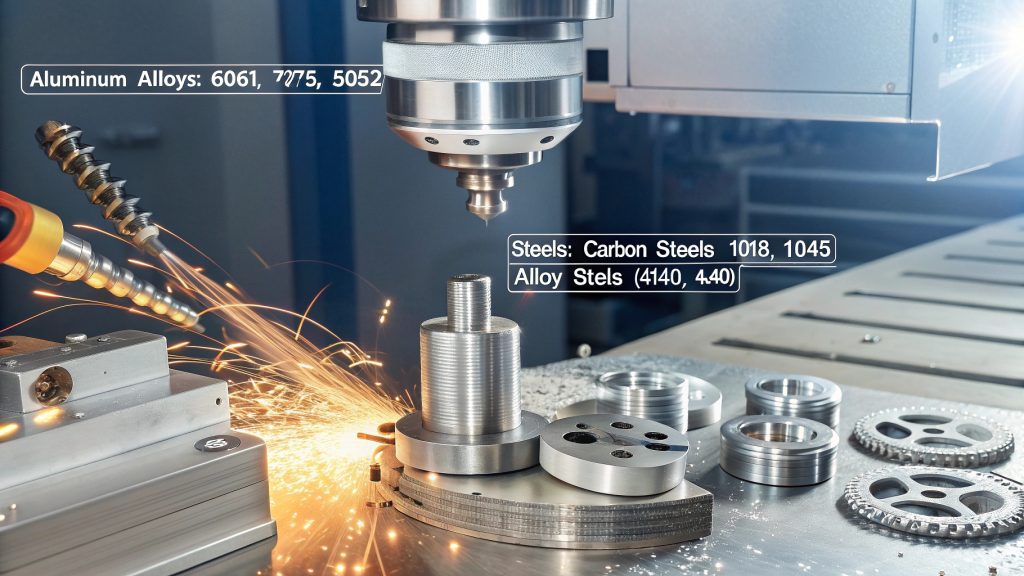
This question, "What metal is used in a CNC machine?", can sometimes be understood in two ways. One way is asking what CNC machines themselves are made of. The other, and I think more relevant for you if you're looking to get parts made, is asking what metals CNC machines can work with or process. And the good news here is that CNC machines are incredibly versatile!
At Worthy, we regularly machine a very wide spectrum of metals for our clients across North America, Europe, and beyond.
-
Aluminum alloys are probably the most common group. We use grades like 6061, 7075, 5052, and others. These are loved by designers and engineers for their ease of machining, good strength-to-weight ratio, and natural corrosion resistance.
-
Steels represent another big category. This is a diverse group that includes:
-
Carbon steels like 1018 or 1045, which are chosen for general-purpose strength and cost-effectiveness.
-
Alloy steels such as 4140 or 4340, which are selected when parts need higher strength, hardness, or toughness after heat treatment.
-
Stainless steels, including popular grades like 304, 316, and 17-4 PH, are used for their excellent corrosion resistance and good strength.
-
Tool steels like A2 or D2 are for applications that demand very high hardness and wear resistance, such as making dies or other tools.
-
-
Brass and Bronze: These are copper alloys. They machine beautifully and are great for making parts like bearings, bushings, decorative items, and plumbing components.
-
Copper: Pure copper is often chosen for its excellent electrical and thermal conductivity. It's key for electrical contacts, heat sinks, and similar applications.
-
Titanium: This metal is used when a high strength-to-weight ratio and excellent corrosion resistance are absolutely critical. You often see it in aerospace, medical, and high-performance automotive parts. It is tougher to machine, but our experienced team and capable machines handle it well.
-
Magnesium alloys: For applications where extreme light weight is the primary goal, magnesium is a good choice.
Essentially, if it is a metal that can be cut, a CNC machine can likely shape it. The key is using the correct cutting tools, setting the right speeds and feeds on the machine, and applying the proper coolants for each specific material. Our engineers and machinists are experts at optimizing these parameters. And just so you know, the CNC machines themselves are built from very rigid and heavy materials like cast iron and heavy-duty steel fabrications. This ensures they can perform with high precision and absorb vibrations, but the main point for you is the amazing range of metals we can make your parts from.
Conclusion
Choosing the right malleable metal, like aluminum or copper, is key for complex CNC parts. Consider all factors like application, cost, and properties to ensure project success.