
What Are The Main Types of Copper Used in CNC Machining?

Choosing copper for CNC is tough. A wrong choice can mean bad parts and wasted money. Learn the main types for project success.
The main types of copper used in CNC machining are pure coppers like C101 and C110, brass alloys, especially C36000 (free-machining brass), and various bronze alloys. Each offers unique properties for different applications, making selection crucial for your project's success.
Now that you have a basic idea, let's look closer at these copper types. Understanding their differences will really help you pick the best one for your CNC machining projects. We want you to get the best results.
Which copper is best for machining?
Want the easiest copper to machine? Some coppers are difficult and slow things down. Free-machining brass is often the top choice for ease.
For general CNC machining, C36000 brass is often considered the best due to its excellent machinability. It allows for high speeds, good surface finish, and long tool life, making it very cost-effective for many applications.
When we talk about the "best" copper for machining, C36000 brass, also known as free-machining brass, usually comes out on top in my experience. Its excellent machinability rating, often set as the 100% benchmark, comes from the small amount of lead added to it. This lead helps break the chips into small, manageable pieces during machining.
This is a big deal because it means we can run our CNC machines at higher speeds and feeds. This leads to faster production times and, importantly for my customers like Mark Chen, lower costs. The surface finish is typically very good straight off the machine, which can sometimes reduce the need for extra finishing steps.
However, "best" always depends on what the part needs to do. If you need very high electrical or thermal conductivity, then pure coppers like C101 or C110 might be necessary. These are gummier and more challenging to machine, but sometimes their properties are essential.
If you need good wear resistance or a part that needs some self-lubrication, a bronze alloy might be better. So, while C36000 is great for machinability, we always look at the end-use requirements. I often help customers weigh these factors. For example, if a part needs good corrosion resistance and decent strength, C36000 is a strong contender. But for electrical contacts or high-performance heat sinks, we'd lean towards purer coppers.
What is the difference between C101 and C110 copper?
C101 and C110 copper seem very similar, right? Choosing the wrong one can affect conductivity and performance. Learn their key oxygen content difference.
The main difference between C101 (Oxygen-Free) and C110 (Electrolytic Tough Pitch) copper is their oxygen content. C101 has minimal oxygen, offering superior electrical and thermal conductivity and better performance in vacuum environments. C110 contains more oxygen.
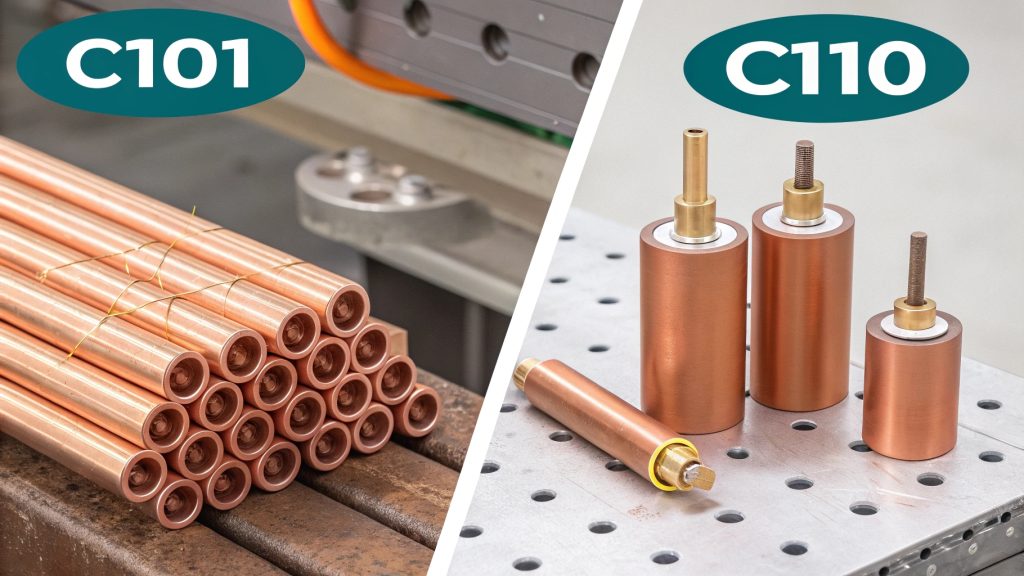
C101 and C110 are both common pure copper grades we machine here at Worthy, but they have an important difference: their oxygen content. C101 is known as Oxygen-Free High Conductivity (OFHC) copper. It typically has a very high copper purity, around 99.99%, and extremely low oxygen levels, something like 0.0005%. This lack of oxygen makes it excellent for applications that need the absolute best electrical and thermal conductivity. It's also very good for use in vacuum applications because it doesn't release much gas, which is critical in sensitive environments like semiconductor manufacturing or aerospace.
On the other hand, C110, or Electrolytic Tough Pitch (ETP) copper, is slightly less pure, usually around 99.90% copper. It contains more oxygen, typically between 0.02% and 0.04%. While C110 still has very high conductivity, it's not quite as good as C101.
Another thing to know is that the oxygen in C110 can lead to a problem called hydrogen embrittlement if the copper is heated in an atmosphere that contains hydrogen. C110 is generally more common and a bit less expensive than C101. From a machining point of view, both can be a bit "gummy," meaning they can be sticky and hard to get a clean cut. But C110 is often slightly easier to machine than C101. We've machined both for various electronic components, busbars, and custom heat sinks.
Here's a simple table to show the main differences:
| Feature | C101 (OFHC) Copper | C110 (ETP) Copper |
|---|---|---|
| Purity (Cu) | ~99.99% | ~99.90% |
| Oxygen Content | Very Low (e.g., <5 PPM) | Higher (e.g., 200-400 PPM) |
| Electrical Conductivity | Highest (e.g., 101% IACS) | Very High (e.g., 100% IACS) |
| Thermal Conductivity | Highest | Very High |
| Hydrogen Embrittlement | Resistant | Susceptible |
| Common Uses | High-end electronics, vacuum devices, anodes | General electrical, plumbing, roofing |
| Cost | Higher | Lower |
What is CNC copper?
You might have heard the term "CNC copper" and wondered about it. It can be confusing. It’s not a special grade, but simply copper that has been machined using CNC methods.
"CNC copper" isn't a specific type of copper material. It simply refers to any copper or copper alloy that is processed using CNC (Computer Numerical Control) machining to create precise parts according to a digital design.
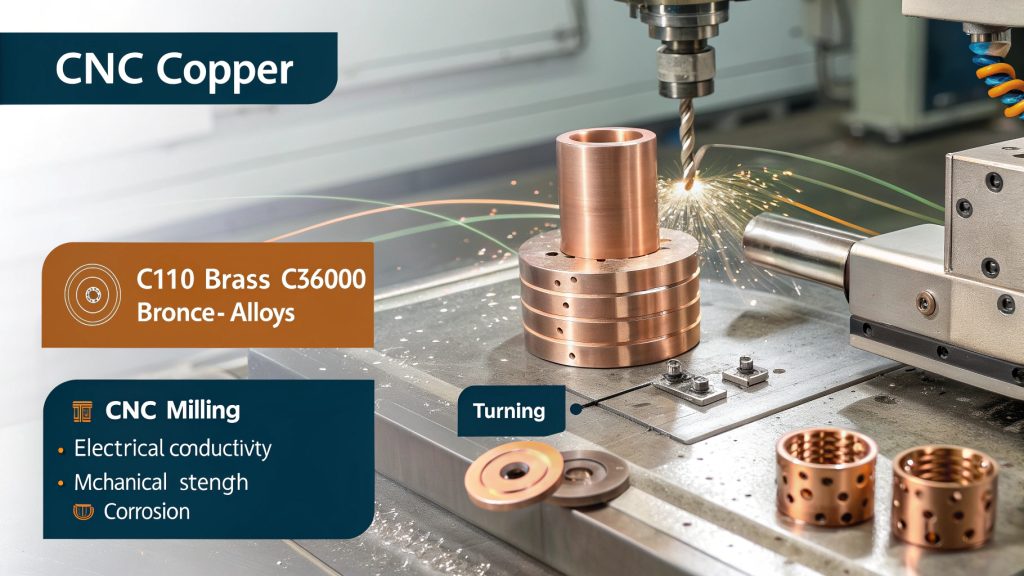
Sometimes customers, especially those new to sourcing custom parts, ask us about CNC copper. I completely understand why this term might cause some confusion. It sounds like it could be a special grade of copper that's made just for CNC machines. However, "CNC copper" really just means any type of copper or copper alloy that we are shaping and cutting using our CNC equipment. The term describes the manufacturing process we use, not the material itself.
At Worthy, we can CNC machine many different types of copper and its alloys. For instance, we use CNC milling[^2] for complex shapes and CNC turning for cylindrical parts made from pure coppers like C110, various brasses like the very machinable C36000, and different bronze alloys. The decision of which copper alloy to use for a "CNC copper" part depends entirely on what the part needs to do in its final application.
We consider factors like required electrical conductivity, mechanical strength, resistance to corrosion, and, of course, how easily it can be machined, which impacts cost. So, when a customer like Mark sends us a drawing for a "CNC copper part," our first job is to talk with them to make sure we understand which specific copper alloy they need based on the part's function. Then, we program our advanced CNC machines to cut that chosen material to their exact specifications, ensuring high precision every time.
What grade of copper is used for machining?
There are so many copper grades available, it can be overwhelming. Which ones are actually suitable and commonly used in CNC shops like ours? Several grades are frequently machined.
Many copper grades are used for machining. Free-machining brass (C36000) is very popular for its ease of machining. Pure coppers (C101, C110) and various bronze alloys (like C93200 Bearing Bronze) are also commonly machined depending on application needs.
When it comes to which grades of copper are actually used for machining, there's a good range available. The choice really depends on what the final part needs to achieve. Based on our 20+ years of experience in CNC machining here at Worthy, I can tell you that customers most often ask us to work with pure coppers, various types of brass, and different bronze alloys.
For pure coppers, C110 (Electrolytic Tough Pitch) and C101 (Oxygen-Free High Conductivity) are frequent choices. These are selected especially when high electrical or thermal conductivity is the most important property, like for electrical connectors, busbars, or heat sinks. As I've mentioned, these pure coppers can be a bit sticky or "gummy" to machine compared to other metals, but we have the right tools, techniques, and experience to handle them effectively and produce quality parts.
Brass is an extremely popular choice for CNC machining, and the standout grade here is almost always C36000, also known as Free-Cutting Brass or free-machining brass. The small amount of lead in its composition makes it incredibly easy to machine. This means we get great tool life, excellent surface finishes, and faster cycle times, which helps keep costs down for our customers. This is often our go-to recommendation if extreme conductivity isn't the primary design driver. We see a lot of C36000 parts moving through our shop for all sorts of applications.
Bronze alloys are also commonly machined. For example, C93200 (also known as SAE 660 Bearing Bronze) is often chosen for its good wear resistance and natural lubricity. This makes it very suitable for manufacturing bearings, bushings, and wear plates. Other bronze alloys offer different combinations of strength, corrosion resistance, and machinability. For instance, phosphor bronzes like C51000 are known for good spring qualities and fatigue resistance. Ultimately, the "best" grade really depends on the specific requirements of the part we are making.
Here’s a quick look at some common ones we machine:
| Copper Family | Common Grades | Key Machining Aspect & Typical Use |
|---|---|---|
| Pure Copper | C101, C110 | High conductivity; can be gummy. Used for electrical components, heat sinks. |
| Brass | C36000 (Free-Cutting) | Excellent machinability; general purpose parts, fittings, connectors. |
| C26000 (Cartridge Brass) | Good for cold working; less machinable than C360. Stampings, shells. | |
| Bronze | C93200 (Bearing) | Good wear resistance, self-lubricating; bearings, bushings. |
| C51000 (Phosphor Bronze) | Good strength & fatigue resistance; springs, electrical contacts. | |
| C65500 (Silicon Bronze) | Good strength, corrosion resistance; marine hardware, hydraulic lines. |
At Worthy, we can source and machine all these grades and more to your exact specifications.
Conclusion
Choosing the right copper—whether pure, brass, or bronze—for CNC machining depends on your specific needs. We at Worthy can help you select and machine the perfect grade.