
How Does CNC Milling Work: Step-by-Step Process Breakdown?

Confused about CNC milling's inner workings? This complex process can seem overwhelming. I'll break down each step clearly for you.
CNC milling works by securing a workpiece and using a rotating multi-point cutting tool. The tool moves along multiple axes to precisely remove material and shape the part according to a digital design.
It might sound a bit technical at first. But if you stick with me, you'll see it's a logical process. I've spent years in this field, and I enjoy making complex topics easy to understand. Let's explore this further so you can see how it all comes together.
How does CNC milling work step by step?
Want a clear, step-by-step guide to CNC milling? The sequence can be tricky if you're new. I'll outline the exact progression for you.
CNC milling involves several key stages. It starts with digital design (CAD), then G-code generation (CAM), machine setup (workpiece, tools), program execution, and finally, part inspection and finishing.
Understanding the step-by-step flow is very important. I've seen many projects, both large and small, get delayed because one crucial step was overlooked or rushed. It’s not just about the machine cutting; it’s about the entire workflow.
First, everything begins with an idea that gets turned into a digital design.
Step 1: Design with Computer-Aided Design (CAD)
We use specialized Computer-Aided Design (CAD) software. This software helps us create a precise 2D drawing or a 3D solid model of the part. This digital blueprint contains all the dimensions and geometric features. I always emphasize to my clients that a good design is the foundation of a good part
.
Step 2: Convert Design to G-code with CAM
Next, this CAD model is imported into Computer-Aided Manufacturing (CAM) software. The CAM software is smart. It translates the design into a set of instructions that the CNC machine can understand. These instructions are called G-code. G-code tells the milling machine exactly where to move, how fast to move, what tool to use, and other operational parameters. I always make sure my team double-checks the G-code output to prevent any errors on the machine.
Step 3: Machine Setup
Then, we move to the CNC milling machine itself. Setting up the machine correctly is vital. This involves securely fixing the raw material, called the workpiece, onto the machine's table or in a fixture. We also load the correct cutting tools into the machine's spindle or automatic tool changer.
Step 4: Execution of the Machining Process
The machine operator loads the G-code program into the CNC controller. Once everything is checked, the machining cycle begins. The CNC machine then automatically executes the G-code instructions. The cutting tool moves along the programmed paths, removing material from the workpiece to create the desired shape.
Step 5: Inspection and Finishing
Finally, after the machine has done its job, we remove the completed part. We then inspect it carefully. We check its dimensions and overall quality against the original design specifications. Sometimes, additional finishing processes like deburring, polishing, or surface treatments such as anodizing are needed to meet the final requirements. This quality check is something we at Worthy take very seriously.
What are the steps of the milling process?
Curious about the specific stages within the milling operation itself? The order of cuts matters a lot for quality. I’ll detail these milling stages.
The milling process usually follows a sequence. This includes roughing to remove bulk material quickly, then sometimes semi-finishing for better accuracy, and finally, finishing for the desired surface quality and precision.
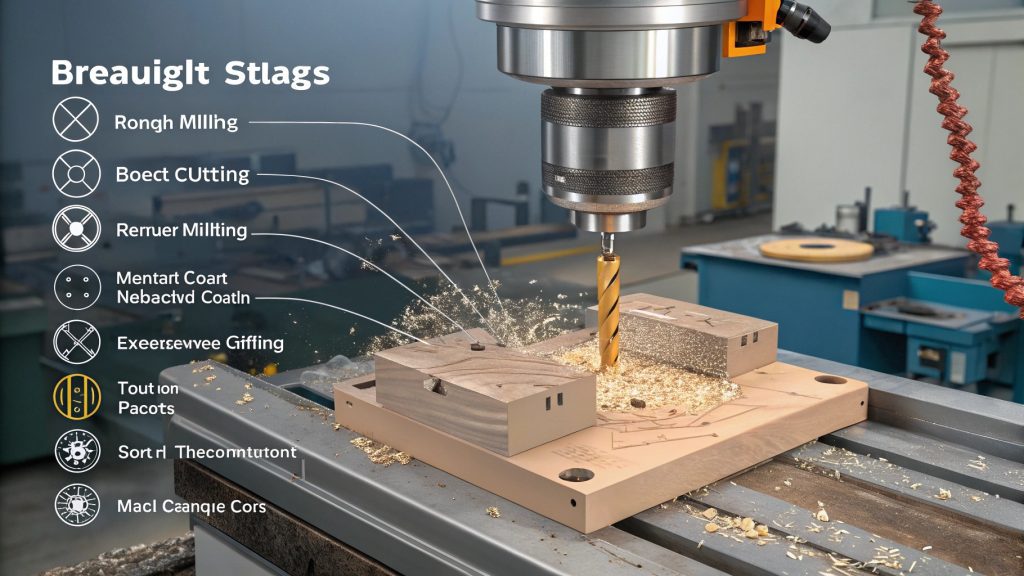
The actual cutting that happens during milling isn't just one quick pass. We break it down into distinct stages to achieve the best results. I often tell my team, "Don't try to do everything at once with a single cut!" My years of experience have shown that following a proper sequence is vital. This is especially true for complex parts or larger components like the custom brackets and intricate housings we often produce.
Initial Stage: Rough Milling
First, we perform rough milling. The main goal here is to remove as much excess material from the workpiece as possible, as quickly as possible. We use robust cutting tools and often higher feed rates and deeper cuts. The surface finish isn't the top priority at this stage. It's all about efficiently getting the part close to its final shape. This saves a lot of time.
Intermediate Stage: Semi-Finish Milling (Sometimes Necessary)
For some parts, especially those that require very tight tolerances or have complex geometries, we might include a semi-finishing pass. This step refines the shape further after roughing. It prepares the surface for the final finishing cut. It helps in achieving better dimensional accuracy and a more uniform surface before the critical final cuts. I find this step particularly useful for parts made from tougher materials.
Final Stage: Finish Milling
Then comes the finish milling stage. Here, we typically use different, often sharper, cutting tools. We also use slower feed rates and shallower depths of cut. The focus is entirely on achieving the precise final dimensions and the specified surface finish. This is the stage where the part really takes its final, high-quality form, meeting all the engineering specifications.
I also always emphasize a general rule of thumb to my machinists: it's often best to machine flat surfaces (faces) before creating features like holes or slots. This is because machining the primary faces first provides a stable and accurate reference surface for subsequent operations. For example, if you mill a face flat, you can then more accurately position and drill holes relative to that flat surface. This order helps maintain overall precision, particularly on larger parts.
How to operate a CNC machine step by step?
Want to know how an operator actually handles a CNC machine? It requires skill, care, and attention to detail. I'll walk you through the operator's steps.
Operating a CNC machine involves loading the G-code program, carefully setting up tools and the workpiece, performing test runs or simulations, monitoring the active machining process, and making adjustments if needed.

Running a CNC machine is a skilled job. It’s much more than just pressing a start button and walking away. I've trained many operators over the years, and I always stress that precision and vigilance are key to successful CNC machining. Even with automation, the human element is critical.
Here’s a general look at what an operator typically does:
1. Program Loading and Verification
The operator first loads the G-code program into the CNC machine's controller. This might be done via a USB drive, a network connection, or direct input. They often review the code on the machine's interface. A very important step is to run a simulation or a "dry run" (where the machine goes through the motions without cutting material) to visually check the tool paths and ensure there are no potential collisions or errors in the program. I always insist on this safety and quality check.
2. Workpiece and Tool Setup
Next, the operator securely mounts the workpiece (the raw block of material) onto the machine bed. This is done using clamps, vises, or custom fixtures. It must be held rigidly. They also load the correct cutting tools into the tool magazine or directly into the spindle if it's a manual tool change machine. A crucial task here is to accurately set the tool offsets. These offsets tell the machine the exact length and diameter of each tool, which is vital for accurate cutting.
3. Setting Work Zero (Datum)
The operator then establishes the "work zero" or "datum point." This is a specific reference point on the workpiece from which all the machine's programmed movements are calculated. This can be a corner, the center of a feature, or any other designated spot. Getting this wrong means the whole part will be wrong, so it's a critical step.
4. Machining and Monitoring
With everything set and double-checked, the operator starts the machining cycle. During the process, they don't just leave. They carefully monitor the machine. They listen for unusual sounds (which can indicate tool wear or other problems), watch the chip formation, and check for coolant flow. They might need to make small adjustments to feed rates or spindle speeds (override) to optimize the cutting conditions.
5. Part Inspection and Unloading
Once the machining is complete, the operator safely unloads the finished part from the machine. They usually perform initial quality checks, measuring critical dimensions with tools like calipers or micrometers to ensure it meets specifications. They also clean the machine, remove chips, and prepare for the next job. It's a continuous cycle of precision work.
How does CNC machining work?
Wondering about the core principle behind all CNC machining? It’s a truly fascinating automated process used everywhere. I’ll explain the fundamental concept clearly for you.
CNC machining is a subtractive manufacturing process. It uses computer-controlled machine tools, like mills or lathes, to precisely remove material from a workpiece, shaping it into a custom-designed part based on a digital model.

CNC machining is a broad term, and CNC milling, which we've been discussing, is a key type of it. I often explain to my clients, especially those new to manufacturing, that CNC machining is like having a highly precise, automated sculptor working from a digital blueprint.
The "CNC" part stands for Computer Numerical Control. At its very heart, CNC machining works by taking a digital design and transforming it into a physical object through controlled material removal.
Here's a simple breakdown of the general principle:
-
Design Input: It all begins with a digital design. This is most commonly a CAD (Computer-Aided Design) file, which is a 2D or, more often, a 3D model of the part you want to create. This file contains all the geometric information.
-
Instruction Generation (Programming): This CAD file is then processed by CAM (Computer-Aided Manufacturing) software. The CAM software, sometimes with manual input from a programmer, generates a set of machine-readable instructions. This is typically in a language called G-code. This code tells the machine tool exactly what to do – where to move its axes, how fast to move, which cutting tool to select, when to turn coolant on or off, and many other parameters.
-
Automated Execution by the Machine: The CNC machine's controller reads this G-code. The machine itself has motors and drive systems that precisely move the cutting tool or the workpiece (or sometimes both) along multiple axes. For example, a 3-axis milling machine moves in X (left/right), Y (front/back), and Z (up/down) directions. More advanced machines, like the 5-axis machines we use at Worthy, have additional rotational axes for even more complex shapes.
-
Material Removal (The "Subtractive" Part): As the cutting tool and workpiece move relative to each other according to the G-code instructions, the sharp cutting tool removes material from the raw stock (like a block of aluminum or steel). This is why CNC machining is called a "subtractive" manufacturing process – we subtract or take away material to arrive at the final desired shape. This is the opposite of additive manufacturing processes like 3D printing, where material is added layer by layer.
This automated, highly precise method of material removal allows us at Worthy to create very complex parts with extremely tight tolerances, consistently and efficiently.
Conclusion
CNC milling is a precise, automated process. It turns digital designs into physical parts using controlled material removal. It's a true cornerstone of modern manufacturing.