
What Is the Difference Between Hardness and Toughness in Metal Materials?

Confused about metal properties? Picking the wrong one costs you. Let's clear up hardness and toughness now.
Hardness is a metal's ability to resist scratches and dents. Toughness is its power to absorb impact without breaking. Think of hardness as resisting surface damage and toughness as resisting sudden fracture.
Understanding just the basic definitions is a good start. But there's so much more to know if you really want to pick the best material for your CNC machining parts. Let's explore these properties more deeply so you can make informed decisions for your projects.
What is the difference between hardness and toughness of metal?
Still mix up hardness and toughness in metals? This can lead to bad choices. Let's clearly define their distinct roles now.
The main difference is how a metal responds to force. Hardness resists surface indentation or scratching. Toughness measures how much energy a metal can absorb before it fractures, especially under impact.
When I talk to clients like Mark Chen from Canada, who needs reliable CNC machining parts, the choice of material is always a big discussion. He needs quality, but also good pricing. Getting the material properties right is key. Hardness and toughness are two properties often discussed, and sometimes confused.
Understanding Their Core Nature
Hardness is really about how well a metal resists localized plastic deformation. Imagine trying to scratch a metal surface with a sharp object, or press a small, hard ball into it. A harder metal will show less of a mark. We often measure this using scales like Rockwell or Brinell. This is super important for parts that experience friction or wear.
For example, for bearing surfaces or cutting tools, high hardness is usually a must. At Worthy Hardware, we frequently work with materials where hardness specifications are critical, ensuring parts like gears or shafts can withstand operational stresses.
Toughness, on the other hand, is about a material's ability to absorb energy and deform plastically before fracturing. Think of it as the material's resistance to breaking when it's hit suddenly. This is often tested using impact tests, like the Charpy or Izod tests. A tough material can take a hit and might bend or deform, but it won't easily shatter.
For parts that might face sudden loads or impacts, like components in automotive applications or construction equipment, toughness is critical. A material can be very hard, like some ceramics, but not very tough – it might shatter easily if dropped. That's why understanding both is so important for custom CNC parts, and it’s something we always discuss with our clients to ensure the final product meets their performance needs.
What is toughness in metals?
Is 'toughness' just a buzzword for strong metals? Misunderstanding it means failed parts. Let's really explore what metal toughness means for you.
Toughness in metals is their ability to absorb energy and deform before fracturing. It's crucial for parts that experience sudden impacts or loads, preventing them from shattering or breaking abruptly.
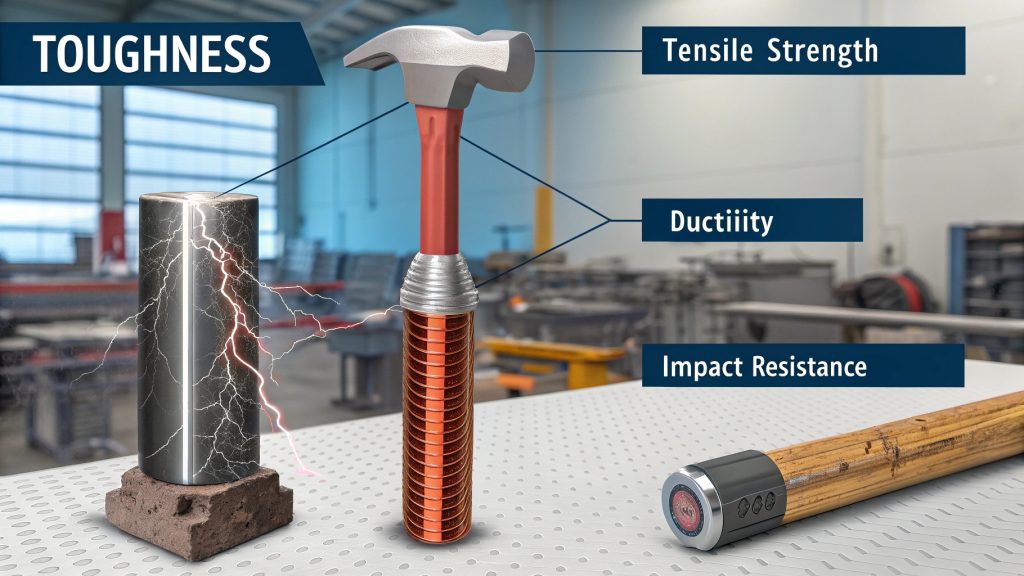
I remember a project for an aerospace client where toughness was the absolute top priority. The parts we were machining at Worthy Hardware had to withstand extreme conditions and potential impacts. So, what exactly is this 'toughness' we were so focused on?
The Essence of Toughness
Toughness isn't just about strength. A material can be very strong (high tensile strength) but brittle (low toughness). Toughness combines strength and ductility. Ductility is the ability of a material to deform plastically under tensile stress, like being drawn into a wire. A tough metal can absorb a lot of energy, both by resisting the force (strength) and by deforming (ductility) before it actually breaks. This means that when a tough part is overloaded, it’s more likely to bend or stretch rather than snap, which can be a crucial safety feature.
Consider these aspects:
-
Impact Resistance: This is where toughness truly shines. Think of a hammer blow. A tough material won't just snap. It will absorb the energy of the blow.
-
Crack Propagation: Tough materials are better at resisting the growth of cracks. Even if a small crack starts, a tough material can often stop it from spreading quickly and causing catastrophic failure. This is vital for components where unexpected flaws might occur.
-
Temperature Dependency: For many metals, toughness can change significantly with temperature. For example, some steels become much more brittle at low temperatures. We always have to consider the operating environment of the part we're making.
So, when we're selecting materials for high-impact applications, like for some automotive components or safety-critical parts in robotics, we look for good toughness. It’s a measure of how much of a beating a material can take. For our clients who need reliable parts, this is a peace-of-mind property.
What is the relationship between hardness and toughness?
Do hard metals mean tough metals? Or vice-versa? Confusing this means wrong materials. Let's clarify the typical link between hardness and toughness.
Generally, hardness and toughness have an inverse relationship in metals. As a metal's hardness increases, its toughness often decreases, and vice versa. It's a trade-off material engineers frequently manage.
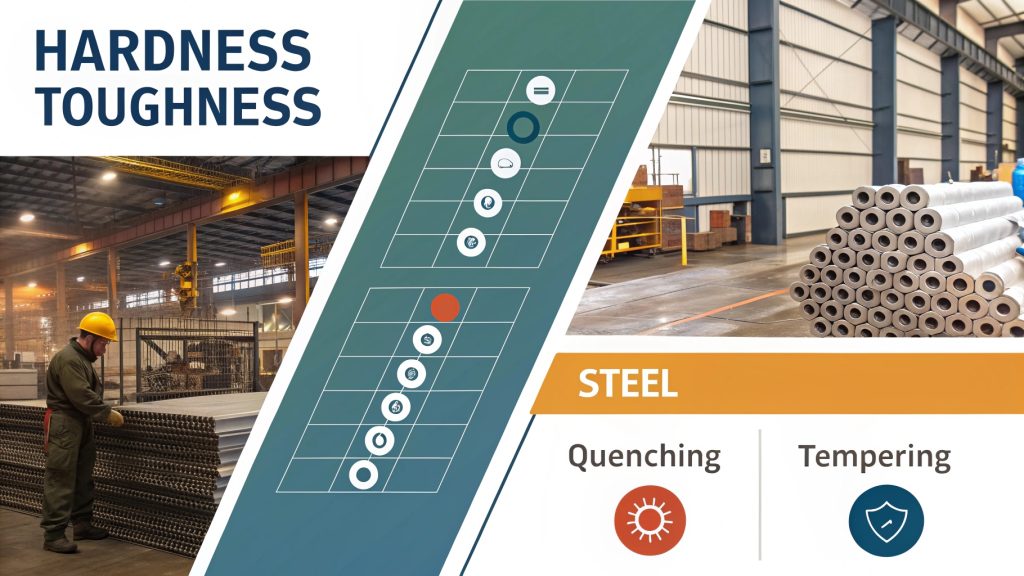
This is a question I get a lot, especially from customers like Mark who are balancing performance and cost for their CNC machined parts. It's a common misconception that a really hard material must also be super tough. In my experience, it's usually a trade-off, and it's a critical factor in material selection.
The General Inverse Relationship
Most of the time, as you make a metal harder, it tends to become more brittle, meaning its toughness goes down. Think about it: processes that increase hardness, like heat treatment (quenching and tempering for steels) or work hardening, often do so by changing the metal's microstructure. These changes can make it more difficult for dislocations (tiny defects in the crystal structure) to move. This resistance to dislocation movement is what makes the material harder and stronger, but it also reduces its ability to deform plastically and absorb energy before fracturing.
Here's a simple way to think about it:
| Property | Effect of Increasing Hardness | Typical Implication for Toughness |
|---|---|---|
| Hardness | Increases | Often Decreases |
| Toughness | Often Decreases | Increases |
However, this isn't a universal, absolute rule. There are advanced alloys and specific heat treatments designed to optimize both hardness and toughness, but for many common metals like various steels, aluminum alloys, and titanium grades we work with, the inverse relationship holds true.
For instance, a very hard tool steel is excellent at cutting and resisting wear, but it might chip or break if you drop it hard. A softer, tougher steel, like one used for car bodies, might dent more easily but will absorb impact much better in a collision.
At Worthy Hardware, helping customers navigate this trade-off for their specific application is a key part of our service. We aim for the sweet spot that delivers the required performance without unnecessary cost or risk of failure.
What is the difference between hardness and toughness of aggregate?
Do hardness and toughness apply to aggregates like stone? Yes, but it's different. Confusing this can cause problems. Let's look at aggregates specifically.
For aggregates, hardness still relates to resisting abrasion and wear. Toughness (or impact value) refers to the aggregate's ability to resist crushing or breaking under sudden loads or impacts from machinery or traffic.
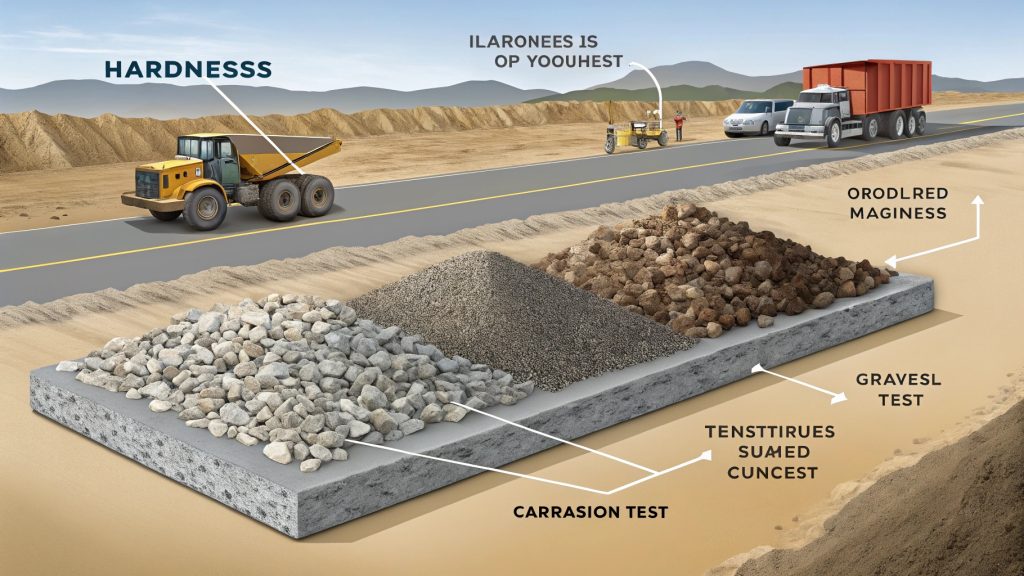
While my primary business at Worthy Hardware is CNC machining of metals and plastics, the concepts of hardness and toughness are fundamental material properties that apply across different fields. I was once discussing material science with an engineer who worked with construction materials, and he brought up aggregates. It's interesting to see the parallels and differences because it highlights how universal these engineering principles are.
Hardness and Toughness in Aggregates
In the context of aggregates (like crushed stone, gravel, or sand used in concrete or asphalt), these terms have specific meanings relevant to their end-use:
-
Hardness of Aggregate: This generally refers to its resistance to abrasion and wear. For example, in road construction, the aggregate in asphalt needs to be hard enough to resist the grinding action of vehicle tires. Tests like the Los Angeles Abrasion test are used to measure this. A softer aggregate would wear down quickly, leading to road surface degradation and requiring more frequent repairs. This is similar to wanting a metal part to resist wear from friction.
-
Toughness of Aggregate: This is often called 'impact value' or 'crushing value'. It measures the aggregate's ability to resist breaking or crushing under sudden impact loads, such as those from heavy machinery during construction or repeated traffic loads. Aggregates used in concrete for high-stress applications, like in building foundations or bridges, need good toughness to prevent them from fracturing under load. This ensures the structural integrity of the concrete.
While the core ideas of resisting surface wear (hardness) and resisting fracture under impact (toughness) are similar to metals, the testing methods and specific failure mechanisms are different. For metals, we're often concerned with plastic deformation at a microscopic level and yield strength. For aggregates, it's more about particle integrity and resisting breakdown into smaller pieces. Understanding these nuances is crucial in every field of engineering, whether you're making precision parts or building a highway.
Conclusion
So, hardness resists surface damage, while toughness resists breaking from impacts. Understanding this key difference helps you choose the right materials for any job.