
What Are The Different Grades Of Titanium And How Do You Choose The Right One?

Choosing titanium for your project is smart, but the grades are confusing. This confusion can lead to costly mistakes. I will help you understand the differences and make the right choice.
Choosing the right titanium grade means matching the material to your needs. You need to consider strength, corrosion resistance, temperature, and cost. For general use, Grade 2 (TA2) is great. For high strength, Grade 5 (TC4) is the top choice. It all depends on your application.
Choosing a material can feel like a big challenge. Titanium is famous for being light and strong, but not all titanium is the same. There are many different grades, and each one is suited for a different job. If you pick the wrong one, your part might fail or you might spend too much money. I want to walk you through this process. My goal is to give you the confidence to select the perfect titanium grade for your next project, ensuring you get the best performance without overspending.
What are the differences between the grades of titanium?
Feeling lost with grade names like TA2 or TC4? Choosing the wrong one can cause big problems for your project. I'll break down the main differences in a simple way.
The primary differences between titanium grades are their alloy content and resulting mechanical properties. Commercially pure (CP) grades, like TA1-TA3, are unalloyed and prized for corrosion resistance. Alloyed grades, like TC4 (Grade 5), add elements like aluminum and vanadium for much higher strength.
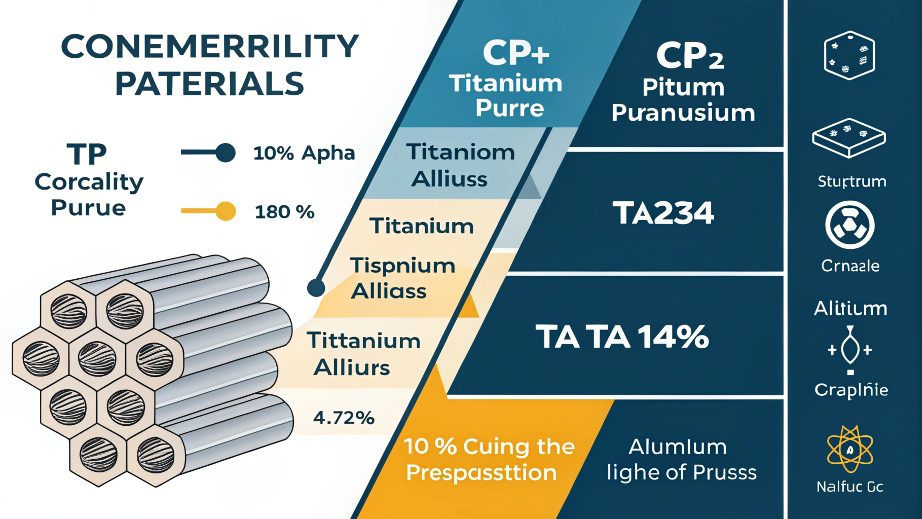
The world of titanium can be broken down into a few main groups. Understanding these groups is the first step to choosing the right material.
Main Titanium Categories
The most common types you'll see are commercially pure (CP) titanium and various titanium alloys. In my experience, these cover almost every application we see at Worthy Hardware.
-
Commercially Pure (CP) Titanium: These are grades like TA1, TA2, and TA3. Think of them as nearly 100% titanium. Their main benefit is amazing corrosion resistance. They are not as strong as the alloys, but they are easier to form and weld. TA2 (Grade 2) is the most common workhorse in this group.
-
Titanium Alloys: These are mixtures. We add other metals to the titanium to give it special properties, usually much higher strength.
- Alpha-Beta Alloys: The most famous one is TC4, also known as Ti-6Al-4V or Grade 5. It has aluminum and vanadium added. This alloy gives you a fantastic combination of high strength, light weight, and good corrosion resistance. It's the most widely used titanium alloy in the world.
- Other Alloys: There are also special alloys for unique jobs. For example, some alloys like TA9 and TA10 have palladium added for even better corrosion resistance in very harsh chemical environments.
Here is a simple table to show the differences:
| Category | Common Grades | Key Characteristic | Best For |
|---|---|---|---|
| Commercially Pure | TA1, TA2 (Grade 2), TA3 | Excellent Corrosion Resistance | Marine parts, chemical processing |
| Alpha-Beta Alloy | TC4 (Grade 5) | High Strength-to-Weight Ratio | Aerospace, performance auto parts |
| Corrosion-Resistant Alloy | TA9, TA10 | Extreme Corrosion Resistance | Chemical reactors, harsh environments |
What is the best grade for titanium?
Everyone wants the "best" material for their project. But picking a titanium grade that is too strong or specialized is just a waste of money. Let's find the "best" for your specific needs.
There is no single "best" grade of titanium. The best choice depends on your specific job. Grade 5 (TC4) is the most popular for its high strength, while Grade 2 (TA2) is perfect for applications needing great corrosion resistance without extreme strength.
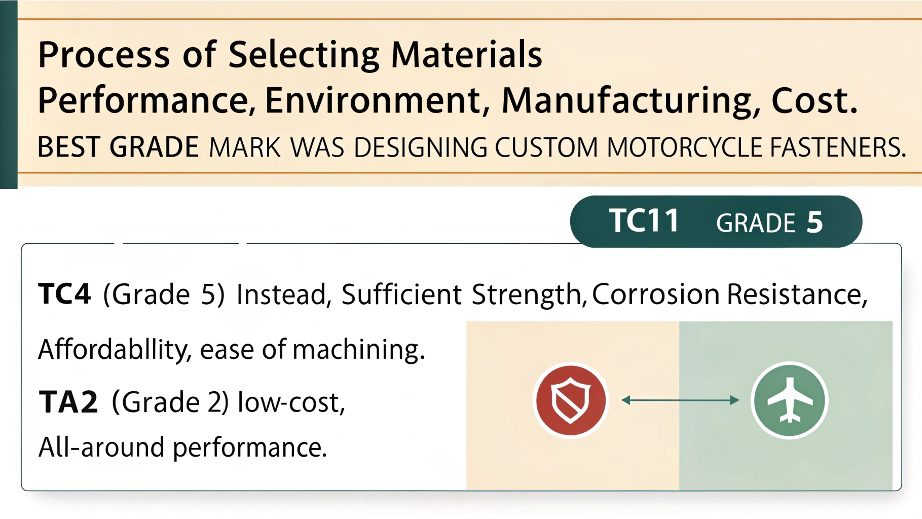
Finding the "best" grade means balancing a few key factors. I always ask my clients to think about four things: performance, environment, manufacturing, and cost. Your answers will point directly to the ideal material.
For example, I once worked with a customer, Mark, who was designing a set of custom motorcycle fasteners. He initially requested a quote for TC11 because he read it was great for high temperatures. We talked about his project, and I learned the fasteners wouldn't see extreme heat. They just needed to be strong, light, and look good.
I suggested we use TC4 (Grade 5) instead. It offered more than enough strength and great corrosion resistance for riding in all weather, but it was much more affordable and easier for us to machine. He saved nearly 30% on his project, and the parts were perfect for the job.
So, how do you decide? Here’s a simple guide based on your top priority:
-
If you need a low-cost, all-around performer: Choose TA2 (Grade 2). It has excellent corrosion resistance and enough strength for most general industrial or consumer product parts.
-
If you need maximum strength: Choose TC4 (Grade 5). This is your go-to for aerospace parts, high-performance automotive components, and medical implants.
-
If you need the absolute best corrosion resistance: Look at TA9 or TA10. These are for extreme situations, like inside a chemical processing tank.
-
If you need to withstand high heat: Grades like TC11 or Ti600 are designed for high-temperature engine components.
The "best" grade is the one that meets your requirements without unnecessary expense.
How do you grade titanium?
The grading system with all its numbers and letters can look complex. This confusion might make you feel unsure about your material. I will explain exactly how titanium is graded.
Titanium is graded based on its chemical makeup and mechanical strength, following standards set by organizations like ASTM. Commercially pure (CP) grades 1-4 are defined by oxygen content, which controls strength. Alloyed grades are defined by the specific metals added to the titanium base.
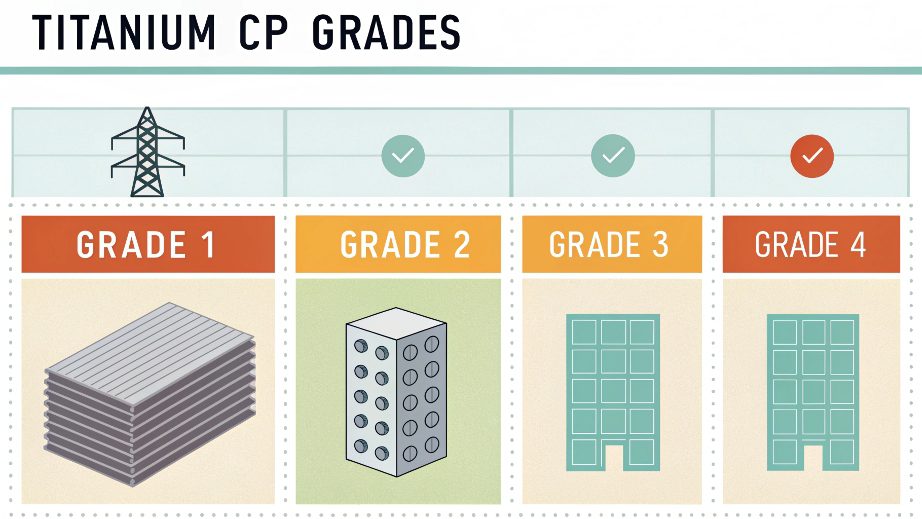
The grading system is actually very logical once you understand the basics. It's all about what's inside the metal and how it behaves.
The most common system is from ASTM International. It divides titanium into two main families.
1. Commercially Pure (CP) Grades
These are numbered Grade 1 through Grade 4. They are mostly pure titanium, but they contain small, controlled amounts of oxygen and iron. These elements are not considered alloys but are critical for determining the material's strength.
-
Grade 1: Has the least oxygen. It is the softest, most ductile, and easiest to form.
-
Grade 2: The most common pure grade. It's a bit stronger than Grade 1 but still has great formability and excellent corrosion resistance. This is our go-to for many general applications.
-
Grade 3: Stronger than Grade 2, but less formable.
-
Grade 4: The strongest of the pure grades. It's often used for airframe parts or medical devices where you need higher strength than Grade 2 but still want a pure, unalloyed material.
2. Alloyed Grades
These grades have higher numbers, like Grade 5, Grade 7, Grade 9, and so on. They are defined by the elements that are intentionally added to the titanium to change its properties.
| Grade | Type | Key Feature | Common Use |
|---|---|---|---|
| Grade 2 | CP | Best balance of strength and formability in CP grades | Marine hardware, chemical pipes |
| Grade 4 | CP | Highest strength CP grade | Medical instruments, airframe parts |
| Grade 5 | Alloy | Very high strength, heat treatable | Aerospace, racing, performance parts |
| Grade 7 | Alloy | Best corrosion resistance (Palladium added) | Chemical processing equipment |
The grade number tells a story. Lower numbers in the pure family mean more ductility, while higher numbers mean more strength. For alloys, the grade number points to a specific recipe designed for a specific purpose.
Which is better Grade 4 or Grade 5 titanium?
You might be stuck between Grade 4 and Grade 5. They sound close, but picking the wrong one could hurt your part's performance. Let's compare them directly so the choice is easy.
Grade 5 is much stronger than Grade 4 because it is an alloy (Ti-6Al-4V). For applications that need high strength, Grade 5 is better. However, Grade 4 is a pure grade, so it is easier to form and weld, which can be a big advantage.
Choosing between Grade 4 and Grade 5 comes down to a simple trade-off: ultimate strength versus manufacturability. They are both excellent materials, but they shine in different areas. Let's look at the key differences.
Strength:
This is the biggest difference. Grade 5 is an alpha-beta alloy, and it is significantly stronger than Grade 4. In fact, Grade 5 is the workhorse of the aerospace industry precisely because of its incredible strength-to-weight ratio. Grade 4 is the strongest of the commercially pure grades, but it cannot compete with Grade 5 on pure tensile or yield strength.
Formability and Weldability:
Here, Grade 4 has the advantage. Because it is a pure, unalloyed metal, it is more ductile. This means it can be bent, stamped, and formed into complex shapes more easily than the stiffer, stronger Grade 5. It is also simpler to weld. We once had a client who needed a complex fluid tank with many curves. Grade 5 was strong enough, but it kept cracking during the forming process. We switched to Grade 4. It still met all the pressure requirements and was much easier for us to manufacture, saving time and money.
Corrosion Resistance:
Both have fantastic corrosion resistance in most environments, like saltwater. They are very similar in this regard for most common applications.
Here is a quick summary:
| Feature | Grade 4 (Pure) | Grade 5 (Alloy) | The Winner Is... |
|---|---|---|---|
| Strength | Good | Excellent | Grade 5 |
| Formability | Excellent | Fair | Grade 4 |
| Weldability | Good | Fair | Grade 4 |
| Cost | Lower | Higher | Depends on budget |
So, the choice is clear. If your design is all about withstanding high stress and loads, and the shape is relatively simple to machine, choose Grade 5. If your part has a complex shape that requires a lot of forming, and the strength of the strongest pure titanium is enough, choose Grade 4.
Conclusion
Choosing the right titanium is simple when you match the grade to your job. Consider strength, corrosion, and cost to find the perfect fit. For expert help, contact me at Worthy Hardware.