
What Are The Main Differences Between Nylon 6 And Nylon 6,6 In CNC Machining Applications?

Choosing the wrong nylon can ruin your CNC project. You might face unexpected part failures or processing headaches. Understanding their key differences ensures success for your parts.
Nylon 6 offers excellent toughness and processability, ideal for complex shapes in CNC machining. Nylon 6,6 boasts superior strength, stiffness, and higher temperature resistance, making it great for demanding mechanical parts. These differences significantly impact machining outcomes and final part performance.
So, you're looking at Nylon 6 and Nylon 6,6 for your next CNC machining project. It's a common point of selection, and getting it right is very important. Let's explore what sets these materials apart in detail. This way, you can pick the perfect one for your needs and make sure your project runs smoothly from start to finish.
What is the difference between nylon 6 and nylon 6 6 (PA66)?
Are you confused about Nylon 6 (PA6) versus Nylon 6,6 (PA66)? Picking incorrectly leads to wasted material and valuable time. Let me clarify their distinct characteristics for you.
PA6 generally has good toughness and is easier to process due to better melt flow characteristics. PA66 typically offers higher mechanical strength, stiffness, and superior heat and wear resistance. These properties make them suitable for different CNC machining applications.
In our CNC machining shop, when we look at Nylon 6 and Nylon 6,6, they appear quite similar on the surface. But their performance capabilities can be very different. I've learned this through many projects over the years. PA6 is fantastic for its mechanical wear resistance.
It also processes very well in CNC machines. Its melt flow is strong, which makes it easier to form into complex shapes, especially if injection molding were a consideration after prototyping via CNC. On the other hand, PA66 has a higher melting point. This characteristic gives it better thermal stability.
For example, parts like automotive engine brackets or high-load gears often use PA66. So, my general rule from experience is this: if your part needs to withstand high temperatures, PA66 is usually the better selection. If you need heavy processing capabilities or excellent toughness for your part, PA6 is often the way to go.
Making the right material choice from the start means your machining process will be much smoother and the final part will perform as expected. This is why we always discuss the application with clients like Mark Chen to ensure the best fit.
Here's a simple table to show some key differences:
| Feature | Nylon 6 (PA6) | Nylon 6,6 (PA66) |
|---|---|---|
| Chemical Origin | Single monomer (caprolactam) | Two monomers (hexamethylenediamine and adipic acid) |
| Melting Point | Lower (around 220°C or 428°F) | Higher (around 265°C or 509°F) |
| Strength & Stiffness | Good | Higher |
| Impact Toughness | Excellent | Good |
| Moisture Absorption | Higher | Lower (but still notable) |
| Processability | Easier, better melt flow | More critical processing window |
| Heat Resistance | Good | Better |
| Typical CNC Uses | Bushings, rollers, general parts | Gears, structural parts, engine area |
Understanding these points is crucial for successful CNC machining.
What is the best nylon for machining?
Do you want the "best" nylon for your machining job? Choosing without full knowledge can easily compromise your part's quality. Let's find what "best" truly means for your specific needs.
There is not one single "best" nylon for all CNC machining. Nylon 6 might be better for intricate parts due to its flow. Nylon 6,6 is often preferred for parts needing higher strength and temperature resistance. The application dictates the ideal choice.
Deciding on the "best" nylon for CNC machining really depends on what you need the final part to do and the conditions it will face. It’s not a one-size-fits-all answer, unfortunately. For instance, if I'm working on a part with very complex geometries or fine details, Nylon 6 might be my go-to. Its generally better melt flow characteristics (more relevant for molding, but indicating easier shaping) can translate to smoother machining for intricate features. It can be a bit more forgiving.
However, if the part needs to be very strong, maintain its shape under significant load, or operate at elevated temperatures, then Nylon 6,6 often comes out on top. Its higher melting point and greater stiffness are big advantages in such scenarios. We also consider how the material behaves during the actual machining process. Some nylons can be a bit "gummy," so using extremely sharp tools and precisely correct speeds and feeds is critical to avoid melting or poor surface finish.
At Worthy, we’ve machined countless nylon parts. We know how to adjust our CNC machining processes for both PA6 and PA66 to achieve those tight tolerances our customers require. Sometimes, this means tolerances down to sub +/- 0.001 inches when a customer's drawing specifically calls for it. So, the "best" nylon is always the one that best meets your specific performance criteria, cost considerations, and machinability for your design.
What is the difference between nylon 66 and 612?
Now there's Nylon 612 in the mix too? More nylon types can create more confusion for your project. Let me explain how Nylon 612 differs from the more common Nylon 66.
Nylon 612 generally has lower moisture absorption compared to Nylon 66. This key difference means Nylon 612 offers better dimensional stability and retains its mechanical properties more consistently, especially in humid environments or wet conditions.
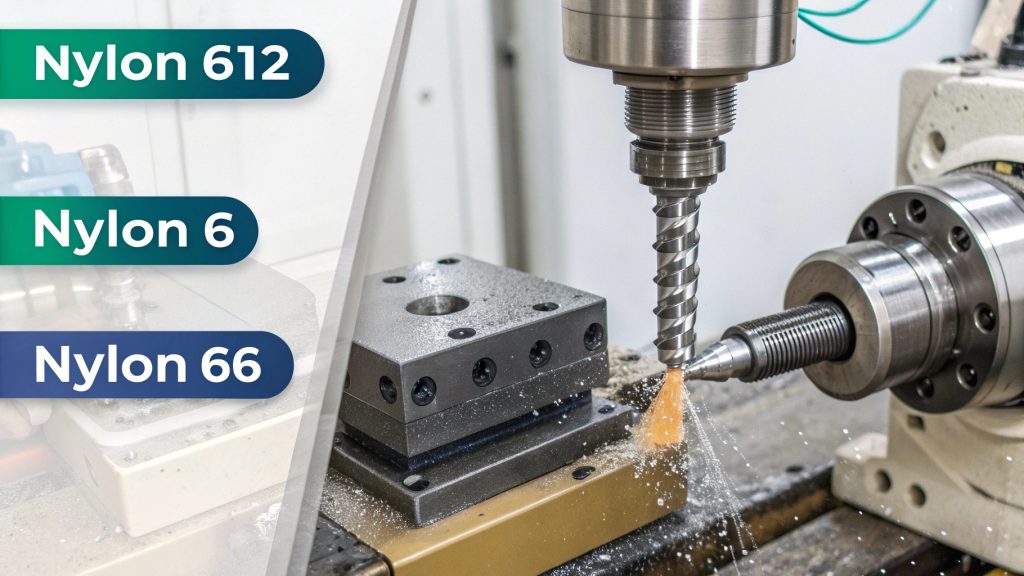
When we look beyond Nylon 6 and Nylon 6,6, sometimes Nylon 612 comes into the discussion for specific CNC machining applications. The main reason customers, or we at Worthy, might consider Nylon 612 is its significantly lower moisture absorption rate. Nylons, as a family of polymers, generally tend to absorb moisture from the surrounding air. This absorption can cause them to swell slightly. It can also change their mechanical properties, like strength, stiffness, and even electrical insulation properties.
Nylon 612is much better in this regard than Nylon 66. Because it absorbs less water, its dimensions stay more stable over time. Its properties are also more consistent, especially if the part will be used in a humid place or directly exposed to water. This stability can be really important for precision CNC machined parts where tight tolerances must be maintained throughout the part's service life.
Nylon 612 also typically offers good chemical resistance. The main trade-off is that Nylon 612 can sometimes be more expensive than Nylon 66. So, if utmost dimensional stability in varying humidity is a critical requirement for your part, and the project budget allows, Nylon 612 is a very strong contender for CNC machining.
Here’s a quick comparison table focusing on these two:
| Feature | Nylon 66 (PA66) | Nylon 612 (PA612) |
|---|---|---|
| Moisture Absorption | Higher | Significantly Lower |
| Dimensional Stability | Good | Excellent (especially in humidity) |
| Mechanical Property Retention (Wet) | Fair to Good | Better |
| Chemical Resistance | Good | Very Good |
| Cost | Moderate | Higher |
| Typical CNC Machined Uses | Gears, structural components | Precision parts, electrical insulators, bristles, components needing high stability |
Choosing between them often comes down to the specific environmental conditions the part will face and how critical dimensional stability is.
What is the tolerance of nylon in machining?
Are you worried about hitting precise dimensions with nylon parts? Machining plastics like nylon can be tricky if you don't understand their inherent limits. Let's talk about achievable tolerances.
CNC machining nylon to tight tolerances is certainly possible but requires careful control and expertise. Nylon's thermal expansion and moisture absorption mean tolerances are generally wider than for metals. Typically, +/- 0.010 inches is standard for plastics, but tighter is achievable.
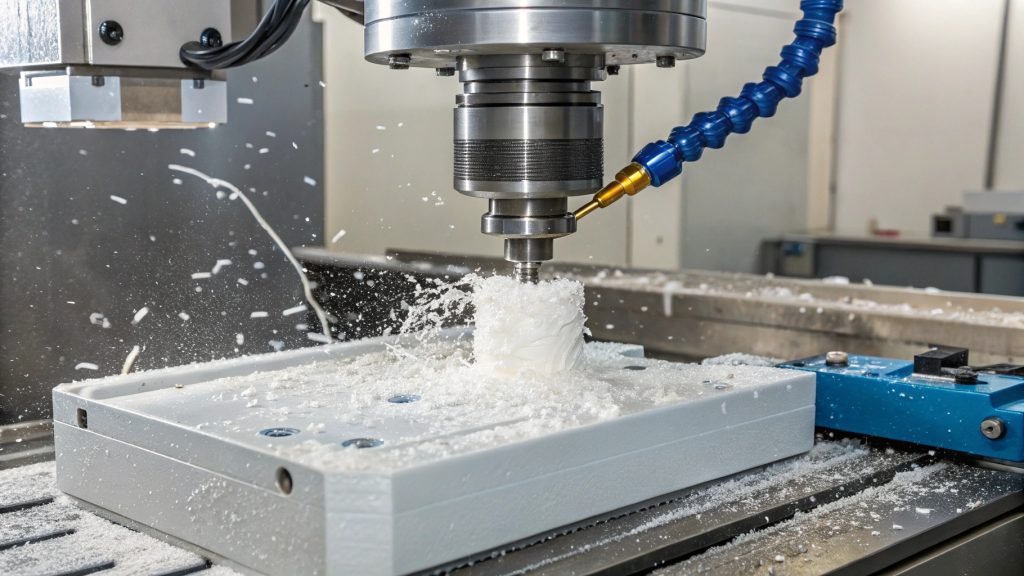
Achieving tight tolerances when CNC machining nylon requires a good understanding of the material's behavior. Nylons have a significantly higher coefficient of thermal expansion compared to most metals. This means they expand and contract more with temperature changes. This characteristic can directly affect the final dimensions of a machined part. This is especially true if there's a lot of heat generated during the machining process, or if the ambient temperature in the workshop fluctuates considerably.
Moisture absorption is another big factor, as I mentioned earlier when discussing Nylon 612. As nylon absorbs moisture from the air, it can swell, changing its size. So, for very precise parts, the raw material might need to be conditioned properly before machining, or these potential changes must be accounted for in the design and machining strategy. Our standard tolerance for plastic parts at Worthy is +/- 0.010 inches, which is a common industry practice.
However, we can definitely hold tighter tolerances. We can achieve sub +/- 0.001 inches if the part design allows, the specific grade of nylon is suitable, and it's clearly specified on the engineering drawing with appropriate GD&T (Geometric Dimensioning and Tolerancing) callouts.
To do this, we use extremely sharp tooling, carefully optimize cutting speeds and feeds to minimize heat buildup, and sometimes use coolants. Careful and frequent inspection during and after machining is also absolutely key. So yes, precise nylon parts are very achievable, but it takes experience, the right equipment, and a meticulous approach to the entire process.
Conclusion
Choosing between Nylon 6, 6,6, or even 612, depends on your application's specific thermal, mechanical, and environmental needs. Understanding their differences ensures your CNC machined parts perform perfectly.