
What Are The Differences Between Composite Materials And Traditional Metals For CNC Machining?

Choosing materials for CNC machining can be confusing. You want great results, but different materials act differently. How do you pick the best one for your needs?
Composite materials and traditional metals mainly differ in their strength, hardness, and how they manage heat during CNC machining. These differences affect tool selection, cutting speeds, and the final quality of the machined part.
Understanding these differences is really important. It helps you make smart choices for your projects. Let's look closer at what makes these materials unique and how that changes the machining process. Knowing this can save you a lot of headaches and money down the line. We've seen many clients, like Mark Chen from Canada, benefit from understanding these nuances to get the best quality at competitive prices.
How is CNC machining different from traditional machining?
Old ways of making parts often meant a lot of handwork. Now, CNC offers amazing accuracy and speed. But what really sets this modern method apart from the older techniques?
CNC machining uses computers to guide machine tools, leading to very precise and consistent parts. Traditional machining depends more on a person's skill, which can mean more variation between parts.
Let's dive deeper into what makes CNC machining a big step forward. Traditional machining required a skilled operator to manually control the cutting tools, lathes, or mills. This meant the quality and consistency of parts heavily relied on the operator's experience and attention on any given day. It was a craft, but it also introduced human error and limitations in complexity and speed. I remember early in my career, watching artisans work, and while their skill was incredible, producing identical parts in large volumes was a huge challenge.
Automation and Control
CNC, which stands for Computer Numerical Control, changed all that. Instead of manual levers and handwheels, a computer program (often G-code) directs the machine's movements. This program tells the machine exactly where to cut, how fast to move, and what tool to use. Once the program is set, the machine can run with minimal supervision. This automation is a game-changer for high-volume production, like the services we offer at Worthy Hardware.
Precision and Repeatability
Because a computer controls the process, CNC machines can achieve incredibly tight tolerances, often down to thousandths of an inch (or even tighter, like our +/- 0.001" capability). More importantly, they can repeat these precise cuts over and over again, ensuring that every part is virtually identical. This is crucial for industries where parts must fit together perfectly, like in aerospace or medical devices.
Operator Skill and Involvement
While CNC machining still requires skilled personnel to program the machines, set them up, and perform quality checks, the direct physical skill of manually guiding the cut is removed. The operator's role shifts to overseeing the process, troubleshooting, and ensuring the machines are running optimally. This allows for more complex part geometries that would be very difficult or impossible to achieve manually.
How composite materials are different from conventional materials?
We all know metals like steel and aluminum. But composites are becoming more popular because they're strong and light. Are they always the best choice, and what makes them so different?
Composite materials are made by combining different materials to get better features, like a high strength-to-weight ratio. Conventional materials, such as metals, usually have the same properties all through them.
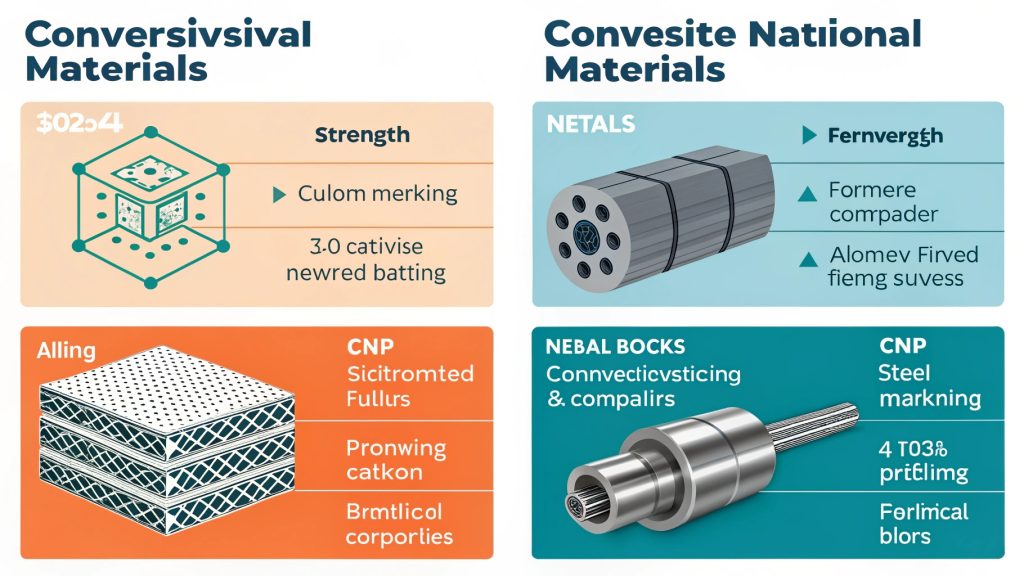
The differences between composites and conventional materials like metals are quite significant, especially when it comes to CNC machining. At Worthy Hardware, we work with both, and understanding these distinctions is key to successful manufacturing. Conventional materials, like a block of aluminum or steel, are generally isotropic. This means their material properties (like strength and stiffness) are the same in all directions. When you machine them, the cutting forces and chip formation are relatively predictable.
Material Composition and Structure
Composite materials, on the other hand, are typically anisotropic. They are made from two or more constituent materials with significantly different physical or chemical properties which, when combined, produce a material with characteristics different from the individual components.
Think of carbon fiber reinforced polymer[^1] – strong carbon fibers embedded in a polymer matrix. The strength of the material is primarily along the direction of the fibers. This layered or fibrous structure means machining them requires a different approach than machining a solid, uniform metal.
Strength-to-Weight Ratio
One of the biggest advantages of composites is their excellent strength-to-weight ratio. They can be as strong as some metals but much lighter. This is why they're so popular in aerospace, automotive, and sporting goods. However, this doesn't always make them easier to machine.
Machining Challenges with Composites
Machining composites presents unique challenges. My experience, and what we always tell our clients, is that the cutting process for composites is very different from metals. The key differences lie in material strength, hardness, and crucially, thermal conductivity. When you machine a composite, the tool encounters varying hardness as it moves through fibers and matrix material. More importantly, many composites are poor conductors of heat.
During cutting, the heat generated doesn't dissipate quickly through the material as it does with most metals. Instead, it concentrates at the cutting edge of the tool. This high temperature can rapidly degrade the tool, reducing its lifespan and potentially damaging the composite material itself through issues like delamination, fiber pull-out, or thermal damage to the resin matrix. We often have to use specialized diamond-coated tools and carefully controlled cutting parameters to manage these effects.
What materials are used in CNC machining?
There are so many materials you can use for CNC machining projects. From soft plastics to very hard metals, the choice is wide. Which ones are most common and why?
CNC machining can shape a huge variety of materials. This includes metals like aluminum and steel, plastics like ABS and PEEK, composites such as carbon fiber, and even different types of wood.
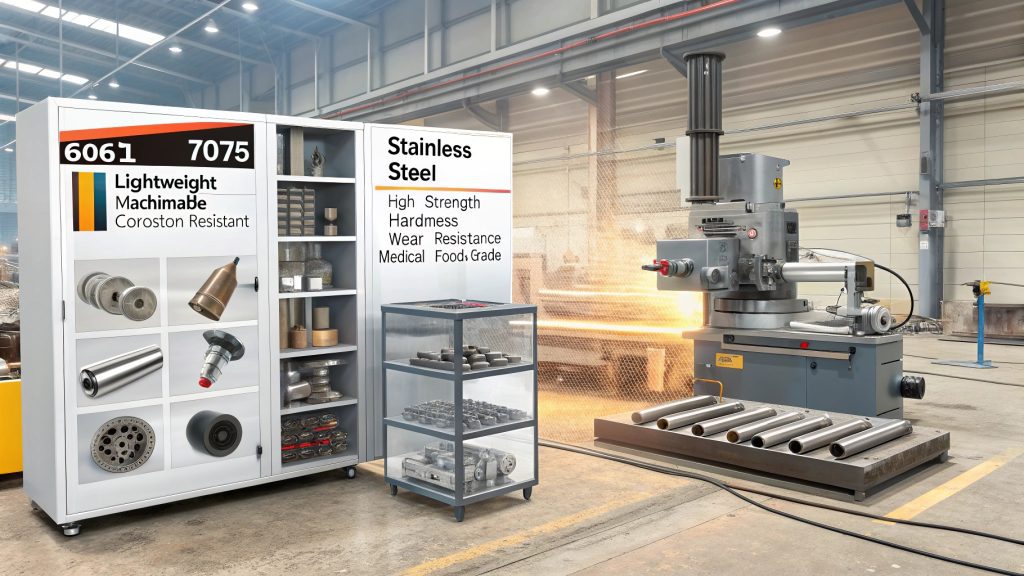
The versatility of CNC machining is partly due to the wide range of materials it can effectively process. At Worthy Hardware, we handle over 100 different materials, so I've seen firsthand how material choice impacts a project. The selection depends heavily on the application's requirements: strength, weight, durability, temperature resistance, chemical resistance, and of course, cost.
Common Metals in CNC
Metals are a staple in CNC machining due to their strength and durability.
-
Aluminum (like 6061 or 7075) is popular because it's lightweight, has good machinability, and offers excellent corrosion resistance. We machine a lot of aluminum parts for everything from consumer electronics to automotive components.
-
Steel (including stainless steel, alloy steel, and tool steel) is chosen for its high strength, hardness, and wear resistance. Stainless steel is also great for medical and food-grade applications due to its corrosion resistance and ease of cleaning.
-
Brass and Copper are valued for their electrical conductivity and corrosion resistance.
-
Titanium is used in high-performance applications like aerospace and medical implants due to its exceptional strength-to-weight ratio and biocompatibility, though it's tougher to machine.
-
Other metals we work with include zinc, bronze, and magnesium alloys.
Popular Plastics for Machining
Plastics offer a wide range of properties and are often more cost-effective for certain applications.
-
ABS is a common thermoplastic known for its toughness and impact resistance.
-
Polycarbonate (PC) offers high impact strength and transparency.
-
Nylon (e.g., Nylon 6/6) is strong, wear-resistant, and has low friction properties.
-
Delrin (Acetal) provides excellent dimensional stability and machinability, often used for precision parts.
-
PEEK is a high-performance thermoplastic with excellent mechanical and chemical resistance properties at high temperatures.
-
Others include Acrylic, HDPE, Polypropylene, PTFE (Teflon), UHMW PE, PVC, and ULTEM.
Other Machinable Materials
Beyond metals and plastics, CNC machines can also handle:
-
Composites: Materials like carbon fiber reinforced polymers and fiberglass are machined for applications requiring high strength and low weight, though they need special tooling and techniques, as I mentioned earlier.
-
Wood: Various hardwoods, softwoods, and engineered woods can be CNC routed for furniture, prototypes, and architectural models.
Choosing the right material is a critical first step, and our team often helps customers navigate these choices to optimize their designs for both performance and cost.
What is the difference between conventional CNC machining and additive manufacturing in detail?
You often hear about CNC machining cutting material away. Then there's additive manufacturing, like 3D printing, which builds parts layer by layer. Both are modern, but how do they really stack up?
Conventional CNC machining is a subtractive process; it removes material from a solid block to create a part. Additive manufacturing, such as 3D printing, is an additive process; it builds objects by adding material layer by layer.
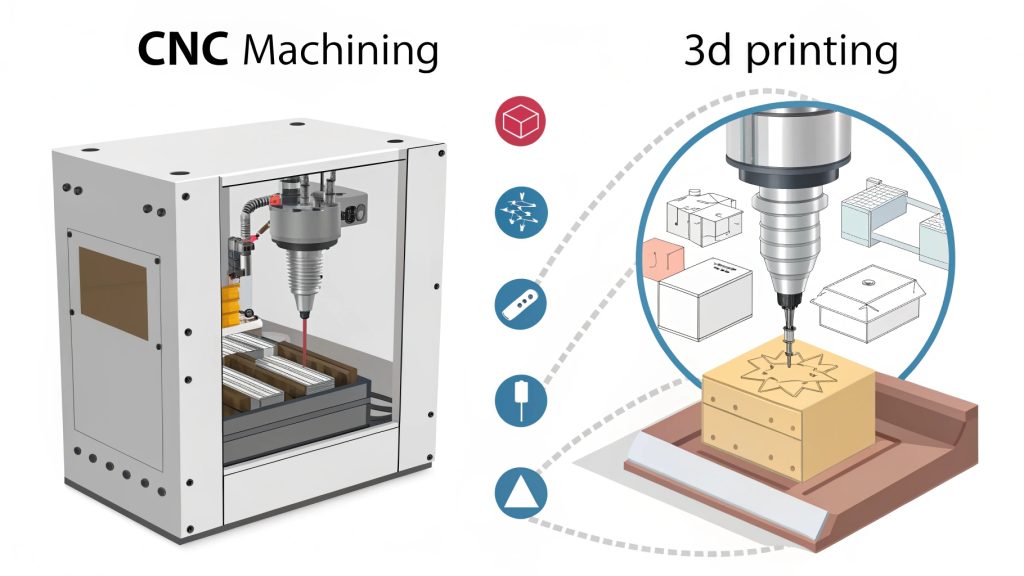
While both conventional CNC machining and additive manufacturing (AM) are used to create parts from digital designs, they operate on fundamentally different principles. At Worthy Hardware, we specialize in CNC machining, which is a subtractive process. However, it's important to understand how it compares to additive methods, as clients often ask about the best approach for their needs.
Subtractive vs. Additive Processes
As the names suggest, subtractive manufacturing starts with a larger block or sheet of material (a "blank") and removes material using cutting tools (drills, mills, lathes) to achieve the desired shape. Think of a sculptor carving a statue from a block of marble. CNC machining automates this sculpting with high precision.
Additive manufacturing, often known as 3D printing, does the opposite. It builds a part layer by layer from raw material, which could be a plastic filament, a resin, or a metal powder. Each layer is fused or bonded to the previous one until the final object is complete.
Material Utilization and Waste
A key difference is material waste. Subtractive processes inherently generate waste material (chips or swarf) from the removed portions of the blank. While this can often be recycled, it's still a consideration. Additive processes tend to use material more efficiently, only depositing it where needed, leading to less waste for complex geometries. However, support structures in some AM processes can create waste.
Suitable Applications and Part Complexity
CNC machining is often preferred for parts requiring high precision, excellent surface finish, and strong material properties, especially with metals. It's very effective for producing robust functional parts, from prototypes to high-volume production runs.
Additive manufacturing excels at creating highly complex geometries, internal features, and customized one-off parts or small batches that would be difficult or impossible to make with subtractive methods. It's fantastic for rapid prototyping because you can go from design to physical part very quickly.
Strength and Surface Finish Considerations
Generally, parts made via CNC machining from a solid block of material tend to have better and more consistent material properties and strength compared to many additive processes, especially those that involve layering. The surface finish from CNC machining is also typically smoother and more precise without requiring extensive post-processing, although AM technologies are continually improving in this area.
For example, our standard as-machined finish is 125 Ra or better.
Both technologies have their place, and sometimes they are even used together. The best choice depends on the specific requirements of the part, including material, complexity, quantity, strength, and desired surface finish.
Conclusion
Composites and metals have key CNC machining differences. Understanding these helps you choose materials wisely, ensuring the best results and efficiency for all your manufacturing projects.