
What’s The Difference Between CNC Milling And CNC Turning?
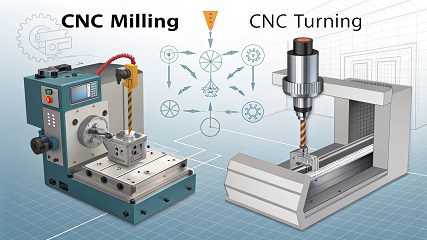
Are you confused about CNC milling and turning? This uncertainty can affect your project choices. Let's clear up these essential machining processes for you.
The main difference is how the material is removed. CNC milling uses rotating multi-point cutting tools on a stationary workpiece. CNC turning, however, rotates the workpiece against a stationary single-point cutting tool. This fundamental distinction dictates their applications and the types of parts they produce.
Understanding these two core CNC machining methods is really important. It helps you choose the right process for your parts, which can save you time and money. I’ve seen many projects benefit from this basic knowledge. Let's dive deeper into what makes them unique and how they work.
LOOP START
What is the difference between CNC milling and CNC turning?
Struggling to see the exact difference between milling and turning? This confusion can be a hurdle. I'll break down their core distinctions for you.
The key difference lies in which part moves. In CNC milling, the cutting tool rotates and moves while the workpiece is fixed. In CNC turning, the workpiece rotates while the cutting tool is typically fixed or moves linearly.
When we talk about CNC milling and CNC turning, the biggest thing to remember, as I mentioned, is how the workpiece and the cutting tool interact. In milling, your part stays still. A cutting tool, often with multiple sharp edges, spins very fast and moves around or across the part to cut away material. Think of it like a sculptor carefully carving details into a stationary block. This is great for making flat surfaces, slots, pockets, and complex shapes.
On the other hand, with CNC turning, the workpiece itself is spinning. A cutting tool, usually with a single cutting point, is brought into contact with the rotating part. This shaves off material, much like how a potter shapes clay on a spinning wheel. This method is perfect for creating cylindrical parts, like shafts, pins, or parts with threads. I often explain it to my clients like this: if you need something round, turning is usually the way to go. If you need something with more complex, non-round features, milling is often the better choice. We frequently handle both types of jobs here at Worthy, and understanding this difference is the first step in good design for manufacturing.
| Feature | CNC Milling | CNC Turning |
|---|---|---|
| Workpiece Motion | Stationary | Rotating |
| Tool Motion | Rotating and moves along multiple axes | Typically stationary or moves linearly |
| Tool Type | Multi-point cutters (e.g., end mills, drills) | Single-point cutting tools (e.g., turning inserts) |
| Typical Shapes | Flat surfaces, slots, gears, complex 3D | Cylindrical, conical, threaded, round shapes |
| Common Products | Engine blocks, molds, custom enclosures | Shafts, pins, screws, bushings, pipes |
Is milling the same as turning?
Do you think milling and turning are just two names for the same thing? This common mistake can lead to design issues. Let's clarify why they are distinct.
No, milling and turning are not the same. Milling uses a rotating tool on a fixed workpiece. Turning uses a rotating workpiece against a fixed tool. They are fundamentally different processes for shaping materials.
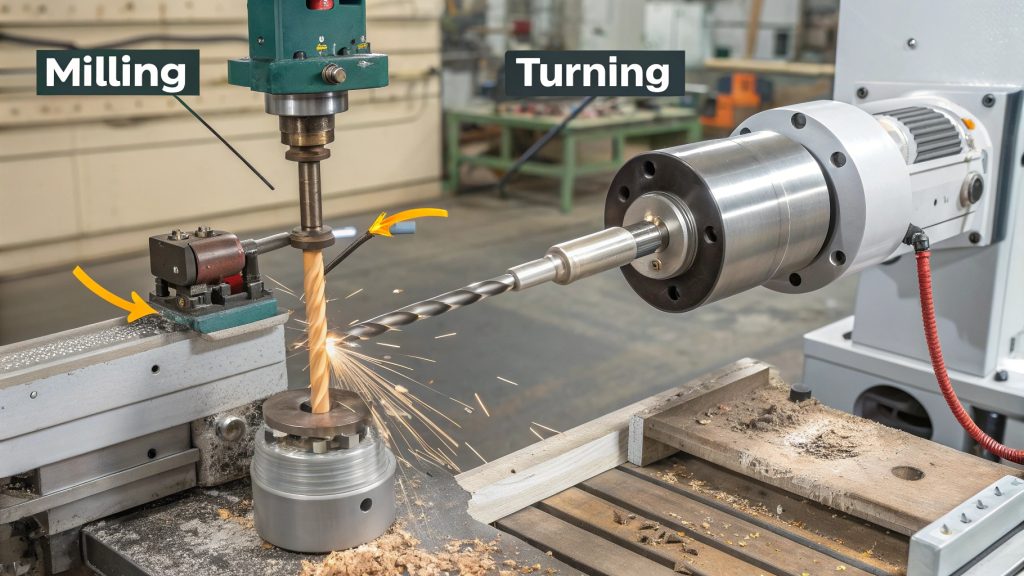
It's a common question I get: "Sandra, are milling and turning basically the same?" And the answer is a definite no. They are two very different ways to cut metal or plastic. The core difference, as we've touched on, is about what's spinning and what's staying put. In milling, the workpiece is clamped down and doesn't move (or moves in a controlled linear way on a table). The cutting tool, which looks a bit like a drill bit but can cut on its sides too, spins and moves to chip away material.
In turning, it’s the opposite. The workpiece is spinning rapidly in a chuck, and a stationary (or slowly moving) cutting tool carves material from it. Imagine holding a piece of wood in a lathe and using a chisel to shape it – that’s the basic idea of turning. So, you can see they achieve different results because of this. You can’t easily make a perfectly round shaft with just a milling machine, and you can’t easily cut a complex pocket into the side of a block with just a basic lathe. Sometimes, a part might need both processes. For example, we might turn a shaft to get the round shape and then mill a keyway into it. We see this a lot at Worthy. Understanding they are separate helps in planning production.
| Aspect | CNC Milling | CNC Turning |
|---|---|---|
| Primary Motion | Rotating tool, stationary/linearly moving part | Rotating part, stationary/linearly moving tool |
| Resulting Geometry | Often prismatic, flat, complex contours | Primarily cylindrical, conical, or faced |
| Tool Engagement | Intermittent cutting (teeth engage/disengage) | Continuous cutting (tool stays in contact) |
| Common Machine | Milling machine (vertical/horizontal) | Lathe |
What is the difference between milling and turning operations?
Are you unsure about what specific tasks milling and turning can do? This gap in knowledge can affect your design choices. Let's explore their distinct operations.
Milling operations involve using rotating cutters for tasks like facing, slotting, or creating complex 3D shapes on a fixed part. Turning operations use a rotating part and a fixed tool for tasks like creating diameters, threads, or grooves.
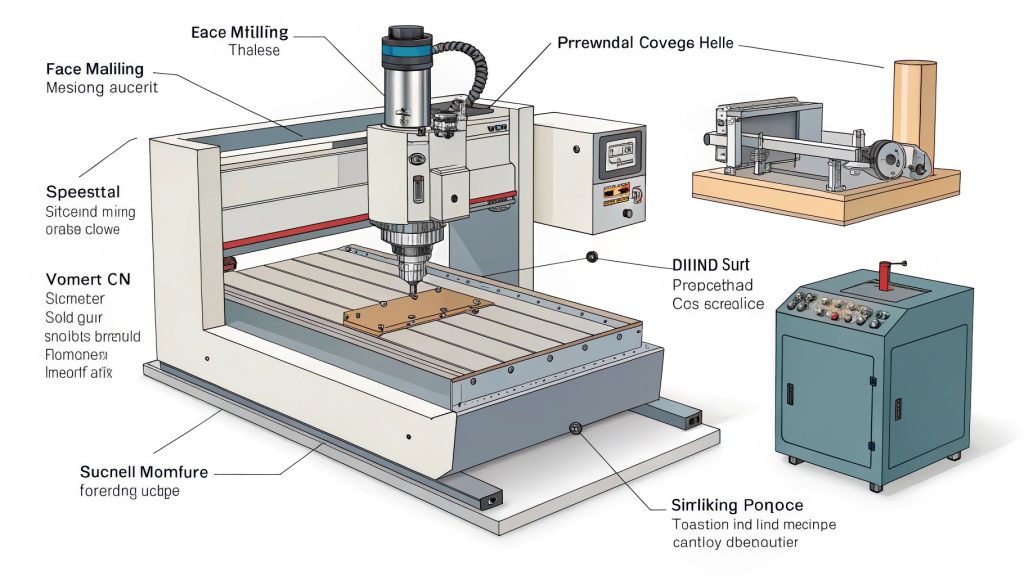
When we talk about "operations," we mean the specific actions each machine can perform to shape a part. For CNC milling, the operations are quite diverse because the tool can move in multiple directions (X, Y, and Z axes, and sometimes more with 5-axis machines like we have at Worthy).
Common milling operations include:
-
Face milling: Creating a large flat surface.
-
Peripheral milling: Machining the outside edges of a part.
-
Slotting: Cutting grooves or slots.
-
Drilling: Making holes.
-
Tapping: Creating internal threads in a hole.
-
Contouring: Creating complex 3D shapes and surfaces.
For CNC turning, the operations are centered around the rotating workpiece:
-
Facing: Creating a flat face on the end of a cylindrical part.
-
Straight Turning: Reducing the diameter of a workpiece.
-
Taper Turning: Creating a conical shape.
-
Threading: Cutting external or internal threads.
-
Grooving/Parting: Cutting a groove or cutting the part off from the main stock.
-
Knurling: Creating a patterned texture on a surface.
I remember a client, Mark from Canada, who needed a part with a very specific cylindrical profile and a flat face. He initially thought it might all be one complex milling job. But by breaking it down, we realized it was best to turn the main body and then use a quick milling operation for another feature. Understanding the specific operations helps us at Worthy choose the most efficient production path, which ultimately saves our customers like Mark costs and ensures quality.
| Process | Operation Example 1 | Operation Example 2 | Resulting Feature Example |
|---|---|---|---|
| Milling | Face Milling | End Milling (Slot) | Flat Surface, Rectangular Pocket |
| Turning | Straight Turning | Threading | Cylindrical Shaft, Screw Thread |
What does CNC turning mean?
Curious about what "CNC turning" really involves? Not knowing this can limit how you design round parts. Let's define CNC turning clearly for you.
CNC turning means using a Computer Numerical Control (CNC) lathe. In this process, the workpiece rotates while a cutting tool, guided by a computer program, shapes it into precise cylindrical, conical, or threaded forms.
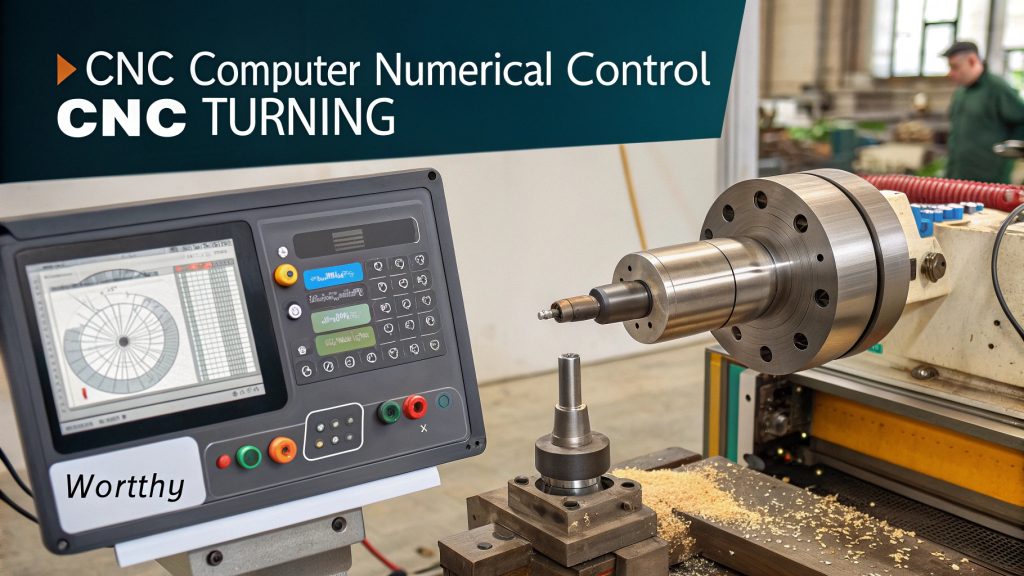
So, what exactly is CNC turning? The "CNC" part stands for Computer Numerical Control. This means a computer program tells the machine exactly what to do – how fast the workpiece should spin, where the cutting tool should move, and how deep it should cut. The "turning" part refers to the process where the material (your workpiece) is held in a chuck and rotated at high speed. A cutting tool is then fed into this rotating workpiece to remove material and create the desired shape. Think of a CNC lathe as a highly automated and precise version of a traditional manual lathe.
At Worthy, our CNC turning capabilities allow us to make parts up to 62 inches in length and 32 inches in diameter. This process is ideal for producing parts that are symmetrical around a central axis. Common examples include:
-
Shafts and axles
-
Pins and dowels
-
Bushings and bearings
-
Screws, bolts, and nuts
-
Flanges and rings
-
Nozzles and connectors
The benefits of CNC turning are significant. It offers high precision and excellent repeatability, meaning every part comes out looking just like the one before it. It’s very efficient for producing round parts in both small and large quantities. We can achieve very tight tolerances, sometimes even sub +/- 0.001", depending on the design. It's a go-to process for so many components across industries like automotive, aerospace, and industrial equipment.
| CNC Turning Aspect | Description |
|---|---|
| Machine Used | CNC Lathe |
| Workpiece Movement | Rotates on an axis |
| Tool Movement | Moves linearly (typically 2 axes: X and Z) to engage the workpiece |
| Key Components | Spindle (rotates workpiece), Chuck (holds workpiece), Tool Turret (holds tools) |
| Advantages | High precision for round parts, excellent surface finish, efficient for volume |
| Typical Materials | Metals (aluminum, steel, brass, titanium), Plastics (Delrin, Nylon, PEEK) |
Conclusion
In short, milling moves the tool around a fixed part, while turning spins the part against a fixed tool. Understanding this key difference helps create better parts.