
What Is the Difference Between Chamfer and Bevel in CNC Machining?

Struggling with sharp edges on your parts? These can cause injuries or assembly problems. Understanding the right edge treatment is key to getting the perfect, functional, and safe component.
A bevel is any sloped edge between two faces, while a chamfer is a specific type of bevel that is typically cut at a 45-degree angle. A chamfer breaks an edge, whereas a bevel can transition an entire surface to another.
In my years of running a CNC machine shop, I've seen how a tiny detail like an edge finish can make or break a project. Clients often use the terms "chamfer" and "bevel" as if they are the same. They are similar, but their differences are very important for the final part's function, safety, and cost. Getting this right from the start saves a lot of time and money. Let's break down these differences so you can make the best choice for your next project.
What is the difference between chamfer and bevel?
Confused about which edge finish to specify on your design? Choosing the wrong one can affect how your parts fit together or even how safe they are to handle.
A bevel is an edge that is sloped, and it can be at any angle. A chamfer is a specific type of bevel, almost always at a 45-degree angle, that cuts off a corner. Think of a chamfer as a specific, symmetrical cut for breaking an edge.
Let's dive deeper into this. The main difference really comes down to intent and application. In my experience, a chamfer is all about safety and looks. We use it to remove sharp, dangerous edges, a process called deburring. This prevents cuts when handling the part and can give the product a more finished, professional look. It also helps with assembly, as a chamfered hole can guide a screw or pin into place easily.
A bevel, on the other hand, is often more functional and can be structural. It's an angled surface that connects two other surfaces. A bevel can be at any angle, not just 45 degrees, and can cover the entire width of the edge. We might use a bevel to prepare parts for welding (a V-groove is made of two beveled edges) or to create a transition between two surfaces of different heights. I see my core idea reflected here: chamfers focus on safety and aesthetics, while bevels often serve a more technical, functional purpose.
Here is a simple table to show the differences:
| Feature | Chamfer | Bevel |
|---|---|---|
| Angle | Typically 45 degrees | Any angle |
| Purpose | Deburring, safety, aesthetics, lead-in for fasteners | Joining parts, welding prep, transitioning surfaces |
| Appearance | Symmetrical, narrow flat surface at a corner | Angled surface, can cover the entire edge |
| Common Use | Edges of holes, corners of parts | Weld preparation, aesthetic transitions, reducing part volume |
What is the difference between a chamfer cut and a bevel cut?
Are you worried about the machining process for your parts? The type of cut you choose can affect both the time it takes to make the part and the final cost.
A chamfer cut is a simple operation that creates a 45-degree angle on an edge, often done with a standard tool. A bevel cut is more versatile and can create an edge at any angle, which might require tilting the part or using a specialized tool head.
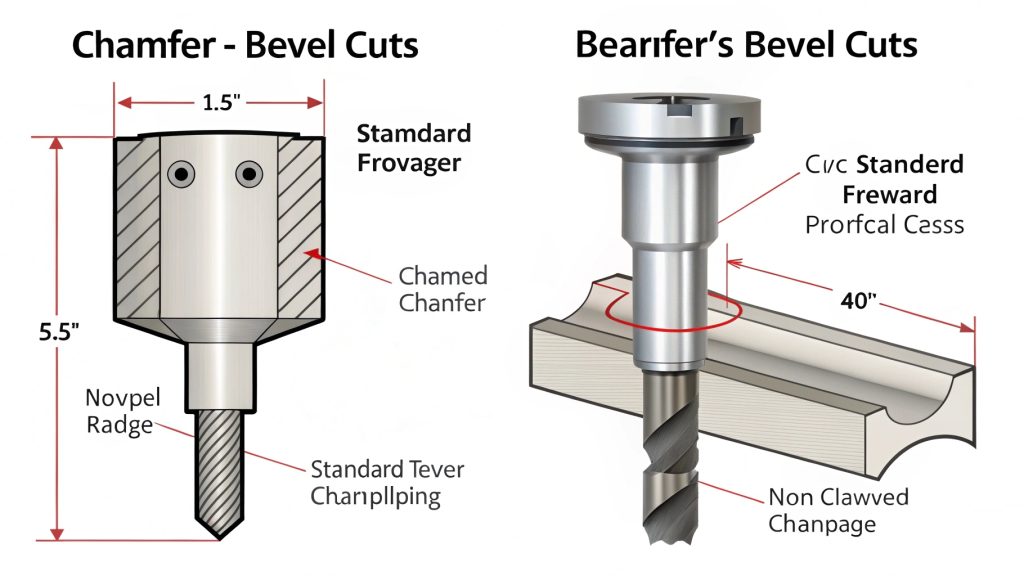
From a machinist's point of view, the difference is about efficiency and complexity. Making a chamfer cut is usually straightforward. On a lathe or a mill, we can use a standard chamfering tool or an angled cutter. It's a quick, repeatable process that adds very little time to the overall machining. This is why it's a popular choice for general deburring on high-volume production runs. It’s a simple way to improve a part without adding significant cost.
A bevel cut can be more involved. If the angle is not a standard one, like 30 or 60 degrees, we might need a special tool. For complex bevels, especially on a curved edge, we often rely on our 5-axis CNC machines. A 5-axis machine can move the cutting tool or the workpiece along five different axes at the same time. This allows us to create a smooth, precise bevel at any angle without having to stop and reposition the part. While this is incredibly versatile, it can be a more time-consuming and therefore more expensive process than a simple chamfer. This reinforces my idea that bevels are for specific functions, while chamfers are for efficient, general improvements.
What is the difference between chamfer and edge?
Do your parts arrive with razor-sharp edges? This is a common problem with freshly machined components and can be a serious safety hazard for anyone who handles them.
An edge is the sharp line where two surfaces of a part meet. A chamfer is not an edge itself, but a modification to that edge. We create a chamfer by cutting away the sharp corner to create a small, angled flat surface, making it safer and less prone to damage.
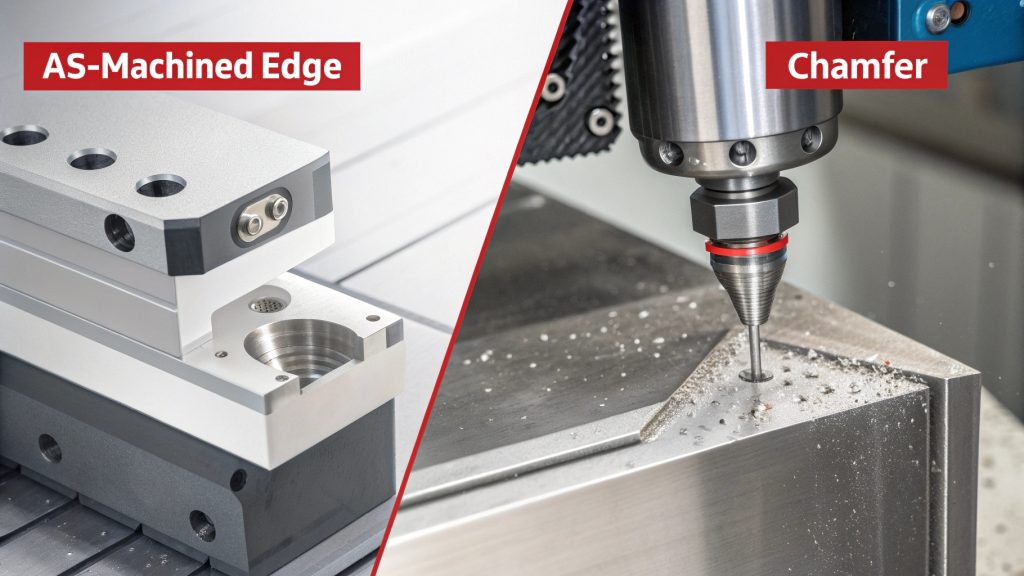
Let’s get back to basics. When our CNC machines cut a piece of metal or plastic, the default result is a very sharp, 90-degree corner, or "edge." We call this an "as-machined" edge. While it's precise, it's also problematic. A sharp edge is weak and can easily be nicked or dented, which could affect the part's tolerance. More importantly, it's a safety risk. I’ve heard stories from customers about employees getting cut while handling parts with unfinished edges.
This is where a chamfer[ comes in. It is an intentional feature we add to the design. By machining a small, 45-degree flat onto that sharp corner, we "break" the edge. The part is now much safer to handle. At Worthy, we consider this so important that breaking sharp edges and deburring them is part of our standard process unless a customer's drawing specifically calls for a sharp corner. So, an edge is the problem, and a chamfer is often the solution. It's a simple change that greatly improves the quality and safety of the final product.
What does chamfer mean in machining?
Are you wondering why your engineer added "chamfer all edges" to your design drawings? This small note has a big impact on the final product's quality and usability.
In machining, a chamfer means cutting a transitional edge between two faces of an object. It is a sloped or angled corner or edge, typically at 45 degrees, created to remove a sharp 90-degree corner. This is done for safety, aesthetics, and function.


A chamfer is one of the most common features we machine at Worthy, and for good reason. It serves several critical purposes. First, as I've mentioned, is safety. It removes burrs and sharp edges.
Second is function. A chamfer on the edge of a hole acts as a guide, making it much easier to insert a bolt or a pin. This is crucial for parts that need to be assembled and disassembled. A client of mine, Mark Chen from Canada, once had trouble with parts not fitting together smoothly. We added a small 0.5mm chamfer to the receiving holes, and the assembly process became twice as fast for his team.
Third, a chamfer can add strength. Sharp internal corners can create stress points where cracks might form under load. A chamfer or a fillet (a rounded corner) helps to distribute that stress over a larger area, making the part more durable. Finally, it improves the look of a part. A clean, consistent chamfer gives a component a finished, professional appearance. It shows attention to detail. So, when you see "chamfer" on a drawing, it's a sign that the designer is thinking about the part's entire lifecycle, from handling and assembly to long-term performance.
Conclusion
Understanding the difference between a chamfer and a bevel ensures your parts are safe, functional, and cost-effective. For expert advice on your next project, contact us at Worthy Hardware.