
CNC Router Vs. CNC Mill: Which One Should You Choose For Your Project?
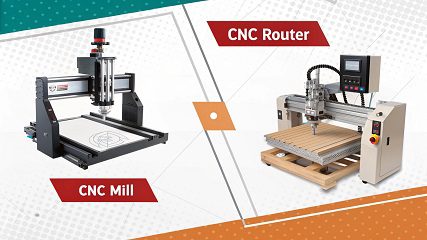
Struggling to decide between a CNC router and a CNC mill? Making the wrong choice can waste time and money, and lead to a final product that doesn't meet your standards.
A CNC router is best for quickly cutting softer materials like wood, plastic, or aluminum sheets. A CNC mill is superior for high-precision machiningof harder materials like steel and titanium, or for creating complex 3D parts from a solid block of metal or plastic.
Choosing the right tool is one of the most important decisions in manufacturing. As someone who has managed countless CNC projects for clients worldwide, I've seen firsthand how this choice impacts the final quality, cost, and lead time. Both machines use computer control to cut materials, but they are built for very different jobs. Understanding these differences is key to getting the results you need. Let’s break down the details so you can make an informed decision for your next project.
Which is better CNC machine or CNC router?
Are you wondering which machine is the right one? Picking the wrong machine for your job can lead to poor quality and high costs, a frustrating experience for any business owner.
Neither machine is better, they are just different. A CNC router is better for fast cutting on large, soft materials. A CNC mill is better for high-precision parts made from hard metals. The "better" machine depends entirely on your project's specific needs.
When I talk to new clients, like Mark from Canada, this question comes up a lot. They want the best quality for the best price, and the machine choice is central to that. The core difference is in how they are built and what they are built for. A CNC router usually has a gantry that moves the cutting tool over a stationary workpiece. This design allows for very fast movement across large sheets of material. A CNC mill, on the other hand, is built with a much more rigid frame. Often the tool is stationary while the workpiece moves. This rigidity is what allows it to cut hard metals with incredible accuracy.
Here's a simple breakdown to help you see the difference:
| Feature | CNC Router | CNC Mill |
|---|---|---|
| Primary Use | Speed | Precision |
| Best Materials | Wood, Plastics, Foam, Soft Metals (Sheets) | Hard Metals, Plastics, Metal Blocks |
| Typical Speed | Very Fast | Slower |
| Precision Level | Good (e.g., +/- 0.010") | Excellent (e.g., +/- 0.001") |
| Construction | Lighter Frame, Moving Gantry | Heavy, Rigid Frame |
So, if you need to make 100 large wooden signs, a CNC router is your best friend. If you need a complex aluminum housing for an electronic device, you absolutely need a CNC mill.
What is the difference between CNC and CNC milling?
Is the terminology confusing you? People often use "CNC" and "CNC milling" as if they mean the same thing, but they don't, and this can cause misunderstandings in project specifications.
"CNC" stands for Computer Numerical Control. It is the automation technology that uses a computer to control a machine. "CNC milling" is a specific manufacturing process that uses CNC technology to cut material with a rotating tool. CNC is the brain; milling is one of the actions.
 "CNC G-Code on a Computer Screen")
Think of it like this: "Vehicle" is a broad category. A "Car" is a specific type of vehicle. In the same way, "CNC" is the broad technology that can control many types of machines. CNC milling is just one of those machine types.
At my company, Worthy Hardware, we use CNC technology to control a whole range of equipment. This ensures we can produce exactly what our customers design, whether it requires milling, turning, or routing.
The CNC Technology Family
CNC is the umbrella term. Underneath it, you have many specific processes. Here are the most common ones:
-
CNC Milling: Uses a rotating multi-point cutting tool to remove material from a stationary workpiece. This is perfect for creating flat surfaces, pockets, and complex 3D shapes.
-
CNC Turning (Lathes): Rotates the workpiece against a stationary single-point cutting tool. This is how we make cylindrical parts like shafts, pins, and rings.
-
CNC Routing: Uses a rotating tool on a gantry system to cut softer materials. It's like a high-speed, highly accurate version of a handheld router.
-
CNC Grinding: Uses a rotating grinding wheel to achieve a very fine surface finish and extremely tight tolerances.
So, when a customer sends us a drawing for a "custom CNC part," our first step is to determine which CNC process is the best fit. CNC milling is one of our core services because it is so versatile, but it's just one tool in our toolbox.
How do CNC mills and routers differ in their typical applications?
Are you using the right tool for your specific application? Applying the wrong process can result in a part that fails under stress or doesn't fit, causing project delays and costing you money.
CNC routers are typically used for large-format 2D or 2.5D cutting in softer materials. Think signs, furniture, and molds. CNC mills are used for high-strength, high-precision 3D parts from metals, for industries like aerospace, automotive, and medical.
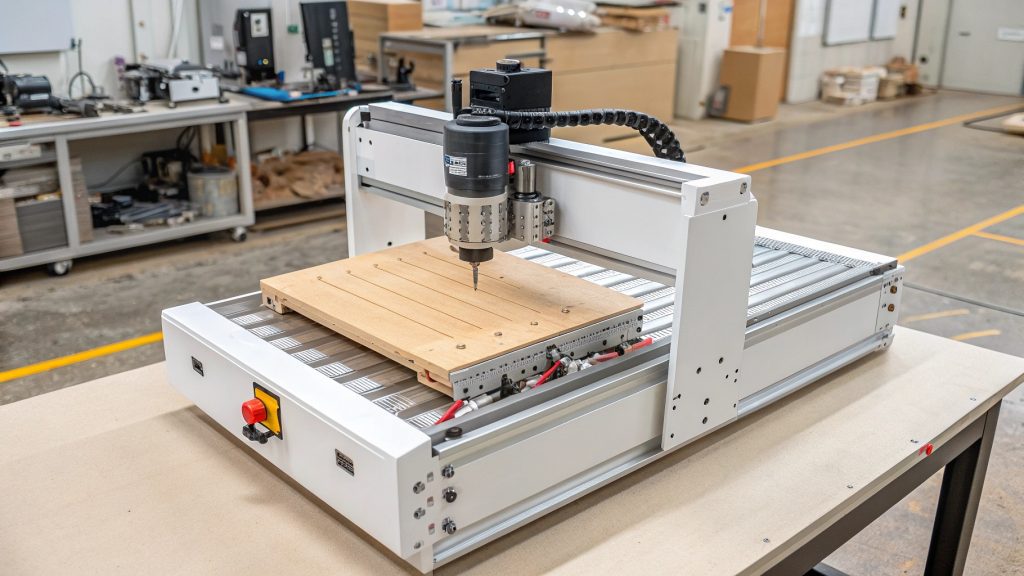
The application is everything. We once had a client who needed a large prototype of a consumer product case. It was about 30 inches long and made of plastic. A CNC router was the perfect choice because it was fast and cost-effective. The next week, another client needed a small, complex titanium part for a medical device. It had to be perfect, with tolerances down to +/- 0.001". For that, our 5-axis CNC millwas the only option. The machine's application is defined by its strengths in handling specific materials and geometries.
Application and Material Comparison
Let's look at this in a table to make it very clear.
| Aspect | CNC Router | CNC Mill |
|---|---|---|
| Typical Industry | Signage, Woodworking, Prototyping, Art | Aerospace, Automotive, Medical, Industrial |
| Materials | Wood, plastics (ABS, Acrylic), foam, composites, thin aluminum sheets. | Hard metals (steel, stainless steel, titanium), engineering plastics (PEEK, Delrin), aluminum blocks. |
| Product Examples | Cabinet doors, large letters, decorative panels, foam inserts, boat hulls. | Engine components, surgical tools, electronic enclosures, precision molds. |
| Complexity | Best for parts cut from flat sheets (2.5D). | Excellent for complex 3D shapes with intricate features from solid blocks. |
The key takeaway is that routers "carve out" from sheets, while mills "sculpt" from blocks. This fundamental difference dictates where each machine excels. At Worthy Hardware, we ask for our client's application first, so we can guide them to the most efficient and effective process.
What are the disadvantages of using a CNC milling machine?
Are you assuming a CNC mill is always the superior choice? While powerful, its strengths come with trade-offs that can make it the wrong tool for certain jobs, adding unnecessary cost and time.
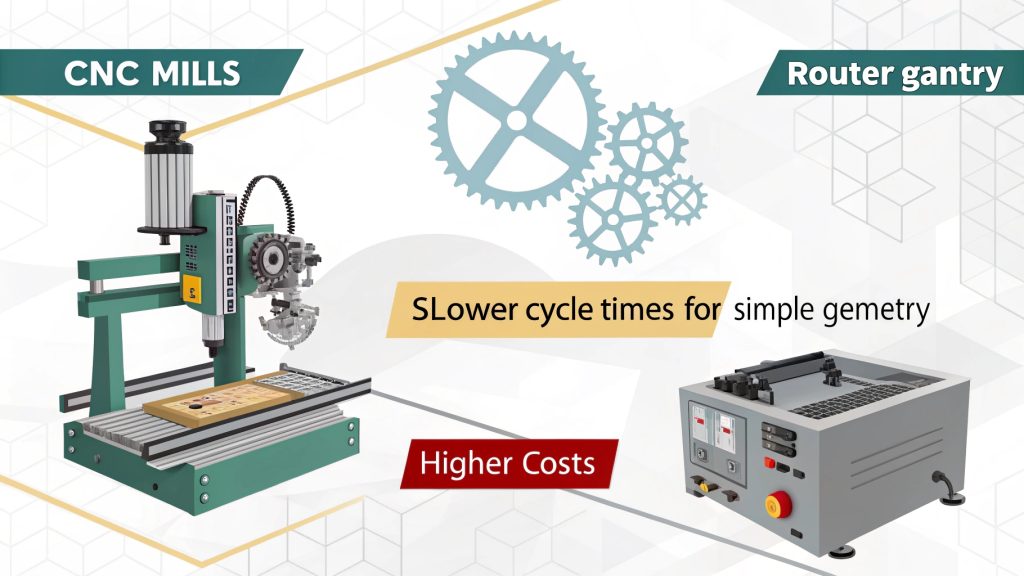
The main disadvantages of a CNC mill are its slower speed on large, simple cuts, its higher machine and tooling costs, and its greater complexity in setup. It can be overkill for simple jobs where a router would be much faster and cheaper.
While we rely on our CNC mills for our most demanding precision work, I'm always honest with my clients about their limitations. A CNC mill is a specialized tool, and using it for the wrong task is like using a surgical scalpel to cut down a tree. It's not efficient. These are not reasons to avoid mills, but factors to consider when planning a project.
Breaking Down the Disadvantages
Let's look at the three main issues in more detail:
-
Slower Cycle Times for Simple Geometry: A mill's heavy, rigid construction is what gives it precision. But that mass means it can't accelerate and move as quickly as a lightweight router gantry. If your project is cutting out a simple shape from a large sheet of plastic, a router could finish the job in a fraction of the time it would take to set up and run on a mill. This directly impacts cost and lead time.
-
Higher Costs: CNC mills are significantly more expensive to purchase, operate, and maintain than CNC routers. The machines themselves are more robust, the cutting tools are often made of more expensive materials like carbide, and the power consumption is higher. For business owners like Mark who are sensitive to pricing, this is a critical factor. The precision of a mill comes at a price, and it's only worth paying if your part requires it.
-
Increased Complexity: Setting up a job on a CNC mill, especially a 5-axis machine, is a highly skilled task. It involves complex programming (G-code), precise workholding (fixturing), and careful tool selection. This complexity adds to the setup time and requires highly trained operators. A simple router job can often be programmed and running much more quickly.
For us at Worthy, managing these "disadvantages" is part of our service. Our experienced engineers ensure we use the right machine for the job, optimizing for cost, speed, and quality for our clients.
Conclusion
The right choice between a CNC router and a mill depends on your project's material, precision, and complexity. Routers offer speed on soft materials; mills provide precision for hard materials.