
What Is The Chemical Structure Of Polypropylene And How Does It Affect Its Performance?

Polypropylene parts are everywhere. But do you know its structure? Understanding it unlocks better material choices for your projects.
Polypropylene's chemical structure is a long chain of propylene monomers. This specific arrangement of carbon and hydrogen atoms, especially its methyl groups, dictates its useful properties like strength, heat resistance, and processability.
That's the quick answer. But there's so much more to explore about how this structure really works. I find this fascinating because understanding the 'why' helps us at Worthy make better parts. Let's dive in and see what makes polypropylene so versatile and why its structure is key.
What is the chemical structure of polypropylene, really?
Confused by polymer chemistry terms? Polypropylene's structure seems complex. I'll break it down simply for you now.
Polypropylene (PP) is a polymer made from repeating units of a simple molecule called propylene. Its backbone consists of carbon atoms, with important methyl (CH3) groups attached, defining its overall characteristics.
I often get questions from customers like Mark Chen from Canada about why we recommend certain plastics. For polypropylene, it starts with its basic building block. Polypropylene is a thermoplastic resin. This means we can heat it, mold it, and then cool it, and it holds its shape.
If needed, we can even reheat and reshape it. It's actually one of the five big general-purpose resins used worldwide. You'll often see it as white, granular pellets. It has no taste and no smell, and it's non-toxic. This is largely because its molecules are arranged in a very regular and orderly way. The "poly" in polypropylene means "many." So, it's many "propylene" units linked together. Propylene itself is a small molecule made of carbon and hydrogen.
When these propylene units join up in a long chain, they form the polymer we call polypropylene. This regular structure not only makes it easy to process in our CNC machines but also gives it fantastic impact strength. It can bend without breaking easily, and it’s a great electrical insulator. These are all things Mark looks for: quality and performance.
What are the structural properties of polypropylene?
You know it's a chain. But how does this chain arrange itself? This arrangement drastically affects how PP behaves.
Key structural properties of polypropylene include its tacticity (the arrangement of methyl groups) and crystallinity. These determine its stiffness, toughness, and melting point, making it suitable for different applications.
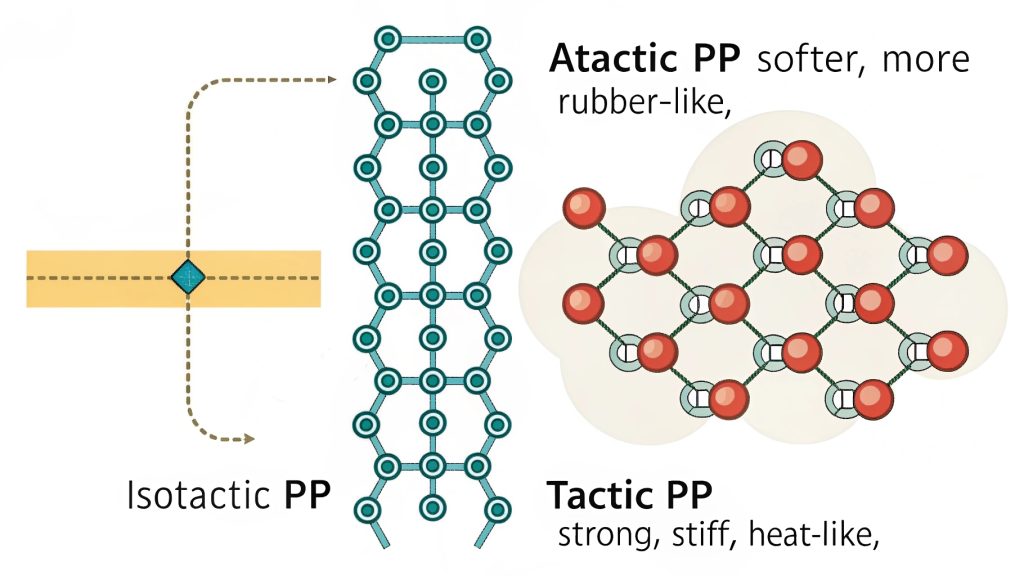
When we talk about the structure, it's not just about the chain itself, but how the little side groups, called methyl groups (CH3), are arranged along that chain. This is called "tacticity." Imagine the main carbon chain as a long backbone. The methyl groups can all be on one side (isotactic), alternate sides regularly (syndiotactic), or be arranged randomly (atactic). This might seem like a small detail, but it's huge for performance.
Most commercial polypropylene is isotactic. This regular arrangement allows the chains to pack closely together, forming crystalline regions. Think of it like neatly stacked logs versus a jumbled pile. The more crystalline it is, the stronger, stiffer, and more heat-resistant the PP becomes. Atactic PP, with its random structure, is softer and more like rubber. I remember a project where we needed very specific rigidity. Understanding the tacticity helped us select the right PP grade. Here’s a simple way to see it:
| Tacticity Type | Methyl Group Arrangement | Crystallinity | Common Properties |
|---|---|---|---|
| Isotactic | All on one side | High | Stiff, strong, hard |
| Syndiotactic | Regularly alternating | Medium | Slightly less rigid |
| Atactic | Random | Low/None | Soft, rubbery, tacky |
This "regular molecular structure" the user mentioned is key here. The isotactic form has that very regular structure, leading to those excellent properties.
What is the atomic structure of polypropylene?
We've talked chains and arrangements. But what are the actual atoms involved? Let's get down to the very basics.
Polypropylene's atomic structure consists of carbon (C) and hydrogen (H) atoms. Each propylene monomer (C3H6) links through its carbon atoms, forming a long saturated hydrocarbon chain with methyl side groups.
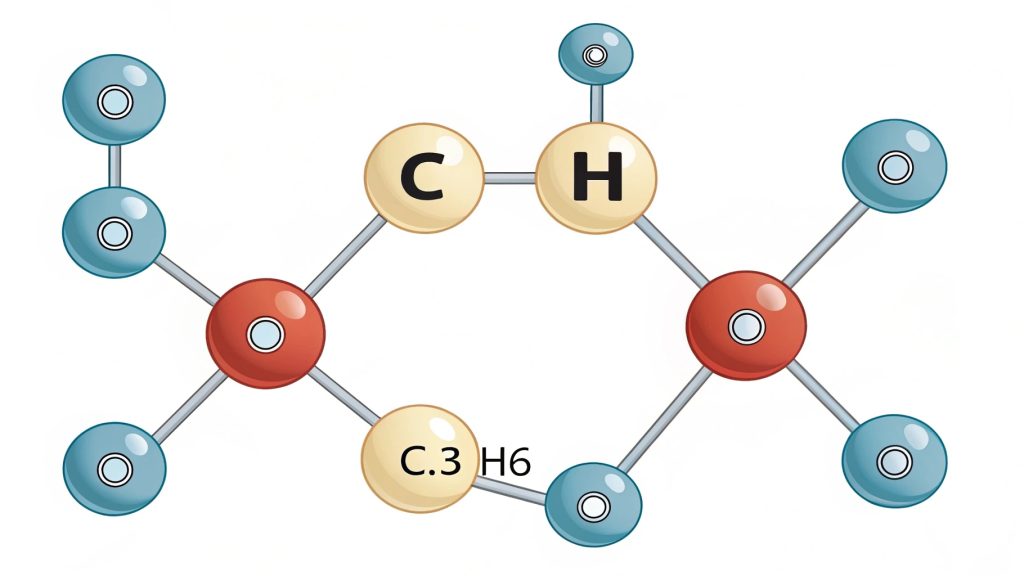
At the most fundamental level, polypropylene is made of just two types of atoms: carbon (C) and hydrogen (H). The propylene monomer, the single repeating unit, has the chemical formula C3H6. This means each monomer unit has three carbon atoms and six hydrogen atoms. When these monomers link up to form the polymer, they do so by forming strong bonds between carbon atoms. This creates a long chain, often called a carbon backbone. Attached to this backbone are the hydrogen atoms and the methyl groups (CH3 – one carbon and three hydrogens).
It’s quite amazing when you think about it; these simple atoms, arranged in a specific way, create a material with so many uses. The way these atoms bond, the angles between them, and the length of the bonds all contribute to the overall shape and flexibility of the polymer chain.
This, in turn, influences how the chains can pack together and, ultimately, the material's properties. I always tell my team, even when we're machining complex parts, it all comes down to these tiny atoms and how they're put together. This simple atomic makeup also contributes to why PP is relatively inexpensive and easy to produce in large quantities.
What are the physical and chemical properties of polypropylene?
So, structure dictates properties. But what are these key properties exactly? This is what truly matters for your application.
Physically, polypropylene is lightweight, has good tensile strength, high heat deflection temperature, and excellent electrical insulation. Chemically, it resists many acids, bases, and solvents, but UV light can degrade it.
The specific chemical and atomic structure gives polypropylene a set of very useful physical and chemical properties. As I mentioned, its regular molecular structure makes it easy to process. It also leads to excellent impact strength – it can take a hit. It has great flexural strength, meaning it can bend repeatedly without breaking, which is why it's used for living hinges, like on a flip-top cap. And, it’s a fantastic electrical insulator.
My customer Mark, who sources CNC parts, always looks for these reliable characteristics. Physically, PP has a low density, making it lightweight. It has a relatively high melting point compared to some other common plastics like polyethylene, so it can handle higher temperatures. Chemically, PP is quite resistant. It doesn't react with most dilute acids or bases, and it stands up well to many organic solvents.
This is a big plus for containers or parts that might come into contact with various chemicals. However, it's not perfect. It can be attacked by strong oxidizing acids and chlorinated solvents, and it's susceptible to degradation from UV light unless specific stabilizers are added. Here's a quick summary of some key properties:
| Property Category | Specific Property | Typical Value/Characteristic |
|---|---|---|
| Physical | Density | Low (around 0.90-0.91 g/cm³) |
| Physical | Tensile Strength | Good (30-40 MPa) |
| Physical | Melting Point | ~160-170 °C (320-338 °F) |
| Physical | Electrical Insulation | Excellent |
| Physical | Water Absorption | Very Low |
| Chemical | Acid Resistance | Good (to weak acids) |
| Chemical | Base Resistance | Excellent |
| Chemical | Solvent Resistance | Good (to many organic solvents) |
| Chemical | UV Resistance (unstabilized) | Poor |
Understanding these properties is crucial when we help customers choose the right material. For example, if a part needs to be lightweight and resist chemicals, PP is often a top contender at Worthy Hardware.
Conclusion
Polypropylene's chain-like structure, with specific methyl group arrangements, directly creates its valuable strength, processability, and resistance, making it a widely used and versatile material in many industries.