
How Does Acrylic Compare to Other Plastic Materials in CNC Machining Projects?

Choosing the right plastic can be tough. Pick wrong, and your project suffers. This guide helps you compare acrylic to other plastics for CNC machining.
Acrylic stands out for its excellent optical clarity and weather resistance. When CNC machined, it offers a smooth, high-quality finish, making it a strong contender against other plastics like PC or ABS for specific applications, especially visual ones.
So, you're looking at plastics for your next CNC machining project. It's a big field, and picking the best one can feel overwhelming. I've been there. Many of my clients, like Mark Chen from Canada, need parts with specific properties. They want quality but also good value. That's why understanding the differences is so important. Let's explore how acrylic stacks up. You might be surprised by what you learn, and it will help you make a better choice. Keep reading to find out more.
How is acrylic different than plastic?
"Plastic" is a broad term, causing confusion. Is acrylic just another plastic, or is it special? Let's clarify the key distinctions for your projects.
Acrylic, or Polymethyl Methacrylate (PMMA), is a specific type of thermoplastic. It's different because of its superior optical clarity, UV resistance, and glass-like finish compared to many general-purpose plastics.
!
When we say "plastic," we're talking about a huge family of synthetic or semi-synthetic materials. Acrylic, technically known as Polymethyl Methacrylate or PMMA, is just one member of this family. But it has some very special traits. In my experience, the biggest difference is its amazing transparency. It’s often used as a lightweight, shatter-resistant alternative to glass.
Many transparent plastics are available, such as Polycarbonate (PC), ABS, PS, PET, and PVC. However, I've consistently found that acrylic's transparency and weather resistance are much better than most of these. It doesn’t yellow or become brittle quickly when exposed to sunlight, which is a huge plus for outdoor applications.
While Polycarbonate is known for its impact strength, my insight is that in certain direct comparisons or specific application contexts, its overall performance considering all factors isn't always superior, and acrylic often wins for visual parts. For example, I remember a client needing crystal-clear housings; acrylic was the clear winner over PC for that pristine look.
Here's a quick comparison:
| Feature | Acrylic (PMMA) | General Plastics (e.g., PE, PP) | Polycarbonate (PC) |
|---|---|---|---|
| Clarity | Excellent, glass-like | Often opaque or translucent | Good, but can yellow more |
| UV Resistance | Very Good | Varies, often poor without additives | Fair, can yellow |
| Brittleness | More brittle than some | Varies | Very tough, impact resistant |
| Scratch Resist. | Fair to Good | Generally Poor | Fair, can scratch easily |
So, while acrylic is a plastic, its unique combination of properties makes it stand out.
What plastics are best for CNC machining?
Need to CNC machine plastic? Choosing the wrong one wastes time and money. Discover the plastics that truly perform well under the cutter.
Several plastics are excellent for CNC machining. Popular choices include Delrin (Acetal), Nylon, ABS, Polycarbonate (PC), and Acrylic (PMMA). The "best" depends on your specific project needs, like strength or clarity.

There isn't one single "best" plastic for every CNC machining job. The ideal material really hinges on what you need the part to do. I always ask my clients, like Mark, detailed questions about their application before recommending a material. For example, if a part needs to be very slippery for a low-friction application, I might suggest Delrin (Acetal) or Nylon. If cost is a major driver and the part is for general use, ABS can be a great option.
For parts needing high impact strength and durability, Polycarbonate (PC) is often considered. However, based on my insights, while PC is generally tough, its performance in specific machined applications, especially where clarity or fine details are critical, sometimes presents trade-offs. Acrylic, on the other hand, machines beautifully when you need optical clarity or a very smooth, polished finish. We've made stunning display pieces from acrylic.
Here's a look at some common choices and their strengths:
-
Acrylic (PMMA): Best for visual appeal, signs, display items. Good machinability for a clear finish.
-
Delrin (Acetal/POM): Excellent for precision parts, gears, bearings due to its low friction and high stiffness. Machines like a dream.
-
Nylon: Good for wear resistance, toughness. Used for rollers, pads.
-
ABS: A good all-rounder. Decent strength, impact resistance, and relatively low cost. Easy to machine.
-
Polycarbonate (PC): Very high impact strength. Good for tough, durable parts.
-
HDPE/UHMWPE: Great chemical resistance, low friction, good for food-grade applications or wear strips.
At Worthy Hardware, we work with over 100 materials, so we can always find a good fit.
Can acrylic be CNC machined?
Have a design in acrylic? Wondering if CNC machining can bring it to life accurately? Let's address if acrylic is suitable for CNC processes.
Yes, acrylic (PMMA) can be CNC machined very effectively. It allows for precise cutting, drilling, engraving, and even threading, making it ideal for complex designs and parts requiring high clarity
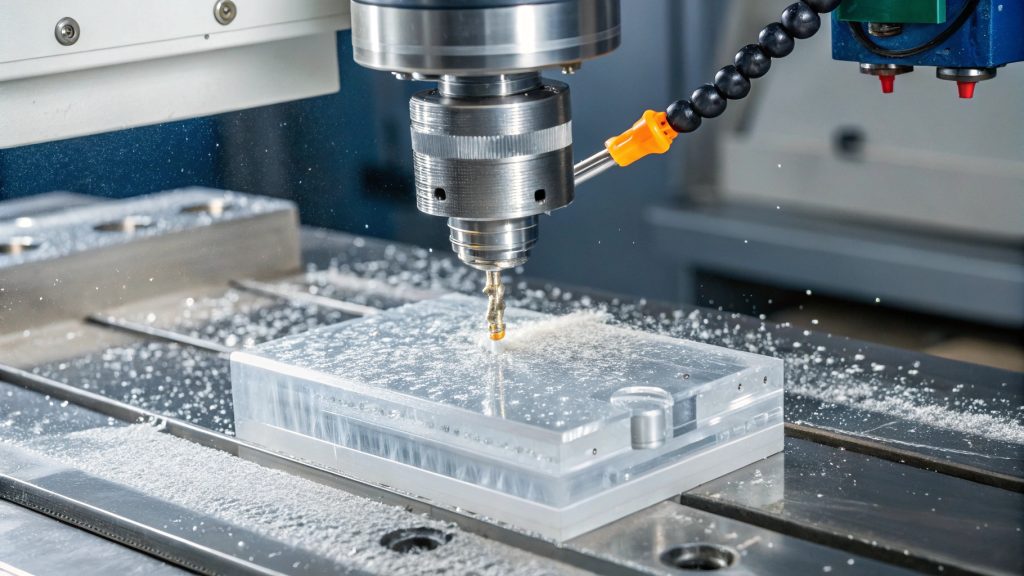
Absolutely, acrylic is a fantastic material for CNC machining. I've seen countless projects at Worthy Hardware where we've turned blocks or sheets of acrylic into incredibly precise and beautiful parts. The key is using the right tools and techniques. Acrylic can be a bit brittle compared to some other plastics, so you need to be careful to avoid chipping or cracking.
We use sharp cutters designed specifically for plastics. The spindle speed and feed rate are also crucial. If you go too fast or the tool is dull, the acrylic can melt instead of cutting cleanly. Sometimes we use a coolant, often just compressed air, to keep things cool and clear away chips. One thing I've learned is that cast acrylic generally machines better than extruded acrylic.
Cast acrylic has less internal stress, so it's less likely to crack and often gives a smoother finish. After machining, acrylic parts can be polished—sometimes even flame polished—to achieve an almost perfectly clear, glass-like edge. We’ve made everything from intricate logos to precise optical components using CNC machined acrylic. It’s versatile.
What is the best material for CNC machine?
Searching for the single "best" CNC material? This common quest often leads to confusion. The truth is, "best" depends entirely on your specific needs.
There's no universal "best" material for CNC machining. The ideal choice hinges on your project's specific requirements: application, desired strength, durability, appearance, and of course, budget.


I get this question a lot: "Sandra, what's the absolute best material for CNC machining?" And my answer is always: it depends! There's no magic material that's perfect for everything. If there were, my job would be much simpler, but also less interesting. The "best" material is the one that best meets the unique demands of your part.
Think about what the part needs to do. Is it a structural component needing high strength? Then a metal like aluminum or steel, or a strong engineering plastic like PEEK, might be best. Is it a visual part where looks are key? Acrylic, with its superior transparency and weather resistance compared to other clear plastics like PC, ABS, PS, PET, and PVC, is often my top recommendation.
My clients often value acrylic's clarity. While PC offers toughness, as I mentioned from my insights, its relative performance in specific demanding applications involving complex machining or where ultimate clarity is paramount might not always be the top choice when all factors are considered.
Consider these factors:
-
Function: What will the part do? (e.g., display, mechanical, high-wear)
-
Environment: Will it be indoors, outdoors, exposed to chemicals?
-
Mechanical Loads: How much stress or impact will it face?
-
Finish: Does it need to be clear, colored, textured, polished?
-
Cost: Material cost and machining time both play a role.
We machine metals, plastics, woods, and even carbon fiber. Each has its place. For Mark Chen's orders, which often involve custom CNC parts, the material choice is a careful balance of quality, performance, and cost.
Conclusion
In summary, acrylic is a great CNC machining plastic for clarity and weather resistance, but the "best" material always depends on your specific project needs.