
What Is Compound Die Stamping? When Should You Use It?
Author: Sandra Gao Precision Metal Stamping Engineering Consultant | Worthy Hardware 📧 [email protected] | 🌐 www.worthyhardware.com Published: July 2025 | Last Updated: July 2025
You need to produce flat, precision metal parts at high volume — but single-station dies lack the throughput you need, and progressive dies blow your tooling budget. Compound die stamping may be exactly the answer you're looking for.
At Worthy Hardware, we handle more than 200 stamping projects from around the world every year. Buyers keep asking me the same question: "What's the most cost-effective tooling approach for my part?" Drawing on over 15 years of real production experience, this article will walk you through exactly how compound die stamping works, where it excels, where it falls short, and which parts it's genuinely built for.
What Is Compound Die Stamping?
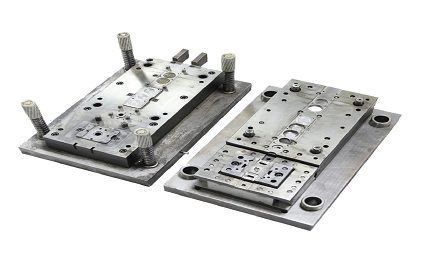
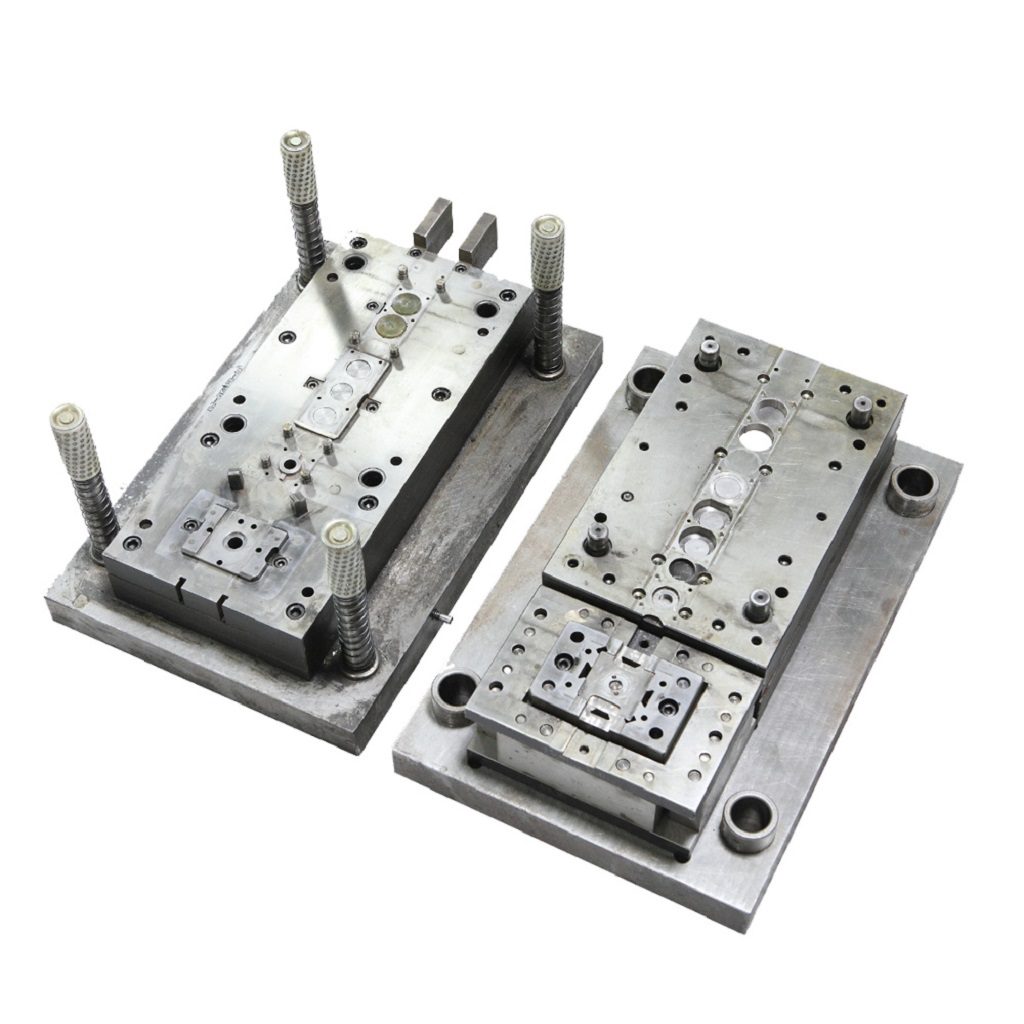
A compound die is a stamping die that integrates multiple cutting operations into a single station, completed in a single press stroke. Every time the punch descends, blanking, piercing, trimming, and all other cutting actions happen simultaneously — one stroke, one finished part.
According to the Precision Metalforming Association (PMA) industry classification, compound dies fall under the category of single-station synchronous stamping tooling and represent one of the mainstream processes for high-volume production of flat precision parts.
Here's a quick comparison of the three most common die types:
| Die Type | Stations | How It Works | Best For |
| Simple Die | Single | One operation per stroke | Very simple shapes, low volume |
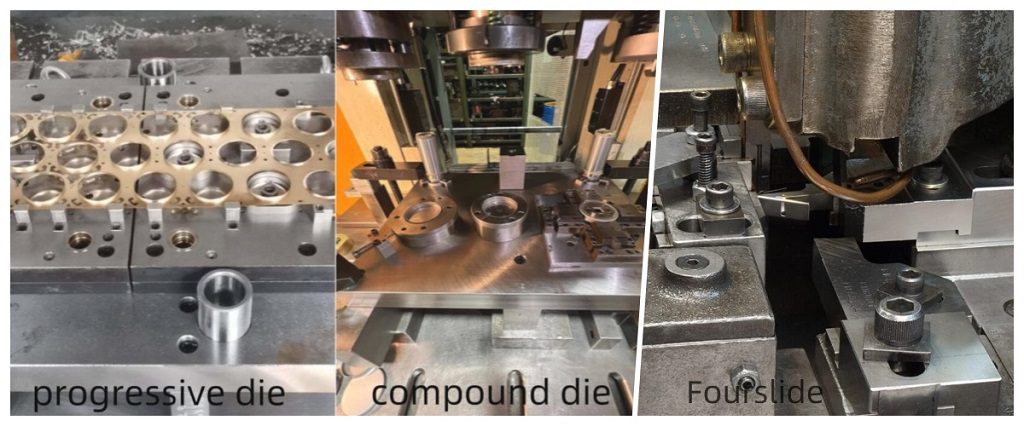
| Progressive Die | Multiple | Strip advances through stations sequentially | Complex parts with bends, ultra-high volume |
| Compound Die | Single | Multiple operations completed simultaneously | Flat precision parts, medium-to-high volume |
Why does compound die stamping produce such exceptional flatness? Because all cutting forces act on the part at the same instant. The part never needs to be transferred between stations, so there's no cumulative deformation from handling or repositioning. Per ISO 2768-1 precision tolerance standards, for parts requiring flatness control within ±0.025mm (0.001"), a compound die is almost always the optimal solution.
At Worthy Hardware, our compound die stamping equipment covers press capacities from 5 to 500 tons, and we can process over 100 metal materials, including cold-rolled steel, stainless steel, aluminum alloys, brass, copper, titanium, and various engineering alloys.
Core Advantages of Compound Die Stamping
① Industry-Leading Flatness
All cutting operations complete within a single stroke, so parts come out of the die flat — no secondary straightening or leveling required. This is critical for gaskets, EMI shielding plates, and any other components where flatness tolerances are non-negotiable.
② Exceptional Hole-to-Profile Positional Accuracy
Because holes and the outer profile are cut at exactly the same moment, their relative positional accuracy is far superior to what multi-station tooling can achieve. Our tolerance capability reaches ±0.025mm, and for specific materials and thicknesses, selected dimensions can be held to ±0.01mm.
③ Cleaner Edges, Lower Secondary Processing Costs
The simultaneous cutting action of a compound die produces minimal burrs and a more consistent shear face. Many parts require no deburring at all and move directly to the next operation — saving labor and cost.
④ Lower Tooling Cost Than Progressive Dies
Compound dies are structurally simpler with fewer stations, so upfront tooling costs are typically 20%–40% lower than a progressive die solution for the same part (depending on part complexity and feature count).
⑤ Ideal for Medium-to-High Volume — Extremely Low Per-Part Cost
Once the tooling is built, the marginal cost per part is minimal. For order quantities ranging from a few thousand to several million pieces, compound die stamping offers a strong cost-per-part advantage.
📌 Real Case Study · Canadian Automotive Parts Buyer
A Tier 2 automotive parts buyer from Canada was producing precision washers in 1.5mm SPCC steel using laser cutting, with a monthly volume of approximately 80,000 pieces. Laser cutting delivered consistent quality, but per-part costs were high — and at that volume, the cumulative procurement cost was putting serious pressure on margins.
We reviewed their drawings and designed a compound die solution: blanking + piercing completed in a single stroke, hole position tolerance ±0.025mm, flatness ≤0.03mm. After switching, per-part cost dropped by more than 60%, and flatness consistency and hole positioning actually came out better than the laser-cut results. The part has been in stable production for two years with zero quality complaints.
"Sandra's team didn't just give us a quote — they actually analyzed our production requirements and came up with a solution we hadn't even considered ourselves."
— Procurement Director, Canadian Automotive Components Supplier (name withheld by request)
This is the compound die "sweet spot" — flat parts + tight tolerances + high volume.
Limitations of Compound Die Stamping
Compound dies are not the right solution for every part. As an engineering consultant, I believe it's more important to be honest about when compound dies are the wrong choice than to simply list their advantages.
① Cannot Perform Forming Operations
Compound dies handle only cutting operations — blanking, piercing, and trimming. If your part requires bending, deep drawing, flanging, or any other forming, you'll need to combine processes or switch to a progressive die or fourslide stamping solution.
② Not Suitable for Geometrically Complex Parts
Multi-angle bends, deep cavities, threaded features — these all fall outside the process boundaries of a compound die. The compound die's strength is in parts that have holes, have a defined profile, and remain flat.
③ Not as Fast as Progressive Dies for Ultra-High-Speed Production
Progressive dies use continuous strip feed and run at higher cycle rates. Compound dies require the finished part to be ejected after each stroke, which adds slightly to cycle time. When you need production rates in the hundreds of parts per minute, progressive dies have the advantage.
④ Large Parts or Heavy Gauge Materials Require Pre-Evaluation
Cutting the entire part profile in a single stroke means tonnage requirements scale quickly with part size and material thickness. Our equipment tops out at 500 tons, which covers the vast majority of applications — but for oversized parts or materials thicker than 6mm, a tonnage calculation must be done during the design phase.
⑤ Ejection System Design Is Critical
Because the part is cut free on all sides simultaneously, a poorly designed ejection system can cause the part to stick in the die or sustain damage during extraction. A well-engineered ejection mechanism is one of the key factors in reliable compound die operation. Our engineering team designs a custom ejection solution for every compound die we build — this is a core part of the institutional knowledge we've built over the years.
📌 Real Case Study · A Project That Almost Went the Wrong Way
A North American customer sent us a drawing: a part with three bends and six holes, and a request to use a compound die to control costs. I told him directly — a compound die can handle the piercing and blanking, but the three bends would require additional operations, and the total cost would actually be higher than he expected.
After re-evaluating, we designed a progressive die solution that completed the bends and holes in a single tool. The progressive die tooling cost was slightly higher, but by eliminating the secondary operations, the blended per-part cost came in 18% lower than the original plan — and lead time was shorter too.
"I really appreciated that Sandra told me upfront, 'This approach isn't right for your part.' You don't hear that from suppliers very often."
— Procurement Manager, North American Industrial Equipment Manufacturer (name withheld by request)
Giving customers honest process recommendations is how we do business — even when that means talking ourselves out of a particular solution.
The Complete Compound Die Stamping Process
Step 1: Material Preparation and Feeding
Sheet stock or coil is loaded and fed into the press — either manually or via an automatic feeder. We support 100+ metal materials with material thicknesses typically ranging from 0.1mm to 6mm depending on part design. Commonly used materials include:
- Steel: SPCC, SECC, 65Mn spring steel, Stainless Steel 304/316
- Non-Ferrous: Aluminum alloy 5052/6061, Brass H62/H65, Copper, Titanium TC4
Step 2: Precise Positioning
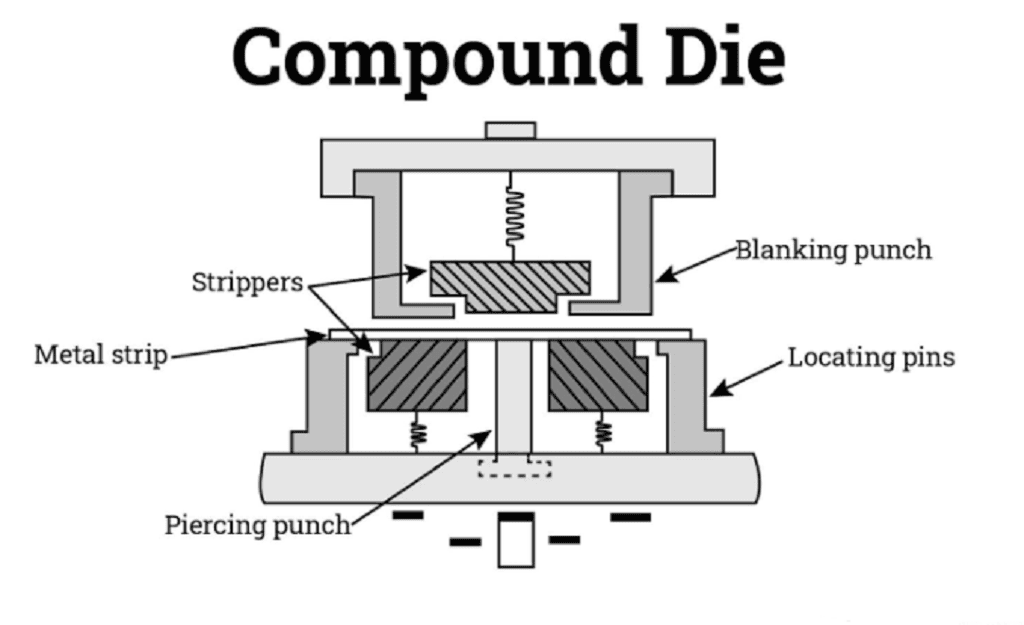
The strip or sheet is precisely located over the die using guide pins and guide rails. This step is the foundation of dimensional accuracy — even a 0.01mm positioning error will push hole locations out of tolerance.
Step 3: The Press Stroke
The punch descends and, in that single stroke, simultaneously:
- Piercing punches cut all holes
- Blanking punch cuts the outer profile
- The part separates completely from the strip
All cutting forces apply at the same instant — this is the fundamental reason compound dies deliver superior flatness.
Step 4: Ejection and Separation
The finished part is separated from the die via a dedicated ejection mechanism (falling through the bottom or pushed clear from the top), while the scrap skeleton is simultaneously cleared.
Step 5: 100% Full Inspection
This is one of the most fundamental differences between Worthy Hardware and the majority of comparable suppliers.
Every single part is inspected. Inspection parameters include:
- Overall dimensions and hole diameters
- Hole-to-hole and hole-to-profile positional accuracy (using CMM¹)
- Flatness
- Edge quality and burr height
¹ CMM (Coordinate Measuring Machine): A precision measurement instrument that determines the geometric dimensions of a part using a three-dimensional coordinate system. Accuracy reaches the micron level.
During production, we use an electronic die monitoring system and press condition monitoring to catch anomalies in real time, combined with optical vision measurement systems to verify that every part meets drawing requirements.
Step 6: Surface Finishing (As Required)
We support 50+ surface finishing processes in-house:
| Category | Common Processes |
| Plating | Zinc plating, nickel plating, chrome plating, tin plating |
| Anodizing | Standard anodizing, hard anodizing (aluminum parts) |
| Coating | Powder coating, e-coating |
| Mechanical | Deburring, polishing, shot blasting |
| Heat Treatment | Quenching, tempering, nitriding |
Engineering Optimization Note: Before any tooling is cut, our team of 4 dedicated engineers conducts a full DFM review (Design for Manufacturability — an engineering methodology for optimizing part designs prior to production to reduce manufacturing cost) of your drawings, identifying opportunities to reduce cost, improve quality, or shorten lead time. This service is completely free of charge and has helped multiple customers reduce their total manufacturing cost by 15%–30% without any compromise in part performance.
Three-Way Stamping Process Comparison
| Criteria | Compound Die | Progressive Die | Fourslide Stamping |
| Best For | Flat parts, profiled parts with holes | Complex parts with bends | Small bent parts, springs |
| Tolerance Capability | ±0.025mm | ±0.025mm – ±0.05mm | ±0.05mm |
| Flatness | ⭐⭐⭐⭐⭐ Excellent | ⭐⭐⭐⭐ Good | ⭐⭐⭐ Moderate |
| Tooling Cost | Medium | Higher | Medium |
| Production Speed | Medium-High | High | Medium |
| Forming Capability | ❌ Cutting only | ✅ Includes bending/forming | ✅ Includes bending/forming |
| Typical Die Life | 500K–1M+ strokes | 500K–1M+ strokes | Depends on structure |
Which Industries Rely Most on Compound Die Stamping
🚗 Automotive
Washers, shims, spacers, mounting brackets, EMI shielding components — these parts consistently share the "flat + high volume + tight tolerances" profile that makes compound die stamping the natural fit.
💡 Electronics & Semiconductors
Shielding cans, contact blanks, connector stampings, terminal components — the internal geometry of electronic products leaves very little room for error. Flatness and hole position accuracy are paramount, and the single-station nature of compound tooling minimizes accumulated positioning error.
✈️ Aerospace & Defense
Precision shims, sealing components, mounting plates — these applications must meet demanding industry standards such as AS9100D, with tolerances typically within ±0.025mm and 100% inspection as a baseline requirement. This aligns directly with our quality management approach.
🏥 Medical & Dental
Surgical instrument components, device structural parts, small precision plates — the medical industry's requirements for consistency, traceability, and material compliance (e.g., medical-grade 316L stainless steel, titanium TC4) are a strong match for our quality system.
🔧 Industrial Hardware
Lock washers, retaining rings, mounting plates, spring clips — flat hardware components are the classic, high-volume application for compound die stamping.
⚡ Energy & Lighting
Battery contact strips, reflector bowl stampings, conductive contact elements — applications with specific requirements for electrical conductivity and dimensional consistency.
What Typical Parts Can Be Made with Compound Die Stamping?
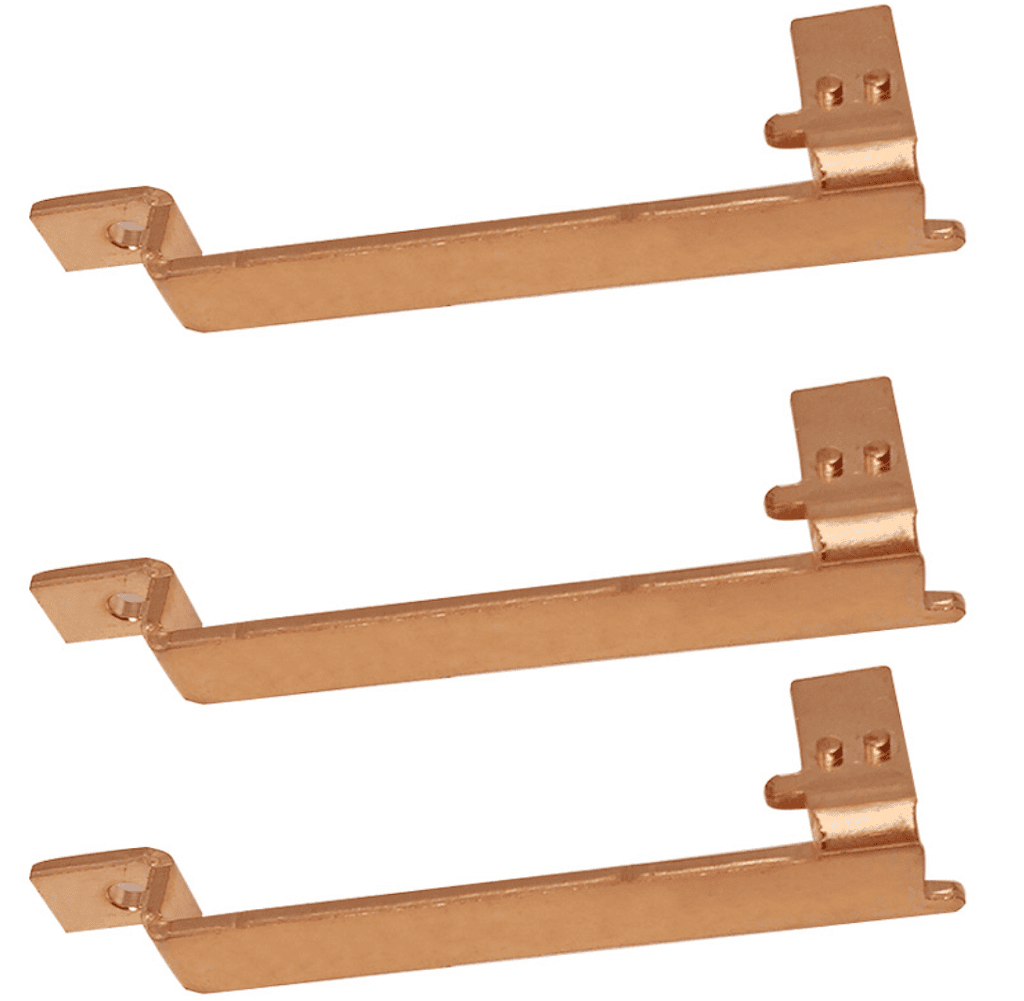
The following are representative compound die stampings we have produced at Worthy Hardware:
Cut-to-finish parts (ready to use as-stamped):
- Washers of all types (flat, wave, custom profile)
- Shims and spacers
- Metal gaskets
- Flat mounting plates (no bends)
- Retaining rings and snap rings
- Contact blanks and terminal stampings
- Connector stampings
- EMI shielding plates and shielding cans
Blanks for downstream operations:
- Flat spring blanks (for subsequent forming)
- Blanks for shallow draw operations
- Strain relief components
- Flat clip blanks
📌 Real Case Study · EMI Shielding Plate for a Japanese Electronics Manufacturer
A Japanese electronics manufacturer provided drawings for an EMI shielding plate requiring a hole-to-edge positional tolerance of ±0.025mm in 0.3mm thick stainless steel 304.
Had we used a progressive die, the strip transfer between stations would have introduced 0.01mm–0.02mm of positioning error per station — cumulative error that would easily push the final part out of tolerance. We selected a compound die solution, cutting all holes and the outer profile in a single synchronized stroke, completely eliminating inter-station transfer error.
The finished parts passed the customer's CMM inspection with hole position consistency at ±0.018mm. This program has been in stable production for three consecutive years, with zero quality complaints and annual volume exceeding 500,000 pieces.
"The quality fully meets our requirements, and delivery has been very consistent. This is a supplier we can genuinely rely on for the long term."
— Procurement Department, Japanese Electronics Manufacturer (name withheld by request)
Frequently Asked Questions (FAQ)
Q: How much less does compound die tooling cost compared to a progressive die?
A: For the same part, compound die tooling typically costs 20%–40% less than a progressive die. However, if your part requires bending or forming, a progressive die is necessary and the two cannot be compared directly. Choosing the right process almost always saves more total cost than negotiating down the tooling price.
Q: Is there a minimum order quantity for compound die stamping?
A: Worthy Hardware has no minimum order quantity. We can start with a single prototype piece. From an economics standpoint, the per-part cost advantage of compound die stamping becomes significant once monthly volume exceeds approximately 5,000 pieces.
Q: How long does compound die tooling last?
A: Compound dies made from quality tool steels such as SKD11 or DC53 typically achieve a service life of 500,000 to 1,000,000+ strokes, depending on material thickness, hardness, and maintenance practices.
Q: How long does sampling take?
A: Our standard lead time for first article samples is 7–15 business days, depending on part complexity and tooling structure. Once you submit drawings, we will provide a process evaluation and confirmed timeline within 24 hours.
Q: What happens if I receive parts with a quality problem?
A: We commit to responding within 48 hours of any quality issue being identified, and we will provide a complete root cause analysis and corrective action report. All shipments leave our facility after 100% inspection, and we maintain complete inspection records for full traceability throughout the supply chain.
Our Commitments to Customers
| Item | Our Commitment |
| Quality Assurance | 100% full inspection, CMM + optical vision dual verification |
| Quality Certification | ISO 9001:2015 |
| Sample Lead Time | Typically 7–15 business days |
| Mass Production Delivery | Flexible scheduling based on order volume; on-time delivery rate 98%+ |
| Minimum Order Quantity | No MOQ — from single prototype to millions of pieces |
| Payment Terms | T/T wire transfer; letter of credit negotiable for large orders |
| Quality Issue Response | Response within 48 hours, complete resolution plan provided |
| Primary Export Markets | North America, Europe, Japan, Singapore, Australia, New Zealand, Middle East |
Summary
Compound die stamping is one of the most efficient manufacturing processes available for high-volume production of flat, precision metal parts. By completing multiple cutting operations simultaneously in a single press stroke, it delivers:
✅ Exceptional flatness
✅ Tight tolerances (to ±0.025mm, with selected dimensions to ±0.01mm)
✅ Clean edges with minimal secondary processing
✅ Tooling cost 20%–40% lower than progressive dies
✅ High-volume production with extremely low per-part cost
But compound die stamping is not a universal solution. Parts with bends, complex forming features, or very large dimensions may be better served by progressive dies, fourslide stamping, or a combination of processes. Selecting the right process nearly always saves more total cost than pushing for a lower price on the wrong one.
At Worthy Hardware, we don't just help you get parts made — we help you get them made right:
📐 Free DFM drawing review by 4 dedicated engineers
🔩 100+ materials, 50+ surface finishes
🔍 100% full inspection, ISO 9001:2015 certified
📦 No MOQ — prototype through mass production
⏱ Quote response within 24 hours
Have a part you'd like us to evaluate?
📧 Send your drawings to: [email protected]
🌐 Visit our website: www.worthyhardware.com
We'll provide honest process recommendations and a competitive quote — typically within 24 hours.
Worthy Hardware — Precision Metal Stamping Manufacturer, China | ISO 9001:2015 Certified | Serving Global B2B Customers
Primary Markets: North America | Europe | Japan | Singapore | Australia | New Zealand | Middle East