
What Do The Different Aluminum Tempers Mean For CNC Manufacturing?
Choosing the right aluminum seems simple until you see codes like T6 or T651. You worry that picking the wrong one will compromise your project, costing you time and money.
Simply put, an aluminum temper designationtells you how the metal was processed to achieve its final strength and hardness. For CNC manufacturing, the "T" tempers, like T5, T6, and T651, are most common, indicating the material has been heat-treated and aged for stability and strength.
I've seen many customers, from seasoned engineers to new hardware entrepreneurs, get puzzled by these temper codes. They know the alloy they want, like 6061 aluminum, but the temper part feels like a mystery. Getting it right is not just about specs on a sheet; it’s about ensuring your final part performs exactly as you designed it, without warping or failing under stress. Let me break down what these codes really mean for your CNC machined parts. Understanding this will help you communicate better with your supplier and get the perfect part every time.
What are the different temper grades of aluminum?
Picking an aluminum alloy is only half the battle. You see codes like "-T6" and wonder if it really matters. Choosing incorrectly can lead to weak or brittle parts.
Aluminum temper grades describe the material's mechanical properties, achieved through hardening and heat-treating. The main categories are F (as-fabricated), O (annealed), H (strain-hardened), W (solution heat-treated), and T (thermally treated). For CNC, the T-series is most important.
When we talk about aluminum for CNC machining, we are almost always dealing with heat-treatable alloys. This is where the "T" temper designation comes in. My own insight is that this T code, followed by one or more numbers, tells you the specific recipe of heat treatment and aging the material has gone through. Think of it like baking a cake; the ingredients (the alloy) are the same, but the baking time and temperature (the temper) completely change the final result. For example, 6061 is a great alloy, but 6061-T6 has very different properties from 6061-T4 because of its thermal treatment.
Understanding the Main Temper Designations
Let's look at the basic codes to understand the landscape.
| Temper Code | Description | Common Use Case in CNC |
|---|---|---|
| F | As Fabricated. No special control over its condition. | Rarely used for final parts; material in raw state. |
| O | Annealed. The softest, most ductile state. | When significant forming is needed before machining. |
| H | Strain Hardened (Work Hardened). For non-heat-treatable alloys. | Not typically seen with popular CNC alloys like 6061 or 7075. |
| T | Thermally Treated. Heat treated to produce stable tempers. | The most common category for CNC machining. |
The T tempers are where we focus our attention at Worthy. A number after the "T" specifies the exact process, like solution heat-treating and then artificial or natural aging. This process is what gives the aluminum its excellent strength, hardness, and stability, making it perfect for machining precise components.
What is the difference between T6 and T651 aluminum tempers?
You need a strong, stable part. You see T6 and T651 offered, but they seem identical. You are worried that choosing the wrong one might cause your parts to warp after machining.
T651 is T6 aluminum that has undergone a stress-relieving process. It is solution heat-treated, artificially aged, and then mechanically stretched. This minimizes internal stress, making T651 far less likely to warp during or after CNC machining, ensuring better dimensional stability.
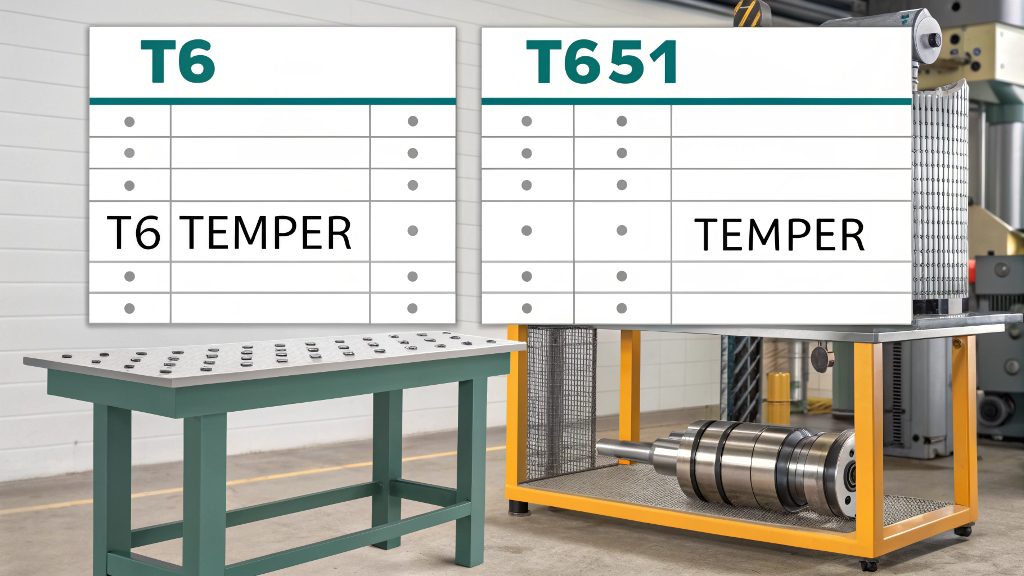
I remember a client, Mark from Canada, who was making very intricate enclosures. He initially quoted for 6061-T6 because it was slightly cheaper. We were removing a lot of material from a large plate. I warned him that with T6, the internal stresses released during machining could cause the thin walls to bow. He trusted our experience and switched to T651. After machining, the parts were perfectly flat, saving him from potential rejects and a huge headache. This is a perfect example of why T651 exists. The "51" indicates stress-relief by stretching after heat treatment. This simple difference is a game-changer for high-precision jobs.
T6 vs T651: Key Differences for Machinists
| Feature | T6 Temper | T651 Temper |
|---|---|---|
| Base Treatment | Solution heat-treated & artificially aged. | Solution heat-treated & artificially aged. |
| Stress Relief | No specific stress-relieving process. | Yes, stress-relieved by controlled stretching. |
| Dimensional Stability | Good, but can warp if heavily machined. | Excellent. Significantly less likely to warp. |
| Cost | Slightly lower. | Slightly higher. |
| Best For | General purpose parts, components with minimal material removal. | High-precision parts, thin-walled components, parts requiring extensive milling. |
For us at Worthy, we almost always recommend T651 for any part where flatness or straightness is critical. The small extra cost for the material is tiny compared to the cost of scrapped parts or extra setup time spent trying to fix a warped component. If your part looks more like a skeleton than a solid block after machining, choose T651.
What is the difference between T5 and T6 temper aluminum?
Your design requires good strength, but you also want to manage costs. You see both T5 and T6 available and wonder if the stronger T6 is always the better, or necessary, choice.
The primary difference is the heat treatment process. T6 temper involves solution heat-treating and then artificial aging, creating maximum strength. T5 is cooled from an elevated temperature shaping process and then artificially aged, which is simpler and results in slightly lower strength and hardness.
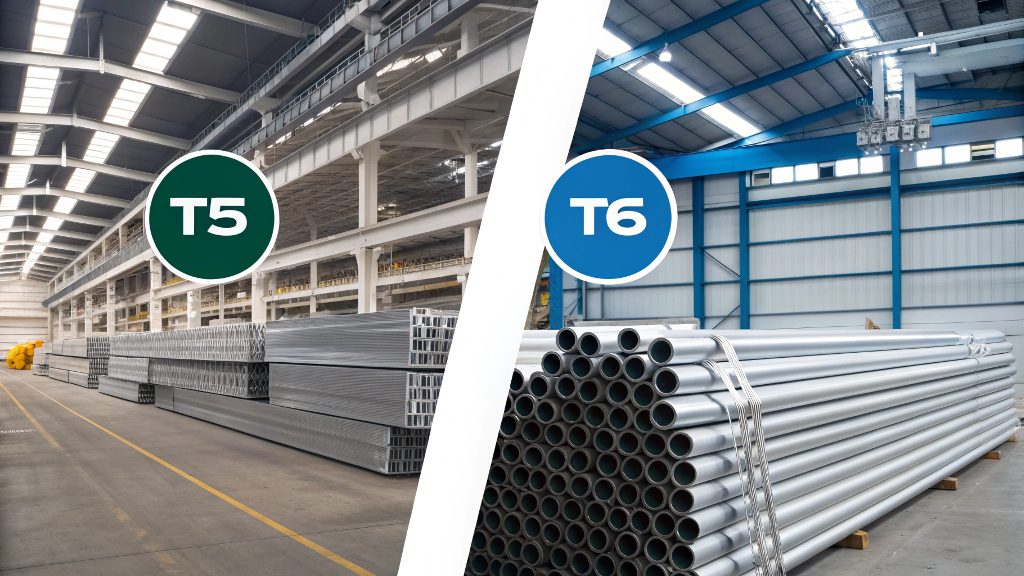
The T5 temper is very common in aluminum extrusions. The process is more energy-efficient because it skips the separate solution heat treatment step that T6 requires. After the aluminum is extruded, it's cooled at a controlled rate and then put into an aging oven. This makes it moderately strong and very cost-effective. T6, on the other hand, is the full-strength option. It goes through the complete heat treatment cycle to achieve the highest possible strength and hardness for that alloy. For parts that need to withstand high loads or impacts, T6 is the way to go.
Comparing T5 and T6 Properties
| Property | T5 Temper | T6 Temper |
|---|---|---|
| Process | Cooled from shaping process + Artificially Aged | Solution Heat-Treated + Artificially Aged |
| Strength | Good (Medium Strength) | Excellent (Maximum Strength) |
| Hardness | Good | Excellent |
| Cost | Lower | Higher |
| Common Use | Architectural parts, window frames, parts where moderate strength is sufficient. | Structural components, aerospace parts, automotive parts, high-stress applications. |
I often explain it to customers like this: if you are making something like a decorative trim or a simple bracket that just needs to hold its own shape, T5 is a smart, cost-saving choice. But if you are building a part for a machine, a vehicle, or anything structural where failure is not an option, the extra strength of T6 is an essential investment. It’s about matching the material’s capability to the demands of the application.
What is the difference between T4 and T6 aluminum temper?
You have a part that needs some forming before final machining. You've heard T4 is softer, but T6 is stronger. You are unsure which one is right for your manufacturing process.
T4 and T6 tempers differ in their aging process. T4 is solution heat-treated and then aged naturally at room temperature. T6 is also solution heat-treated but is then aged artificially in an oven. This makes T4 softer and more formable, while T6 is harder and stronger.
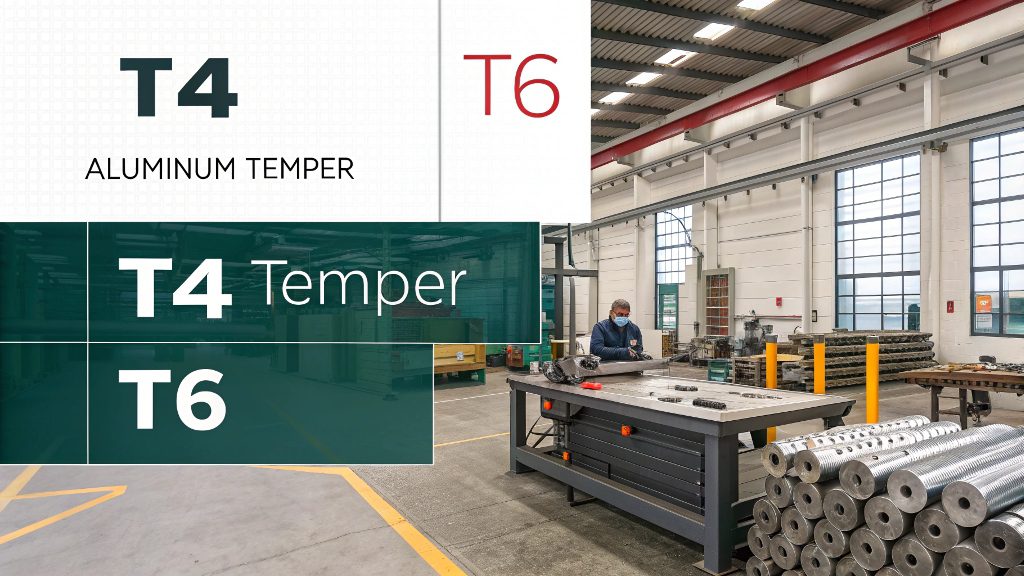
The key here is the state you need the material in for your production steps. The T4 temper is essentially a stable but intermediate state. The material is relatively soft and has excellent formability, so you can bend, stamp, or shape it easily. Over time, it will continue to age slowly. In contrast, the T6 temper is the final, fully hardened state. It's strong and stable but not suitable for significant forming because it's more likely to crack. I once worked with a startup making custom robotics chassis; they needed to bend aluminum sheets into complex shapes before drilling and tapping holes. T4 was the perfect choice for them. They could form the parts easily in the T4 condition and then, for some critical components, have them heat-treated to T6 for maximum strength.
Choosing Between T4 and T6
| Attribute | T4 Temper | T6 Temper |
|---|---|---|
| Aging | Natural (at room temperature) | Artificial (in an oven) |
| State | Softer, more ductile, good formability. | Harder, stronger, less formability. |
| Strength | Lower than T6. | Higher than T4. |
| Stability | Can age-harden slightly over time. | Fully stable, properties do not change. |
| Best For | Parts that require forming or bending before final use. | Finished parts that need maximum strength and hardness from the start. |
Essentially, you choose T4 when you need to do a lot of shaping. You choose T6 when you need a finished part with maximum mechanical properties right out of the machine. At Worthy, we machine both, but it is critical to know what the part needs to do. Machining T4 is generally easier on tools, but the final part won't be as strong unless it's aged further. For most direct-to-machining applications our clients need, T6 or T651 is the standard choice.
Conclusion
Choosing the right aluminum temper is crucial for your part's success. Understanding codes like T5, T6, and T651 ensures you get the strength, stability, and performance your project demands.