
How Do Large Part CNC Machining Services Differ from Standard CNC?
Struggling to understand the difference between large and standard CNC? Choosing the wrong service can be costly and delay your project. Let's make the distinction clear.
The primary difference lies in scale and complexity. Large part CNC machining utilizes bigger, more robust machines with worktables often exceeding 1.5 meters to handle massive components. Standard CNC is suited for smaller parts. This also requires operators with more specialized skills for large format jobs.
When you look at a a standard CNC machine, you see incredible precision at a familiar scale. But some projects, especially in industries like aerospace or energy, require something much bigger. I remember a client, Mark from Canada, who was expanding his product line to include large industrial frames. He initially thought any CNC service would do, but soon realized the unique challenges of large-scale manufacturing. This experience taught me how important it is to understand these differences. It's not just about a bigger machine; it's a completely different approach to manufacturing that impacts everything from programming to final inspection. Let's dive into what sets these services apart.
What is a large CNC?
Are you unsure what the term "large CNC" truly means? This confusion can lead you to choose the wrong manufacturing partner, wasting time and money on a service not built for your needs.
A large CNC machine is specifically engineered for oversized workpieces. Its defining feature is a massive worktable and structure, capable of handling parts much larger and heavier than standard machines can. At Worthy, our large mills handle parts up to 2,032 mm (80 inches).


When we talk about "large," we're referring to a significant jump in capacity. A standard CNC machine might be perfect for parts that fit in your hands, but large CNC machining is for components that can be bigger than a person. Think about massive molds for the automotive industry or structural components for aircraft. These machines need more than just a bigger bed. They require a more rigid frame to handle the immense weight and cutting forces without losing precision. The machine itself is heavier and more powerful to ensure it can cut dense materials accurately over a large surface area. For B2B clients who need these large parts, understanding this distinction is the first step.
Here’s a simple breakdown:
| Feature | Standard CNC Machine | Large CNC Machine |
|---|---|---|
| Work Envelope | Typically under 1,000 mm | Often 1,500 mm to over 2,000 mm+ |
| Typical Use | Small to medium-sized parts, consumer products | Industrial frames, molds, aerospace parts |
| Machine Structure | Standard rigidity | Heavy-duty, reinforced for stability |
| Operator Skill | General CNC operation | Specialized skills for large setups & programming |
This difference in scale requires specialized knowledge, which is why working with an experienced partner is critical.
What is the main disadvantage of CNC machining when compared to conventional machining?
CNC machining seems perfect, but are there downsides? Ignoring the potential drawbacks can lead to unexpected costs and complexity, especially if you're new to the process. Let's look at the main disadvantage.
The primary disadvantage of CNC machining is the high initial investment. The machines, specialized software, and the training needed for skilled programmers and operators are all very expensive. This high upfront cost can be a major hurdle for smaller shops or simple, one-off jobs.
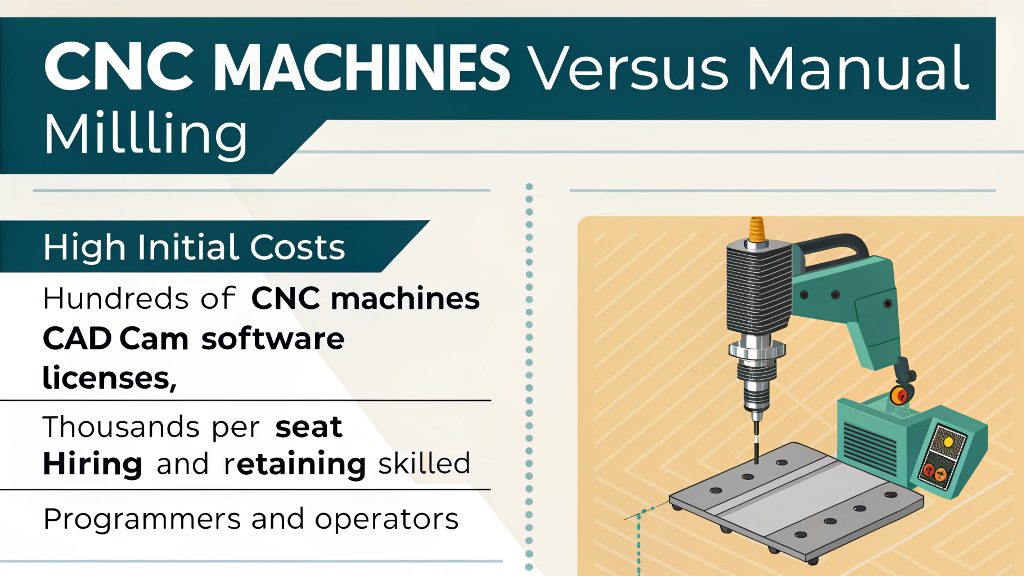
The cost barrier is significant. A new, quality CNC machine can cost hundreds of thousands of dollars. Then, you need to add the cost of CAD/CAM software licenses, which can run into the thousands per seat. Finally, you need to hire and retain skilled programmers and operators, whose salaries reflect their specialized expertise. For a very simple part, a machinist using a conventional, manual mill might actually be faster and cheaper. They can just walk up to the machine and start cutting without any programming. However, my B2B customers, like Mark, aren't looking for just one simple part. They need hundreds or thousands of identical, complex parts. For them, the initial cost disadvantage of CNC is easily offset by its incredible repeatability, precision, and efficiency in mass production. Once the program is written, the CNC machine can run it over and over with minimal human error, ensuring every part is exactly the same.
How does CNC machining differ from conventional machining?
Both CNC and conventional machining cut material. But they are worlds apart in how they work and the results they produce, which directly impacts your project's outcome and cost.
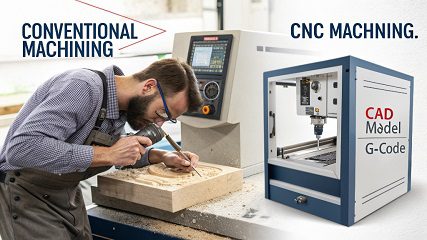
The core difference is automation. CNC (Computer Numerical Control) machining uses a computer program to control the machine's movements precisely. Conventional machining relies entirely on a human operator to manually control the machine's tools using handwheels and levers.
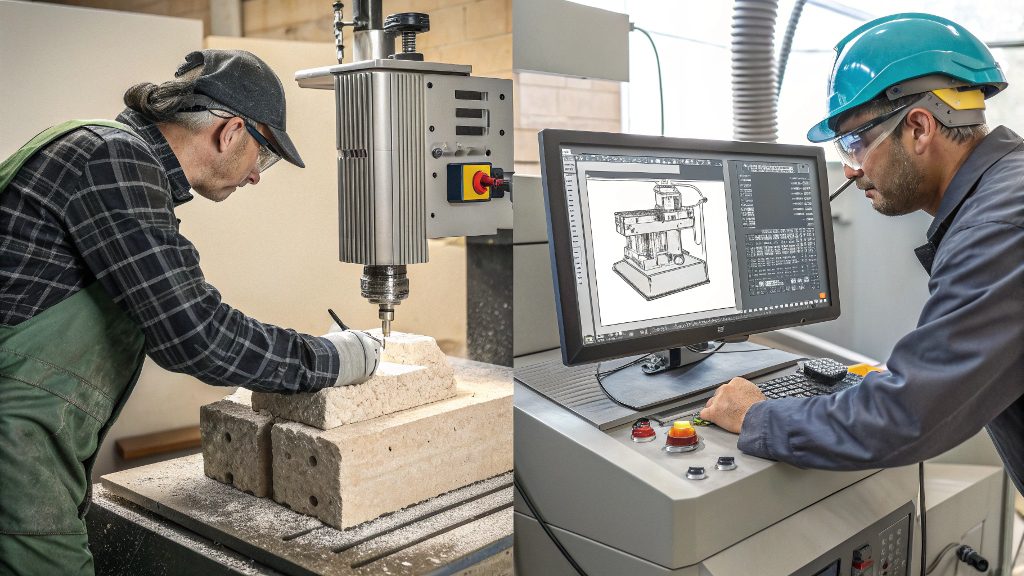
Think of it like this: conventional machining is like a sculptor carving by hand. The final piece depends entirely on the artist's skill, steadiness, and moment-to-moment decisions. It’s a manual process. On the other hand, CNC machining is like using a highly advanced, computer-guided tool. We first create a detailed digital blueprint of the part (a CAD model) and then write a set of instructions (G-code) for the machine to follow. The computer then executes these instructions perfectly, moving the cutting tool along multiple axes to create the part. This digital control is what separates CNC from the manual world. This method eliminates the potential for human error that exists in conventional machining, ensuring every piece is a perfect match to the digital design. It’s this automation that allows us to produce highly complex parts with incredible accuracy, time after time.
Which advantage makes CNC machines suitable for complex part manufacturing?
With so many benefits, what is the one key advantage? Knowing this helps you understand why CNC is the top choice for today's most demanding industries, from aerospace to medical devices.
The single biggest advantage that makes CNC machines perfect for complex parts is their ability to execute multi-axis movements simultaneously with extreme precision. A 5-axis CNC machine can move a part or cutting tool on five different axes at the same time.
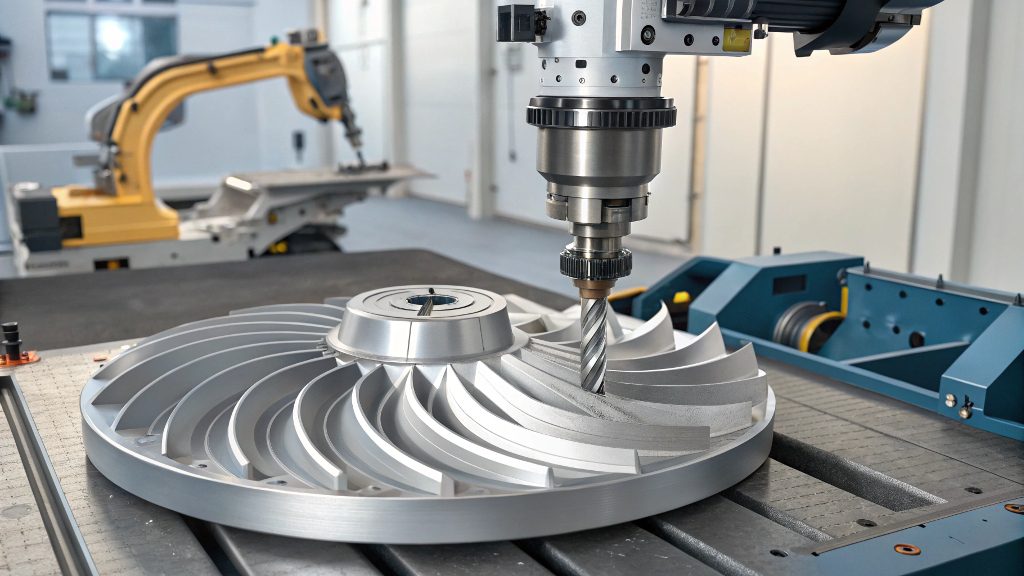
This capability is a game-changer. Imagine trying to create a complex curved surface, like an impeller blade, on a manual machine. An operator would have to make countless small adjustments and reposition the part over and over. It would be incredibly time-consuming and almost impossible to get perfect. A 5-axis CNC machine, however, can create that same smooth, complex geometry in a single setup. By moving the tool and the workpiece at the same time, it can follow complex toolpaths that would be impossible for a human operator to replicate manually. This is why when I work with clients in robotics or aerospace, 5-axis CNC is often the only option. It allows us to produce parts with intricate angles, undercuts, and organic shapes that used to be impossible to manufacture efficiently. This ability to create complexity with precision is the true power of modern CNC.
Conclusion
Understanding the differences between large and standard CNC, and its advantages over conventional methods, is key. This knowledge helps you choose the right service for parts of any complexity or scale.
At Worthy, we provide the expertise for both. From prototypes to mass production, we ensure your parts meet the highest standards. Email me at [email protected] or visit www.worthyhardware.com.