
What New Applications Does Precision Stamping Have in Electric Vehicle Components?
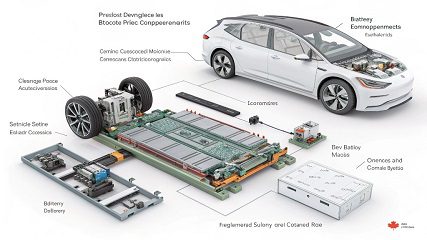
The EV revolution demands perfection in every part. Compromising on component quality isn't an option. Precision stamping is the manufacturing backbone, creating the critical parts that power this change.
Precision stamping is essential for creating core electric vehicle components. These include complex battery connectors, motor laminations, terminals for battery management systems (BMS), lightweight chassis brackets, and intricate parts for charging systems. These components require tight tolerances and high reliability, which stamping provides efficiently.
I remember a client, Mark from Canada, who was developing a new EV charging station. He was frustrated with inconsistencies from his previous supplier, which caused delays. When we took on the project, he was skeptical. We showed him our process, focusing on the precision of our tooling and our 100% inspection policy. Seeing the first batch of perfectly formed terminals and housings, all identical down to the micron, completely changed his perspective. He realized that the right manufacturing partner doesn't just make parts; we build the trust necessary for innovation. This is the foundation we build every partnership on, especially in a demanding field like electric vehicles.
What are the latest innovations in electric vehicles?
Struggling to keep up with the rapid pace of EV innovation? You know new battery and motor technologies demand better components. This is where advanced manufacturing steps in to make them possible.
The latest innovations in EVs focus on increasing range, reducing charge times, and improving safety. This includes solid-state batteries, high-efficiency motors, and integrated thermal management systems. Precision stamping is critical to creating the core components that make these advancements a reality, from intricate connectors to housing.
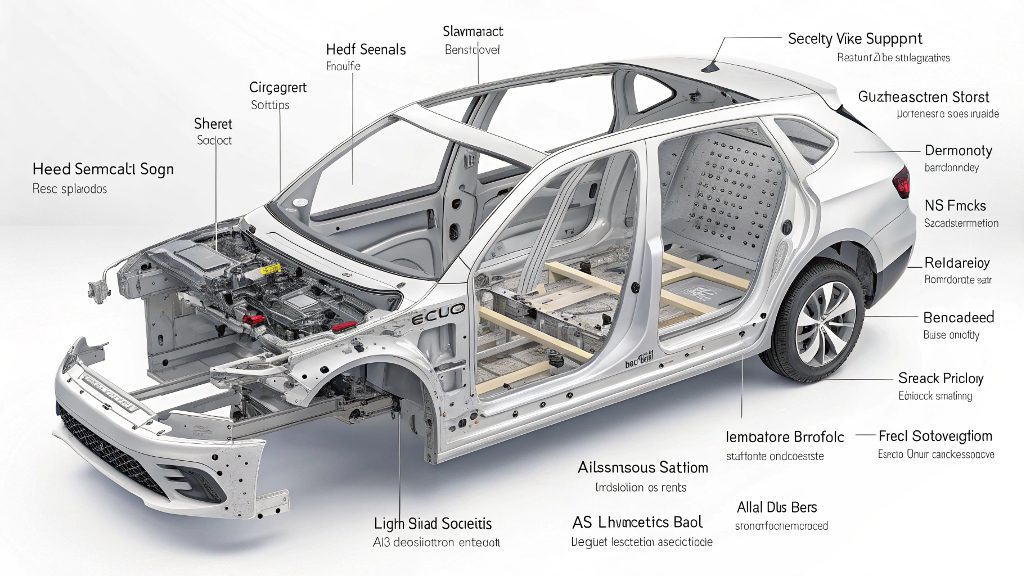
At Worthy, we see these innovations firsthand in the designs our clients bring us. For example, new battery pack designs require more complex and dense busbars and connectors to handle higher power loads. These aren't simple stamped pieces anymore. They often involve in-die tapping or even plastic overmolding to create a single, integrated component. We helped a client in Europe develop a new busbar that improved thermal dissipation by 15%. We achieved this by using a specific copper alloy and designing a die that created micro-channels on the surface during the stamping process. These small details, enabled by precision stamping, are what drive the big leaps forward in EV performance. It's not just about making a shape; it's about embedding functionality directly into the metal component.
What are the applications of stamping?
Are you unsure which parts in your project are best suited for stamping? Choosing the wrong process can lead to higher costs and lower quality. Stamping is the ideal solution for high-volume, high-precision metal parts.
In the context of EVs, stamping is used for a huge range of applications. This includes everything from the powertrain to the vehicle body. Components like motor laminations, battery module connectors, inverter housings, lightweight frame brackets, and even small clips and terminals are all produced through stamping.
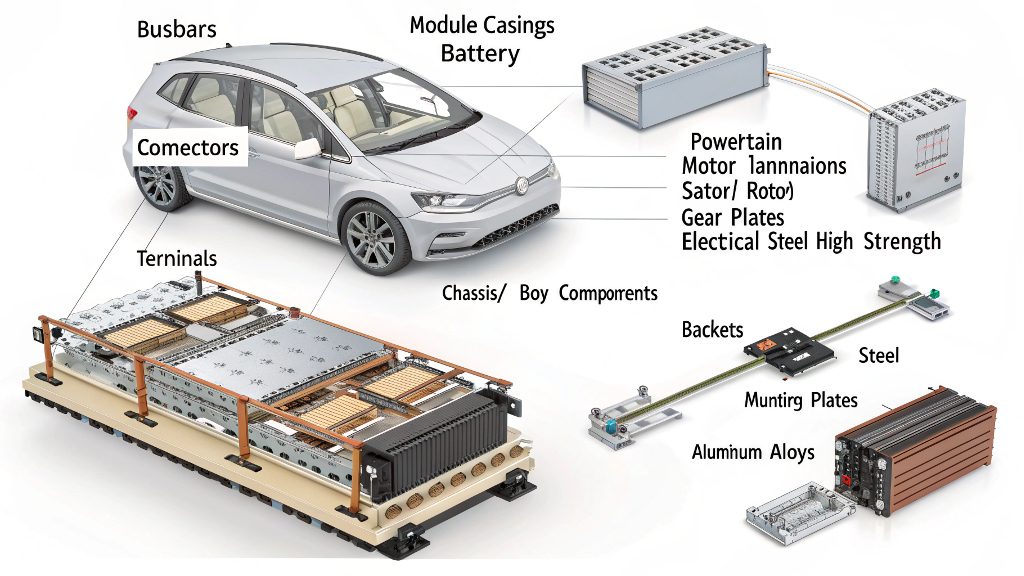
When a customer asks us about applications, I often point to the unseen heroes of an electric vehicle. Think about the battery management system (BMS). It relies on dozens of tiny, precise terminals and shields to function correctly. We produce these parts by the million, each one identical to the last. This is possible through progressive stamping, where a strip of metal goes through a series of operations in one continuous process.
Here’s a breakdown of common EV stamping applications:
| EV System | Stamped Components | Material Examples | Key Requirement |
|---|---|---|---|
| Battery System | Busbars, Connectors, Terminals, Module Casings | Copper, Aluminum, Nickel-plated Steel | High Conductivity, Corrosion Resistance |
| Powertrain | Motor Laminations (Stator/Rotor), Gear plates | Electrical Steel, High-Strength Steel | Tight Tolerances, Magnetic Properties |
| Chassis/Body | Brackets, Reinforcements, Mounting Plates | High-Strength Steel, Aluminum Alloys | Strength-to-Weight Ratio, Durability |
| Electronics | EMI Shields, Connector Housings, Heat Sinks | Stainless Steel, Copper Alloys, Aluminum | Shielding Effectiveness, Thermal Mgt. |
Each application demands a deep understanding of both the material and the stamping process to ensure the final part performs perfectly for the life of the vehicle.
How can machine learning be used to enhance the safety features in electric vehicles?
Concerned that traditional quality control can’t guarantee the safety of every component? Defects in critical safety parts can have serious consequences. Machine learning offers a new level of precision and predictive quality control.
Machine learning enhances EV safety by optimizing the design and manufacturing of critical components. It can simulate crash performance to design stronger stamped parts and use predictive analytics during production to identify potential defects in real-time, ensuring every single safety component meets exact specifications.
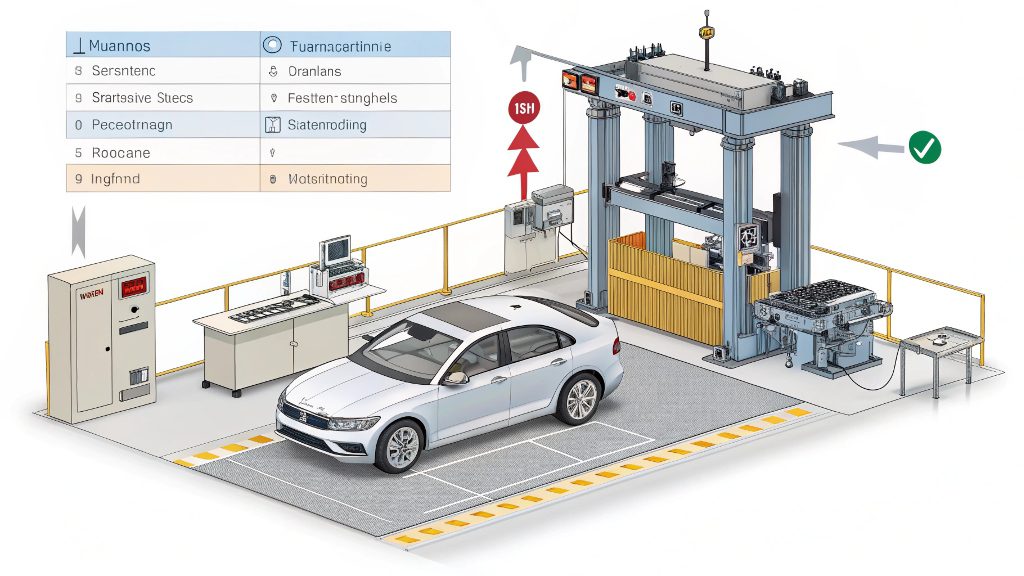
This is an area we are actively exploring at Worthy. While we already do 100% inspection, we're implementing machine learning with our electronic press monitoring systems. Imagine a stamping press making a critical bracket for a seatbelt assembly. Our sensors collect data on pressure, temperature, and material feed with every stroke. A machine learning algorithm analyzes this data in real-time. It can detect a microscopic change in material thickness or a slight die misalignment that a human eye would miss. Instead of just catching a bad part at the end of the line, the system can flag a potential issue before a bad part is even made. This predictive approach is the future of quality assurance for safety-critical components, and it's how we provide clients with an even higher level of confidence in our parts.
What is stamping in the automotive industry?
Finding that generic stamping definitions don't capture the demands of the automotive world? The difference between standard and automotive stamping is huge. A failure in an auto part isn't an inconvenience; it's a safety risk.
In the automotive industry, stamping is a high-volume manufacturing process used to form sheet metal into specific shapes for vehicle components. It uses a tool and die to press metal into precise parts like body panels, brackets, and connectors, valued for its speed, repeatability, and cost-effectiveness.
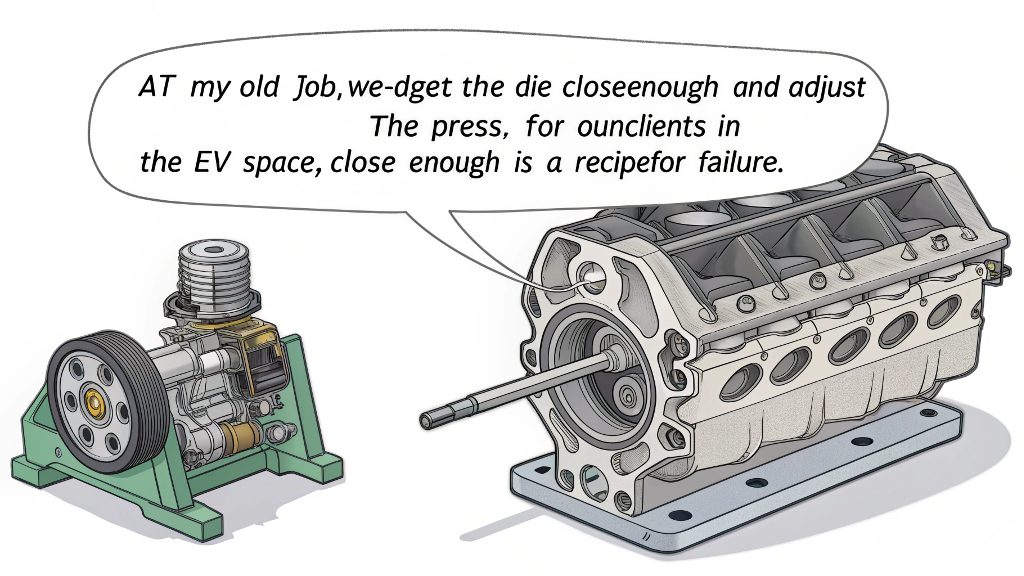
The key difference for EVs is the required level of precision. For an internal combustion engine, a bracket might have a tolerance of 0.5mm. For an EV battery connector, we regularly work with tolerances of 0.025mm. Any deviation could impact electrical conductivity or safety. I once had a new engineer join our team who was surprised by our rigorous tooling standards. He said, "At my old job, we'd get the die 'close enough' and adjust the press." I explained that for our clients in the EV space, "close enough" is a recipe for failure. Our tool and die sets are engineered to be perfect from the first part to the millionth. This is why we handle toolmaking in-house. It gives us complete control over the most critical element of the stamping process and ensures we deliver the precision our automotive clients depend on.
Conclusion
Precision stamping is not just a process; it's a core enabler of the electric vehicle revolution, crucial for creating the safe, efficient, and innovative components that define modern EVs.