
What Safety Components in Automobiles Rely on Precision Metal Stamping?
Are you worried about the safety and reliability of your automotive parts? Using the wrong manufacturing process can lead to failure. Precision metal stamping is the trusted solution for many critical components.
Many crucial automotive safety parts depend on precision metal stamping. This includes seatbelt buckles, disc brake pad brackets, engine gaskets, and airbag components. This process ensures the high strength and tight tolerances these parts need to function perfectly and keep passengers safe every single day.
When I talk to clients, they are often surprised by how many parts inside a car are made using stamping. It's not just the big body panels. The small, unseen parts are often the most important for safety. They need to be perfect every time. This is where our expertise becomes so valuable. We understand that a tiny bracket is not just a piece of metal; it’s a component that saves lives. Let's explore more about how this process is so central to the automotive world.
What is stamping in the automotive industry?
You hear "stamping" but might not know what it means for cars. This knowledge gap can lead to costly design errors. So, let me explain its role very clearly.
Automotive stamping is a manufacturing process that uses a die and press to shape or cut sheet metal into specific car parts. It is essential for producing everything from large body panels like doors and hoods to smaller, complex safety components, all done quickly and affordably.
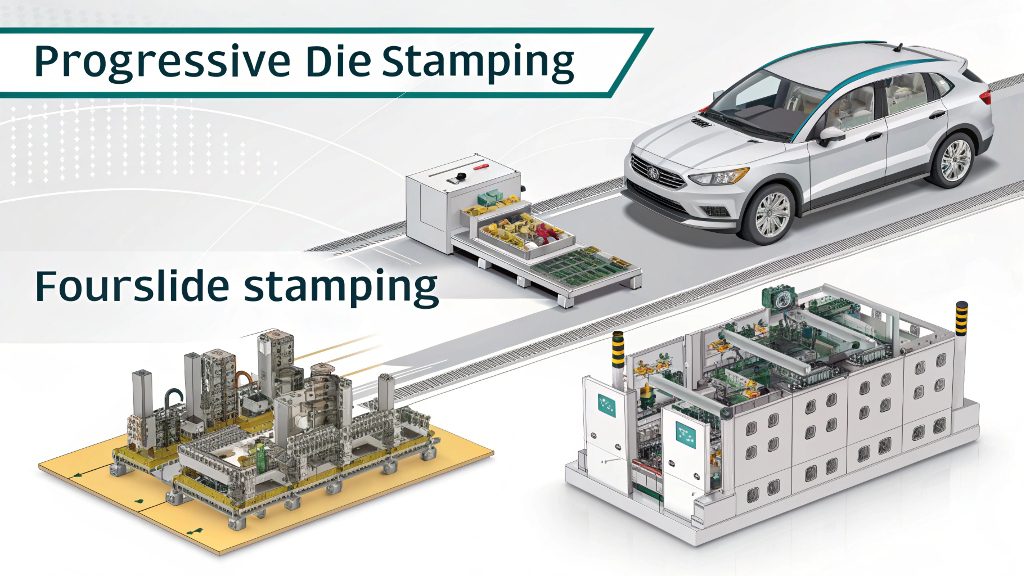
Stamping is the backbone of modern car manufacturing. Think about the sheer number of metal parts in a single vehicle. We need a way to make them quickly, consistently, and at a low cost. Stamping does exactly that. At my company, Worthy, we use several types of stamping. For many small, complex parts, we use progressive die stamping.
In this method, a strip of metal goes through a series of stations, and each station performs a different operation like cutting, bending, or punching. It is very efficient for high-volume orders. For other parts, fourslide stamping is better because it can form complex shapes from four different directions. This versatility is key. It allows us to choose the most effective method for our client's specific design. The choice depends on the part's complexity, the material, and the quantity needed.
| Stamping Method | Best For | Key Advantage |
|---|---|---|
| Progressive Die | High volume, complex parts | High speed and efficiency |
| Fourslide/Multi-slide | Complex bends, wire forms | Versatility, less material waste |
| Deep Draw | Cup-shaped or cylindrical parts | Creates deep parts seamlessly |
| Blanking/Piercing | Simple flat parts, holes | Basic, fast, and cost-effective |
What are the components of sheet metal stamping?
You now know what stamping is, but what parts does it actually make? Not understanding the range of components can make sourcing difficult. We can break them down for you.
Sheet metal stamping creates a huge variety of components. These range from large structural parts like vehicle frames and body panels to smaller items like brackets, clips, terminals, and critical safety components. Almost every metal part in a car likely started as a stamped piece.
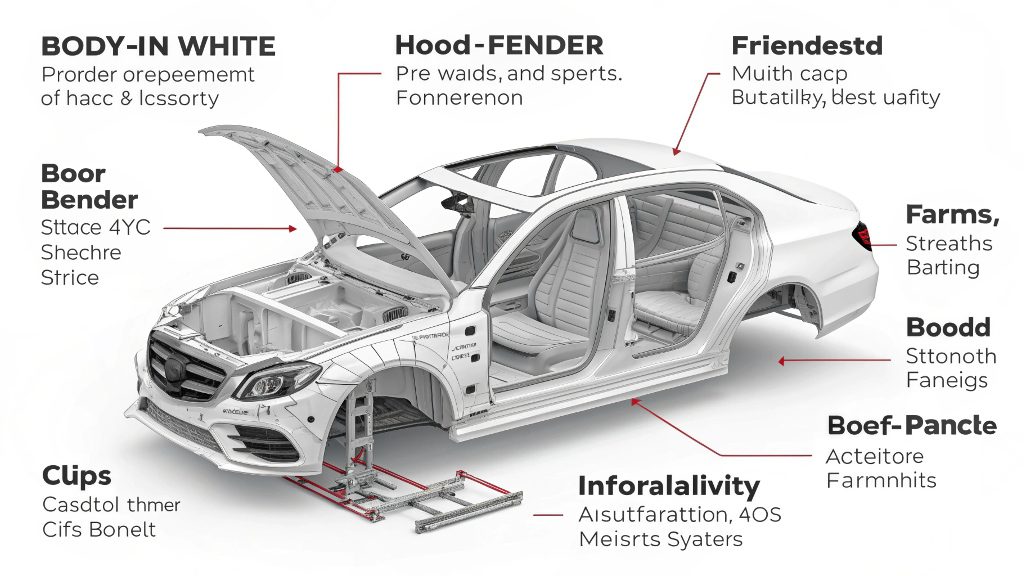
I find it helpful to group stamped automotive components into a few main categories. This makes it easier to understand their function. First, you have the big "Body-in-White" (BIW) parts. These are the car's skeleton before painting, including doors, hoods, fenders, and roof panels. They need to be strong but also have a good surface for painting. Then, you have structural components like the vehicle frame and chassis parts.
Here, strength and durability are the most important qualities. The third category is where we specialize: smaller, functional, and safety parts. These are things you might not see, but they are critical. This includes brackets for mounting systems, clips for holding wires, terminals for electrical connections, and shields to protect electronics. These parts demand incredible precision, often down to 0.025mm, because a small error can cause big problems.
| Component Category | Examples | Key Requirement |
|---|---|---|
| Body-in-White (BIW) | Doors, Hoods, Fenders, Roof | Good surface finish, formability |
| Structural | Frame rails, Cross-members, Pillars | High strength, durability |
| Functional & Safety | Brackets, Clips, Terminals, Shields | High precision, tight tolerances |
| Powertrain | Gaskets, Heat shields, Engine mounts | Heat resistance, durability |
Which metal is used in automobiles?
Choosing the right metal for your automotive part can be confusing. Making the wrong choice can compromise the part's function, safety, and cost. Let me clarify the common options.
Steel is the most common metal in automobiles, especially for the body and structure, due to its strength and low cost. Aluminum is also widely used for its lightweight properties, which improve fuel efficiency. Other metals like copper and brass are used in electrical components.


Every project begins with a conversation about materials. A client like Mark from Canada will care about both quality and cost, so we have to find the right balance. Steel is the workhorse. Different types of steel are used for different applications. For example, High-Strength Steel (HSS) is used for safety components because it provides excellent protection in a crash without adding too much weight. For body panels, we might use a more formable grade of steel. Aluminum is the top choice when weight reduction is the main goal.
Lighter cars are more fuel-efficient and can have better performance. We see it used in hoods, doors, and sometimes even structural parts. But aluminumis more expensive than steel. Copper and its alloys, like brass and bronze, are essential for electrical systems. They are excellent conductors of electricity, so we use them to stamp terminals, connectors, and contacts. At Worthy, we can work with over 100 different materials, so we can always find the perfect match for a customer's design and budget.
What are the applications of sheet metal in the automobile industry?
You know the parts and the materials, but where do they all go? Seeing the real-world applications helps connect everything. The use of sheet metal is everywhere in a car.
The applications are vast. Sheet metal forms the car's entire outer body and structure. It's used inside for dashboards and seat frames, and in the engine bay for mounts, heat shields, and gaskets. It's also critical for safety systems like airbags and seatbelts.
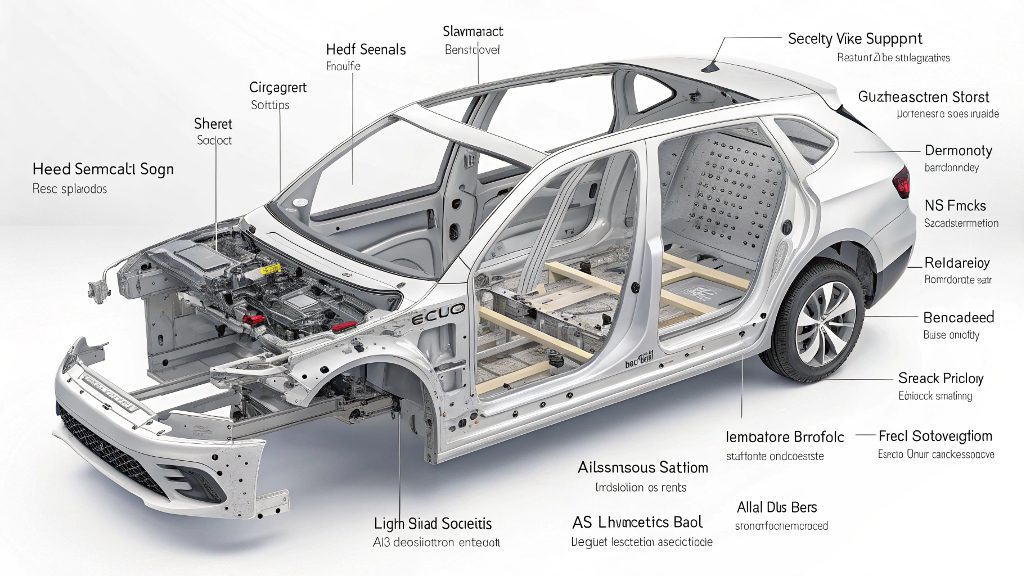
Think of a car as a complex assembly of stamped metal parts. The largest application is the Body-in-White, which I mentioned earlier. This is the entire shell of the car. But the applications go much deeper. Inside the car, sheet metal forms the support structures for the seats and the dashboard. In the chassis and suspension system, you have countless stamped brackets, mounts, and levers that hold everything together and ensure a smooth ride. Under the hood, stamped parts have to resist high temperatures and vibrations. We make engine and transmission components, heat shields to protect other parts from the engine's heat, and gaskets that need to create a perfect seal. Finally, and most importantly, are the safety applications. We manufacture components for airbag systems, brackets for Anti-lock Braking Systems (ABS), and, as I said at the start, seatbelt parts. Every single one of these applications relies on the precision and repeatability of the metal stamping process to ensure the car is safe, reliable, and performs as designed.
Conclusion
Precision metal stamping is essential for creating strong, reliable, and exact safety components for cars. From seatbelts to brakes, this process ensures parts perform perfectly when it matters most.