
How to Choose Between Progressive Die and Traditional Stamping Methods?

Struggling to select the right metal stamping process for your parts? Making the wrong choice can lead to higher costs and project delays, impacting your bottom line.
Progressive die stamping is best for high-volume, complex parts as it performs multiple operations in one tool. Traditional stamping, using separate single-operation dies, is more cost-effective for simpler parts or low-volume production runs. The choice depends entirely on your project's complexity, quantity, and budget.
Now that you have a general overview, you likely have more questions about the specifics. Making the right decision for your business means understanding these details. Let's break down the key differences so you can choose with confidence for your next project and avoid costly mistakes.
What is the difference between a stamping die and a progressive die?
Are you confused about the actual tooling used in these processes? This confusion can cause mistakes in quoting and production. Let's clarify the fundamental difference between these tools.
A traditional stamping die, or single-stage die, performs only one operation per press stroke, like cutting or bending. A progressive die is a single, complex tool with multiple stations that perform a sequence of different operations as a metal strip feeds through it with each press stroke.
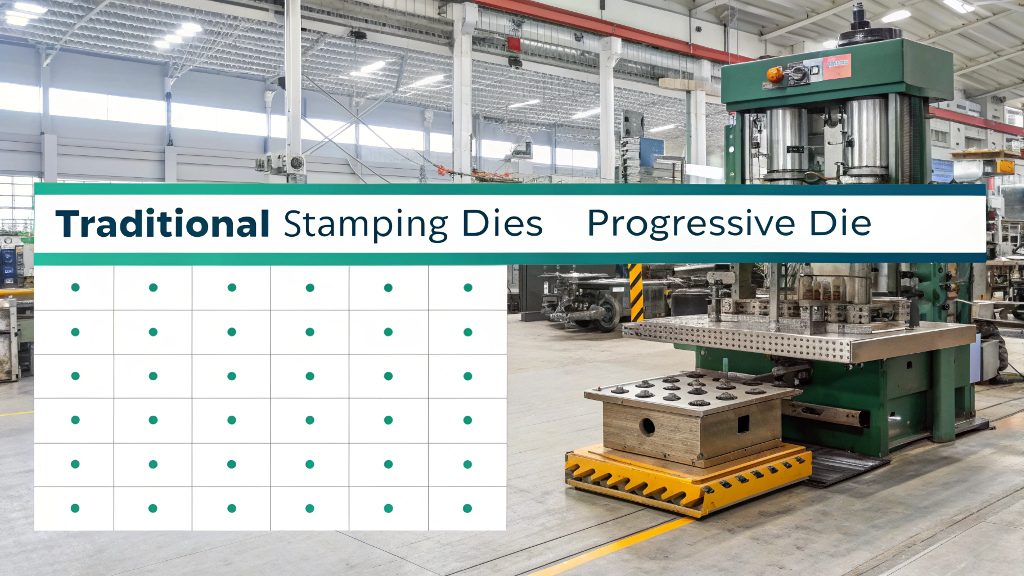
Let's dive deeper into this. The key difference is in the complexity and function of the tool itself. At Worthy, we build both types of tools, and the choice always comes back to the client's part design and production volume.
Think of it like an assembly line. With traditional stamping, you have separate workstations. One station cuts the shape, another bends it, and a third punches a hole. Each step requires a separate tool and setup. The part is moved manually or automatically between these stations.
A progressive die puts that entire assembly line into one single tool. The metal strip feeds in, and with each stroke of the press, it moves to the next station within the die, getting another operation done. The finished part is only cut from the strip at the very last station.
Here’s a simple table to show the difference:
| Feature | Traditional Stamping Dies | Progressive Die |
|---|---|---|
| Tool Function | One operation per die | Multiple operations in one die |
| Part Handling | Parts handled between steps | Part stays on a carrier strip |
| Setup | Multiple setups required | Single, more complex setup |
| Best For | Simple parts, low volume | Complex parts, high volume |
I’ve had clients like Mark from Canada who initially requested separate tools for a bracket because the individual tool cost seemed lower. But when we looked at his annual volume of 500,000 pieces, the labor and setup costs for traditional stamping were huge. We showed him that a one-time investment in a progressive die would save him over 40% per part in the long run.
What are the advantages of progressive stamping?
Are you trying to make your production faster and more cost-efficient? Slow speeds and high labor costs can eat into your profits, especially on large orders. Progressive stamping offers huge benefits.
The primary advantages are high speed, lower per-part cost at high volumes, and excellent repeatability. Because everything happens in one tool, production is extremely fast and consistent, reducing labor costs and material waste. This makes it ideal for large production runs requiring tight tolerances.
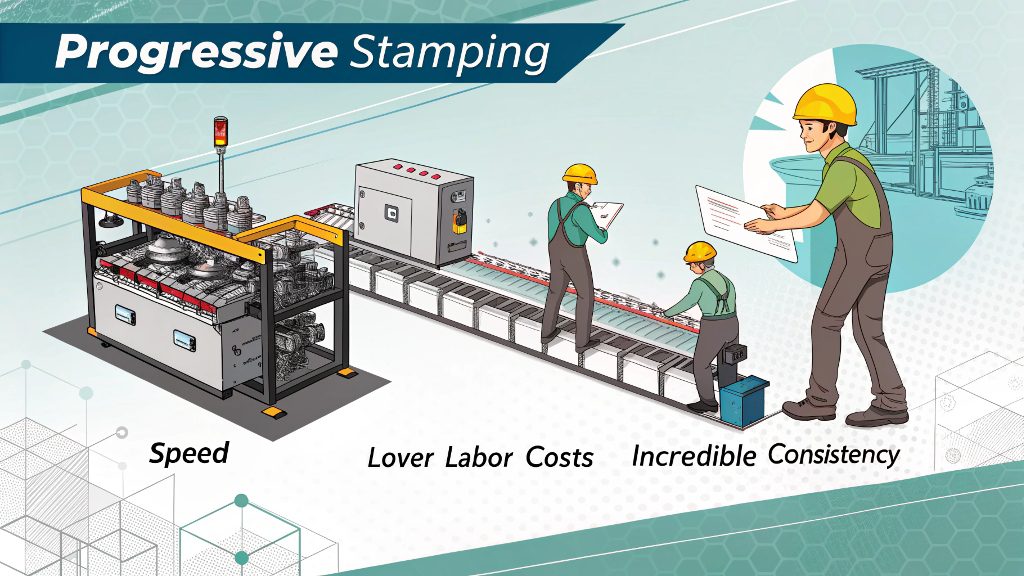
The benefits of progressive stamping become very clear when you look at a large-scale project. We focus on these advantages to help our customers save money without sacrificing quality. The first and most obvious benefit is speed. A progressive die press can run continuously, producing hundreds or even thousands of finished parts per hour with minimal human intervention.
This automation directly leads to the second benefit: lower labor costs. With traditional stamping, you need an operator for each step or machine. With progressive stamping, one operator can oversee a press that produces a complete part. This drastically reduces the cost for each individual part.
Finally, you get incredible consistency. Because the part never leaves the carrier strip until it's finished, the relationship between each bend, hole, and cut is perfectly maintained. This ensures a high degree of repeatability and accuracy, which is critical for parts in the electronics, automotive, or medical industries. For parts with tight tolerances, like the 0.025mm we often hold, progressive stamping is frequently the only practical choice. It minimizes the chance of human error that can occur when moving a part between multiple machines. This consistency is a major reason why our quality is 100% inspected and reliable.
What is the process of progressive die stamping?
Curious about how a complex part is made in a single machine? It can seem complex, but understanding the steps makes it clear. Let's walk through the process together.
The process starts by feeding a coil of metal into the press. With each stroke, the die closes, performing operations like punching, bending, and coining at different stations. The metal strip "progresses" through the die, and a finished part is cut off at the final station.
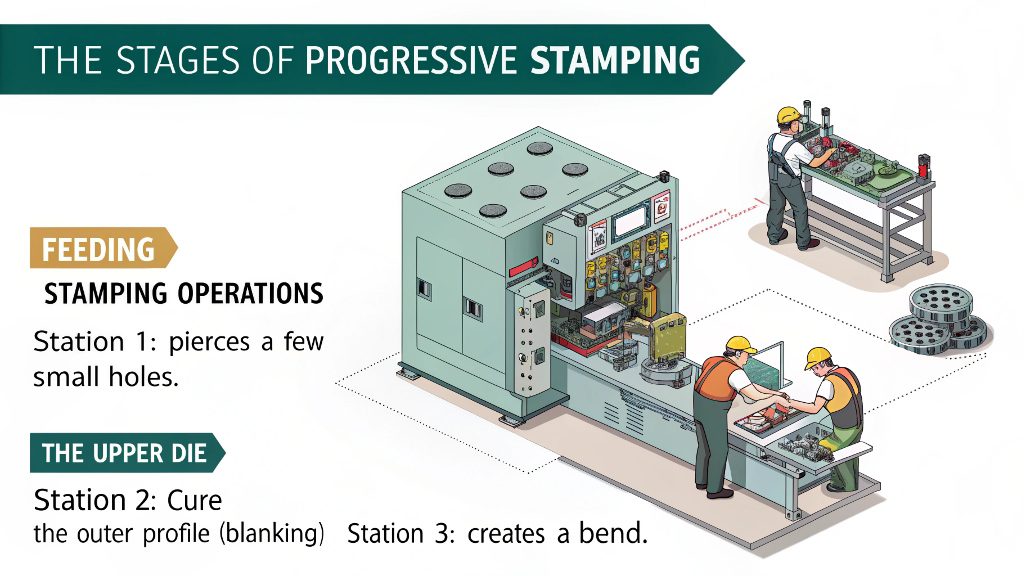
Let me break down the journey a part takes inside a progressive die. It’s a very systematic and carefully engineered sequence. Our four engineers spend a lot of time designing these tools to be efficient and reliable.
The Stages of Progressive Stamping
- Feeding: It all begins with a large coil of raw material, like steel or aluminum, which is unrolled and fed into the stamping press by a feeding system. This system must be very precise to ensure the strip advances the exact same distance each time.
- Stamping Operations: As the press cycles, the upper die comes down onto the lower die. The metal strip is held in place by pilots, which are pins that locate into previously pierced holes. This ensures perfect alignment. The strip then undergoes a series of operations in a specific order.
- Station 1: Might pierce a few small holes.
- Station 2: Might cut the outer profile (blanking).
- Station 3: Might create a small bend.
- Station 4: Might tap a thread or form a deeper shape (drawing).
- Part Ejection: This sequence continues through all the stations of the die. At the very last station, the finished part is cut from the carrier strip and ejected from the press, often falling into a collection bin. The leftover material, the carrier strip, is coiled up or chopped for scrap recycling.
This entire sequence is automated and happens at very high speed, making it an incredibly efficient manufacturing method for the right application.
What is the difference between a progressive tool and a compound tool?
Does the term "compound tool" add to the confusion? It’s another type of stamping tool, and knowing the difference helps you have clearer conversations with your suppliers.
A progressive tool performs multiple operations sequentially as the material strip moves through it. In contrast, a compound tool performs two or more operations, like cutting and punching, in a single press stroke at one single station. The material does not move between operations.


This is a great question because these two tool types are often mistaken for one another, but they serve different purposes. I often explain this to clients who need high-precision flat parts.
A compound tool is all about precision in a single hit. Imagine you need a simple washer with a very precise, concentric hole in the center. A compound tool can blank the outer diameter and pierce the inner hole in the same station with one stroke of the press. Because both cuts happen at the same time, the concentricity between the inner and outer diameters is extremely high. However, compound tools are typically limited to flatter parts and simpler geometries. They are not suited for making parts with multiple bends or forms.
A progressive tool is about building complexity step-by-step. It cannot perform all operations in one station. Instead, it creates features sequentially as the part "progresses" through the tool. This allows for the creation of very complex 3D geometries that a compound tool could never produce.
Here is a quick summary:
| Feature | Progressive Tool | Compound Tool |
|---|---|---|
| Operations | Sequential, at multiple stations | Simultaneous, at a single station |
| Part Complexity | Can produce complex 3D parts | Best for simple, flat parts |
| Key Advantage | High-volume production of complex parts | High precision on flat features (e.g., concentricity) |
| Material Feed | Material strip moves through stations | Material is stationary during the hit |
For a customer like Mark, we might use a compound die for a simple, high-precision flat retainer, but we would always choose a progressive die for a multi-bend electronic shield or a complex mounting bracket.
Conclusion
In summary, choosing between progressive and traditional stamping depends on your part’s complexity and volume. Progressive is for high-volume, complex parts; traditional is for low-volume, simpler jobs.