
What Are The Main Differences Between Countersink And Counterbore In CNC Machining?
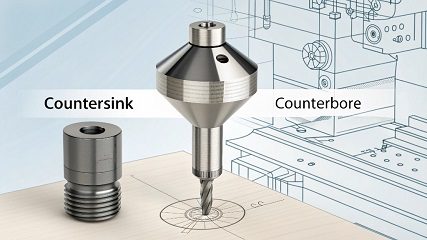
Choosing between a countersink and a counterbore can be confusing. The wrong choice can ruin your design and assembly. Let me clarify the key differences to ensure your parts fit perfectly.
The main difference is shape and function. A countersink is a cone-shaped hole that allows tapered screw heads to sit flush with the surface. A counterbore is a flat-bottomed, cylindrical hole that lets fasteners with flat-bottomed heads sit recessed below the surface.
While that’s the simple explanation, there is more to it than just the shape. The choice you make affects the tools used, the appearance of your final product, and even how you note it on your engineering drawings. It's a small detail that has a big impact on the final quality of your CNC machined parts.
Let's break down each concept further so you can make the best choice for your specific application.
What is the difference between counterbore and countersink?
You know they are different, but which one is right for your project? A wrong choice means your fasteners won't fit correctly. Let’s clarify their specific functions for you.
A countersink creates a V-shaped opening for screws with angled heads, like flat-head screws, allowing them to sit perfectly flush. A counterbore creates a flat-bottomed recess for fasteners with cylindrical heads, like socket head cap screws, hiding them completely below the surface.
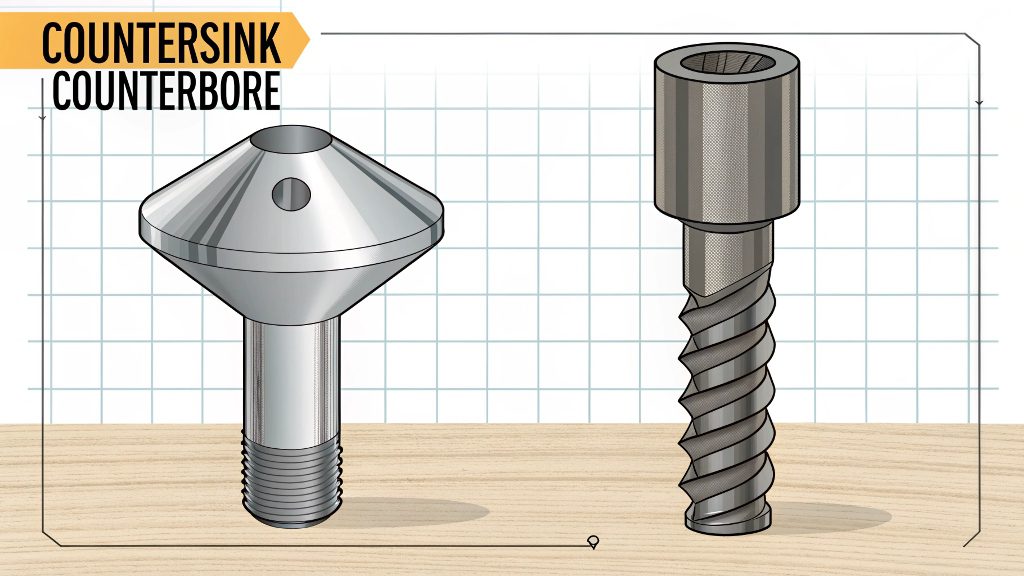
When I help my customers design parts, the first question is always about the final use. This helps us decide between these two features. A countersink is often chosen for aesthetics. It creates a smooth, continuous surface, which is great for consumer products or panels where you don't want anything catching. My insight is that the countersink's angled transition is smoother.
A counterbore is all about mechanical function. By recessing the entire head of a bolt or screw, you protect it from damage and create a stronger connection, often using a washer. This is common in industrial machinery where parts need to be assembled and disassembled. A client of mine, Mark, who builds industrial equipment, always specifies counterbores for his assembly points to ensure a robust and secure fit.
Here's a simple table to help you remember:
| Feature | Countersink | Counterbore |
|---|---|---|
| Shape | Conical / V-shaped | Cylindrical / Flat-bottomed |
| Purpose | Sits fastener flush with surface | Sits fastener below the surface |
| Common Fastener | Flat-head or Oval-head screws | Socket head cap screws, Hex bolts |
| Main Benefit | Aerodynamic, smooth finish | Stronger clamping, protects fastener |
| Appearance | Flush and seamless | Recessed and hidden |
What is the difference between a counterbore tool and a countersink tool?
Do you need special tools for these features on your parts? Using the wrong tool can damage your workpiece and cost you money. Let's look at the tools we use.
A countersink tool, often just called a countersink, has a cone-shaped tip with cutting edges. A counterbore tool has a flat-ended cutter with a non-cutting pilot in the center. The pilot fits into the existing hole to keep the counterbore perfectly aligned.


The tools themselves are designed for their specific jobs. In our shop at Worthy Hardware, we have a wide range of both to match any fastener specification.
Countersink Tools
A countersink tool, or countersink bit, is fairly simple. Its main feature is the cutting angle. The most common angles are 82° for standard screws in the US and 90° for metric screws. It's critical that the angle of the tool matches the angle on the head of the screw. If they don't match, the screw won't sit flush and the load won't be distributed evenly, which can cause the material to fail.
Counterbore Tools
A counterbore tool is a bit more complex. It has two main parts: the cutting end and the pilot. The pilot is a key feature. It slides into the pre-drilled hole and guides the tool. This ensures the counterbore is perfectly concentric with the hole, which is critical for a proper fit. Without the pilot, the tool could "walk" and create an off-center recess. Some counterbore tools have fixed pilots, while others have interchangeable ones to match different hole sizes, giving us more flexibility.
What is the difference between countersink and through hole?
It is easy to confuse a countersink with a simple through hole, especially when you are starting out. This mix-up can cause big problems in your design. Let's clear up the difference now.
A through hole is a simple hole that passes completely through the material. A countersink is a secondary feature, a cone shape machined at the opening of a hole. You can have a countersink on a through hole or on a blind hole (one that doesn't go through).

Think of it this way: the hole itself is the primary operation. A countersink is a secondary operation that modifies the hole's entrance. A "through hole" simply describes the path of the primary hole—it goes from one side of the part to the other. You can have a "through hole" that is just a simple drilled hole, or you can have a "through hole with a countersink" at one or both ends.
The same logic applies to a "blind hole," which is a hole that does not go all the way through the material. You can also add a countersink to the opening of a blind hole.
The key takeaway is that "through hole" describes the depth and path of the hole, while "countersink" describes the shape at the opening of that hole. Another practical use for a countersink feature, even without a screw, is for deburring. Machining a very slight countersink on the edge of a hole creates a clean, smooth edge, removing any sharp burrs left from drilling.
What is the symbol for counterbore and countersink?
How do you specify these features on a technical drawing for your manufacturer? Using the wrong symbol guarantees your parts will be made incorrectly, which is a big pain point for customers.
On engineering drawings, the countersink symbol looks like a 'V'. The counterbore symbol looks like a square 'U' or an open rectangle. These symbols are always followed by dimensions for diameter and depth or angle, so we can machine the exact feature you need.
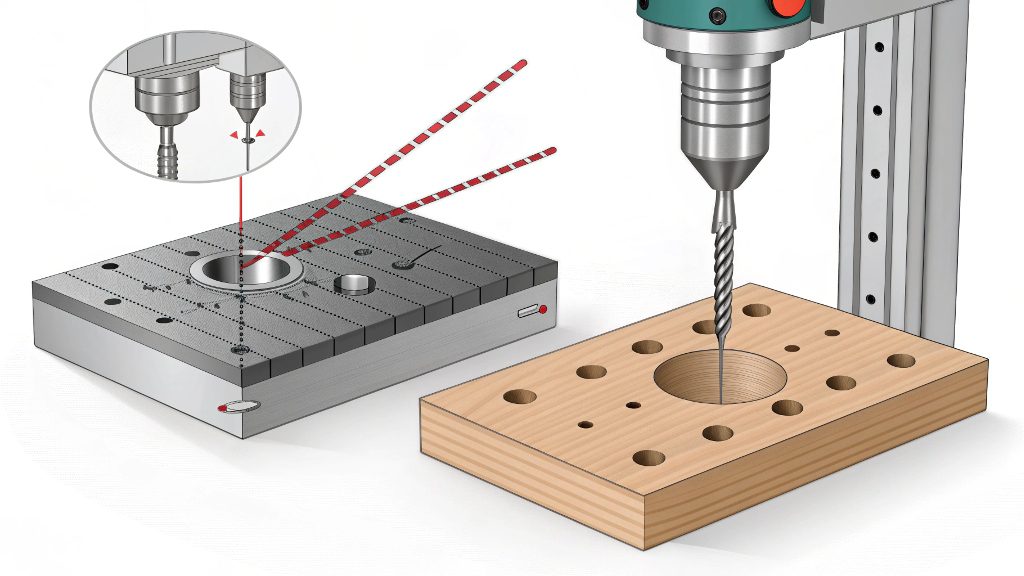
Clear technical drawings are the most important part of good communication with a manufacturer. At Worthy Hardware, we rely on these symbols to produce your parts to your exact specifications. Getting them right avoids delays and errors.
Reading a Countersink Callout
The callout for a countersink gives us all the information needed. It typically looks like this:
Ø.250 THRU ⋁ Ø.500 X 82°
Let’s break that down:
- Ø.250 THRU: This defines the inner hole. It has a diameter of 0.250 inches and goes all the way through the part.
- ⋁: This is the standard symbol for a countersink.
- Ø.500: This is the major (outer) diameter of the countersink.
- X 82°: This is the included angle of the countersink.
Reading a Counterbore Callout
The callout for a counterbore is similar but specifies a depth instead of an angle. It looks like this:
Ø.250 THRU ⌴ Ø.500 ↧ .250
Let's break that down:
- Ø.250 THRU: This is the inner through hole with a 0.250-inch diameter.
- ⌴: This is the standard symbol for a counterbore.
- Ø.500: This is the diameter of the counterbore.
- ↧ .250: This is the depth symbol and the depth of the counterbore, which is 0.250 inches.
Conclusion
In short, countersinks are for flush, tapered screws, while counterbores are for recessed, flat-bottomed fasteners. Choosing correctly ensures your final product assembles perfectly and looks professional.