
How do different surface treatments affect the durability of CNC machined parts?
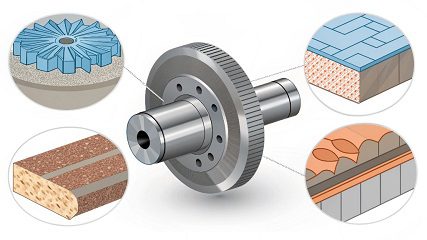
Your parts wear out too fast, causing costly failures and downtime. The right surface treatment is not just a cosmetic choice; it is essential for protecting your investment.
Surface treatments like anodizing, powder coating, and heat treatment add a protective layer to your parts. This layer improves hardness, corrosion resistance, and wear resistance. As a result, your CNC machined parts last much longer and perform better under stress.
These treatments are a key step in manufacturing durable components. Many of my clients, especially those in demanding industries like automotive or aerospace, rely on them. But you might not be sure which treatment is best for your specific application. It's important to understand how they work so you can make the right choice. Let's explore how different surface enhancements and processes contribute to the final quality and durability of a part.
How does surface finish enhancement contribute to the quality of machined components?
A rough surface creates friction and causes parts to wear down quickly. This can lead to unexpected failures in your products, damaging your reputation and costing you money.
Enhancing the surface finish reduces friction, improves wear resistance, and increases the fatigue life of a part. A smoother surface also creates a better seal for mating components and provides a superior look and feel, directly improving overall quality.
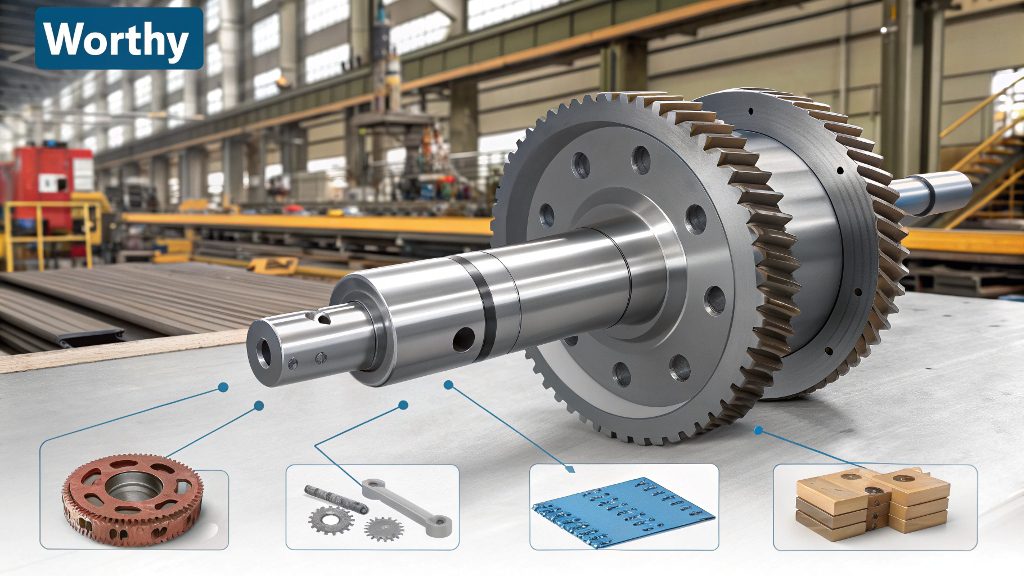
At my company, Worthy, we see the direct impact of surface finish every day. A part's quality is not just about its dimensions; it's also about how its surface performs. A smoother surface finish, often measured in Ra (Roughness Average), is critical.
Reduced Friction and Wear
A smooth surface has fewer peaks and valleys. This means less friction when it moves against another part. Less friction means less heat buildup and slower wear. For a client like Mark in Canada, who sells parts for industrial machinery, this means his customers get a product that lasts longer.
Improved Fatigue Strength
Microscopic cracks can form in the "valleys" of a rough surface. Over time, these cracks can grow and cause the part to fail under repeated stress. A smoother finish removes these potential failure points, making the part much stronger over its lifetime.
Better Aesthetic and Sealing
A polished or finely machined surface simply looks more professional. It also creates a tighter seal for gaskets and O-rings, preventing leaks.
| Quality Factor | Rough Surface (High Ra) | Smooth Surface (Low Ra) |
|---|---|---|
| Friction | High | Low |
| Wear Rate | Fast | Slow |
| Fatigue Life | Shorter | Longer |
| Corrosion Risk | Higher | Lower |
How will surface coating play an important role in a CNC machine?
Bare metal is often vulnerable to its environment. It can rust, corrode, or wear down easily, which can ruin an expensive and complex part very quickly.
A surface coating acts as a protective shield for the part. It can prevent rust, increase surface hardness, reduce friction, or add specific colors. Coatings are essential for parts that will be exposed to harsh conditions or heavy use.
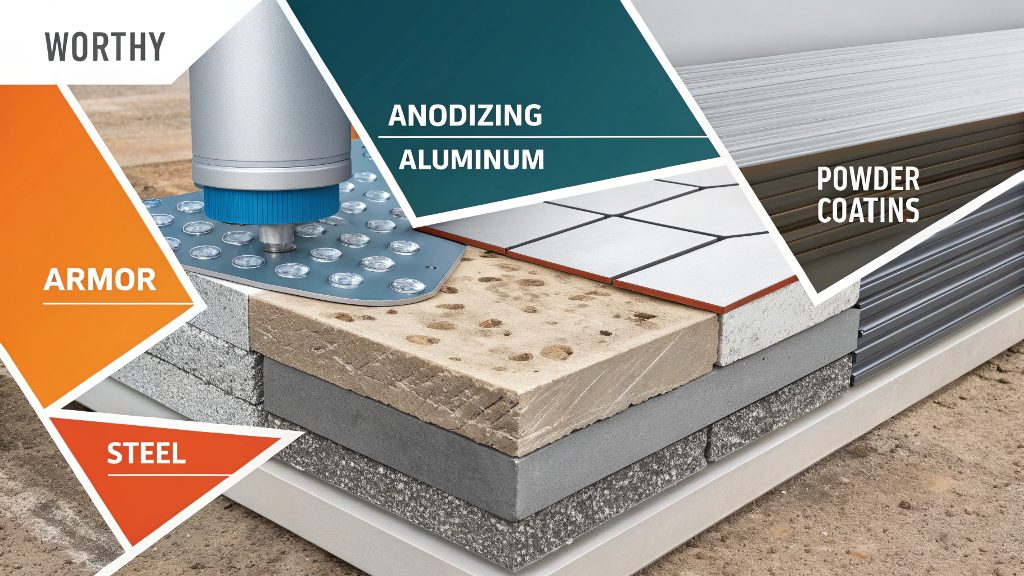
I always tell my customers to think of coatings as armor for their parts. At Worthy, we offer over 50 different surface finishes because every application has unique needs. The base material provides the core strength, but the coating provides the durability against the outside world.
Anodizing for Aluminum
Anodizing is a process I recommend often for aluminum parts. It creates a hard, corrosion-resistant oxide layer on the surface. It's not a paint; the layer is grown directly from the aluminum itself. This makes it very durable and resistant to chipping. We can also add dyes during the process to create parts in different colors.
Powder Coating for Durability
For steel or other metals that need a tough, protective layer, powder coating is an excellent choice. A dry powder is applied to the part and then baked. This creates a thick, hard finish that is much more durable than conventional paint. It’s great for parts exposed to impacts or outdoor elements.
Plating for Conductivity and Protection
Plating involves applying a thin layer of another metal, like zinc, nickel, or chrome, onto the part's surface. Zinc plating is great for preventing rust on steel parts. Nickel plating provides excellent wear resistance.
What are the factors affecting the surface roughness of a machined component?
You need a part with a specific surface smoothness, but you get inconsistent results. Getting this wrong can ruin the function of the final product and lead to costly remakes.
The most important factors are the cutting speed, feed rate, and the geometry of the cutting tool, especially its nose radius. The type of material and the use of cutting fluid also have a major impact on the final surface roughness.
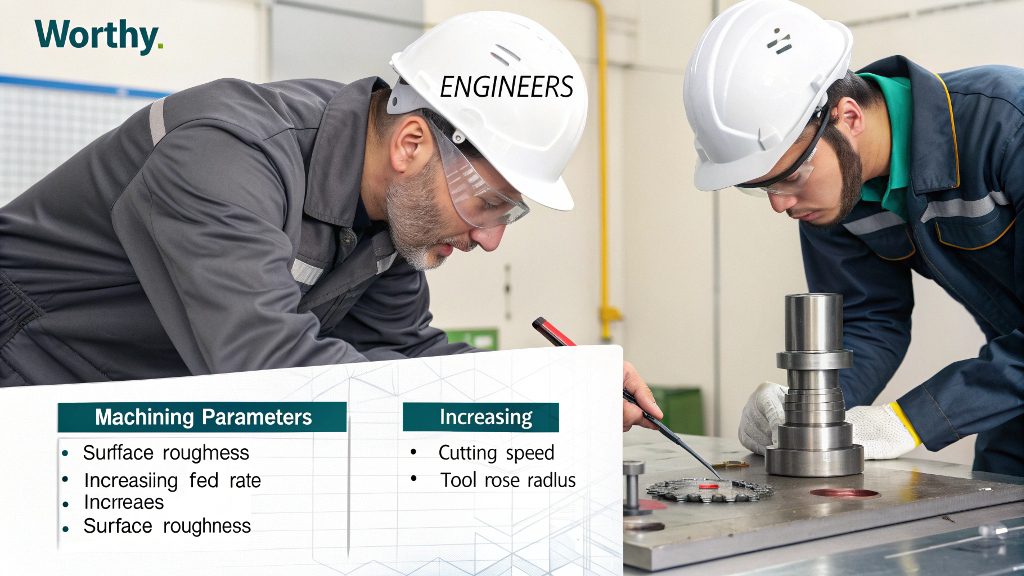
When we set up a job at Worthy, our engineers carefully consider every factor to achieve the exact surface finish our customer needs. It's a science. Simply putting a piece of metal in a machine and pressing "start" is not enough. Controlling these variables is how we guarantee quality and even save costs by optimizing the process.
| Machining Parameter | Change | Effect on Surface Roughness |
|---|---|---|
| Feed Rate | Increase | Increases (gets rougher) |
| Cutting Speed | Increase | Decreases (gets smoother) |
| Tool Nose Radius | Increase | Decreases (gets smoother) |
How do machining processes affect surface finish?
Not all machining methods create the same surface. If you choose the wrong process for your part's requirements, you could end up with a poor finish or a very high cost.
Different machining processes produce unique surface finishes. Grinding and lapping create extremely smooth surfaces. Milling and turning offer a good balance of speed and finish. The chosen process sets the baseline for the part's final surface quality.
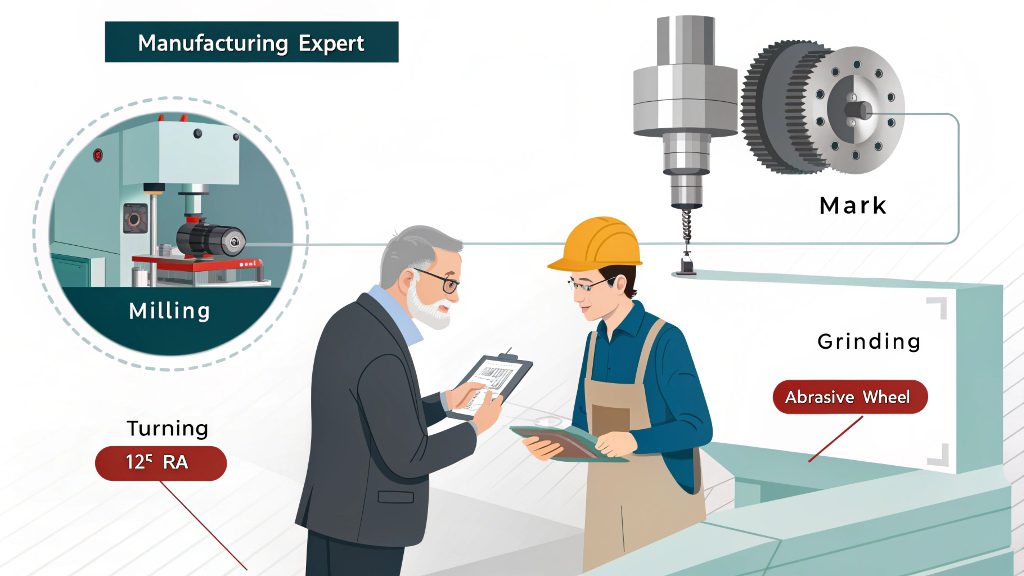
The first step in achieving a good surface finish is choosing the right manufacturing process. I often have conversations with customers like Mark, who is very sensitive to quality but also wants competitive pricing. We discuss how we can use a combination of processes to meet both goals. For example, we might use a fast milling operation for the main shape and then a secondary grinding process for critical surfaces.
Milling and Turning Finishes
These are the most common CNC processes. They can produce very good finishes, typically around 125 Ra, which is our standard at Worthy. The finish is characterized by a regular pattern of tool marks. By adjusting speeds and feeds, we can achieve much finer finishes directly from the machine.
Grinding for Precision
When a customer needs an extremely smooth and flat surface, we use grinding. This process uses an abrasive wheel to remove tiny amounts of material. It can achieve finishes that are much smoother than milling or turning and is essential for parts like shafts and bearings that require tight tolerances.
The Role of Secondary Operations
Sometimes, the best way to get the desired finish is with a secondary operation after machining. This includes processes like polishing, sandblasting, or lapping. Sandblasting creates a uniform matte texture, while polishing can create a mirror-like finish.
Conclusion
Surface treatments and finishes are vital. They ensure the durability, performance, and long life of your CNC machined parts and should be a key part of your design.