
What Tolerances Can Wire EDM Achieve With Different Materials?
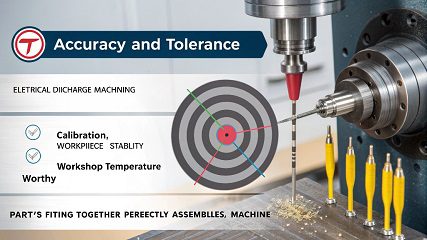
Struggling to get extreme precision for your parts? The material you choose dramatically affects Wire EDM results, risking project failure. Let's see how you can get it right.
Wire EDM can achieve tolerances from ±0.001mm to ±0.02mm. For easy-to-cut materials like aluminum or copper, expect higher precision around ±0.001mm. For harder materials like stainless or alloy steels, a realistic tolerance is closer to ±0.005mm, ensuring accuracy for even the toughest jobs.
Achieving these tight tolerances is a great start, but it's just one piece of the puzzle. You probably have more questions about what Wire EDM is truly capable of and how its accuracy compares to other methods. Understanding the details will help you communicate better with my team and ensure you get the exact parts you need. Let’s dive deeper into what makes Wire EDM so precise.
What is the tolerance capability of wire EDM?
Are you trying to push the boundaries of precision for a new design? Not understanding Wire EDM's full capabilities can limit your design's potential and cause missed opportunities.
The tolerance capability of Wire EDM is exceptionally high, typically ranging from ±0.001mm to ±0.01mm. Modern slow-wire machines achieve the tightest tolerances, often required for medical or aerospace components. This precision is consistent across complex geometries and very hard materials.
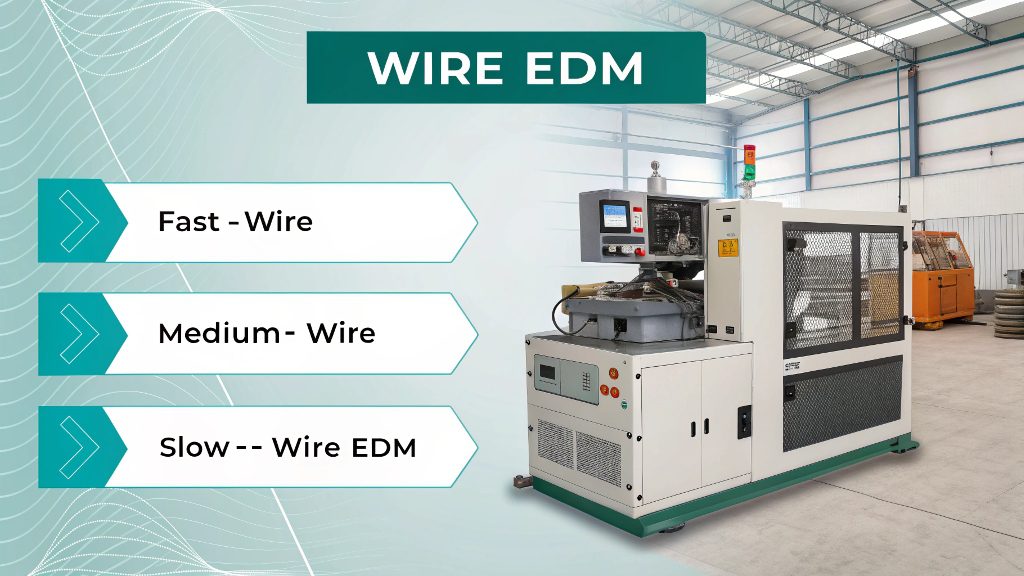
The term "capability" really depends on the type of machine used. In my experience, customers are sometimes surprised to learn there are different kinds of Wire EDM. It's not a one-size-fits-all process. The main types are fast-wire, medium-wire, and slow-wire EDM. At Worthy Hardware, we help clients choose the right one for their budget and needs. For example, a customer from Canada, Mark, needed a component with a very tight tolerance. His previous supplier used a fast-wire machine, and the parts were inconsistent. We switched his project to our slow-wire machine. Although the process was slower, it solved his quality problem completely. This is how the machines generally stack up:
| Machine Type | Typical Application | Achievable Tolerance | Cost & Speed |
|---|---|---|---|
| Fast-Wire EDM | Rough cuts, less critical parts | ±0.02mm | Low cost, very fast |
| Medium-Wire EDM | Good balance of speed & precision | ±0.01mm | Medium cost & speed |
| Slow-Wire EDM | High-precision, fine finish | ±0.001mm - ±0.005mm | High cost, very slow |
What is the accuracy of wire EDM?
Do you find the terms 'accuracy' and 'tolerance' confusing? Mixing them up can cause costly miscommunications with your supplier and result in parts that don't meet the specification.
The accuracy of Wire EDM refers to how closely the machined part conforms to the CAD model's true dimensions. High-end machines can achieve positional accuracy down to ±0.001mm. This means features are not just consistent (tight tolerance) but are also in the exact right place.
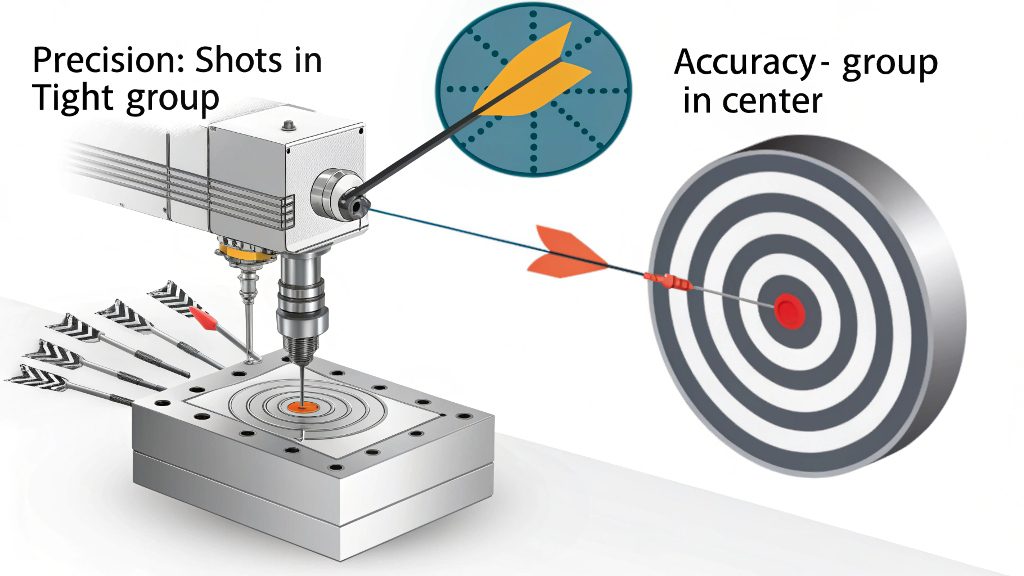
It's helpful to think of accuracy and tolerance like shooting at a target. Tolerance (or precision) is about getting all your shots in a very tight group. Accuracy is about that group being right in the center of the bullseye. Wire EDM excels at both. The accuracy of the process is critical when you are making parts that need to fit together perfectly in an assembly. If the holes on one part are not in the exact right location, they won't line up with the pins on another part, even if the hole diameters have very tight tolerances.
Many factors influence accuracy. These include the machine's regular calibration, the stability of the workpiece clamping, and even the temperature of the workshop. At my company, Worthy, our engineers always review the customer's drawings with accuracy in mind. We check the GD&T callouts and think about how the part will be used. This helps us prevent problems before machining even begins, ensuring the final parts function exactly as intended.
What are the tolerance values obtained by machining using EDM?
Do you need exact tolerance values for your specific material? Estimating these numbers can lead to paying too much for unnecessary precision or getting parts that are not good enough.
For softer, conductive materials like aluminum and copper, you can expect excellent tolerances between ±0.001mm and ±0.01mm. For hard materials like tool steel, stainless steel, or titanium, achievable tolerances are typically between ±0.005mm and ±0.02mm.
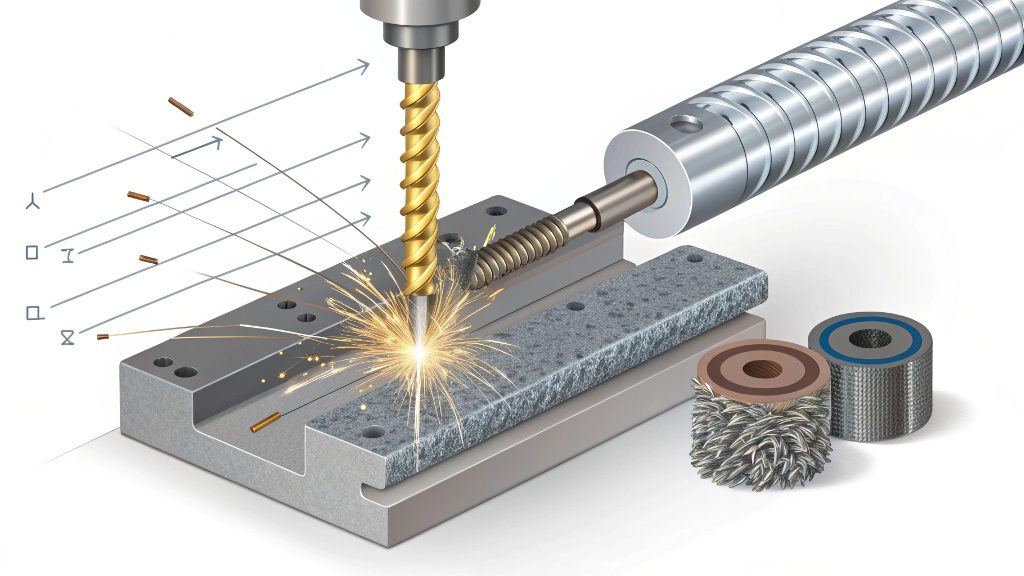
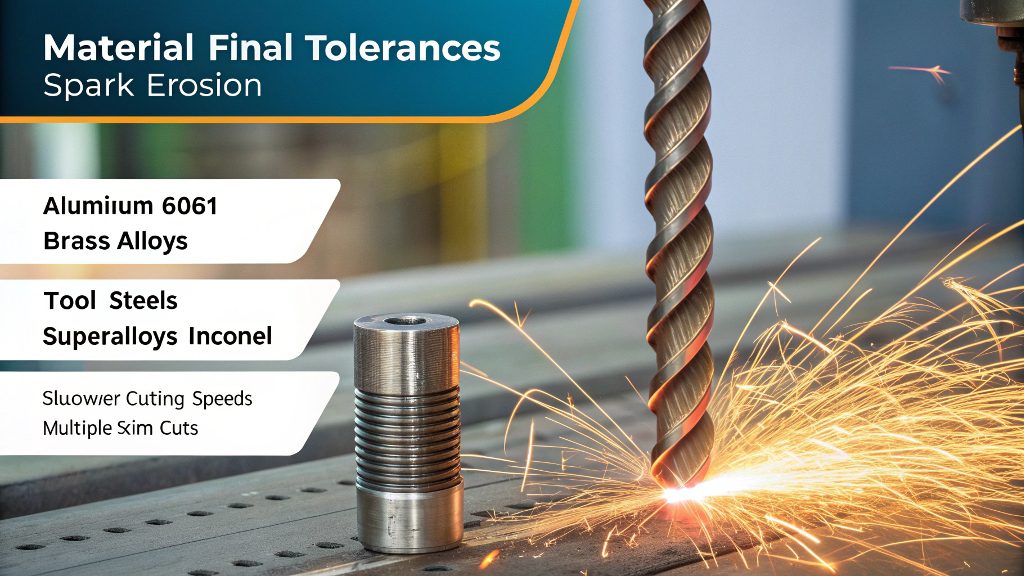
The material itself plays a huge role in the final tolerance. The whole process is based on spark erosion, and different materials react differently to the electrical sparks. Highly conductive and softer metals, like the aluminum 6061 or brass alloys we frequently machine, allow for a very stable and predictable erosion process. This stability lets us achieve extremely tight tolerances.
On the other hand, very hard materials like tool steels or superalloys like Inconel resist the erosion more. This can introduce tiny variations in the cutting process. To get the best results on these tough materials, we have to use a slower cutting speed and program multiple "skim cuts." A skim cut is a very light finishing pass that removes a tiny amount of material to improve the surface finish and bring the dimension into its final, tight tolerance. My team has experience with over 100 materials, so we know the right parameters to use for each one.
| Material Group | Examples | Typical Tolerance Range | Key Considerations |
|---|---|---|---|
| Soft Conductive Metals | Aluminum, Copper, Brass | ±0.001mm to ±0.01mm | High conductivity allows for stable, controlled cutting. |
| Steels | Stainless Steel, Alloy Steel | ±0.005mm to ±0.02mm | Hardness requires slower speeds and essential skim passes. |
| Exotic/Hard Metals | Titanium, Inconel, Carbide | ±0.005mm to ±0.02mm | Requires expert process control and specific machine settings. |
What are the limitations of wire EDM?
Is Wire EDM always the perfect choice for your project? Believing so can lead to surprise costs and project roadblocks. It is very important to understand the process's limitations.
The main limitations of Wire EDM are that it only works on electrically conductive materials and can be a slow process. It is also unable to create features like blind pockets or holes that do not pass completely through the part.
While Wire EDM is an amazing technology, it is not the right tool for every job. I always want my customers to be fully informed so they can make the best choices. The first and most important limitation is that the material must conduct electricity. This means we cannot use Wire EDM to cut standard plastics, wood, or most ceramics.
Second, the wire must be able to pass all the way through the workpiece. This is a fundamental part of the process. As a result, you cannot create "blind" features. For example, a pocket that does not go all the way through the part, or a threaded hole with a solid bottom, cannot be made with Wire EDM. For those features, we would use our CNC milling or turning services. Another small limitation is that Wire EDM cannot create a perfectly sharp 90-degree internal corner. There will always be a tiny radius left by the cutting wire. We always point this out during our design review to avoid any surprises for our clients.
Conclusion
Wire EDM offers incredible precision, especially with slow-wire machines. Understanding its capabilities and limitations with different materials ensures you get accurate, high-quality parts for your most demanding projects.