
What Industries Benefit Most From EDM Technology?
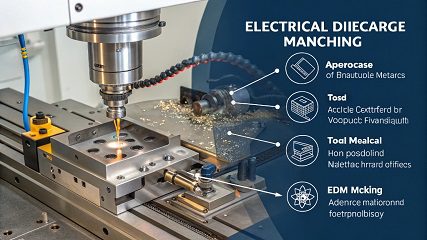
Struggling to machine complex parts from hard metals? Traditional methods often fail, causing delays and waste. Electrical Discharge Machining (EDM) provides a precise, non-contact solution for these challenging tasks.
The primary industries that benefit from EDM are aerospace, automotive, medical, and tool and die making. This is because EDM excels at machining hard, conductive materials like titanium and hardened steel into complex shapes with extreme precision, which is a common requirement in these sectors.
When I first started in this business, many clients like Mark Chen in Canada would come to us with designs that were simply impossible to create with our CNC mills. They needed intricate shapes in materials that were too hard to cut. We quickly learned that to serve industries that push the boundaries of engineering, we needed more than just traditional tools. That's when we invested heavily in our EDM capabilities. Understanding what this technology is and what it's used for is key to unlocking new manufacturing possibilities. Let's dive deeper into how it can help you.
What is EDM in the industrial industry?
Have you heard the term EDM but found it confusing? Not understanding the process makes it hard to know if it's the right choice for your project. Let's simplify it.
EDM, or Electrical Discharge Machining, is a manufacturing process that uses controlled electrical sparks to shape metal. It's considered a non-traditional method because no tool ever physically touches the workpiece, removing material through thermal energy instead of force.
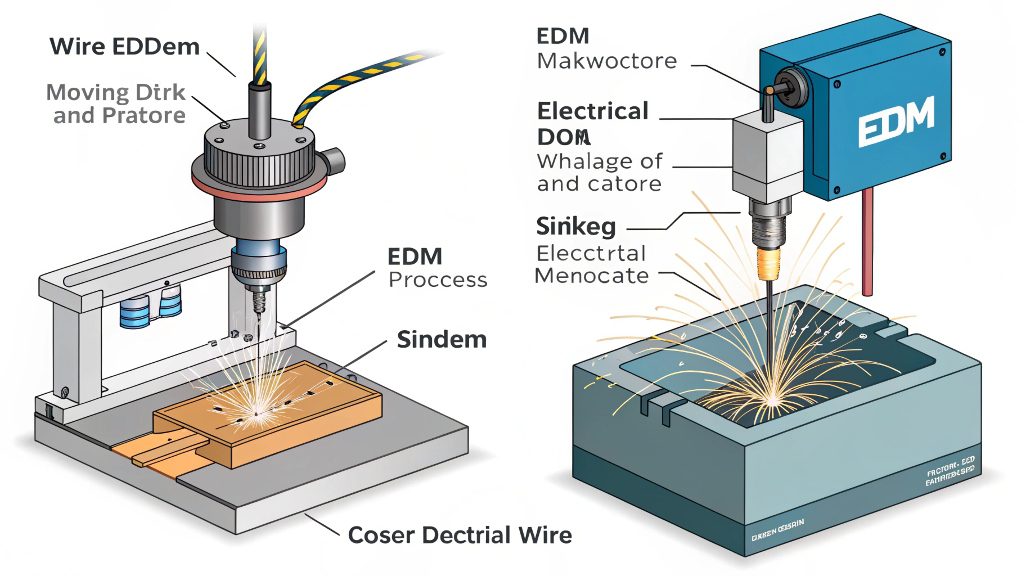
At its core, EDM works by creating a rapid series of electrical discharges between two electrodes. One electrode is the tool (often called the trode), and the other is the workpiece itself. Both are submerged in a dielectric fluid, which acts as an insulator until enough voltage is applied. The spark melts and vaporizes a tiny amount of material from the workpiece, which is then flushed away by the fluid. This process is repeated thousands of times per second to erode the material into the desired shape. This no-contact approach is what makes it so unique. I remember explaining this to a customer who was worried about damaging a very thin-walled part. Once he understood there was no cutting force involved, he realized EDM was the perfect solution.
There are two main types of EDM we use at Worthy Hardware:
| Feature | Wire EDM | Sinker EDM (Ram EDM) |
|---|---|---|
| Tool | A thin, continuously fed wire | A custom-shaped electrode (trode) |
| Process | The wire moves like a band saw, cutting a path through the part | The electrode is plunged into the part, creating a cavity |
| Best For | Cutting intricate outlines, sharp corners, and complex profiles | Creating complex cavities, molds, and blind holes |
What is EDM primarily used for?
Do you have a design with tiny details or need to work with super-hard metals? Traditional drills and mills often can't create sharp internal corners or machine hardened tool steel effectively.
EDM is primarily used for machining hard, electrically conductive materials like hardened steel and titanium. It excels at creating complex shapes, sharp internal corners, deep cavities, and small, intricate features that are difficult or impossible to produce with conventional methods.
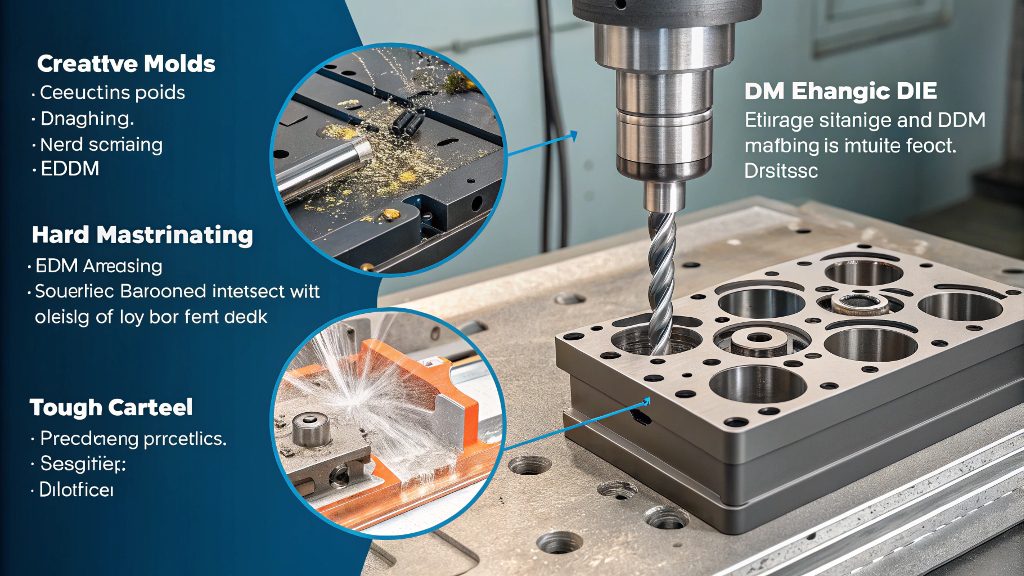
The applications for EDM are incredibly specific and solve major manufacturing challenges. I've seen it save countless projects that would have otherwise been stuck in the design phase. Its primary uses fall into a few key areas.
Creating Molds and Dies
One of the biggest uses for EDM is in tool, die, and mold making. For example, plastic injection molds often have complex cavities and tiny features that define the final product's shape. Sinker EDM is perfect for this. We can create a graphite electrode in the exact shape of the cavity and use it to erode the hardened tool steel, creating a perfect negative impression for the mold.
Machining Hard Materials
This is where EDM truly shines. Materials like tungsten carbide, Inconel, and D2 tool steel are too hard for most conventional cutting tools. Trying to mill them would just destroy the tool. We had a client in the automotive sector who needed a stamping die from hardened steel. EDM was the only way we could machine it precisely after the heat treatment process was completed.
Complex Geometries and Sharp Corners
A spinning tool, like an end mill, can't create a perfectly sharp internal corner; it will always leave a radius. Wire EDM, however, uses a thin wire, allowing it to cut incredibly sharp inside corners and very intricate patterns. This is essential for parts in the aerospace and electronics industries where precision is everything.
What are the benefits of EDM?
Is high precision non-negotiable for your parts, but you're also worried about damage? The mechanical stress from traditional cutting can easily warp thin walls or break delicate features on your parts.
The main benefits of EDM include its ability to machine any conductive material regardless of hardness, produce complex shapes with high precision, achieve excellent surface finishes, and do it all without putting mechanical stress on the workpiece, which prevents damage.
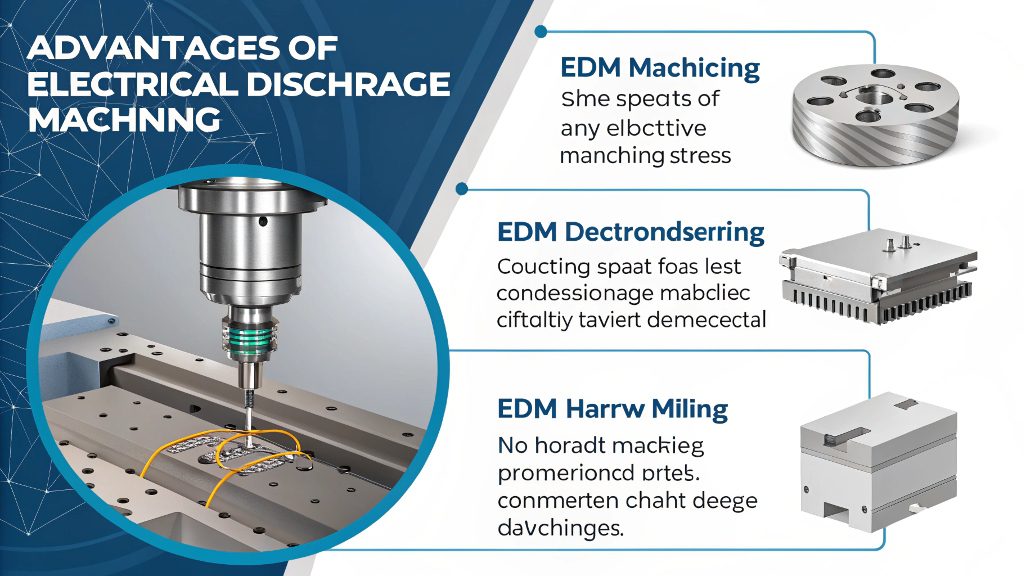
The advantages of EDM make it a go-to process for our most demanding projects. When a client needs the best, this is often what we recommend. The benefits are clear and directly address the biggest pain points in manufacturing. First, you can machine any material as long as it conducts electricity. This opens the door to working with titanium, hardened steels, and other exotic alloys without any issues.
Second, there is absolutely no mechanical stress. Because the tool never touches the part, there's no cutting force. I remember a project with a delicate aluminum housing that had very thin walls. Every time we tried to mill it, the pressure from the tool would cause it to warp. Switching to wire EDM solved the problem immediately, delivering a perfect part with no distortion.
Finally, the precision is unmatched for certain features. It allows us to create geometries that are physically impossible for other machines, like sharp inside corners or deep, narrow slots, all while holding very tight tolerances.
What is the main advantage of EDM over conventional machining methods?
You need to cut a hardened steel block, but your traditional tools can't handle it. This forces you to machine the steel while it's soft, then heat-treat it, which risks warping and losing precision.
The main advantage of EDM is its ability to machine materials regardless of their hardness. It easily cuts through hardened tool steel, titanium, and exotic alloys that would destroy traditional cutting tools, all while maintaining extremely high precision.
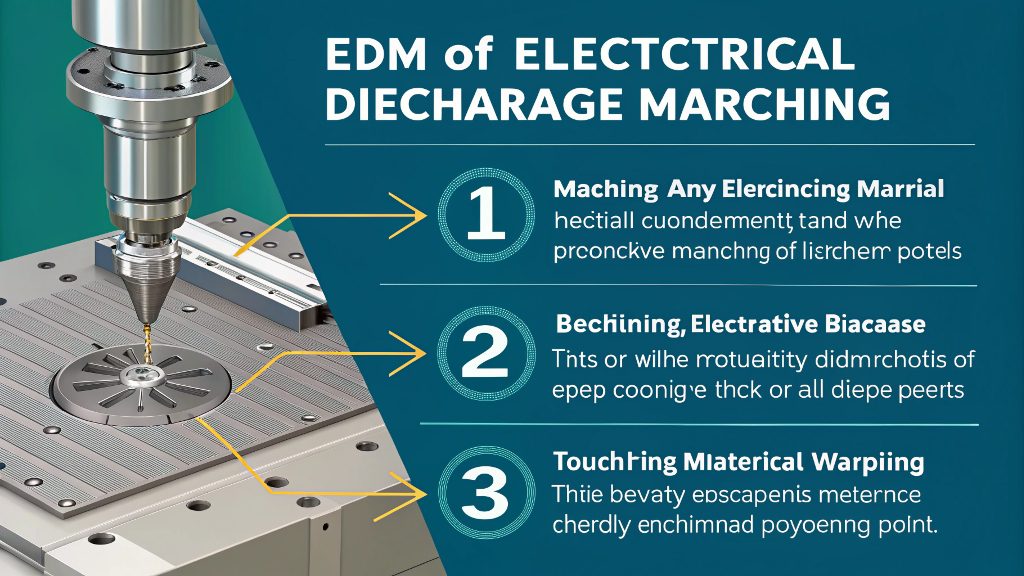
This single advantage changes the entire manufacturing workflow for the better. With conventional machining, the process is often complicated by heat treatment. You have to machine the part in its softer, annealed state and then send it to be hardened. This extra step not only adds time and cost but also introduces a huge risk: warping. The intense heat of the hardening process can cause the part to distort, ruining all the precise work you just did.
With EDM, we reverse the process. We take the raw material block, have it heat-treated to its final, required hardness first, and then we machine it. Because EDM erodes material with sparks, the hardness of the material doesn't matter. This workflow guarantees that the final part has the desired mechanical properties and is dimensionally perfect, with no risk of post-machining distortion. For customers like Mark, who are very sensitive to quality, this is a game-changer. It eliminates a major variable and ensures the parts we deliver are right the first time.
| Aspect | Conventional Machining (Milling) | Electrical Discharge Machining (EDM) |
|---|---|---|
| Material Hardness | Limited to softer materials; struggles with hardened steel | Unaffected by hardness; can machine any conductive material |
| Mechanical Stress | High cutting forces can cause warping and stress | No mechanical stress on the part; ideal for delicate features |
| Internal Corners | Leaves a radius based on the tool's diameter | Can produce sharp, clean internal corners |
| Tool Wear | High, especially on tough materials | Minimal electrode wear, which is predictable and manageable |
Conclusion
In short, EDM is a vital technology for industries like aerospace, medical, and automotive. It excels at cutting hard materials and complex shapes, ensuring top precision and quality for critical parts.
If you have a challenging design or need to machine a tough material, EDM might be the perfect solution for you. At Worthy Hardware, we specialize in these complex projects. My team of engineers and I are ready to help you improve your designs and bring them to life with our advanced CNC and EDM capabilities.
Feel free to reach out to me, Sandra Gao, at [email protected] or visit our website at www.worthyhardware.com to get a quote.