
What Makes Tungsten the Best Material for CNC Milling in High-Temperature Applications?
Need parts for extreme heat but worry about failure? Material warping causes costly downtime. Tungsten's unique properties make it the perfect solution for high-temperature CNC milling projects.
Tungsten is the best material for high-temperature CNC milling because of its incredibly high melting point of 3422°C (6192°F). This unique property ensures it remains solid and structurally stable, maintaining its physical integrity and performance even in the most extreme thermal environments.
I've seen firsthand how tungsten's high melting point makes it a superstar material for our clients. But having a high melting point is just one piece of the puzzle. You might be wondering about its other properties and how it actually performs under different conditions. Let's break it down further and explore what makes this metal so special for tough jobs.
Can tungsten withstand high temperatures?
Designing for aerospace or industrial furnaces? The intense heat can destroy most metals. Tungsten, however, thrives in these environments, ensuring your components will not fail under extreme thermal stress.
Absolutely. Tungsten has the highest melting point of any metal at 3422°C (6192°F). It also has a low coefficient of thermal expansion, meaning it doesn't expand much when heated. This combination makes it exceptionally stable and strong at very high temperatures.
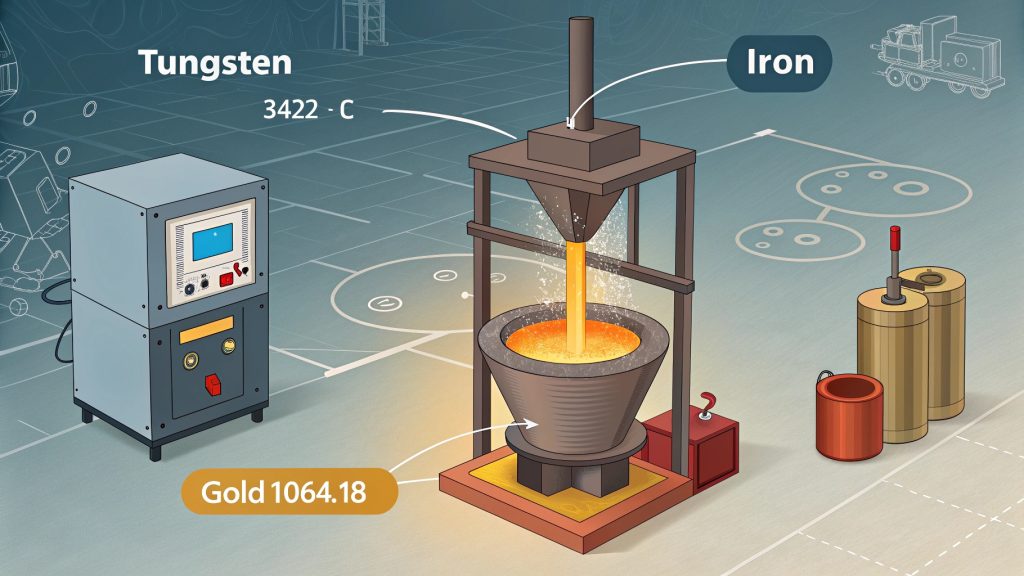
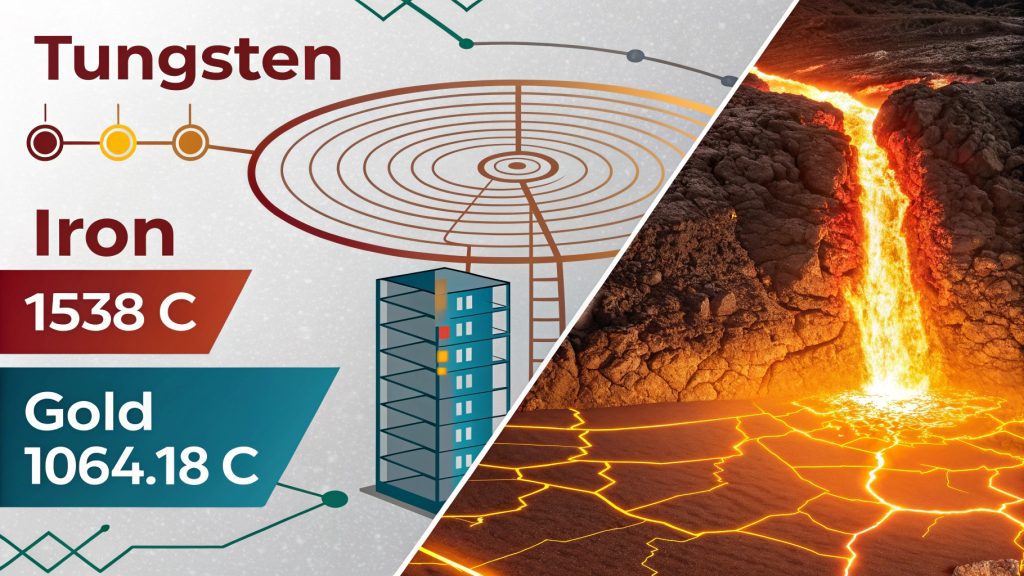
The most impressive thing about tungsten is its ability to handle heat. As I mentioned, its melting point is 3422°C. My insight on this is that when you compare it to other metals, the difference is huge. For example, iron melts at 1538°C, and gold melts at only 1064.18°C. This massive difference means tungsten stays solid and reliable long after many other common metals have turned to liquid. I remember a customer inquiry for a part that needed to operate inside a specialized high-temperature furnace. They had tried using a high-grade stainless steel, but it kept warping under the heat. For them, switching to tungsten was the only logical choice to ensure the part's stability.
Why Melting Point is Just the Start
A high melting point is crucial, but tungsten has another key feature: a low coefficient of thermal expansion. This means it resists changing its shape or size when the temperature changes dramatically. In high-precision applications, even a tiny expansion can cause a component to fail. Tungsten’s stability prevents this.
Let's look at a quick comparison:
| Material | Melting Point (°C) | Thermal Expansion (ppm/°C) |
|---|---|---|
| Tungsten | 3422 | 4.5 |
| Steel | ~1538 | ~12.0 |
| Aluminum | 660 | 23.1 |
| Titanium | 1668 | 8.6 |
This combination is why you see tungsten used in rocket nozzles, heating elements for industrial furnaces, and welding electrodes. It simply performs where other metals cannot.
Can tungsten be CNC machined?
You know tungsten is strong, but now you're worried it's too hard to machine. Machining difficulties can lead to high costs and project delays. We have the experience to handle it.
Yes, tungsten can be CNC machined, but it is challenging due to its hardness and brittleness at room temperature. It requires specialized tools, like carbide or diamond cutters, and specific techniques such as lower speeds and feeds. Proper coolant is also essential.
At my company, Worthy Hardware, we often get questions about machining tungsten. It is not like machining aluminum or steel. Tungsten is very hard and dense. It is also brittle at room temperature, which means it can chip or crack easily if you’re not careful. Because of this, machining it requires a specific approach and a lot of experience from our engineers. You cannot just use standard tools and expect good results. It's a material that demands respect and a deep understanding of its properties. Our ability to machine to tight tolerances, even below +/- 0.001", is critical here.
Key Considerations for Machining Tungsten
Success in machining tungsten comes down to controlling all the variables. You must use the right tools and machine settings to avoid damaging the material or wearing out the tooling. The main goal is to cut the material cleanly without causing any stress fractures.
Here are some general tips we follow in our shop:
| Parameter | Recommendation for Tungsten |
|---|---|
| Cutting Tools | Use very sharp, strong tools like coated carbide or PCD (polycrystalline diamond). |
| Cutting Speed | Keep cutting speeds low to reduce heat buildup and excessive tool wear. |
| Feed Rate | Use a consistent, moderate feed rate to prevent chipping the material. |
| Coolant | Use a high-quality, high-pressure coolant generously to manage temperature and clear chips. |
| Machine Rigidity | A heavy-duty, very rigid, and stable CNC machine is absolutely necessary. |
It takes patience and precision, but with the right setup and expertise, we can produce complex tungsten parts for our customers around the world, from North America to Australia.
At what temperature can tungsten be forged?
Need to shape tungsten into a complex form? Forging it at room temperature is impossible. Working with it at the wrong temperature can cause it to shatter into pieces.
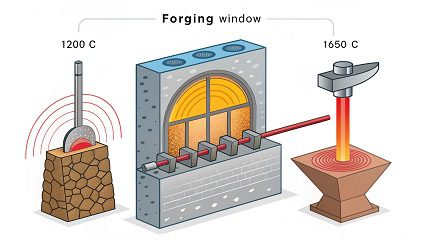
Tungsten is forged at very high temperatures, typically between 1200°C and 1650°C (2192°F to 3002°F). At these temperatures, it becomes ductile and malleable, allowing it to be shaped through forging, rolling, or swaging without cracking or breaking.

Forging is a process of shaping metal using powerful compressive forces. With a material as hard as tungsten, you might think this is impossible. The secret is temperature. Tungsten has something called a Ductile-Brittle Transition Temperature (DBTT). Below this temperature, it is very brittle and will fracture if you try to deform it. This is a common pain point for designers who are new to the material. Above this temperature, it becomes ductile, which means it can be bent and shaped without breaking. This is a fundamental concept we explain to customers who want to form tungsten parts.
The Forging Window for Tungsten
For pure tungsten, the transition from brittle to ductile begins around 400°C, but for effective forging, much higher temperatures are needed. The standard forging range is between 1200°C and 1650°C. In this "window," the metal becomes soft enough to be hammered or pressed into shape. This process is how raw tungsten blocks are turned into rods, plates, and other basic forms before they go for final CNC machining.
| Process Stage | Temperature Range (°C) | Material State |
|---|---|---|
| Room Temperature | < 400°C | Brittle, hard |
| Forging / Working | 1200°C - 1650°C | Ductile, Malleable |
| Melting | > 3422°C | Liquid |
Controlling this temperature is critical. If it's too low, the tungsten will crack. If it's too high, it can cause other issues like grain growth, which weakens the material. This is why working with tungsten requires specialized equipment and deep expertise.
Is tungsten stronger than titanium?
Choosing between tungsten and titanium for a demanding application? The wrong choice could lead to part failure. Understanding their key differences in strength and density is crucial for project success.
It depends on the definition of "stronger." Tungsten has a higher tensile strength and is much harder and denser than titanium. However, titanium has a higher strength-to-weight ratio, making it "stronger" for its weight. Your choice depends on the application.

This is a question I get a lot from clients like Mark Chen, a company owner from Canada who is very sensitive to both quality and performance. The answer is not a simple yes or no. It really depends on what you mean by "strong." Both materials are very tough, but they are good for different things. Tungsten is the heavyweight champion in terms of raw strength and density. Titanium is the agile, lightweight champion. At Worthy Hardware, we help customers choose the right one based on their specific needs, whether it is for aerospace, medical, or industrial use.
A Tale of Two Metals
Let's break down their properties. Tungsten is one of the densest metals you can use, and it has an extremely high tensile strength. This means it resists being pulled apart under great force. It is also incredibly hard. Titanium, on the other hand, is famous for its amazing strength-to-weight ratio. It's about half as dense as tungsten but still very strong.
| Property | Tungsten | Titanium (Ti-6Al-4V) | Winner For... |
|---|---|---|---|
| Density | 19.3 g/cm³ | 4.43 g/cm³ | Weight Savings (Titanium) |
| Tensile Strength | ~980 MPa | ~950 MPa | Absolute Strength (Tungsten) |
| Hardness (Mohs) | 7.5 | 6.0 | Scratch Resistance (Tungsten) |
| Melting Point | 3422°C | 1668°C | High Temperature (Tungsten) |
So, if you need a part that is incredibly durable, resistant to wear, and can withstand extreme heat, tungsten is the winner. But if you need a part that is very strong but also lightweight, like for aircraft frames or medical implants, titanium is the better choice.
Conclusion
In summary, tungsten's unmatched melting point and heat resistance make it the top choice for extreme temperature CNC applications. It is strong, durable, and uniquely suited for demanding jobs.