
What’s the Difference Between Progressive Die and Transfer Die Stamping?

Choosing the wrong stamping process can inflate your costs and delay production. This confusion leads to inefficient manufacturing, impacting your bottom line and project timelines.
Progressive die stamping is a high-speed process that uses a single die to perform multiple operations on a metal strip that remains connected. Transfer die stamping uses several separate dies, and a mechanical system moves a detached part from one station to the next for more complex forming.
The choice between these two methods seems simple on the surface, but the details truly matter for your project's success. As an engineer with years of experience, I’ve seen how the right decision can save a client thousands of dollars, while the wrong one can lead to costly rework and delays. It all comes down to the complexity of your part, your required production volume, and your budget. Let's dig into the specifics of each process so you can make an informed choice that benefits your business.
What is the difference between progressive dies and transfer dies?
Are you confused about which stamping die is right for your project? A wrong choice can mean wasted material and higher tooling costs for your parts, which nobody wants.
The main difference is material handling. Progressive dies keep the part attached to a carrier strip. Transfer dies cut the part free first, then use mechanical "fingers" to move it between stations. This allows transfer dies to handle more complex operations on larger parts.
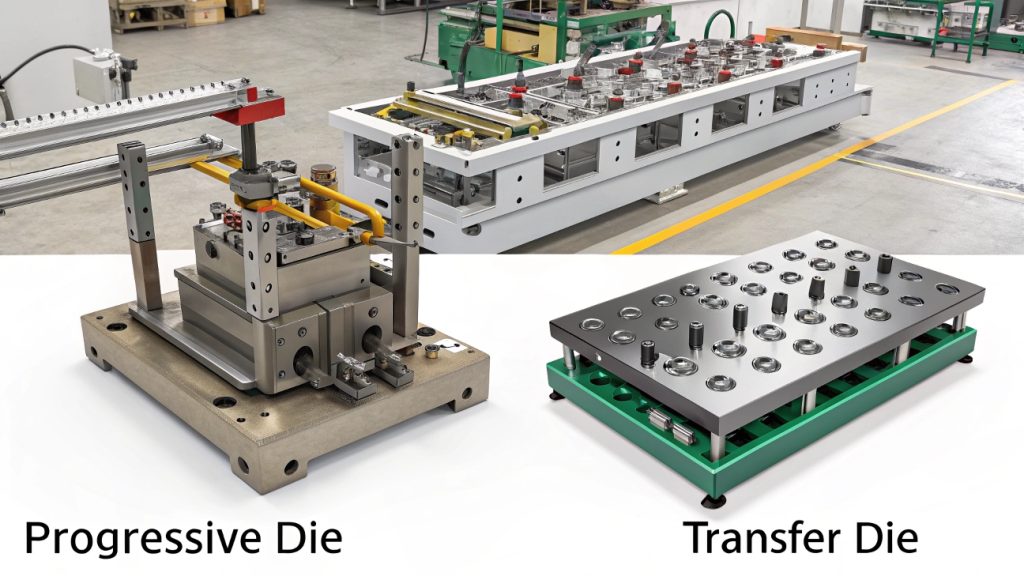
The best way to understand the difference is to visualize how the part moves through the press. In our workshop at Worthy, we use both methods, and the choice is always driven by the part's design. A progressive die is one single, long tool with many stations built into it. A metal coil feeds in one end, and with each stroke of the press, the strip "progresses" to the next station, where a new operation happens. The part stays connected to the metal strip until the very last step.
A transfer die is different. It can be a series of individual dies set up in a large press. The part is first cut out from the metal strip. Then, a transfer system with mechanical arms picks up this free part and moves it to the next die for the next operation. This freedom of movement is the key advantage.
Here is a simple table to show the differences:
| Feature | Progressive Die | Transfer Die |
|---|---|---|
| Part Handling | Attached to a carrier strip | Handled as an individual part |
| Material Feed | Continuous metal coil | Individual blanks or coil-fed |
| Best for | High-speed, high-volume parts | Larger, complex, deep-drawn parts |
| Production Speed | Very fast | Slower than progressive |
| Tooling | Single, complex die set | Multiple separate die sets |
What is the difference between a progressive die and a single die?
Wondering if a simple single die is enough for your needs? Choosing a multi-stage process when a single stage would do can drastically increase your initial tooling investment.
A single die performs only one operation per press stroke, like cutting or bending. A progressive die combines many operations into one tool, performing them in sequence as a metal strip moves through it. This makes progressive dies much faster and more automated for complex parts.
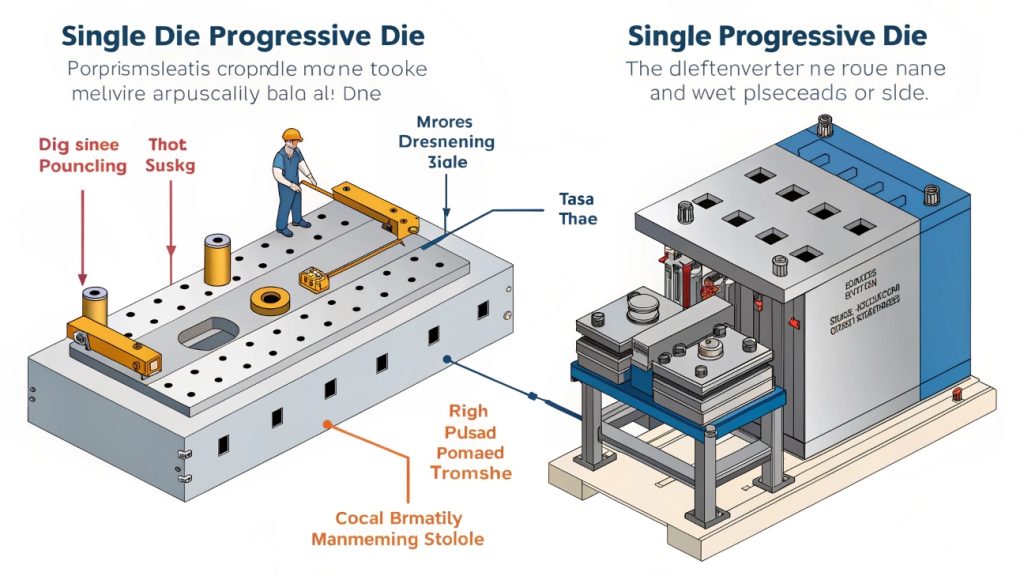
Think of it like an assembly line. A single die, which we also call a line die or stage tool, is like one worker doing one task. For example, one die cuts the flat shape of a bracket. If that bracket also needs a hole and a bend, you would need two more separate dies. The parts would have to be moved to the next die, often by hand, for each new step. This is great for simple parts, prototypes, or very low production runs because the tools are simple and cheap to make.
A progressive die, on the other hand, is the entire assembly line combined into one machine. The metal strip enters, and at the first station, maybe a hole is pierced. At the next, a feature is formed. At the third, it's bent. This continues until the very end, when the finished bracket is cut from the strip. For a client like Mark in Canada, who needs thousands of high-quality terminals with tight tolerances, a progressive die is the only way to get the speed, consistency, and low per-part cost he needs for his business. It eliminates manual labor between steps, which improves safety and ensures every part is identical.
What is progressive die stamping?
You've heard the term "progressive die," but what does it really mean? Not understanding the process can make it hard to discuss your project needs effectively with a supplier.
Progressive die stamping is a high-speed metal forming method where a coil of metal is fed through a multi-station die. With each press stroke, the die performs various cuts and bends, and the strip "progresses" until a finished part is completed and cut off.
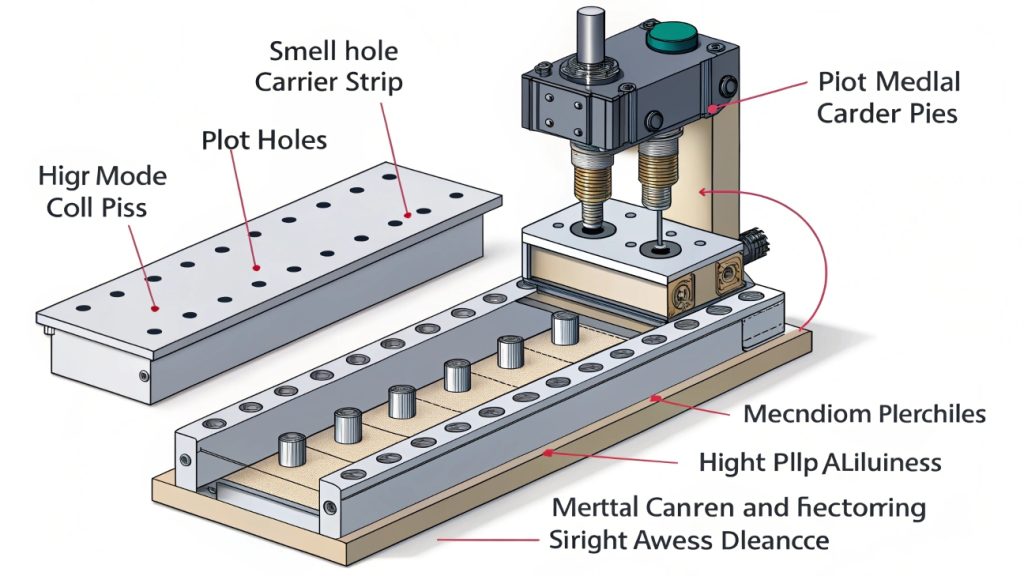
Let's break down this powerful and efficient process that we rely on for countless projects. It is the workhorse of the metal stamping industry for producing small to medium-sized parts in high volumes.
The Carrier Strip
The heart of the process is the metal carrier strip. The part remains attached to this strip for almost the entire journey. This is important because the strip itself is used to move and locate the part from one station to the next. Small holes, called pilot holes, are punched in the strip, and pilot pins in the die engage these holes to ensure perfect alignment with every single stroke of the press. This guarantees incredible precision and repeatability, which is why we can hold tolerances as tight as .001" (.025mm).
The Process in Action
The process is a fast, seamless cycle. A metal coil is fed into the press, and the die performs the first operation. The press opens, the strip advances a precise distance, and the press closes again for the second operation. This happens very quickly, sometimes hundreds of times per minute. At each station, the part takes another step toward its final shape. Common operations include blanking, piercing, coining, and bending. It's perfect for making parts like clips, contacts, shields, and flat springs.
What is the transfer stamping process?
Need to stamp larger or more complex parts like deep-drawn cups? A progressive die might not be suitable, which could lead to design compromises or even tool failure.
Transfer stamping is a process where a part is first cut from the metal strip. Then, a mechanical system, often using robotic arms or "fingers," picks up the individual part and moves it from one die station to the next for sequential operations.
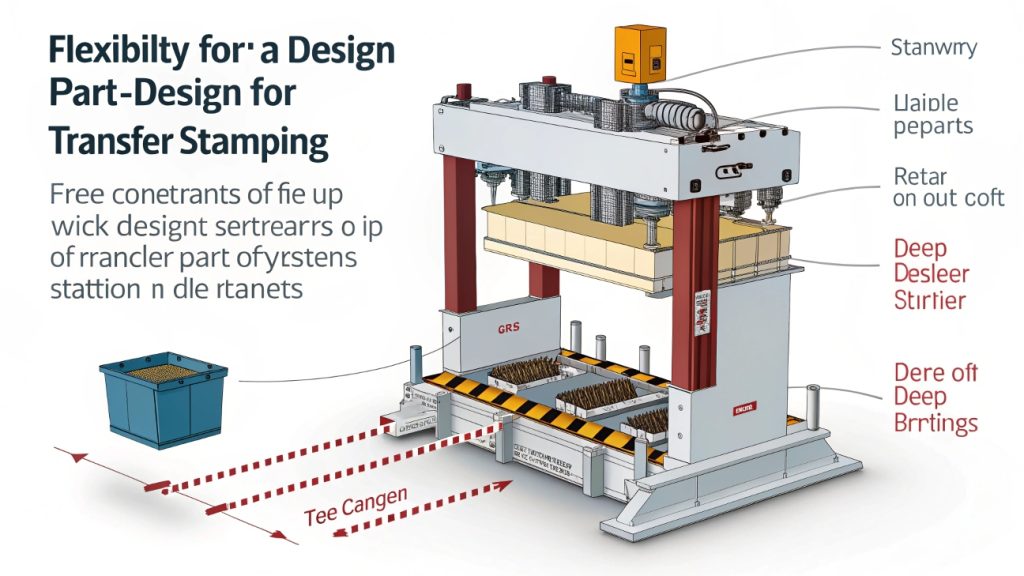
This method is all about flexibility. Once the part is free from the constraints of the carrier strip, we can do much more with it. This is the key insight I share with customers when their part design is too complex for a standard progressive die.
Freedom from the Strip
Without the carrier strip in the way, a transfer system can pick up the part, lift it high out of the die, rotate it, and place it perfectly into the next station. This allows us to perform operations that would be impossible otherwise. For example, we can create very deep-drawn parts, like a metal cup, because we can lift the part completely clear of the lower die between hits. We can also perform operations on all sides of the part. This freedom makes transfer stamping ideal for larger components, such as automotive brackets or industrial equipment housings.
Key Applications
While transfer stamping is generally slower than progressive stamping, its versatility is unmatched for certain applications. It's the go-to method for deep-drawn shells, parts that need in-die tapping or assembly, or any large part where the material of a carrier strip would be significant and wasteful. The tooling can be more complex, but for the right component, it is the most effective and often the only possible manufacturing solution.
Conclusion
Progressive stamping uses a connected carrier strip for speed and efficiency. Transfer stamping moves individual parts for greater complexity and flexibility. Choosing correctly balances your design, volume, and budget for success.