
What are the properties and applications of 1018 steel in CNC machining?

Struggling to find a versatile, reliable steel for your CNC machining projects? It's tough when material choice can make or break your part's performance and your budget.
1018 steel is a low-carbon, mild steel that is excellent for CNC machining. It offers a great combination of toughness, ductility, and strength. It's widely used for parts that require good formability and a hard surface after case hardening, like shafts, pins, and gears.
Choosing the right material is one of the most critical decisions in any manufacturing project. I've seen clients struggle with this choice time and time again. They often look for a material that is not only easy to machine but also cost-effective and suitable for a wide range of applications. This is where my experience points to a clear winner for many situations. Let's explore why 1018 steel might be the perfect solution you've been searching for.
What are the applications of 1018 steel?
Need a go-to steel for various mechanical parts but unsure which grade offers the most flexibility? This uncertainty can lead to overspending on specialized materials or part failure.
1018 steel is incredibly versatile. It's used for making parts like pins, rods, shafts, spindles, and gears. You'll also find it in automotive components, machine parts, and structural applications where good strength and weldability are needed without high-stress requirements.
When my clients, especially those like Mark from Canada who values both quality and cost, ask for a general-purpose steel, I often bring up 1018. It's a fantastic workhorse material. Its versatility comes from its balanced properties. Because it's a low-carbon steel, it's easy to form and weld. A key feature is its suitability for case hardening, or carburizing. This process allows us to create a part with a very hard, wear-resistant surface while keeping the inner core tough and ductile. This dual nature is perfect for components that experience surface wear but also need to withstand impacts without fracturing. Think about parts like:
-
Fasteners and Bolts: Its good strength and formability make it ideal for creating reliable threaded parts.
-
Mounting Plates and Brackets: It's strong enough for structural support and can be easily welded into complex assemblies.
-
Shafts and Axles: Especially for low-stress applications, its toughness and machinability are a huge plus.
-
Gears and Sprockets: After case hardening, it provides the durable surface needed for these components.
I remember a project for a customer in the automotive sector. They needed a series of custom dowel pins. The pins required a hard surface to prevent wear but needed to remain ductile to absorb vibrations. 1018 steel was the perfect choice. We machined the pins, then sent them for carburizing. The result was a high-quality part that met their exact specifications at a very competitive price. This is a classic example of how 1018 steel solves real-world engineering problems.
What are the properties of SAE 1018 steel?
Confused by technical data sheets when trying to understand a material's behavior? Picking the wrong material based on a misunderstanding can lead to costly project failures.
SAE 1018 steel has a great balance of mechanical properties. It is known for its good ductility, weldability, and toughness. It has a tensile strength of around 63,800 psi (440 MPa) and a yield strength of about 53,700 psi (370 MPa).
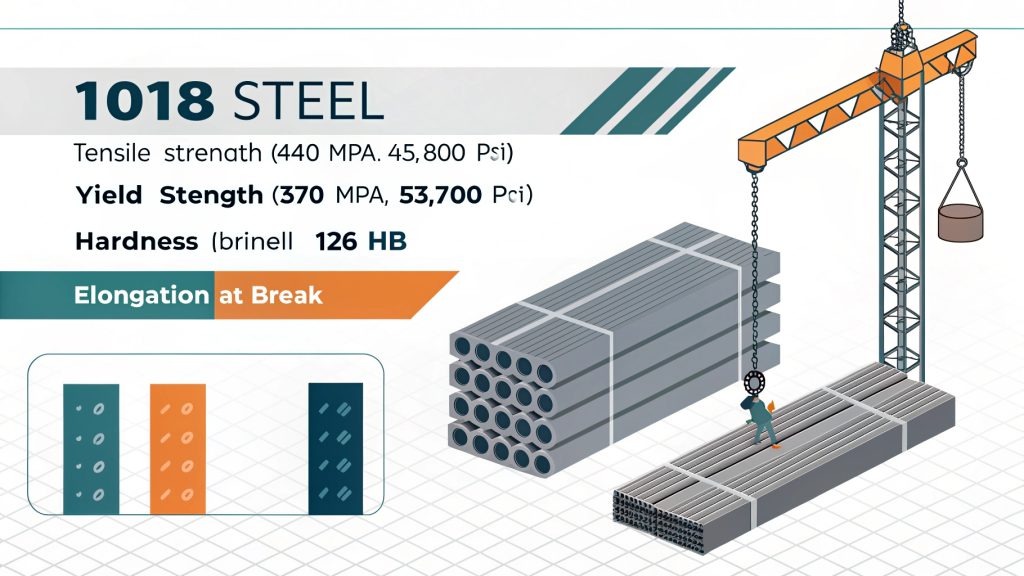
Understanding a material's properties is the key to successful part design. Let’s break down what makes 1018 steel so useful in a simple way. It's a low-carbon steel, which means it has a relatively small amount of carbon (0.15%-0.20%). This low carbon content is the main reason for its excellent ductility and weldability. Welding high-carbon steels can be tricky and often requires special procedures, but 1018 is straightforward to work with.
Here’s a simple table of its key properties:
| Property | Value | What it means for your project |
|---|---|---|
| Tensile Strength | ~440 MPa (63,800 psi) | It can handle a good amount of pulling force before it breaks. |
| Yield Strength | ~370 MPa (53,700 psi) | This is the point where it starts to deform permanently. It's quite tough. |
| Hardness (Brinell) | ~126 HB | It's relatively soft, which makes it very easy to machine. |
| Elongation at Break | ~15% | It can stretch quite a bit before fracturing, showing its good ductility. |
| Machinability | ~78% (of 1212 steel) | This is a high rating, meaning it cuts cleanly and causes less tool wear. |
At Worthy, we work with over 100 materials, and 1018 remains one of the most popular for a reason. Its properties make it forgiving. For prototypes, this is a huge advantage. You can easily make design changes without fighting the material. For mass production, its reliability and consistency mean fewer rejected parts and smoother production runs. Its predictable performance makes our job as machinists easier and gives our customers confidence in the final product.
Is 1018 steel good for machining?
Worried about high machining costs and long lead times? Choosing a material that is difficult to machine can quickly inflate your budget and delay your project schedule.
Yes, 1018 steel is considered one of the best steels for machining. Its low carbon content and soft, uniform structure result in excellent machinability, leading to faster production, longer tool life, and a superior surface finish on the final part.
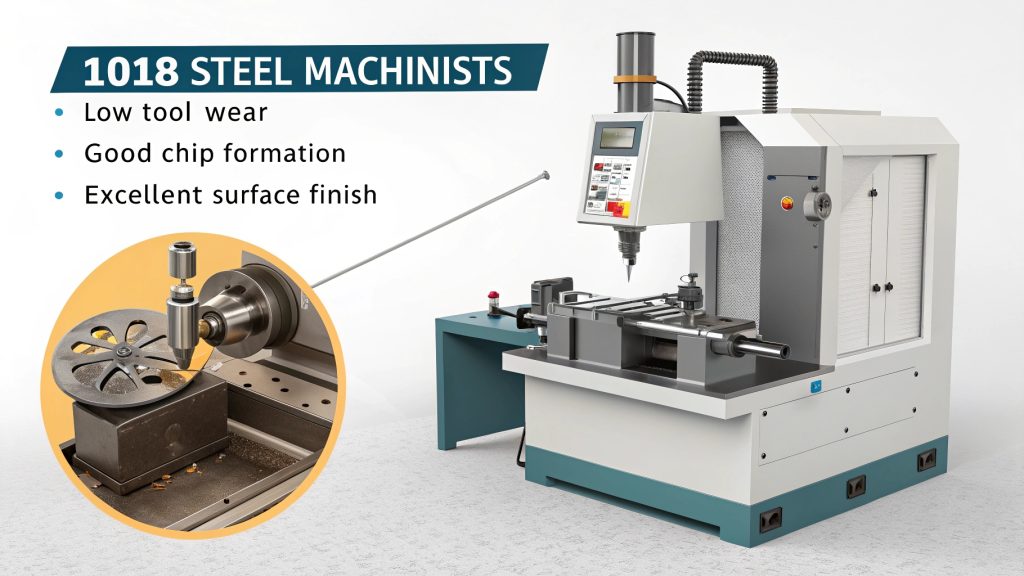
From a machinist's perspective, 1018 steel is a dream to work with. When a client wants a part made quickly and affordably, the material's machinability is a huge factor. At our facility, we have advanced machines, including 5-axis CNC centers, but the material itself plays a big role. Here’s why we like machining 1018 steel:
-
Low Tool Wear: 1018 is soft and doesn't contain hard abrasive elements. This means our cutting tools last longer. For a large production run, this translates directly into cost savings for the customer, as we don't have to replace expensive tools as often.
-
Good Chip Formation: During machining, 1018 produces chips that break away cleanly and easily. This prevents long, stringy chips from wrapping around the tool or the part, which can damage the surface finish or even break the tool.
-
Excellent Surface Finish: Because it cuts so cleanly, we can achieve a very smooth surface finish directly from the machine. We can get a standard finish of 125 Ra or better without needing secondary polishing operations, which saves time and money.
-
High Speeds and Feeds: We can run our machines at faster speeds when cutting 1018 compared to harder steels. This reduces the cycle time for each part, allowing us to deliver orders faster, which is crucial for customers with tight deadlines.
I’ve had customers who initially specified a tougher alloy steel for their parts, thinking they needed the extra strength. After we discussed the application, it was clear that 1018 steel was more than sufficient. By switching, we not only reduced the material cost but also cut the machining time by nearly 30%. The customer got a perfectly functional part, faster and for a lower price. This is the kind of practical, cost-saving advice our engineers provide.
What is 1018 equivalent to in SAE?
Feeling lost trying to compare international steel standards? Using the wrong equivalent material can lead to unexpected performance issues and compromise the integrity of your final product.
SAE 1018 is a designation from the Society of Automotive Engineers (SAE). In other systems, its common equivalents are AISI 1018, UNS G10180, and ASTM A108. In Europe, a closely comparable grade would be EN S235JR or DIN C15.


Navigating different material standards can be confusing, especially when working with international suppliers. A customer in Europe might specify a material using a DIN or EN standard, while a customer in North America uses SAE or ASTM. Part of my job is to bridge that gap and ensure we are all talking about the same thing. 1018 is a very common grade, so it has well-established equivalents.
Let's look at the most common ones:
| Standard System | Grade Designation | Notes |
|---|---|---|
| SAE / AISI | 1018 | The most common designation in North America. |
| UNS | G10180 | The Unified Numbering System, a more detailed ID. |
| ASTM | A108 | A specification covering cold-finished carbon steel bars. |
| EN (European) | S235JR (1.0038) | A very common structural steel with similar properties. |
| DIN (German) | C15 / Ck15 | A German standard for non-alloy steel for case hardening. |
| JIS (Japanese) | S20C | A Japanese standard for carbon steel for machine structural use. |
It's important to know that these are not always perfect 1-to-1 matches. There can be minor differences in chemical composition or mechanical properties. For example, S235JR is specified by its minimum yield strength (235 MPa), while 1018 is defined by its chemical composition. However, for most general-purpose applications, they are considered interchangeable. When a client sends a drawing with a material we aren't familiar with, our engineers immediately cross-reference it to find the closest equivalent we can source. This ensures we can quote accurately and produce a part that meets their functional requirements without delay. This ability to work with global standards is essential for a company like Worthy that serves customers worldwide.
Conclusion
In short, 1018 steel is a versatile, machinable, and cost-effective choice for many CNC projects, offering a great balance of properties suitable for a wide range of applications.