
How Does Heat Treatment Affect Carbon Steel Machined Parts?

Struggling with parts that wear out too fast or are tough to machine? Your carbon steel components might be missing a critical step that drastically improves their performance and lifespan.
Heat treatment fundamentally changes the internal structure of carbon steel, altering its physical and mechanical properties. This process can increase hardness, toughness, and wear resistance, or improve its machinability, making it suitable for specific applications.
This process is a game-changer in manufacturing. I've seen firsthand how a well-executed heat treatment can turn a standard steel part into a high-performance component. It's not just about making steel harder; it's about tailoring its properties to meet exact needs. Understanding how it works is key for anyone involved in designing or ordering custom machined parts. It allows you to make smarter material and processing choices, ultimately leading to better products and cost savings. Let's explore what this powerful process can do for your projects.
What are the effects of heat treatment on carbon steel?
Are you finding your carbon steel parts are either too brittle or too soft? Getting the right balance of properties can be tricky, often leading to component failure or high costs.
The main effects of heat treatment on carbon steel are improving its strength, toughness, and service life. It also enhances machinability, making it easier to cut and shape. These changes happen by altering the steel's internal microstructure through controlled heating and cooling.
Let's dive deeper into these effects. Heat treatment is not a single process but a group of procedures, each with a specific goal. The four most common types are annealing, normalizing, quenching, and tempering. Each one manipulates the steel's crystalline structure in a unique way. For example, annealing makes the steel softer and more ductile, which is great for relieving internal stresses from previous work and making it easier to machine. On the other hand, quenching rapidly cools the steel to make it extremely hard. This hardness often comes with brittleness, so a follow-up process called tempering is used to reduce that brittleness while keeping most of the hardness. Normalizing refines the grain structure, leading to a good balance of strength and ductility. By choosing the right heat treatment, we can precisely control the final properties of the part to match its intended use perfectly.
How does heat treatment affect machinability?
Ever faced a situation where machining a steel part felt like cutting through rock? This difficulty slows down production, wears out tools quickly, and increases costs, a major headache for any project.
Heat treatment can significantly improve the machinability of carbon steel. Processes like annealing or normalizing soften the material, reduce its hardness, and create a more uniform internal structure. This makes the steel easier to cut, shape, and drill, leading to faster production and longer tool life.
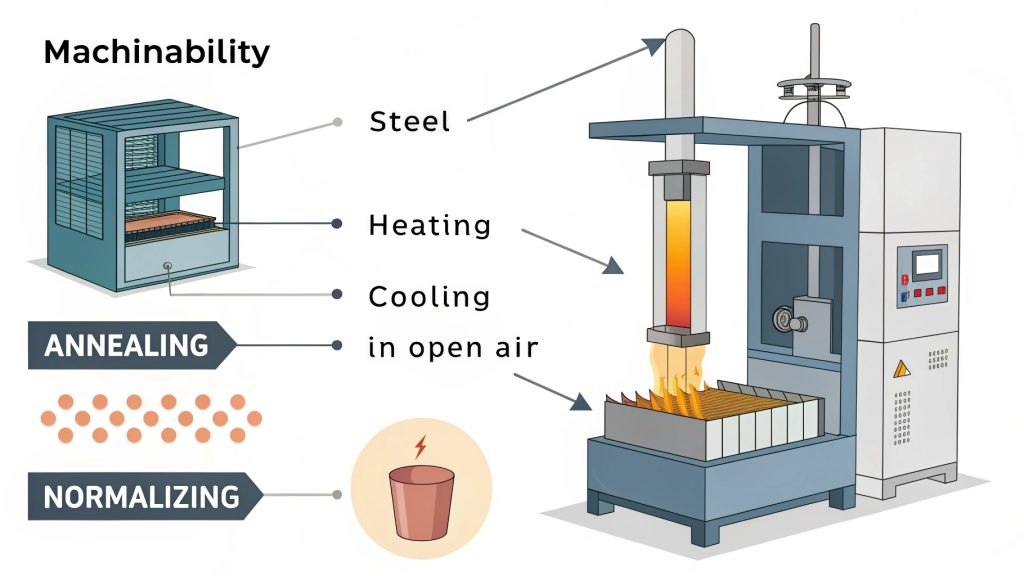
Let's break down how this works. Machinability is all about how easily a material can be cut. Hard, brittle materials tend to chip tools, while very soft, gummy materials can stick to the cutting edge. Heat treatment helps find the sweet spot.
-
Annealing: This process involves heating the steel and then cooling it very slowly. This results in the softest possible state for the steel, making it very easy to machine. It's perfect for complex parts that require a lot of material removal. I often recommend annealing for designs where machinability is the top priority before the final hardening process.
-
Normalizing: This involves heating the steel and then letting it cool in the open air. The cooling is faster than annealing. This process creates a fine, uniform grain structure. It's not as soft as annealed steel, but it offers a great combination of decent strength and good machinability. It’s a common choice for general-purpose machining.
By using these treatments, we make the material behave predictably on the CNC machine, reducing tool wear and improving the surface finish of the final part.
What does heat treating do to steel?
Are you wondering what actually happens inside steel during heat treatment? It’s not magic, but a controlled process that can seem complex, leaving you unsure of how to specify it for your parts.
Heat treating physically rearranges the atoms within the steel's crystalline structure. By heating steel to specific temperatures, we change its phase, and by controlling the cooling rate, we lock in a desired microstructure, which in turn defines its mechanical properties like hardness and strength.
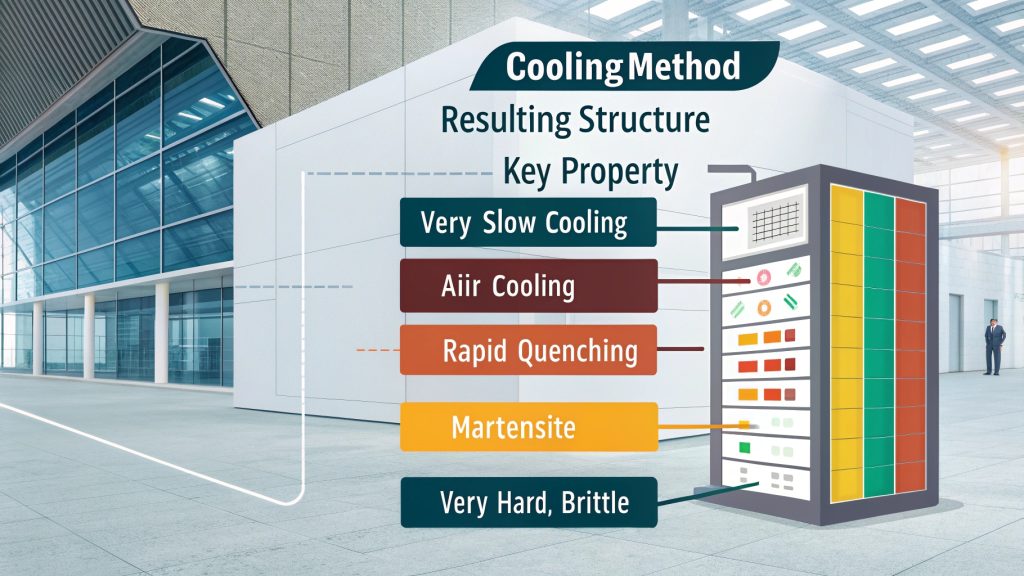
Let's get into the specifics. At room temperature, carbon steel has a structure called ferrite and pearlite. When we heat it above a critical temperature (around 727°C or 1340°F), this structure transforms into a new phase called austenite. The magic happens during the cooling stage. How we cool the austenite determines the final structure and properties of the steel.
| Cooling Method | Resulting Structure | Key Property |
|---|---|---|
| Very Slow Cooling | Coarse Pearlite | Soft, Ductile |
| Air Cooling | Fine Pearlite | Balanced Strength |
| Rapid Quenching | Martensite | Very Hard, Brittle |
If we cool it slowly, like in annealing, it reverts to a soft pearlite and ferrite structure. If we cool it rapidly by quenching it in water or oil, the carbon atoms get trapped, forming a very hard and brittle structure called martensite. This is the basis of hardening steel. Subsequent tempering, which is a gentle reheating, allows some of this structure to relax, trading some hardness for a significant increase in toughness. So, heat treating is essentially a tool for atomic-level engineering.
How does heat treatment change the properties of steel?
Do you need your steel parts to be stronger, more durable, or more resistant to wear? Without the right treatment, standard steel often falls short, leading to premature failure and costly replacements.
Heat treatment systematically alters key mechanical properties of steel. It can drastically increase hardness and tensile strength through quenching, or it can improve ductility and toughness through annealing or tempering. Essentially, it allows us to customize the steel's performance characteristics.
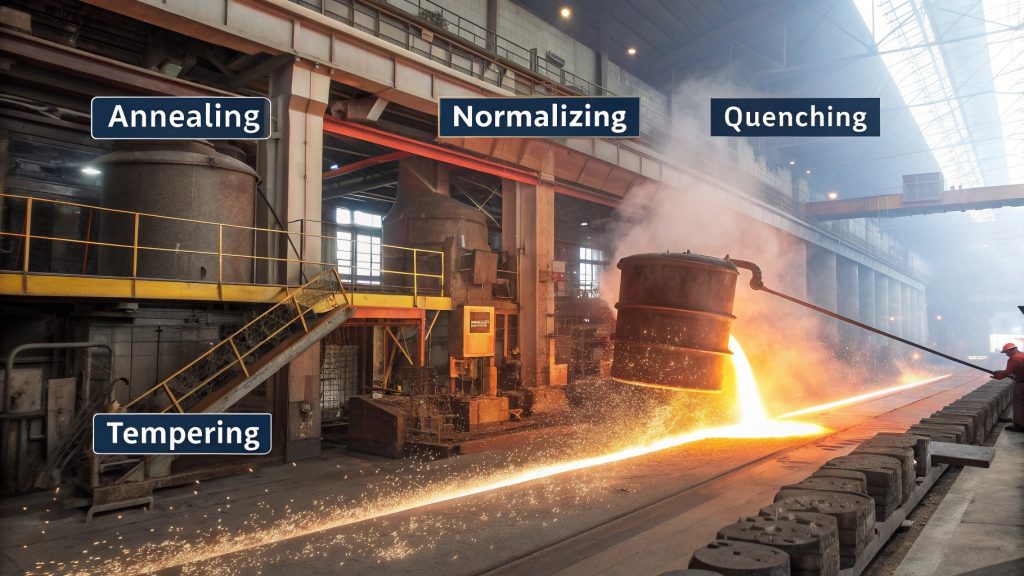
Let’s look at the property changes from the four main processes. When I help a client improve a design, we often discuss which property is most important. The choice of heat treatment directly follows that discussion.
-
Annealing: This process prioritizes softness and ductility. It reduces hardness and strength, relieves internal stresses, and refines the grain structure. The main goal is to make the steel easier to work with for subsequent operations.
-
Normalizing: This gives a more uniform and desirable grain size than annealing. The result is a steel that is stronger and harder than annealed steel but still has good ductility. It's a great "all-around" treatment.
-
Quenching: This is all about maximizing hardness. By cooling the steel rapidly, we create a very hard but brittle martensitic structure. This gives the steel excellent wear resistance but makes it unsuitable for applications with high impact.
-
Tempering: This process always follows quenching. It involves reheating the hardened steel to a lower temperature to reduce brittleness. It slightly decreases hardness but significantly increases toughness, making the part durable and resilient.
By combining these methods, we can achieve a precise balance of properties for any application.
Conclusion
Heat treatment is a vital process that customizes carbon steel's properties. It can increase strength, improve machinability, and extend the life of your parts, making it essential for high-performance components.