
What Are The Advantages of Zinc Die Casting For Precision Parts?

Struggling to find a material that is both strong and precise for complex parts? The wrong choice can be costly. Zinc die casting might be your perfect solution.
Zinc die casting provides exceptional dimensional accuracy, complex geometry capabilities, and a smooth surface finish. Its strength, conductivity, and lower melting point make it a cost-effective and efficient choice for producing high-quality precision parts, superior to many other materials and processes.
You now know the quick benefits. But to really understand if zinc is the right choice for your project, we need to look closer. We will break down the specific advantages, see how precise it can be, and compare it to other common materials. Let's get into the details that will help you make a smarter decision.
What are the advantages of zinc die casting?
Feeling unsure about which casting process to choose? The wrong decision wastes money and time. Let's explore the specific benefits of zinc die casting for your project.
The main advantages are its high strength and hardness, excellent dimensional stability, and superior finishing characteristics. Zinc alloys also have a low melting point, which reduces energy costs and extends tool life, making the entire process faster and more economical for high-volume production.
From my experience, the first thing customers notice about zinc parts is their feel. They have a substantial weight and texture that plastic parts just can't match. This gives a product a premium quality feel right out of the box. But the advantages go much deeper than that. To get a great result, you need the right machine and the right process working together. When they do, zinc's properties really shine. Let's look at a few key areas.
Performance and Design Flexibility
Zinc alloys are strong and hard. This allows for the creation of parts with very thin walls without sacrificing durability. This is a huge advantage for creating complex, lightweight components. You can design intricate features that would be difficult or impossible with other methods.
Smooth Surface Finish
The casting process naturally produces a very smooth surface. This is great because it often reduces the need for secondary finishing operations, saving you time and money. Of course, if you need a specific look, zinc parts are perfect for a wide range of surface treatments like plating, painting, or powder coating.
Efficiency and Cost
The low melting point of around 385°C is a major benefit. It means less energy is needed to melt the metal, and the casting cycle times are faster compared to aluminum. This also puts less stress on the molds, so they last much longer. This all adds up to a more cost-effective process, especially for large production runs.
What is the main advantage of die casting?
Need to produce thousands of identical parts quickly? Slow methods can kill your timeline and budget. The main advantage of die casting is its incredible speed and repeatability.
The single greatest advantage of die casting is its ability to produce large quantities of complex, near-net-shape parts with high precision and at a very rapid pace. This efficiency significantly lowers the cost per part, making it ideal for mass production projects.
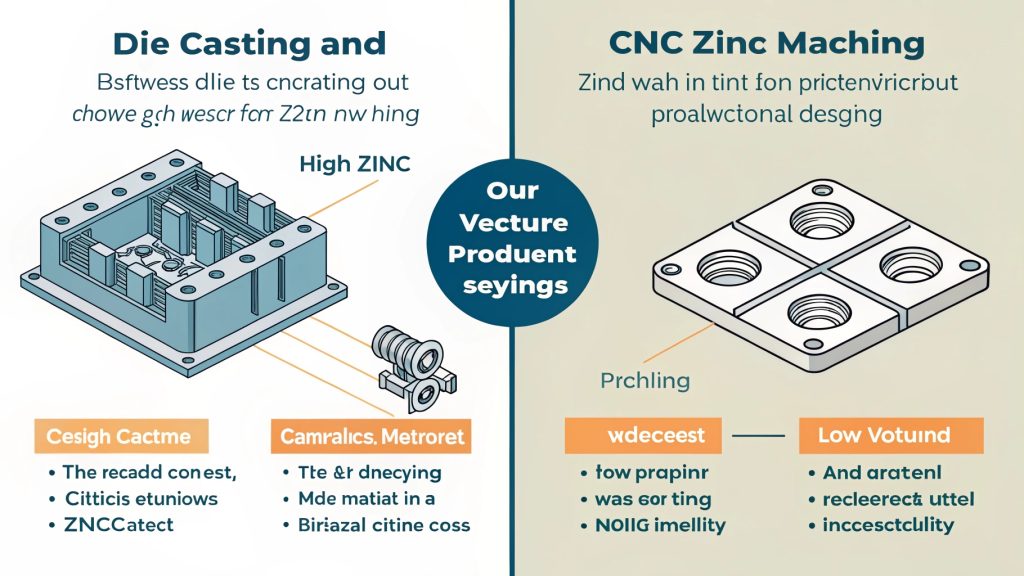
When clients ask me about the biggest benefit of die casting, I always talk about speed and consistency. Think about making just one part. CNC machining is perfect for that. But what if you need 50,000 parts? Machining each one would take forever and be very expensive. This is where die casting excels. The main advantage is that you create a reusable steel mold, called a die. Once that die is made, you can inject molten metal into it over and over again, very quickly. You can produce hundreds or even thousands of parts per hour from a single mold.
Each part comes out virtually identical to the last one, which is critical for quality control. We call the parts "near-net-shape." This means they come out of the mold very close to their final form. This minimizes the need for extra work like machining or drilling. The combination of high speed, high consistency, and minimal secondary operations makes die casting unbeatable for high-volume manufacturing. It is how you get a low cost per part without sacrificing quality.
How precise is die casting?
Do your components require a perfect fit? Inaccurate parts cause assembly failures and waste. Modern die casting offers impressive precision to meet your tight tolerance requirements.
Die casting is very precise. Standard tolerances are typically within +/- 0.127 mm (+/- 0.005"). However, for zinc alloys, even tighter tolerances are achievable. With careful process control and quality tooling, precision down to +/- 0.025 mm (+/- 0.001") is possible for specific features.
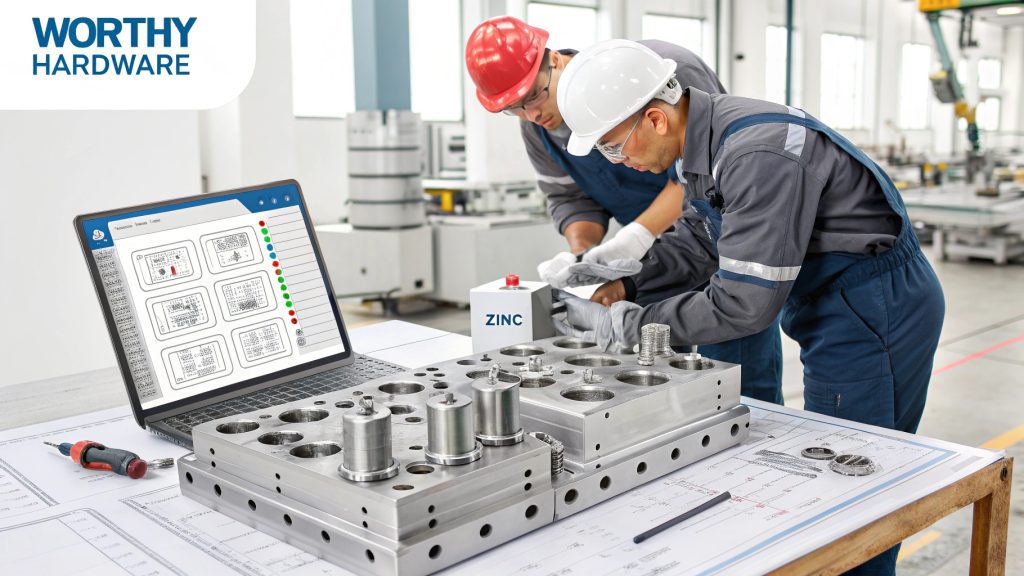
Precision is a huge concern for my customers, and rightly so. If parts do not fit, the entire product fails. The good news is that die casting, especially with zinc, is a very precise process. The final accuracy depends on a few key factors: the quality of the steel mold, the consistency of the zinc alloy, and the control over the casting process itself. At my company, Worthy Hardware, we handle these variables carefully. A well-made die is the foundation. Then, we control the injection pressure, temperature, and cooling time precisely for every single shot. This level of control allows us to achieve very consistent results. While standard tolerances are already good for most applications, we can push it further for critical features. Here’s a simple breakdown of what you can generally expect:
| Tolerance Level | Typical Measurement (mm) | Typical Measurement (inches) | Best For |
|---|---|---|---|
| Standard | +/- 0.127 mm | +/- 0.005" | General-purpose parts |
| Precision | +/- 0.025 mm | +/- 0.001" | Critical features, tight assemblies |
This ability to hold tight tolerances consistently across thousands of parts is a key reason why engineers choose die casting for complex assemblies in automotive, electronics, and medical devices.
Why is zinc often used for die casting rather than steel?
Need a strong metal part but unsure if zinc or steel is better? The wrong choice can be expensive. Let's compare them to see why zinc is preferred for die casting.
Zinc is used for die casting over steel primarily because of its much lower melting point. This makes the process faster, uses less energy, and dramatically increases the life of the steel molds. Steel's high melting point makes it unsuitable for traditional hot-chamber die casting.
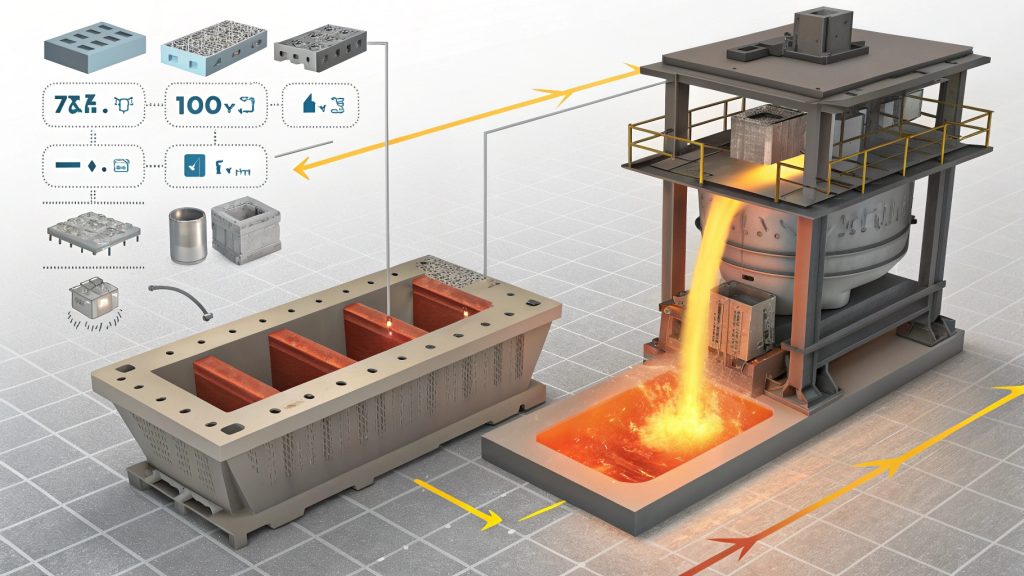
This is a question I get all the time. People know steel is strong, so they ask, "Why not die cast with steel?" The answer is simple: temperature. Steel has a very high melting point, over 1370°C (2500°F). Zinc, on the other hand, melts at just 385°C (725°F). This huge difference changes everything. The molds used in die casting are made of steel. If you tried to inject molten steel into a steel mold, the mold would soften, warp, or even melt. It just would not last. Because zinc melts at a much lower temperature, it does not damage the steel mold.
This means the mold can be used for hundreds of thousands, or even millions of cycles before it needs to be replaced. This long tool life is a major reason why die casting with zinc is so cost-effective for high volumes. The lower temperature also means faster production. It takes less time to heat the zinc and less time for the part to cool and solidify in the mold. This results in shorter cycle times and more parts per hour. While you can cast steel using other methods like investment casting, it is a much slower and more expensive process, not suitable for the high-speed production that die casting is famous for.
Conclusion
In summary, zinc die casting offers an unmatched blend of precision, strength, and manufacturing speed. It is an ideal choice for creating complex, cost-effective, high-quality parts in large volumes.