
What Are The Key Differences Between Die Casting And CNC Machining For Zinc Parts?

Struggling to pick the best way to make your zinc parts? Choosing wrong costs time and money. Understanding these methods is key.
Die casting is excellent for high-volume, complex zinc parts with lower unit costs, but involves initial mold expenses. CNC machining provides high precision for prototypes and low-to-mid volumes of zinc parts without tooling investment, offering design flexibility.
You want the best result for your project, right? Making the wrong choice between die casting and CNC machining for your zinc components can lead to budget overruns or parts that don't meet your needs. It's a common challenge, but one we can solve. Let's look closer at these processes. Knowing more will help you make a smart decision and get your zinc parts made efficiently.
What is the difference between CNC and die casting?
Confused about CNC versus die casting for making parts? This confusion can lead to choosing a less efficient or more costly production method. Let's clear it up.
CNC machining is a subtractive process, carving parts from a solid block of material like zinc for high precision. Die casting is a formative process, injecting molten metal (often zinc alloys) into a custom mold, ideal for mass-producing complex shapes.
When we talk about CNC machining, imagine a sculptor carefully chipping away at a block to reveal a shape. That's essentially what CNC machines do, but with incredible precision using computer-controlled cutting tools. We often use it for zinc parts when clients need very tight tolerances or are in the prototyping stage. For example, I had a client, Mark, who needed a few highly accurate zinc prototypes for a new electronic enclosure. CNC was perfect because we could make them quickly without the high cost of a die cast mold.
Die casting, on the other hand, is like using a high-tech Jell-O mold. We melt the zinc alloy and inject it under high pressure into a steel die (the mold). Once it cools and solidifies, the part is ejected. This is super-efficient for making thousands, or even millions, of identical zinc parts. The initial mold is an investment, but the cost per part becomes very low at high volumes. So, if Mark's product took off, we'd then discuss moving to die casting for mass production. The key difference lies in how the material is shaped: CNC removes material, while die casting forms it.
Here's a simple breakdown:
| Feature | CNC Machining (for Zinc) | Die Casting (for Zinc) |
|---|---|---|
| Process Type | Subtractive (material removal) | Formative (material shaping in a mold) |
| Best For | Prototypes, low-mid volume, high precision | High volume, complex shapes, lower unit cost |
| Tooling | Standard cutting tools | Custom-made steel dies (molds) |
| Lead Time | Shorter for initial parts | Longer initially (mold making), then fast |
| Material Waste | Can be higher (chips removed) | Lower (excess can often be remelted) |
Understanding these fundamental differences is the first step in choosing the right path for your zinc components.
What is the difference between die cast and machined?
Do "die cast" and "machined" parts seem similar? Not knowing the crucial differences can lead you to pick a process that isn't ideal for your zinc project.
Die cast parts are created by injecting molten metal, like zinc alloys, into a reusable mold. Machined parts are shaped by precisely removing material from a solid block using cutting tools, often achieving tighter tolerances and smoother finishes without draft angles.
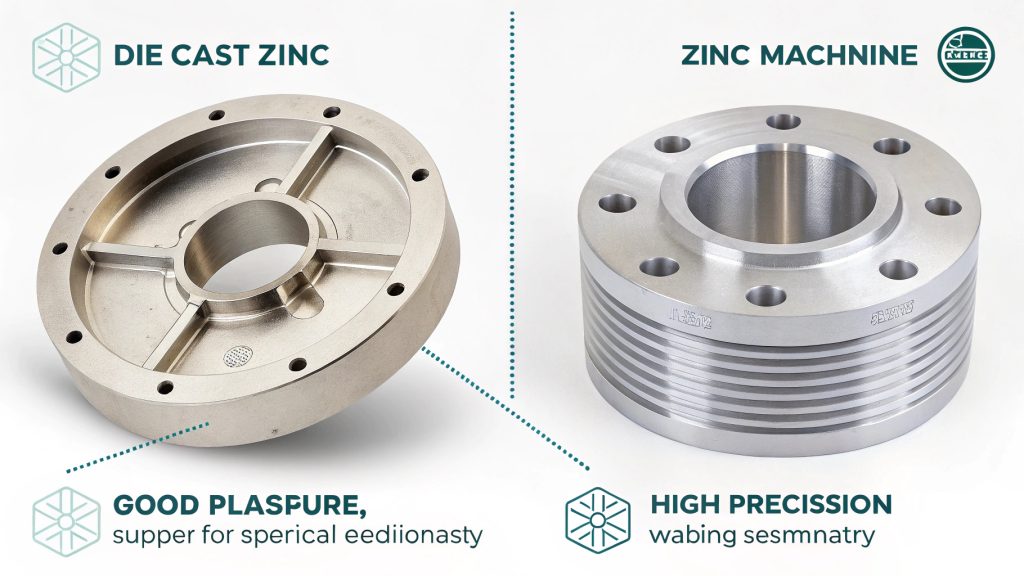
The terms "die cast" and "machined" describe how a part achieves its final form, and this directly impacts its characteristics, especially for zinc components. A die cast zinc part is formed in a mold. Think of it like making a waffle; the batter (molten zinc) fills the shape of the waffle iron (the die). This process is fast for large quantities. However, die cast parts often have certain features like parting lines (where the mold halves meet) and require draft angles (slight tapers) to help eject the part from the mold. The surface finish is generally good but might need secondary operations for ultra-smoothness.
A machined zinc part, however, is cut from a solid piece of zinc. We use CNC machines to meticulously remove material. This means we can achieve very high precision and complex geometries without needing draft angles. The surface finish can be controlled to be very smooth, often better than "as-cast." I remember a customer needing a zinc housing with very flat sealing surfaces. Die casting would have required a secondary machining step for that flatness, but CNC machining achieved it directly. So, "machined" generally implies a subtractive process resulting in potentially higher accuracy and different surface features than a part that is "die cast." Often, die cast parts might undergo secondary machining operations to add features or improve tolerances.
Consider these aspects:
| Aspect | Die Cast Zinc Part | Machined Zinc Part |
|---|---|---|
| Formation | Molten zinc alloy solidified in a mold | Material removed from solid zinc block |
| Precision | Good, but generally lower than machining | Typically very high |
| Surface Finish | Good (e.g., Ra 3.2-6.3 μm), may have parting lines | Can be very smooth (e.g., Ra 1.6 μm or better) |
| Draft Angles | Usually required | Not required |
| Complexity | Excellent for complex external shapes | Excellent for internal/external features |
| Internal Voids | Possible (porosity), can be minimized | Generally not an issue (solid material) |
This distinction is important because it affects design choices and final part quality
What is the difference between die cast and zinc alloy?
Is "die cast" a material? Or is "zinc alloy" a process? This common mix-up can be confusing when specifying your parts. Let's clarify these terms.
"Die cast" refers to the die casting manufacturing process where molten metal is forced into a mold. "Zinc alloy" is a type of metallic material (zinc mixed with other elements like aluminum or copper) that is commonly shaped using the die casting process, but can also be CNC machined.
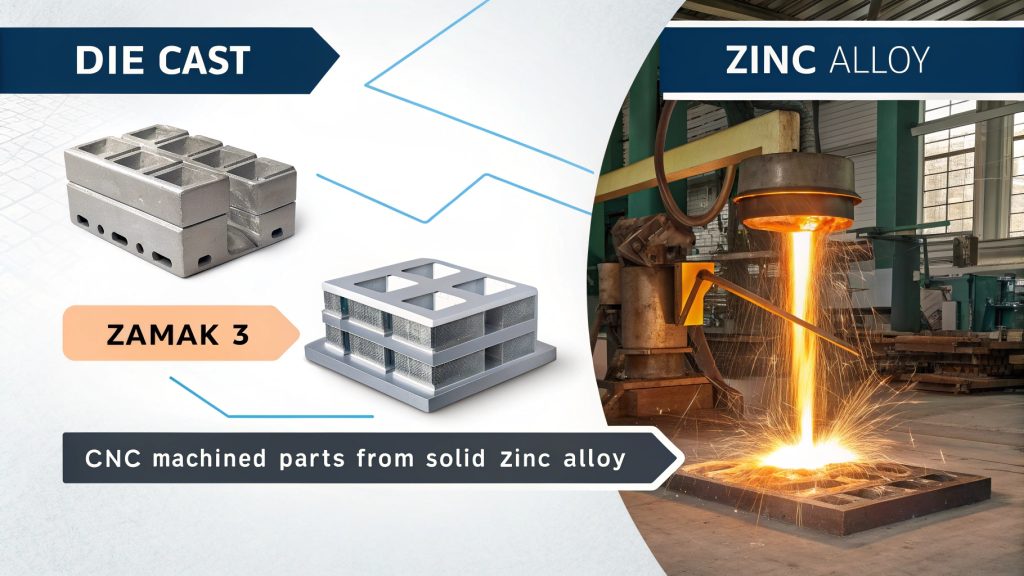
It's easy to get these terms tangled, but the difference is quite straightforward. "Die cast" describes how something is made – it's a manufacturing method. Specifically, it's the process of injecting molten metal into a specially designed mold, or die, under high pressure. Many different metals can be die cast.
"Zinc alloy," on the other hand, describes what something is made of – it's a material. Zinc, on its own, is a metal. When we talk about zinc alloys, we mean zinc that has been mixed with other elements like aluminum, magnesium, copper, or others. These additions enhance properties like strength, castability, or corrosion resistance.
For instance, ZAMAK 3 is a very popular zinc alloy we use for die casting because it has excellent fluidity and dimensional stability. However, we also machine parts from solid zinc alloy blocks using CNC. I've worked on projects where a client needed a prototype from a specific zinc alloy before committing to die cast tooling; in that case, we CNC machined it from that exact zinc alloy. So, you can have a "die cast zinc alloy part," meaning a part made from zinc alloy material using the die casting process. But you could also have a "CNC machined zinc alloy part." The process and material are distinct concepts.
Key takeaway:
-
Die Casting: A manufacturing process.
-
Zinc Alloy: A type of material.
You can use the die casting process with various materials (like aluminum, magnesium, or zinc alloys). And you can shape zinc alloys using various processes (like die casting, CNC machining, or even sand casting for some applications). Knowing this helps in clear communication with your manufacturing partner.
What is the difference between casting and machining?
"Casting" and "machining" are two big words in manufacturing. Many people get them mixed up, which can lead to confusion when planning a project. Let's simplify them.
Casting is a manufacturing process that involves pouring molten material (like metal or plastic) into a mold to create a desired shape after it solidifies. Machining is a subtractive process that uses cutting tools to remove material from a solid workpiece to achieve the final geometry.
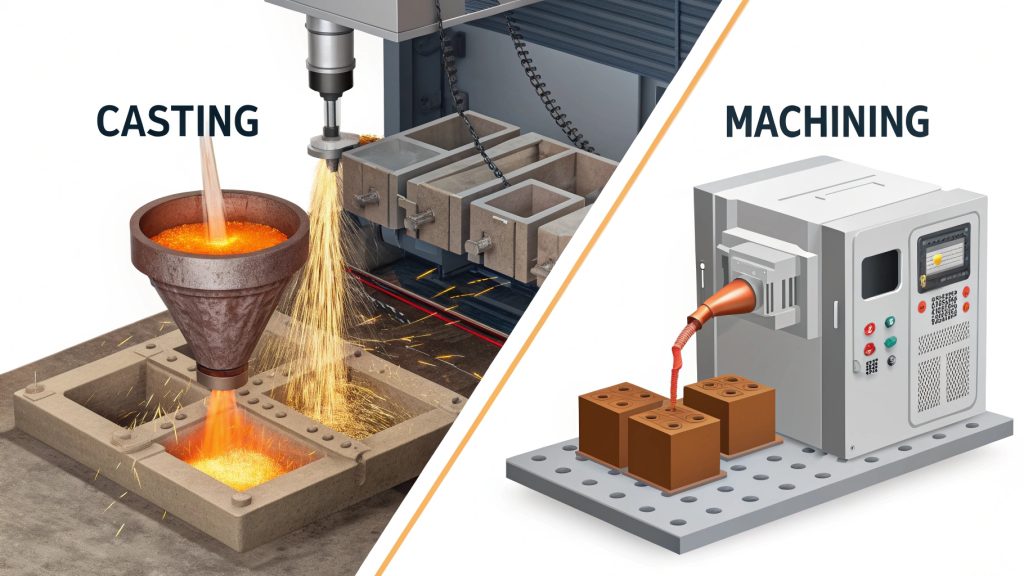
Casting and machining are two fundamental, yet very different, families of manufacturing processes. "Casting" is an umbrella term for processes where you start with a liquid material. This liquid (often molten metal like zinc, aluminum, iron, or even plastics) is poured or forced into a cavity – the mold – that has the shape of the part you want to make. Once the material cools and solidifies, you get your part. Die casting, which we've discussed, is a type of casting. Sand casting and investment casting are other common casting methods. Casting is generally great for creating complex shapes, especially in high volumes, as the tooling (mold) can be reused many times. My experience shows that for very intricate zinc designs meant for mass production, casting is often the first consideration because of its ability to replicate details efficiently.
"Machining," on the other hand, always starts with a solid block, bar, or sheet of material. It's a subtractive process, meaning material is removed to get to the final shape. Think of a sculptor with a chisel, but on an industrial and highly precise scale. CNC machining (milling, turning, drilling) falls under this category. Machining is known for its ability to achieve very high precision and excellent surface finishes. We often use machining for zinc parts when the tolerances are extremely tight, when a prototype is needed quickly, or when the production volumes are too low to justify the cost of casting molds. The insight here is that machining offers flexibility and precision, while casting excels at volume and complex net shapes.
Here's a broader comparison:
| Feature | Casting (General) | Machining (General) |
|---|---|---|
| Starting Form | Molten material | Solid material (block, bar, sheet) |
| Process | Material solidifies in a mold | Material removed by cutting tools |
| Shape Complexity | Good for complex, near-net shapes | Good for precise features, less so for highly organic net shapes |
| Volume | Often economical for medium to high volumes | Economical for prototypes to medium volumes |
| Precision | Varies by casting type; generally less than machining | Typically high to very high |
| Tooling | Molds, patterns | Cutting tools, fixtures |
| Material Choice | Wide range of castable metals and plastics | Wide range of machinable metals and plastics |
Both have their place, and sometimes they are even used together – a cast part might be machined to add precise features.
Conclusion
Choosing between die casting and CNC machining for zinc parts depends on volume, precision, and budget. Die casting suits high-volume, while CNC excels in precision and prototyping.