
What Is Heat Treatment: Types, Processes and Effects on Metal Properties?

Struggling with metal parts that aren't tough enough or wear out too fast? Heat treatment could be the key to unlocking superior performance.
Heat treatment is a controlled heating and cooling process. It changes a metal's internal structure to improve its mechanical properties like hardness, strength, and ductility for specific applications.
Understanding heat treatment[^1] can make a huge difference in your project's success and the final quality of your CNC machined parts[^2]. It's a fascinating field. Let's explore what it really means and how it works, so you can make better decisions for your components.
What is the definition of heat treatment of metals?
Confused about what "heat treatment" actually means for metals? You're not alone; many find the term a bit vague despite its huge importance in manufacturing.
Heat treatment of metals is a group of industrial processes. It involves heating and cooling solid metals to precise temperatures to alter their microstructure and achieve desired physical and mechanical properties.
At its core, heat treatment is all about carefully controlling temperature and time. We take a metal, heat it up to a specific point, hold it there for a while, and then cool it down in a particular way. It’s not just about making metal hot and then letting it cool. The "controlled" part is super important. Why do we do this? The main reason is to change the metal’s internal structure, what we call its microstructure. Think of it like changing the arrangement of tiny crystals within the metal. This change, in turn, modifies its properties.
We might want to make the metal harder so it doesn't wear out, or softer so it's easier to machine. Or perhaps we need it to be stronger, or more resistant to breaking under impact. I remember when I first started in this industry, understanding the science behind heat treatment was a game-changer. For instance, a client needed some custom CNC parts that required high tensile strength but also good machinability. We had to select an alloy that, with the right heat treatment sequence, could deliver both. It showed me that heat treatment is a precise science, essential for getting the best out of metals for services like the CNC machining we offer at Worthy Hardware. It’s a whole family of processes, each designed for a specific outcome.
What is the heating process in heat treatment?
Wondering what actually happens when metal is heated for treatment? It's more than just cranking up the temperature; precise control is absolutely key for success.
The heating process in heat treatment involves three main stages: heating the metal to a specific temperature, holding it at that temperature (soaking), and then cooling it at a controlled rate.
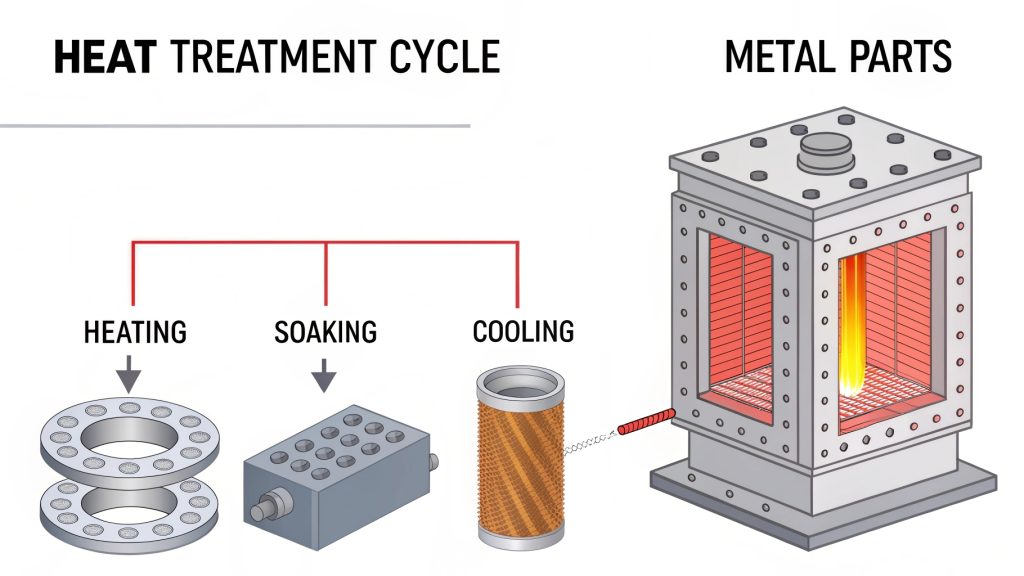
The entire heat treatment cycle relies on careful management of temperature and time, broken down into three critical stages.
First is the heating stage. The metal part is heated to a predetermined temperature. The rate of heating is important; if it's too fast, especially for complex shapes or certain alloys, it can cause warping or even cracking due to internal stresses. The goal is to reach the target temperature uniformly throughout the part.
Once the metal reaches this temperature, we enter the soaking stage. During soaking, the part is held at that specific temperature for a set period. This holding time is crucial because it allows the necessary changes in the metal's microstructure to take place completely. For example, it might be for atoms to diffuse and form new structures, or for existing ones to dissolve. If you don't soak it long enough, the treatment might not be effective. I recall a project where some large steel components weren't achieving uniform hardness. We found out the soaking time wasn't sufficient for the heat to fully penetrate and transform the core.
Finally, there's the cooling stage. After soaking, the metal is cooled back to room temperature. The rate of cooling is perhaps the most critical factor determining the final properties. Rapid cooling, like quenching in water or oil, can make steel very hard. Slower cooling, like letting it cool in the furnace, usually makes it softer. The specific cooling rate and medium (air, oil, water, brine, or even still air in the furnace) are chosen based on the metal type and the desired outcome. This control over each stage is fundamental to what we do at Worthy Hardware when preparing materials for precision machining.
| Stage | Purpose | Key Factors | My Experience Notes |
|---|---|---|---|
| Heating | Bring metal to transformation temperature | Rate, uniformity | Avoid thermal shock, ensure even temperature. |
| Soaking | Allow internal structure changes to occur | Time, temperature stability | Crucial for homogeneity and complete transformation. |
| Cooling | Lock in desired structure and properties | Rate, cooling medium | Determines final hardness, strength, and toughness. |
What are the different types of heat treatment process for metals?
Heard terms like annealing or quenching but unsure what they do? These different heat treatments offer unique benefits for your metal components. It’s good to know the basics.
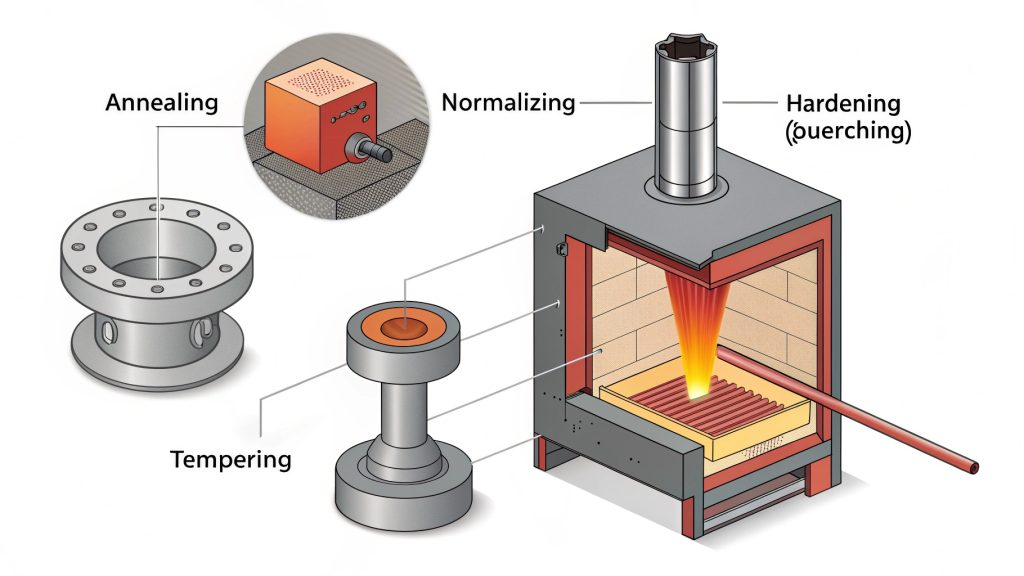
Common types include annealing (softening), normalizing (refining grain), hardening (increasing hardness), and tempering (reducing brittleness). Each serves a specific purpose in modifying metal properties for different applications.
 "Types of Heat Treatment")
There are many specific heat treatment processes, but some of the most common ones we encounter in the CNC machining world include annealing, normalizing, hardening (often called quenching), and tempering.
Annealing is generally used to make metals softer, more ductile, and easier to machine. It involves heating the metal to a specific temperature and then cooling it very slowly, usually by leaving it in the furnace to cool. This process also helps relieve internal stresses that might have built up during previous manufacturing steps.
Normalizing is often applied to steels to refine their grain structure and improve mechanical properties like toughness and strength. The metal is heated above its upper critical temperature and then cooled in still air. This results in a more uniform and finer grain structure compared to annealing.
Hardening, or quenching, is done to significantly increase the hardness and wear resistance of steel. The steel is heated to a high temperature to transform its structure into austenite, and then rapidly cooled (quenched) in a medium like water, oil, or air. This rapid cooling traps carbon in a very hard structure called martensite.
Tempering is almost always performed after hardening. Hardened steel is very strong but also very brittle, meaning it can break easily. Tempering involves reheating the hardened steel to a lower temperature (below the critical point) and holding it for a certain time, then cooling it, usually in air. This process reduces some of the hardness and brittleness but significantly increases toughness.
We differentiate between low-temperature tempering, which retains most of the hardness while relieving stresses, and high-temperature tempering (sometimes called "temper drawing"), which results in lower hardness but much greater ductility and toughness. I remember a client, much like Mark Chen, who needed parts for a high-stress application. The initial design was just hardened, but parts were failing. By adding a specific high-temperature tempering step, we achieved the necessary toughness without sacrificing too much strength. At Worthy Hardware, selecting and controlling these processes is vital for the custom CNC parts we produce.
How does heat treatment affect the properties of metals?
Want your metal parts to be stronger, tougher, or more resistant to wear? Heat treatment directly influences these critical material characteristics for better performance.
Heat treatment alters a metal's microstructure. This change directly affects mechanical properties like hardness, strength, ductility, toughness, and wear resistance, and sometimes physical properties.
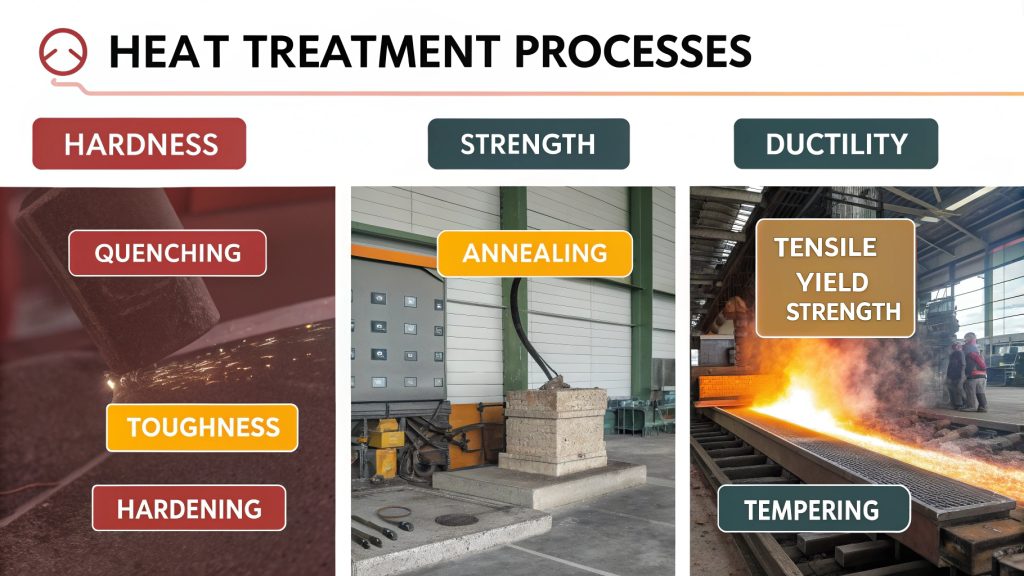
Heat treatment is all about changing a metal's internal microscopic structure to get the desired macroscopic properties. When we talk about properties, we mainly mean mechanical properties. For example, hardness is a big one. Processes like quenching can make steel incredibly hard, which is great for tools or parts that need to resist wear.
On the other hand, annealing makes metals softer. Strength, including tensile strength (how much it can be pulled before breaking) and yield strength (how much stress it can take before permanently deforming), can be significantly increased by processes like hardening and tempering.
Then there's ductility, which is the ability of a metal to deform without breaking – think of drawing it into a wire. Annealing typically increases ductility, while hardening reduces it.
Toughness is another crucial property; it's the metal's ability to absorb energy and resist fracture, especially under impact. Hardened metals are often brittle (low toughness), but tempering improves toughness significantly, usually at some expense of hardness. This balance is critical in many applications. For instance, at Worthy Hardware, when we make shafts or gears through CNC turning or milling, they often need to be hard for wear resistance but also tough enough to handle shocks.
Heat treatment also directly impacts wear resistance, primarily by increasing surface hardness. Beyond these, internal stresses within a material can be relieved or introduced by heat treatment, affecting dimensional stability and performance. All these changes happen because heat treatment modifies the grain size, grain structure, and the phases present within the metal (like ferrite, pearlite, austenite, or martensite). Understanding these relationships allows us to tailor materials for specific needs, ensuring our CNC machined parts perform as expected. I once worked on a project where components were warping after machining. We introduced a stress-relieving heat treatment step before final machining, and it solved the problem completely.
Conclusion
Heat treatment is vital for optimizing metal parts. It offers diverse processes to achieve desired strength, hardness, and durability for many engineering applications.