
What Is CNC Turning: Your Complete Guide to Process, Materials, and Applications?

Struggling to understand CNC turning? Wondering how it creates precise parts? This guide clearly explains everything you need to know.
CNC turning is a manufacturing process. A cutting tool shapes material as the workpiece rotates on a lathe. It's used to create cylindrical parts with high precision. This method is essential for many industries, offering accuracy and repeatability.
Now that you have a basic idea, you might be wondering about the machines themselves and how they fit into the bigger picture of manufacturing. I've seen many clients, just like Mark Chen from Canada, initially curious about the specifics. Let's dive deeper to help you understand more about this fascinating technology. It's more straightforward than you might think, and understanding it can really help when you're looking for the best way to get your parts made.
What is a CNC turning lathe and what are its applications?
Confused about what a CNC lathe actually does? Unsure what kinds of parts it can produce? We'll clarify its function and common uses.
A CNC turning lathe is a machine tool. It precisely rotates a workpiece while a cutting tool removes material to create a desired shape. It’s widely used for producing shafts, pins, bushings, and other cylindrical components for various industries.
A CNC turning lathe, or simply CNC lathe, is really the heart of the CNC turning process. Think of it as a highly automated and precise version of a traditional lathe. The "CNC" part, which stands for Computer Numerical Control, means a computer program dictates all the machine's movements. This allows for incredible accuracy and repeatability, which is so important for customers like Mark who prioritize quality.
The main components of a CNC lathe include:
-
Headstock: Contains the main spindle that rotates the workpiece.
-
Chuck/Collet: Holds the workpiece securely to the spindle.
-
Bed: The foundation of the machine, providing stability.
-
Carriage: Moves the cutting tool along the workpiece.
-
Turret: Holds multiple cutting tools, allowing for automatic tool changes.
-
Tailstock: Supports the other end of long workpieces.
-
CNC Controller: The "brain" that reads the program and controls the machine.
Its applications are vast. In my experience at Worthy, we've made parts for:
- Automotive: Engine components, transmission shafts, suspension parts.
- Aerospace: Fittings, connectors, structural components demanding tight tolerances.
- Medical: Custom surgical tools, implants, and device components.
- Electronics: Housings, connectors, and small intricate parts.
- Industrial Machinery: Gears, rollers, and custom fittings.
The ability to produce complex geometries with precision makes CNC lathes indispensable. We can handle lathe parts up to 62 inches in length and 32 inches in diameter, which covers a wide range of needs.
What is the basic concept of a CNC turning Centre?
Heard of CNC turning centers? Wondering if they are just advanced lathes or something more? Let's explore their enhanced capabilities simply.
A CNC turning center is an advanced lathe. It often includes live tooling for milling, drilling, and tapping operations, plus sub-spindles. This allows for more complex parts to be completed in a single setup, improving efficiency.
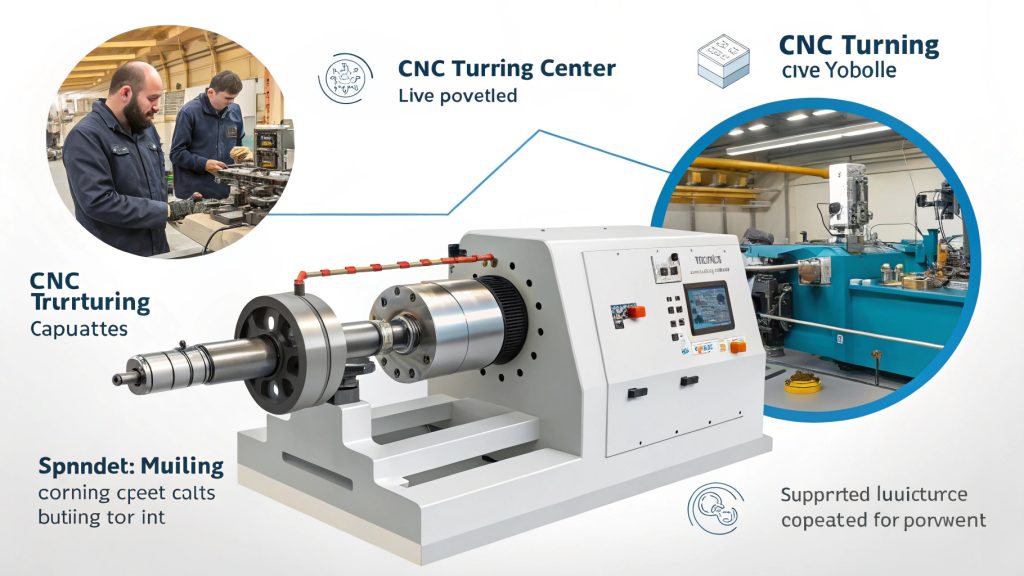
While a CNC lathe focuses primarily on turning operations (removing material as the part rotates), a CNC turning center takes this a step further. It's essentially a lathe with added functionalities. The most significant addition is often "live tooling." This means that besides the main spindle rotating the workpiece, the turret can also have powered tools that can spin independently. So, you can perform operations like drilling holes off-center, milling flats or slots, or tapping threads, all while the part is still clamped in its primary turning setup.
Here's why this is a big deal:
-
Reduced Setups: Traditionally, a part might need turning on a lathe, then moving to a milling machine for other features. A turning center can do much of this in one go. Fewer setups mean less handling, lower risk of errors from re-clamping, and faster production times. This directly addresses pain points like delayed shipments that Mark has experienced.
-
Increased Complexity: Parts with both turned and milled features can be produced more easily.
-
Improved Accuracy: Machining more features in a single clamping generally leads to better concentricity and overall dimensional accuracy.
Some turning centers also have a sub-spindle. This is a second spindle that can grab the part from the main spindle, allowing machining on the "back" side of the part without manual intervention. They can also have a Y-axis, allowing the tools to move up and down, perpendicular to the X (diameter) and Z (length) axes, further expanding milling capabilities. At Worthy, leveraging such advanced machines helps us meet the demand for precision machining and complex custom CNC parts.
How to explain what CNC is?
Is "CNC" just technical jargon to you? Finding it hard to grasp the "computer numerical control" idea? Let's break it down clearly.
CNC stands for Computer Numerical Control. In essence, a computer reads a pre-written program (G-code) and uses it to precisely control the movements of a machine tool, like a lathe or mill, to shape material automatically.

When I explain CNC to someone new to manufacturing, I often start by saying it's about telling a machine exactly what to do using a computer. Instead of an operator manually turning cranks and levers, like on old-fashioned machines, a computer handles all the precise movements.
Here’s a simplified breakdown of how it works, especially in the context of turning:
-
Design (CAD): First, the part is designed using Computer-Aided Design (CAD) software. This creates a 3D model.
-
Programming (CAM): Then, Computer-Aided Manufacturing (CAM) software takes this CAD model. The programmer (or sometimes our engineers helping customers improve designs) defines the machining strategy – what tools to use, cutting speeds, feed rates, and the path the tools will take. The CAM software then translates this into a special programming language called G-code.
-
G-code: This is the set of instructions the CNC machine understands. It consists of commands like
G01(linear movement),X10.0(move to X-coordinate 10.0),Z-5.0(move to Z-coordinate -5.0),S1200(set spindle speed to 1200 RPM),T0101(select tool number 1). -
Machine Operation: The G-code is loaded into the CNC machine's controller. The controller then interprets these commands and precisely activates the machine's motors and drives to move the cutting tools and the workpiece to create the part.
The beauty of CNC is its precision and repeatability. Once a program is proven, the machine can produce identical parts over and over again, meeting tight tolerances – we can even hold sub +/- 0.001" tolerances. This consistency is crucial for quality, a key focus for buyers like Mark Chen. It also allows for complex shapes that would be very difficult or impossible to make manually.
What is the CNC method of processing?
Curious about the step-by-step CNC turning journey? Want to see how raw material transforms into a finished, precise part? Let's walk through it.
The CNC turning method involves designing the part (CAD), programming the machine (CAM/G-code), setting up the lathe with material and tools, running the automated cutting cycle, and finally, inspecting the finished part for quality.
The CNC method of processing, specifically for turning, is a systematic approach. As I mentioned in my insights, CNC turning is a key part of CNC machining. The core idea is that the workpiece rotates rapidly, while a stationary cutting tool is fed along its axis (longitudinally) or across its face (radially) to remove material and achieve the desired cylindrical or conical shape.
Let's break down the typical workflow we follow at Worthy Hardware:
-
Design & Programming:
- It starts with a customer's design, often a 2D drawing or 3D CAD model. Our engineers sometimes help customers refine designs for better manufacturability and cost savings.
- This design is then translated into a CNC program (G-code) using CAM software, detailing every movement and operation.
-
Machine Setup:
- The correct raw material is selected. We work with over 100 materials, including various metals like aluminum, steel, brass, titanium, and plastics like ABS, Delrin, PEEK, and even wood or carbon fiber.
- The raw material (usually a bar or slug) is securely clamped in the lathe's chuck or collet.
- The necessary cutting tools are loaded into the machine's turret.
- The operator sets the machine's work offsets, telling the machine where the raw material is located in relation to the tools.
-
Machining Operations:
- The CNC program is executed. The workpiece begins to rotate at a programmed speed.
- The cutting tool engages the workpiece. Common turning operations include:
- Facing: Creating a flat surface on the end of the part.
- Roughing: Quickly removing large amounts of material.
- Finishing: Achieving the final dimensions and desired surface finish (our standard is 125 Ra or better).
- Grooving: Cutting channels or recesses.
- Threading: Creating internal or external threads.
- Drilling/Boring: Creating or enlarging holes along the centerline.
- If it's a turning center, additional milling, drilling, or tapping operations might occur.
-
Inspection & Finishing:
- After machining, the part is removed.
- Crucially, we perform 100% inspection to ensure all dimensions meet the drawing specifications and our general tolerances (typically +/- 0.005" for metals unless tighter is specified).
- If required, additional surface finishing like anodizing, plating, or powder coating is applied. We support over 50 surface finishes.
This systematic process, from digital design to a tangible, precise part, is what makes CNC turning so powerful and reliable for producing custom components for a wide array of applications.
Conclusion
In short, CNC turning is a precise, automated process for shaping rotating material, vital for creating high-quality cylindrical parts across many industries.