
What Are the Key Differences Between Extruded and Cast Acrylic for Custom Parts?

Choosing acrylic for your parts seems simple, right? But wait, there are types! Picking the wrong one can cause headaches and hit your wallet.
The main differences between extruded and cast acrylic come from how they're made. This affects their strength, how they handle chemicals, how easy they are to work with, and their cost. Cast acrylic is generally stronger and more versatile, while extruded is more budget-friendly.
You might think acrylic is just acrylic. But when you're getting custom parts made, knowing these differences is super important. Let's dive a bit deeper so you can make the best choice for your project.
What is the difference between cast and extruded acrylic specifically?
Confused about which acrylic type suits your needs best? This uncertainty can lead to parts that don't perform as expected or cost more than necessary.
Cast acrylic is made by pouring liquid acrylic between two glass plates, creating a strong, uniform sheet. Extruded acrylic is made by pushing acrylic through a die, making it more consistent in thickness but with internal stresses. This means cast is often tougher and machines better.
When we talk about cast versus extruded acrylic, the manufacturing process is king. For cast acrylic, think of it like baking a cake in a pan. Liquid monomers are poured into a mold, often made of glass sheets, and then polymerized. This process results in a material with higher molecular weight. That means it's generally tougher, has better impact resistance, and stands up to solvents much better. I've seen many customers choose cast acrylic for parts that need to be very clear or will be exposed to chemicals.
On the other hand, extruded acrylic is made by pushing molten acrylic pellets through a die, kind of like squeezing toothpaste from a tube. This process is faster and cheaper, which is great for budget-sensitive projects. However, the extrusion process can introduce internal stresses and directionality into the material.
This means it might crack more easily when machined or exposed to certain solvents. One simple test I often tell my clients about, if they're unsure what they have, involves a lighter. If you carefully heat a small edge and touch it, extruded acrylic tends to get stringy, like it's pulling a thread. Cast acrylic usually doesn't do that; it just melts or burns a bit cleaner.
This little trick can sometimes save a lot of guesswork, especially when you're trying to match an existing part. The price difference is also a big giveaway; cast acrylic is almost always more expensive because the manufacturing process is slower and more labor-intensive.
What is the difference between extruded and casting as general manufacturing processes?
Are "extruded" and "casting" just fancy words? Understanding these core manufacturing methods helps you grasp why materials made by them behave differently.
Casting involves pouring a liquid material into a mold to solidify. Extrusion involves forcing a material through a shaped opening (a die). Casting allows for complex shapes and less internal stress. Extrusion is great for continuous profiles and is often more cost-effective for simpler shapes.
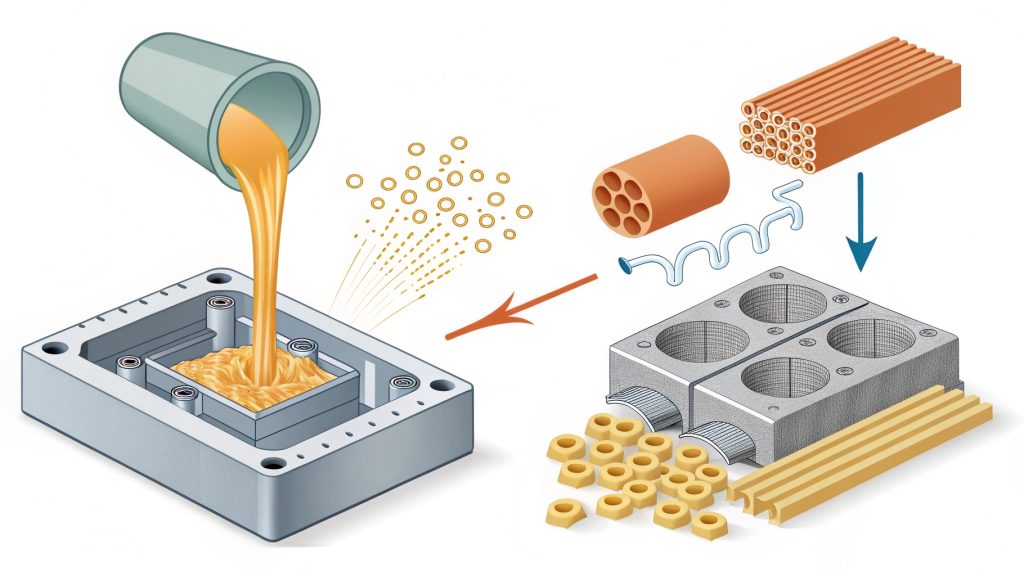
Let's look at casting and extrusion as general manufacturing methods, not just for acrylic. Casting is a really old technique. You take a material in its liquid state—it could be metal, plastic, or even plaster—and pour it into a mold. The mold has the shape of the part you want to make. Once the material cools and solidifies, you take it out. This method is great for making complex shapes. Because the material fills the mold and then sets, there's usually less internal stress compared to other methods. Think about making a detailed statue; casting is perfect for that.
Extrusion is quite different. Here, you start with a solid material, often in pellet or billet form, which is then heated to become soft or molten. This softened material is then forced under pressure through a die. A die is basically a tool with a specially shaped hole. The material comes out of the die with a continuous profile that matches the shape of the hole. Think of making pasta shapes, or long pipes and window frames.
Extrusion is excellent for creating long, uniform cross-sections. It's a continuous process, which can make it very efficient and cost-effective for producing large quantities of parts with a consistent profile. For acrylic, this means extruded sheets have a very uniform thickness, but the process inherently orients the polymer chains, leading to different properties along versus across the extrusion direction.
What are the advantages of cast acrylic?
Wondering why you'd pay more for cast acrylic? Its unique benefits might be exactly what your high-performance custom part needs for success.
Cast acrylic boasts superior optical clarity, higher impact resistance, and better chemical resistance than extruded. It's also easier to machine without chipping or melting, comes in more colors and thicknesses, and is ideal for laser engraving, giving a frosted look.
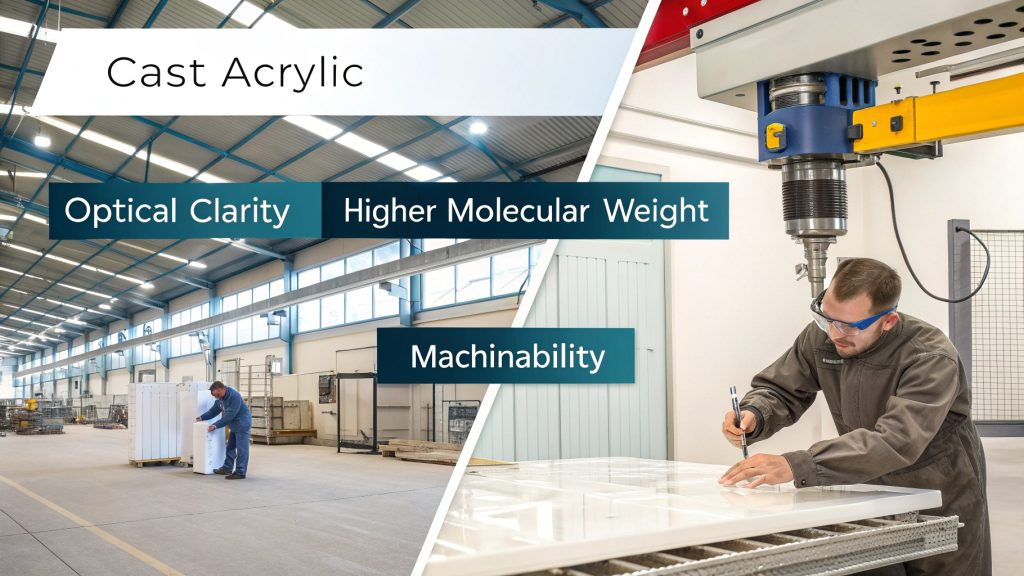
Cast acrylic really shines in several areas, which is why it's often the go-to for demanding applications, even if it costs a bit more. First, its optical clarity is outstanding. Because of how it's made – curing slowly between glass plates – it has a very smooth, clear surface and less distortion. This makes it perfect for things like display cases, high-end signage, or any application where visual quality is paramount.
Another big plus is its higher molecular weight. This translates to better strength and impact resistance. It's less likely to crack or break compared to extruded acrylic. It also has superior chemical resistance. If your part is going to be exposed to solvents or harsh cleaning agents, cast acrylic will hold up much better. I've had clients who initially tried extruded for chemical environments, only to find it crazing or cracking, then successfully switched to cast.
Machinability is another key advantage. Cast acrylic is less prone to melting or chipping when being cut, drilled, or routed. This makes it easier for us at Worthy to achieve clean, precise features on custom parts. It also laser engraves beautifully, producing a nice, frosted white contrast, whereas extruded acrylic tends to engrave clear and can melt more. Finally, cast acrylic is available in a much wider range of thicknesses and a broader palette of colors, including custom colors for smaller production runs, which gives designers more freedom.
What is the difference between cast and extruded nylon?
Thinking about nylon parts and see "cast" or "extruded"? Just like acrylic, these terms mean different properties and performance for your components.
Cast nylon generally has higher molecular weight, leading to better wear resistance, lower moisture absorption, and greater dimensional stability than extruded nylon. Extruded nylon is often more cost-effective and offers good toughness, but cast nylon excels in demanding applications.
Now, let's switch gears to nylon. While the basic principles of casting and extrusion are similar to acrylic, the specific outcomes for nylon are different because it's a different polymer. For cast nylon, the process involves pouring liquid caprolactam monomer directly into a mold where it polymerizes.
This typically results in a nylon with a very high molecular weight and a high degree of crystallinity. What does this mean for your parts? Well, cast nylon often has superior wear resistance, making it great for bearings, gears, and wear pads. It also tends to have lower moisture absorption compared to some extruded nylons, which means better dimensional stability in humid environments. I’ve seen cast nylon succeed in applications where extruded nylon parts swelled too much.
Extruded nylon, on the other hand, is made by melting nylon pellets and forcing them through a die. This process is generally faster and can be more economical for certain shapes and sizes, especially rods and profiles. Extruded nylons, like Nylon 6/6, are very tough and have good mechanical properties.
However, their molecular weight is typically lower than cast nylon, and they might absorb more moisture. This can affect their strength and dimensions. When we machine nylon parts, we also notice differences; cast nylon can sometimes machine more cleanly due to its structure. So, if you need high compressive strength, low friction, and excellent wear life, especially in larger parts, cast nylon is often the better choice. For general-purpose toughness at a potentially lower cost, extruded nylon might be suitable.
Conclusion
So, cast and extruded acrylics (and nylons) have clear differences. Understanding these helps you choose the best material for your custom parts, ensuring performance and value.