
What Are The Best Heat Treatment Methods For 4140 Alloy Steel?
Struggling to get the right properties from your 4140 alloy steel? You need the correct heat treatment. I can help you understand the best options.
The best heat treatment methods for 4140 alloy steel generally involve quenching and tempering to achieve a balance of hardness, strength, and toughness. Specific temperatures and cooling media will vary based on the desired final mechanical properties for your application.
Understanding heat treatment can seem complex. But, getting it right is key for your parts. I want to share my insights to help you choose wisely. Let's explore the common methods.
How do you heat treat 4140 alloy steel?
Want to improve your 4140 steel's performance? Proper heat treatment is essential. I'll explain the common steps clearly for you.
Heat treating 4140 alloy steel typically involves austenitizing (heating), quenching (rapid cooling), and tempering (reheating to a lower temperature). This process refines the grain structure and modifies mechanical properties like hardness and toughness for optimal performance.
When I work with 4140 alloy steel, the most common and effective approach involves two main stages: quenching and tempering. First, we heat the steel. This is called austenitizing. For 4140 steel, I usually heat it to around 850°C (1550°F). We hold it at this temperature long enough for the entire part to reach it. This transforms the steel's internal structure.
After heating, we need to cool it quickly. This is quenching. I recommend oil quenching for 4140 steel. Oil cooling helps prevent cracking compared to water, especially for complex shapes. This rapid cooling makes the steel very hard but also brittle. That's why the next step, tempering, is so important. We reheat the quenched steel to a lower temperature.
For 4140, I often use a tempering temperature around 560°C (1040°F). The exact temperature depends on the final hardness needed. After holding at this temperature, we cool it again, often in air, water, or oil. This tempering step reduces brittleness and increases toughness, making the steel much more useful.
What is the heat treatment of alloy steel?
Confused about what "heat treatment" really means for alloy steels? It's a crucial process. Let me break down this important manufacturing step for you.
Heat treatment of alloy steel is a controlled process of heating and cooling the metal to alter its microstructure. This changes its mechanical properties, such as hardness, strength, ductility, and toughness, to suit specific application requirements.
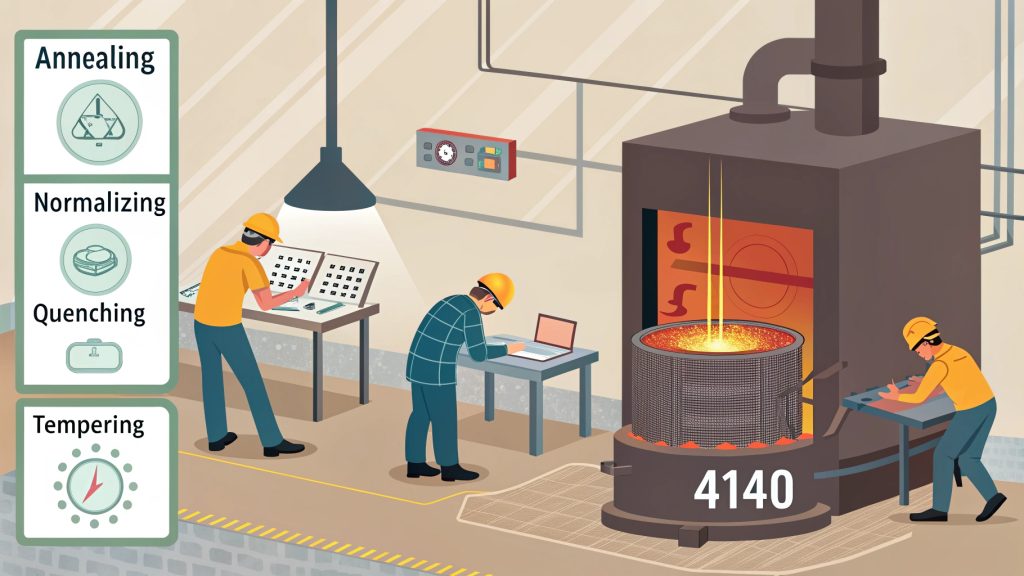
Heat treatment is a very important step when we make parts from alloy steels, like 4140. Think of it like baking. You control the heat and time to get the perfect result. For alloy steel, heat treatment changes its internal structure. This change affects how the steel behaves. For example, we can make it harder, stronger, or more resistant to wear. We can also make it softer and easier to machine.
There are several types of heat treatment.
Common Heat Treatment Processes
| Process | Purpose | Typical Outcome for Alloy Steel |
|---|---|---|
| Annealing | Soften steel, improve machinability, relieve stress | Softer, more ductile |
| Normalizing | Refine grain structure, improve uniformity | Stronger, more uniform |
| Quenching | Harden steel | Very hard, potentially brittle |
| Tempering | Reduce brittleness, increase toughness | Tougher, less brittle |
These processes involve heating the steel to specific temperatures, holding it there, and then cooling it at a controlled rate. For alloy steels, the "alloy" part – meaning other elements like chromium, molybdenum (as in 4140), nickel, etc. – influences how the steel responds to these treatments. This allows us to achieve a wide range of properties.
What is the best heat treatment for steel?
Are you wondering which heat treatment is absolutely the "best" for steel? This is a common question. The answer really depends on your needs.
The "best" heat treatment for steel is not one-size-fits-all. It entirely depends on the specific type of steel, the desired mechanical properties (like hardness, toughness, or ductility), and the intended application of the final part.
I often tell my clients, like Mark, that there isn't a single "best" heat treatment for all steel. It's like asking what the best tool is. The best tool depends on the job you need to do. For steel, the "job" is defined by how the part will be used. If you need a very hard part that resists wear, then quenching and possibly a low-temperature temper might be best. If you need a part that can absorb impacts without breaking (high toughness), then quenching followed by a higher-temperature temper is usually better.
For 4140 steel, we often aim for a good balance of strength and toughness, which is why quenching and tempering is so popular. But if you were just trying to make the 4140 easier to machine before the final hardening, then an annealing or normalizing treatment might be "best" for that stage. The specific alloy composition also plays a huge role. Different steels respond differently to heat. So, the best approach is always to define your requirements first, then select the heat treatment that achieves those properties most effectively and economically.
What is the stress relieving temperature for 4140 steel?
Worried about internal stresses in your 4140 steel parts after machining? Stress relieving is key. I'll explain the right temperature to use.
The typical stress relieving temperature range for 4140 steel is between 600°C to 675°C (1100°F to 1250°F). Holding at this temperature, followed by slow cooling, reduces internal stresses with minimal impact on hardness.
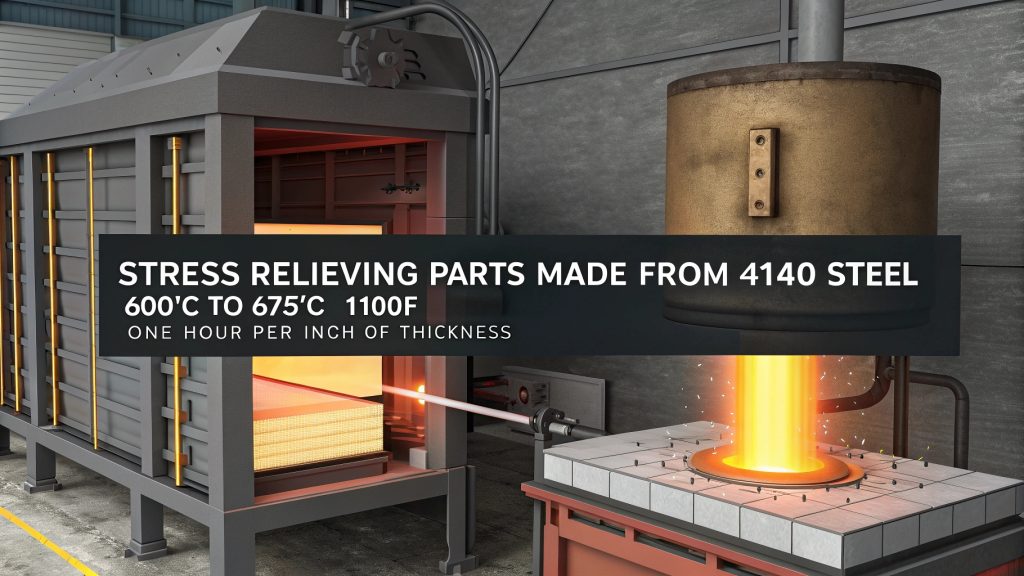
Stress relieving is a really important step, especially for parts made from 4140 steel that have undergone significant machining, welding, or cold working. These processes can introduce internal stresses. If these stresses aren't removed, they can cause problems later. For example, the part might warp or distort during further processing, or even in service. For 4140 steel, I usually recommend a stress relieving temperature in the range of 600°C to 675°C (about 1100°F to 1250°F). The exact temperature can depend on the prior condition of the steel (e.g., if it's already hardened and tempered, we might use a temperature slightly below the original tempering temperature).
The process involves heating the steel slowly and uniformly to this temperature. Then, we hold it at that temperature for a period, typically one hour per inch of thickness. After that, the most crucial part is slow cooling, usually inside the furnace, to avoid reintroducing new stresses. This process doesn't usually change the hardness significantly if done correctly, but it greatly improves dimensional stability and reduces the risk of cracking.
Conclusion
Choosing the right heat treatment for 4140 steel, like quenching and tempering, is crucial for optimal part performance, balancing strength and toughness effectively.