
Which Nylon Type Is Best For Custom Machined Parts In High-Temperature Environments?

Your machined parts failing under heat? This causes big problems. We can help you pick the right high-temperature nylon for your needs.
For high-temperature custom machined parts, nylons like PA46, PA6T, PA9T, and PPA are excellent choices. Specifically, DuPont's PA6T alloy series stands out, boasting a heat distortion temperature around 290°C, making it very strong.
Choosing the best nylon for your hot applications can feel tricky. There are many types out there, and you want parts that last. Let's look closer at what makes a nylon good for heat. We will also see which ones we, at Worthy Hardware, often work with for our customers. We want to help you understand this better so you can make the best choice for your project.
What Is The Best Nylon For Machining?
Is picking a nylon for machining confusing you? Wrong choices can cost you valuable time and money. Good news, some nylons are great for machining.
For general machining, Nylon 6 (PA6) and Nylon 66 (PA66) are quite good. They are strong materials and relatively easy to work with. But for high heat applications, we really need to look at special types.
When we talk about the "best" nylon for machining, it often depends on the specific job you have in mind. For many general applications, I find that Nylon 6 (PA6) and Nylon 66 (PA66) are fantastic. They offer a good balance of toughness, they resist wear well, and they are easy to machine. Here at Worthy Hardware, we've machined countless custom parts from these materials. They cut cleanly, which is important for precision. They also hold tolerances well, and we can achieve smooth surface finishes. I remember a project for a customer needing durable gears; PA66 was a perfect fit due to its strength and machinability.
However, the story changes when high temperatures come into play. These standard nylons might not be enough because their properties can change too much when they get hot. That's when we start looking at specialized high-temperature grades. These are designed to keep their strength and shape even when things get very hot. So, "best" really means "best for your specific needs," especially when we consider the operating temperature. W
e always ask our customers, like Mark from Canada, about the environment where the part will be used. It’s a key part of making sure the custom CNC parts we deliver will perform perfectly and reliably. Our engineers, with their rich experience, can also help improve designs and even save costs by selecting the optimal material.
Is Nylon Good For High Temperature?
Are you concerned if your nylon parts will survive high heat? Standard types of nylon can warp or even fail. But special high-temperature nylons are made for these tough, hot jobs.
Regular nylon isn't always the best choice for high temperatures. But special types like PA46, PA6T, PA9T, and PPA are designed for it. They work very well even above 250°C, sometimes up to 300°C.
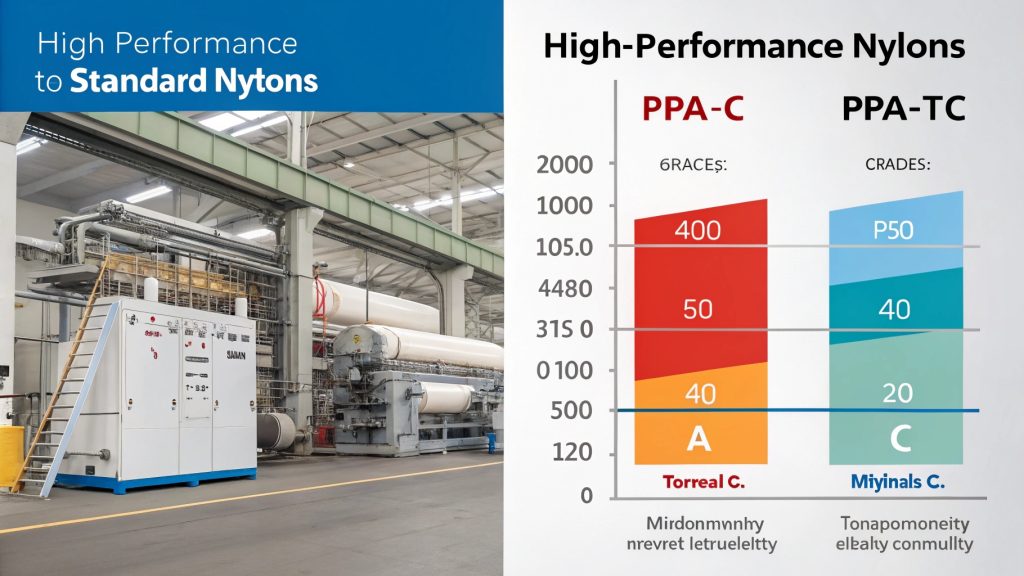
So, is nylon good for high temperatures? The answer, I've learned over years in this business, is: it really depends on the type of nylon. Your everyday nylons, like some common grades of PA6 or PA66, have a continuous service temperature that might only be around 80°C to 120°C. For many industrial applications where parts face serious heat, this is simply not enough. I’ve seen standard nylon parts deform when customers underestimated the operating temperature.
But, there's a whole family of high-performance nylons designed for these exact challenging situations. I'm talking about materials such as PA46, PA6T, PA9T, PA10T, and PPA (Polyphthalamide). These are not your average plastics. Their chemical structures are different, and this gives them much better stability at high temperatures. We often see their heat distortion temperatures (HDT) go well above 250°C.
Some can even handle short peaks close to 300°C. This makes them suitable for demanding applications in aerospace, automotive, or industrial equipment where both strength and heat resistance are absolutely critical. For instance, we supply custom machined PPA parts to a client in the electronics sector for components near heat-generating elements. These parts maintain their integrity and precision, which is essential.
Which Is Better, Nylon 6 Or Nylon 66?
Nylon 6 or Nylon 66 – are you wondering which one to pick? The wrong choice here can really affect how your part performs. Let's see what makes each one different.
Nylon 66 usually has a higher melting point and is stiffer than Nylon 6. Nylon 6, on the other hand, is a bit tougher and often easier to make into parts. For high heat, special versions are what truly matter.
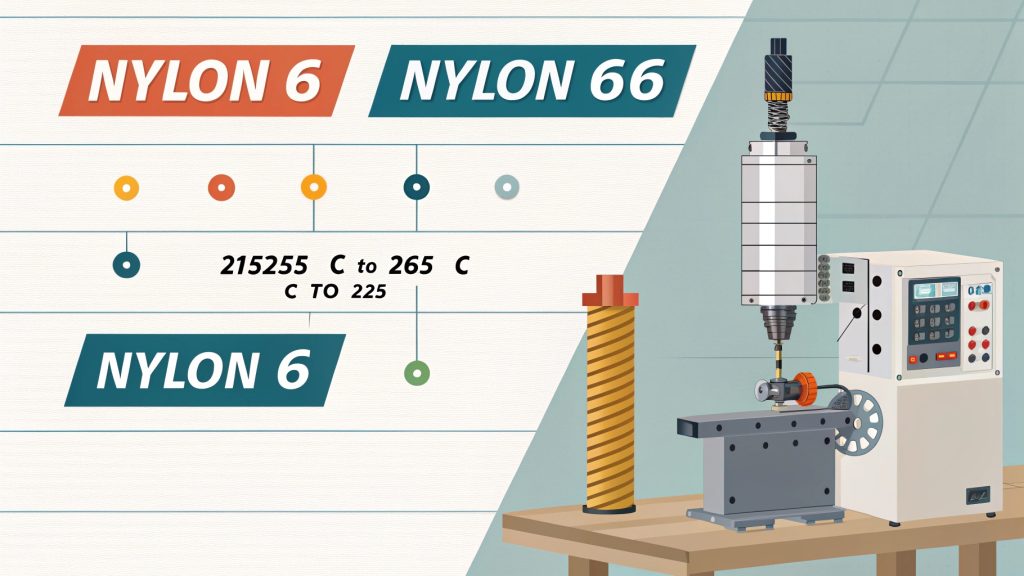
Customers often ask us, "Which is better, Nylon 6 or Nylon 66?" It's a very common question in the world of custom CNC machining. Both are excellent engineering plastics, but they do have some key differences for general use that are worth noting.
Nylon 66 typically has a higher melting point. We're talking around 255°C to 265°C for Nylon 66, compared to about 215°C to 225°C for Nylon 6. Nylon 66 also generally offers greater stiffness and tensile strength, and it often has better wear resistance.
Nylon 6, on the other hand, tends to have better impact strength, meaning it can take a hit better. It also usually has higher moisture absorption, which can sometimes affect dimensional stability if not accounted for in the design. It's also often considered a bit easier to process.
Here's a simple table to show some general differences:
| Property | Nylon 6 (PA6) | Nylon 66 (PA66) |
|---|---|---|
| Melting Point | Lower (~220°C) | Higher (~260°C) |
| Stiffness | Good | Better |
| Impact Strength | Better | Good |
| Moisture Absorption | Higher | Lower |
| General Machinability | Very Good | Good |
However, when we are specifically talking about high-temperature environments for custom machined parts, this direct comparison between standard PA6 and PA66 becomes less important. Why is that? Because neither standard PA6 nor standard PA66 are ideal for continuous use at very high temperatures, like those over 150°C for extended periods. For those tough jobs, we then look at specialized high-temperature nylons like PA6T or PPA. These are in a different league altogether when it comes to heat performance.
What Is The Temperature Limit For Nylon?
Are you wondering about nylon's maximum heat resistance? If you go over this limit, your parts will likely fail. The limit changes a lot depending on the exact nylon type you are using.
Standard nylons like PA6 can typically handle continuous use temperatures around 80-150°C. High-temperature nylons such as PA46 or PA6T can perform well above 250°C. DuPont’s PA6T can even reach a heat distortion temperature around 290°C.
The "temperature limit" for nylon isn't just one single number that applies to all nylons. It really depends on which specific type of nylon we are talking about. It also depends on what we mean by "limit." In engineering and machining, we often look at two important things: the continuous service temperature and the heat distortion temperature (HDT). The continuous service temperature is what the material can handle for long periods without degrading. The HDT is the temperature at which the material starts to deform when a load is applied.
Standard nylons, like common PA6 or PA66, might have a continuous service temperature somewhere between 80°C and 120°C. Some glass-filled grades might go up to 150°C. Their HDT is often in this range or perhaps slightly higher.
But for the high-temperature nylons we've discussed – like PA46, PA6T, PA9T, PA10T, and PPA – the story is very different. Their HDTs are often well above 250°C. For example, one of the materials I often recommend from my experience is the DuPont Zytel® HTN series, which includes PA6T alloys. These are known for exceptional performance in heat.
Some of these specific materials have an average melting point as high as 320°C. Even more importantly for practical applications, their heat distortion temperature can be around an impressive 290°C. This means they maintain their strength and precision at temperatures where other plastics would simply soften and fail. At Worthy Hardware, when a customer like Mark needs parts for extreme heat conditions, these are the kinds of advanced materials we recommend. We then use our precision CNC machining capabilities, including 5-axis machining, to produce these parts with tight tolerances, sometimes even below +/- 0.001 inch. We always ensure 100% inspection because quality is key, especially for such critical applications.
Conclusion
For demanding hot jobs, high-temperature nylons like PA6T are your best bet. They offer crucial strength and precision above 250°C. We can help you choose and machine them.